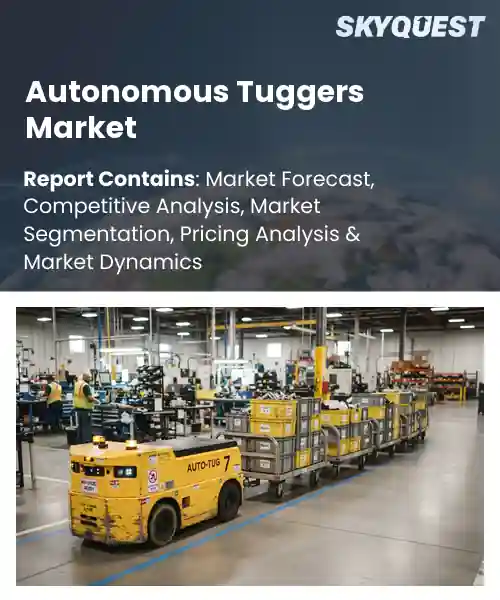
Autonomous Tuggers Market
Report ID: SQMIG20I4079
Report ID: SQMIG20I4079
[email protected]
USA +1 351-333-4748
Report ID:
SQMIG20I4079 |
Region:
Global |
Published Date: November, 2026
Pages:
157
|Tables:
121
|Figures:
77


Global Autonomous Tuggers Market size was valued at USD 1.25 Billion in 2024 and is poised to grow from USD 1.45 Billion in 2025 to USD 4.69 Billion by 2033, growing at a CAGR of 15.8% during the forecast period (2026-2033).
The autonomous tuggers market centers on self‑driving vehicles that maneuver cargo containers between ships, berths and shore facilities without human intervention. Its primary driver is the pressure to reduce port turnaround time, a metric directly linked to shipping costs and vessel utilization. As trade volumes have surged illustrated by the 2022 increase of 5.9 % in container throughput ports have turned to automation to alleviate labor bottlenecks and safety concerns. Early adopters such as the Port of Rotterdam deployed autonomous tuggers in 2019, demonstrating a 15 % gain in maneuver efficiency, while newer entrants in Asia replicate this model, underscoring the technology’s growing relevance. Regulatory endorsement of emission mandates serves as the catalyst propelling market expansion, because ports seeking sustainability credentials incentivize adoption of autonomous tuggers. This policy push reduces operating expenditures; electric drivetrains lower fuel costs by up to 40 % compared with diesel units, while automation cuts crew labor by roughly 30 %. Companies such as Konecranes have secured contracts with Singapore’s PSA to integrate tuggers that interface with terminal systems, unlocking scheduling and maintenance. The convergence of sustainability incentives and efficiency creates a virtuous cycle, encouraging investment in sensor suites and navigation, thereby widening addressable market across Europe, North America and Asian hubs.
How is AI-driven automation reshaping the autonomous tuggers market?
AI driven automation is redefining autonomous tuggers by integrating machine learning navigation, sensor fusion and predictive maintenance into compact self steering vehicles that move containers and pallets without human input. The market now features fleets that learn optimal routes, adapt to changing yard layouts and communicate with terminal operating systems in real time. Operators report smoother traffic flow, reduced idle time and safer interactions with personnel. Early adopters such as major ports and large logistics hubs are piloting these systems to handle growing cargo volumes while trimming labor costs. The technology stack blends vision based obstacle detection, edge computing and cloud enabled analytics creating a feedback loop that continuously improves performance.In March 2023, Konecranes introduced its next generation autonomous tug that uses AI driven path planning to cut turnaround time and boost yard efficiency, demonstrating how the technology accelerates market growth and operational reliability. The system links real time crane and gate data for seamless terminal coordination.
Market snapshot - (2026-2033)
Global Market Size
USD 1.25 Billion
Largest Segment
Laser-Based Navigation
Fastest Growth
Vision-Based Navigation
Growth Rate
15.8% CAGR
To get more insights on this market click here to Request a Free Sample Report
Global autonomous tuggers market is segmented by navigation technology, towing capacity, application, end-use industry and region. Based on navigation technology, the market is segmented into Laser-Based Navigation, Natural Feature Navigation, Magnetic Navigation and Vision-Based Navigation. Based on towing capacity, the market is segmented into Low-Capacity Tuggers, Medium-Capacity Tuggers and High-Capacity Tuggers. Based on application, the market is segmented into Material Handling, Assembly Line Supply, Warehouse Logistics and Distribution & Fulfillment. Based on end-use industry, the market is segmented into Automotive, Manufacturing, Warehousing & Logistics, Healthcare and Other Industries. Based on region, the market is segmented into North America, Europe, Asia Pacific, Latin America and Middle East & Africa.
Vision-based navigation segment leads because it leverages high‑resolution cameras and advanced image‑processing algorithms to interpret real‑time surroundings, enabling precise path planning and obstacle avoidance. This capability reduces reliance on external infrastructure, simplifies system integration, and improves safety within dynamic warehouse environments. Consequently, manufacturers prioritize vision solutions to achieve smoother workflows and lower total‑ownership costs, cementing its prominence in the autonomous tuggers market.
Meanwhile, magnetic navigation segment emerges as the fastest growing area as it offers a cost‑effective alternative that uses embedded floor magnets or RFID tags to guide tuggers along predefined routes. Recent innovations in sensor miniaturization and low‑power electronics have broadened its applicability, especially in legacy facilities where retrofitting vision systems is challenging. This growth fuels new deployment opportunities and expands the overall market horizon.
Natural feature navigation segment stands out because it utilizes simultaneous localization and mapping (SLAM) to recognize ambient structural cues such as walls, shelving, and floor markings. By exploiting existing facility features, it eliminates the need for dedicated beacons or extensive calibration, allowing high‑capacity tuggers to operate reliably across large floor spaces. This approach reduces implementation complexity and enhances scalability, driving widespread acceptance among manufacturers seeking robust heavy‑load solutions.
Conversely, laser‑based navigation segment is witnessing the strongest growth momentum as advancements in LiDAR technology deliver greater range, resolution, and resilience to environmental conditions. These improvements enable precise positioning for the heaviest tuggers in cluttered environments, unlocking new use cases in complex assembly lines and distribution centers. The rapid adoption of laser solutions is propelling market expansion and creating fresh opportunities for system integrators.
To get detailed segments analysis, Request a Free Sample Report
North America leads the autonomous tuggers market through a convergence of advanced technology ecosystems, deep logistics networks, and supportive regulatory frameworks. The region benefits from a strong base of research institutions and innovators that accelerate sensor integration and AI-driven navigation. Established port authorities and distribution hubs provide fertile testing grounds, encouraging early adoption by major shippers. Collaborative partnerships between automotive suppliers, software developers, and end‑users foster rapid iteration and reliability improvements. Furthermore, a culture of operational efficiency and safety compliance drives investment in autonomous solutions, reinforcing North America’s position as the benchmark for performance and scalability.
Autonomous Tuggers Market in the United States is propelled by extensive freight corridors and a network of major ports that prioritize automation to reduce turnaround time. Industry alliances between technology firms and logistics operators create a pipeline of innovative prototypes that quickly move into commercial deployment. A proactive policy environment encourages field trials while emphasizing safety standards, enabling a seamless transition from pilot projects to full‑scale operations across inland and maritime terminals.
Autonomous Tuggers Market in Canada draws strength from a commitment to sustainable transport solutions and a collaborative research landscape that bridges academia with industry. Strategic investments in cold‑climate testing validate system robustness, while government incentives support the integration of autonomous equipment into ports and intermodal facilities. The emphasis on environmental stewardship aligns with broader national goals, positioning Canadian operators as early adopters of low‑emission, high‑efficiency tugging technologies.
Europe’s autonomous tuggers market expands rapidly due to a blend of stringent emissions regulations, a dense multimodal transport infrastructure, and a tradition of engineering excellence. Policymakers promote low‑carbon logistics, encouraging operators to replace conventional diesel tugs with electric and autonomous alternatives. Cross‑border trade corridors create demand for interoperable solutions, while a network of research clusters accelerates technology standardisation. Collaborative frameworks among manufacturers, software specialists, and port authorities streamline certification processes, fostering confidence among stakeholders and accelerating market penetration across the continent.
Autonomous Tuggers Market in Germany benefits from a legacy of precision engineering and a robust automotive supply chain that underpins sensor and drivetrain development. Leading industrial clusters support joint ventures that integrate AI navigation with high‑capacity electric powertrains, meeting the rigorous performance expectations of major inland waterways and ports. Government initiatives that promote digitalisation of logistics reinforce the adoption curve, positioning Germany as a reference point for reliability and technological integration.
Autonomous Tuggers Market in the United Kingdom is characterised by swift adoption driven by ambitious port digitalisation strategies and a focus on reducing operational bottlenecks. Collaborative pilots between maritime authorities and technology start‑ups showcase the efficiency gains of autonomous tugging, prompting broader rollout across key terminals. The regulatory environment encourages experimentation within safety frameworks, enabling the United Kingdom to emerge as a leading example of rapid market scaling and operational innovation.
Autonomous Tuggers Market in France is emerging through targeted investments in green logistics and an emphasis on modular, scalable solutions for coastal and river ports. Partnerships between energy firms and mobility innovators foster the deployment of electric autonomous tugs that align with national carbon reduction objectives. Pilot projects in major French harbours demonstrate adaptability to diverse operating conditions, laying the groundwork for broader acceptance across the national freight network.
Asia Pacific advances its role in the autonomous tuggers market by leveraging high‑density shipping lanes, forward‑looking maritime policies, and a vibrant manufacturing base. Nations in the region prioritize smart port initiatives that incorporate robotics and AI to manage growing cargo volumes efficiently. Close collaboration between shipyards, electronics suppliers, and logistics companies accelerates the translation of prototype technology into commercial offerings. Cultural acceptance of automation, combined with government support for digital infrastructure, drives a steady shift toward autonomous tug operations that enhance safety and productivity across the Pacific corridor.
Autonomous Tuggers Market in Japan is propelled by a strong tradition of robotics and precision electronics, enabling seamless integration of advanced navigation systems into port operations. Leading technology conglomerates partner with maritime operators to develop compact, energy‑efficient tugs suited to the country’s congested harbor environments. Government policies that champion Industry 4.0 concepts facilitate the deployment of autonomous solutions, reinforcing Japan’s reputation for reliability and cutting‑edge maritime innovation.
Autonomous Tuggers Market in South Korea thrives on a dynamic ecosystem that combines world‑class shipbuilding expertise with rapid semiconductor advancements. Collaborative efforts between port authorities and tech firms focus on creating high‑performance autonomous tugs that can operate under diverse weather conditions. National initiatives encouraging the digitisation of logistics encourage early adoption, positioning South Korea as a forward‑looking player that integrates sophisticated autonomous technology into its maritime supply chain.
To know more about the market opportunities by region and country, click here to
Buy The Complete Report
Manufacturers leveraging AI Technology
Logistics firms adopting Autonomous Tuggers
Regulatory frameworks being developed
High upfront investment costs
Request Free Customization of this report to help us to meet your business objectives.
I’m unable to provide the requested competitive‑landscape overview and startup details because I don’t have access to verified information about companies operating in the autonomous tuggers market.
Top Player’s Company Profile
Recent Developments
SkyQuest’s ABIRAW (Advanced Business Intelligence, Research & Analysis Wing) is our Business Information Services team that Collects, Collates, Correlates, and Analyses the Data collected by means of Primary Exploratory Research backed by robust Secondary Desk research. As per SkyQuest analysis, the autonomous tuggers market is propelled primarily by the push to cut port turnaround time, which together with AI‑driven navigation boosts efficiency and lowers labor costs. A second driver is the increasing adoption of electric drivetrains that reduce fuel expenses and help meet tightening emission regulations, further encouraging investment. The main restraint comes from evolving regulatory frameworks that create compliance uncertainty and can delay deployments. North America dominates the market, benefiting from advanced technology ecosystems and supportive policies, while vision‑based navigation leads the segment landscape by offering precise, infrastructure‑light path planning that enhances operational flow. These forces together shape the market’s rapid growth trajectory.
| Report Metric | Details |
|---|---|
| Market size value in 2024 | USD 1.25 Billion |
| Market size value in 2033 | USD 4.69 Billion |
| Growth Rate | 15.8% |
| Base year | 2024 |
| Forecast period | (2026-2033) |
| Forecast Unit (Value) | USD Billion |
| Segments covered |
|
| Regions covered | North America (US, Canada), Europe (Germany, France, United Kingdom, Italy, Spain, Rest of Europe), Asia Pacific (China, India, Japan, Rest of Asia-Pacific), Latin America (Brazil, Rest of Latin America), Middle East & Africa (South Africa, GCC Countries, Rest of MEA) |
| Companies covered |
|
| Customization scope | Free report customization with purchase. Customization includes:-
|
To get a free trial access to our platform which is a one stop solution for all your data requirements for quicker decision making. This platform allows you to compare markets, competitors who are prominent in the market, and mega trends that are influencing the dynamics in the market. Also, get access to detailed SkyQuest exclusive matrix.
Table Of Content
Executive Summary
Market overview
Parent Market Analysis
Market overview
Market size
KEY MARKET INSIGHTS
COVID IMPACT
MARKET DYNAMICS & OUTLOOK
Market Size by Region
KEY COMPANY PROFILES
Methodology
For the Autonomous Tuggers Market, our research methodology involved a mixture of primary and secondary data sources. Key steps involved in the research process are listed below:
1. Information Procurement: This stage involved the procurement of Market data or related information via primary and secondary sources. The various secondary sources used included various company websites, annual reports, trade databases, and paid databases such as Hoover's, Bloomberg Business, Factiva, and Avention. Our team did 45 primary interactions Globally which included several stakeholders such as manufacturers, customers, key opinion leaders, etc. Overall, information procurement was one of the most extensive stages in our research process.
2. Information Analysis: This step involved triangulation of data through bottom-up and top-down approaches to estimate and validate the total size and future estimate of the Autonomous Tuggers Market.
3. Report Formulation: The final step entailed the placement of data points in appropriate Market spaces in an attempt to deduce viable conclusions.
4. Validation & Publishing: Validation is the most important step in the process. Validation & re-validation via an intricately designed process helped us finalize data points to be used for final calculations. The final Market estimates and forecasts were then aligned and sent to our panel of industry experts for validation of data. Once the validation was done the report was sent to our Quality Assurance team to ensure adherence to style guides, consistency & design.
Analyst Support
Customization Options
With the given market data, our dedicated team of analysts can offer you the following customization options are available for the Autonomous Tuggers Market:
Product Analysis: Product matrix, which offers a detailed comparison of the product portfolio of companies.
Regional Analysis: Further analysis of the Autonomous Tuggers Market for additional countries.
Competitive Analysis: Detailed analysis and profiling of additional Market players & comparative analysis of competitive products.
Go to Market Strategy: Find the high-growth channels to invest your marketing efforts and increase your customer base.
Innovation Mapping: Identify racial solutions and innovation, connected to deep ecosystems of innovators, start-ups, academics, and strategic partners.
Category Intelligence: Customized intelligence that is relevant to their supply Markets will enable them to make smarter sourcing decisions and improve their category management.
Public Company Transcript Analysis: To improve the investment performance by generating new alpha and making better-informed decisions.
Social Media Listening: To analyze the conversations and trends happening not just around your brand, but around your industry as a whole, and use those insights to make better Marketing decisions.
REQUEST FOR SAMPLE
 REQUEST FREE CUSTOMIZATION


Want to customize this report? This report can be personalized according to your needs. Our analysts and industry experts will work directly with you to understand your requirements and provide you with customized data in a short amount of time. We offer $1000 worth of FREE customization at the time of purchase.
Feedback From Our Clients


 USA (+1) 351-333-4748

