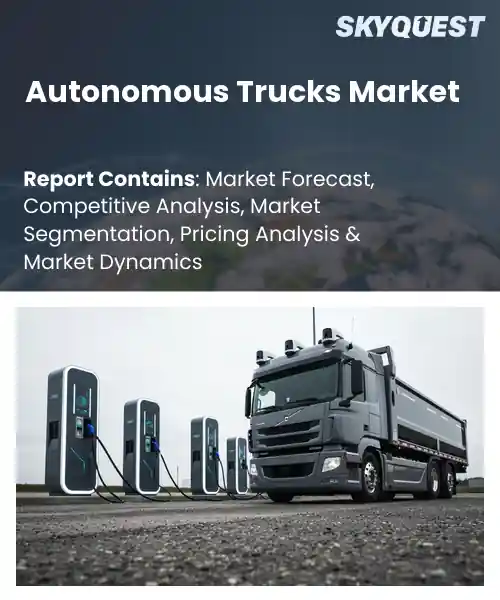
Autonomous Trucks Market
Report ID: SQMIG25C2262
Report ID: SQMIG25C2262
[email protected]
USA +1 351-333-4748
Report ID:
SQMIG25C2262 |
Region:
Global |
Published Date: June, 2026
Pages:
157
|Tables:
177
|Figures:
79


Global Autonomous Trucks Market size was valued at USD 46.77 Billion in 2024 and is poised to grow from USD 53.69 Billion in 2025 to USD 161.97 Billion by 2033, growing at a CAGR of 14.8% during the forecast period (2026-2033).
The autonomous trucks market is a global market of trucks fitted with advanced sensors and control systems powered by AI and connectivity that are able to perform self-driving freight operations without constant human intervention. Logistics providers facing driver shortages find it attractive because of the promise of lower labor costs, better safety and higher highway efficiency. The market has evolved largely due to an increasing shortage of qualified truck drivers, worsened by an aging demographic and more stringent hours-of-service regulations. Pilots like TuSimple’s test runs on California’s Nevada corridor and Daimler’s Freightliner eCascadia tests have shown technical progress and commercial interest over the past decade.
The main growth driver presently is the convergence of cloud-based fleet management platforms with high-resolution mapping services that convert raw sensor data into actionable logistics decisions, exploiting that driver shortage. Operators are adding autonomous trucks to centralized dispatch systems. Route optimization enhances fuel efficiency and delivery reliability, allowing shippers to contract larger volumes at lower rates. Examples include Walmart’s partnership with Waymo to test fully driverless milk runs between distribution centers, and Amazon’s acquisition of autonomous-driving startup Zoox to retrofit its delivery fleet. These efforts reduce the cost of ownership, encourage regulatory support and attract investment, thereby speeding market growth worldwide.
How are AI and IoT integration influencing the autonomous trucks market?
The game is changing drastically for autonomous trucks with the power of AI and IoT with real time data and complex decision making. AI algorithms use inputs from lidar, radar and cameras to spot obstacles, plot courses and react to traffic. All vehicles are linked to cloud platforms that collect data on fleet performance, weather and road conditions. The synergy facilitates predictive maintenance, continuous learning and dynamic dispatch, helping to reduce fuel consumption and downtime. The industry is moving from isolated test beds to integrated logistics networks and manufacturers are embedding edge computing modules and telematics to enable seamless coordination, according to industry analysts. This allows operators to offer cheaper, more reliable freight services and accelerate adoption across supply chains.
Aurora aims to be operating a fully driverless freight operation by October 2025. AI perception stacks and fleet telemetry enabled by IoT That synergy is less time on route planning, more asset utilization, pointing to connected intelligence as a driver of both market growth and operational efficiencies.
Market snapshot - (2026-2033)
Global Market Size
USD 46.77 Billion
Largest Segment
Heavy-Duty Trucks
Fastest Growth
Light-Duty Trucks
Growth Rate
14.8% CAGR
To get more insights on this market click here to Request a Free Sample Report
Global autonomous trucks market is segmented by truck type, level of autonomy, adas feature, component, drive type, application and region. Based on truck type, the market is segmented into Light-Duty Trucks, Medium-Duty Trucks and Heavy-Duty Trucks. Based on level of autonomy, the market is segmented into SAE Level 1 and 2, SAE Level 3, SAE Level 4 and SAE Level 5. Based on adas feature, the market is segmented into Adaptive Cruise Control, Lane Departure Warning, Traffic Jam Assist, Highway Pilot, Automatic Emergency Braking, Blind-Spot Detection and Lane-Keeping Assist. Based on component, the market is segmented into Sensor Suites and AI Compute Modules. Based on drive type, the market is segmented into Internal Combustion Engine, Battery-Electric, Hybrid and Hydrogen Fuel-Cell. Based on application, the market is segmented into Last-Mile Delivery, Long-Haul Logistics, Port Drayage and Mining and Construction Operations. Based on region, the market is segmented into North America, Europe, Asia Pacific, Latin America and Middle East & Africa.
The Heavy Duty Trucks segment is the largest and addresses the basic need to move large loads over long distances, the backbone of freight logistics. Makers strive to make their chassis strong, their drivetrains powerful and their cars trustworthy enough to be put through the wringer. This is a compelling value proposition for carriers seeking efficiency and durability. It is driving ongoing innovation in powertrain integration and autonomous control systems across the supply chain worldwide.
At the same time, the Medium Duty Trucks segment is experiencing the highest growth momentum as urban distribution centers require flexible payload capacity and tighter maneuverability. Operators are increasingly turning to vehicles that can combine autonomous navigation with moderate load ratings as new ecommerce fulfillment models emerge, resulting in fast adoption of smart chassis and scalable software platforms.
This is a conditional automation that allows trucks to drive without driver intervention in defined zones like highways and dedicated corridors, making it one of the SAE Level 4 segment leaders. This capability meets carrier needs for safety and productivity without the regulatory challenges of full autonomy. That’s why OEMs are spending R&D on robust sensor fusion and failsafe architectures to create a mature ecosystem that can accelerate commercial deployments in global logistics networks and service providers.
On the other hand, the SAE Level 5 segment is emerging as the key high growth segment as breakthroughs in AI perception and edge computing clear the last hurdles to fully driverless operation. Pilots in controlled freight corridors are enjoying complete freedom, driving investor confidence and prompting fleets to plan for next generation deployments that could reshape long haul logistics.
To get detailed segments analysis, Request a Free Sample Report
North America has the largest share in the autonomous trucks market as it has a robust logistics infrastructure and can invest heavily in research and development. The U.S. has a large concentration of technology companies, large car makers and a regulatory environment that encourages pilots and real world testing. Wide freight corridors, high freight volumes and early investments in sensor and AI capabilities combined provide fertile ground for scaling autonomous solutions. Canada’s complementary strengths include a focus on safety standards, cross-border collaboration and a growing ecosystem of startups that benefit from government incentives. All of these feed into a self-reinforcing cycle of innovation, talent attraction and infrastructure readiness that keeps North America at the front of the pack.
The U.S. autonomous trucks market is a confluence of sophisticated research institutions, venture capital momentum and shipper willingness to trial new technologies. Major carriers and OEMs collaborate tightly with software innovators to develop integrated platforms to address complex routing and regulatory challenges. Positive policy environment allows for field testing on public roadways Big freight corridors offer real-world data that is critical to algorithm refinement. It’s the depth of the ecosystem combined with the scale of operations that keeps the US at the forefront of developing autonomous trucking.
Canada Autonomous Trucks Market is going to Boom with Safety Certification and Cross Border Logistics Coordination. Canadian manufacturers are working with technology partners in the U.S. to learn from each other, standardize and collaborate on pilot projects through federal and provincial programs. The country’s geography, long-haul routes over varying terrain, makes it an ideal test bed for robust autonomous systems. Canada is becoming a leader in North America’s autonomous trucking space, with more investment in sensor research and a growing list of specialized engineering companies.
The swift roll-out of autonomous trucks in Europe is driven by a political will to promote decarbonisation and digitalisation in freight transport. Carriers seek technologies that improve efficiency to help meet stringent emissions targets, while EU-wide pilot projects are setting safety and data protocols for consistency. Germany has a sophisticated manufacturing infrastructure, deep engineering knowledge and produces sophisticated vehicle platforms. Liberal testing rules in the UK, alliances between logistics companies and tech pioneers boost adoption. France is moving faster, with new startups attacking urban last-mile automation and integration with multimodal networks. This mix of regulatory harmonization, industry collaboration and a robust supply chain ecosystem is fueling rapid market growth in Europe.
The German automotive industry, mixing traditional vehicle engineering with state-of-the-art software development, is a boost for the market in autonomous trucks. German manufacturers have established production capacities to integrate autonomous systems into existing truck platforms and research institutes have stringent testing environments. Industry associations work with government bodies to help speed up certification processes and encourage early commercial deployment. The country’s dense highway network and export orientation create opportunities to scale autonomous freight solutions across the continent.
The UK market for autonomous trucks is influenced by a regulatory landscape that encourages rapid testing and deployment. The UK government has passed permissive legislation to allow autonomous trucks on public roads prompting global technology firms to open innovation hubs. Universities and fintech firms work together with logistics companies to build data-driven routing and fleet management tools. This openness and focus on green logistics and a robust financial services sector make the United Kingdom the fastest growing market for autonomous freight in Europe.
The French market of autonomous trucks is still in its infancy and aims at automating urban freight and integrating it into public transportation networks. French startups are developing small, driverless delivery vehicles for tight urban environments and testing them in cities. National policies are driving low carbon logistics and conventional carriers are looking at autonomous technologies as part of broader sustainability initiatives. A co-operative paradigm to speed up knowledge transfer and market penetration through alliances between research labs, automotive companies and logistics operators.
Asia Pacific is consolidating its position in autonomous trucks with fast industrial growth, government intervention and an expanding network of technology players. Japan has a long history of precision engineering and state-of-the-art sensor making to develop highly reliable autonomous platforms, and promotes cooperation between automobile makers and specialists in artificial intelligence. South Korea stresses the integration of high-speed connectivity and electric propulsion. Large scale data collection is enabled by national road-testing programs. Both countries have dense logistics corridors and export-oriented supply chains that enable ongoing improvement of autonomous capabilities. The region will be a competitive center of gravity for next-gen freight automation, with a focus on standards alignment, talent development and scaling pilots.
Japan’s autonomous trucks market has a strong history of robotics and sensor technology, which enables the development of very precise navigation systems. Japanese makers say skilled vehicle craftsmanship and sophisticated AI algorithms combine to produce trucks that can handle complicated road conditions. Such collaborative testbeds are funded by government agencies and connect universities, automakers and logistics companies to create a culture of iterative innovation. The ecosystem makes it easier for autonomous trucks to be integrated into Japan’s complex supply chain and reinforces Japan’s leadership in high-quality autonomous freight solutions.
South Korea autonomous trucks market is driven by national priorities of connectivity and electric mobility. It has an advanced telecommunications infrastructure that allows for high-speed real-time data exchange between trucks and traffic management centers, improving safety and efficiency. The industry is being driven by environmental goals, and large companies are joining forces with smaller companies in different parts of the world to put advanced perception systems on electric truck platforms. Government-sponsored demonstration projects on major highways are yielding valuable operational insights and speeding up commercial readiness. South Korea is looking to move up in the autonomous trucking space through technology, policy and industry collaboration.
To know more about the market opportunities by region and country, click here to
Buy The Complete Report
Advances In Sensor Technology
Regulatory Support For Autonomous Vehicles
High Initial Capital Investment
Cybersecurity Risks and Data Privacy
Request Free Customization of this report to help us to meet your business objectives.
The fierce competition between companies like Aurora and Waabi is pushing developments in technology, cost cuts and regulatory adherence in the self-driving truck industry. In response to competitive pressures, companies are engaging in strategic partnerships with freight carriers and vehicle manufacturers, leading to fast-paced pilot programs and technology upgrades to gain market share and meet evolving safety standards.
SkyQuest’s ABIRAW (Advanced Business Intelligence, Research & Analysis Wing) is our Business Information Services team that Collects, Collates, Correlates, and Analyses the Data collected by means of Primary Exploratory Research backed by robust Secondary Desk research.
As per SkyQuest analysis the market is being propelled mainly by advances in sensor technology that improve safety and perception, and a second strong catalyst is the fusion of AI and IoT which turns real‑time data into smarter dispatch and predictive maintenance. The biggest hurdle remains the high initial capital investment required for sensors, compute modules and testing, which slows adoption among smaller fleets. North America is the clear dominant region thanks to its mature logistics network and supportive regulations, while the heavy‑duty truck segment is the dominant segment because it delivers the core payload capacity needed for long‑haul freight.
| Report Metric | Details |
|---|---|
| Market size value in 2024 | USD 46.77 Billion |
| Market size value in 2033 | USD 161.97 Billion |
| Growth Rate | 14.8% |
| Base year | 2024 |
| Forecast period | (2026-2033) |
| Forecast Unit (Value) | USD Billion |
| Segments covered |
|
| Regions covered | North America (US, Canada), Europe (Germany, France, United Kingdom, Italy, Spain, Rest of Europe), Asia Pacific (China, India, Japan, Rest of Asia-Pacific), Latin America (Brazil, Rest of Latin America), Middle East & Africa (South Africa, GCC Countries, Rest of MEA) |
| Companies covered |
|
| Customization scope | Free report customization with purchase. Customization includes:-
|
To get a free trial access to our platform which is a one stop solution for all your data requirements for quicker decision making. This platform allows you to compare markets, competitors who are prominent in the market, and mega trends that are influencing the dynamics in the market. Also, get access to detailed SkyQuest exclusive matrix.
Table Of Content
Executive Summary
Market overview
Parent Market Analysis
Market overview
Market size
KEY MARKET INSIGHTS
COVID IMPACT
MARKET DYNAMICS & OUTLOOK
Market Size by Region
KEY COMPANY PROFILES
Methodology
For the Autonomous Trucks Market, our research methodology involved a mixture of primary and secondary data sources. Key steps involved in the research process are listed below:
1. Information Procurement: This stage involved the procurement of Market data or related information via primary and secondary sources. The various secondary sources used included various company websites, annual reports, trade databases, and paid databases such as Hoover's, Bloomberg Business, Factiva, and Avention. Our team did 45 primary interactions Globally which included several stakeholders such as manufacturers, customers, key opinion leaders, etc. Overall, information procurement was one of the most extensive stages in our research process.
2. Information Analysis: This step involved triangulation of data through bottom-up and top-down approaches to estimate and validate the total size and future estimate of the Autonomous Trucks Market.
3. Report Formulation: The final step entailed the placement of data points in appropriate Market spaces in an attempt to deduce viable conclusions.
4. Validation & Publishing: Validation is the most important step in the process. Validation & re-validation via an intricately designed process helped us finalize data points to be used for final calculations. The final Market estimates and forecasts were then aligned and sent to our panel of industry experts for validation of data. Once the validation was done the report was sent to our Quality Assurance team to ensure adherence to style guides, consistency & design.
Analyst Support
Customization Options
With the given market data, our dedicated team of analysts can offer you the following customization options are available for the Autonomous Trucks Market:
Product Analysis: Product matrix, which offers a detailed comparison of the product portfolio of companies.
Regional Analysis: Further analysis of the Autonomous Trucks Market for additional countries.
Competitive Analysis: Detailed analysis and profiling of additional Market players & comparative analysis of competitive products.
Go to Market Strategy: Find the high-growth channels to invest your marketing efforts and increase your customer base.
Innovation Mapping: Identify racial solutions and innovation, connected to deep ecosystems of innovators, start-ups, academics, and strategic partners.
Category Intelligence: Customized intelligence that is relevant to their supply Markets will enable them to make smarter sourcing decisions and improve their category management.
Public Company Transcript Analysis: To improve the investment performance by generating new alpha and making better-informed decisions.
Social Media Listening: To analyze the conversations and trends happening not just around your brand, but around your industry as a whole, and use those insights to make better Marketing decisions.
REQUEST FOR SAMPLE
 REQUEST FREE CUSTOMIZATION
Global Autonomous Trucks Market size was valued at USD 46.77 Billion in 2024 and is poised to grow from USD 53.69 Billion in 2025 to USD 161.97 Billion by 2033, growing at a CAGR of 14.8% during the forecast period (2026-2033).
Intense rivalry among firms such as Aurora and Waabi is accelerating technology integration, cost reduction, and regulatory compliance in the autonomous truck sector. Competitive pressure is prompting strategic collaborations with freight carriers and vehicle manufacturers, while companies pursue rapid pilot programs and technology upgrades to secure market share and meet emerging safety standards. 'PACCAR Inc', 'Volvo Group', 'Daimler Truck AG', 'Traton SE', 'Aurora Innovation Inc', 'Kodiak Robotics Inc', 'Gatik AI Inc', 'Waabi Innovation Inc', 'Plus AI Inc', 'TuSimple Holdings Inc', 'Einride AB', 'Inceptio Technology', 'Scania AB', 'MAN Truck & Bus SE', 'Iveco Group NV', 'Navistar International Corporation', 'Peterbilt Motors Company', 'Kenworth Truck Company', 'Freightliner Trucks', 'Oshkosh Corporation'
Advanced sensor suites, including LiDAR, radar, and high‑resolution cameras, enable precise environmental perception, allowing autonomous trucks to navigate complex routes safely. These technologies improve detection of obstacles, road markings, and weather conditions, reducing accident risk. As sensor reliability and integration continue to improve, manufacturers gain confidence in deploying fully autonomous systems, which in turn encourages logistics providers to adopt the technology for efficiency gains and safety enhancements across long‑haul operations. Ongoing cost reductions further support fleet retrofits, accelerating broader market acceptance.
Advanced Sensor Fusion Adoption: Manufacturers are rapidly integrating multi-modal sensor arrays, combining lidar, radar, and high‑resolution cameras into unified perception platforms. This convergence reduces blind spots, enhances object classification, and enables trucks to operate safely in diverse weather and lighting conditions. The resulting reliability gains foster greater stakeholder confidence, encouraging early adopters among fleet operators. As sensor costs decline and processing algorithms mature, the industry anticipates a shift from isolated hardware solutions toward comprehensive, software‑driven perception stacks that underpin autonomous freight movement efficiently globally.
Why does North America Dominate the Global Autonomous Trucks Market? |@12


Want to customize this report? This report can be personalized according to your needs. Our analysts and industry experts will work directly with you to understand your requirements and provide you with customized data in a short amount of time. We offer $1000 worth of FREE customization at the time of purchase.
Feedback From Our Clients


 USA (+1) 351-333-4748

