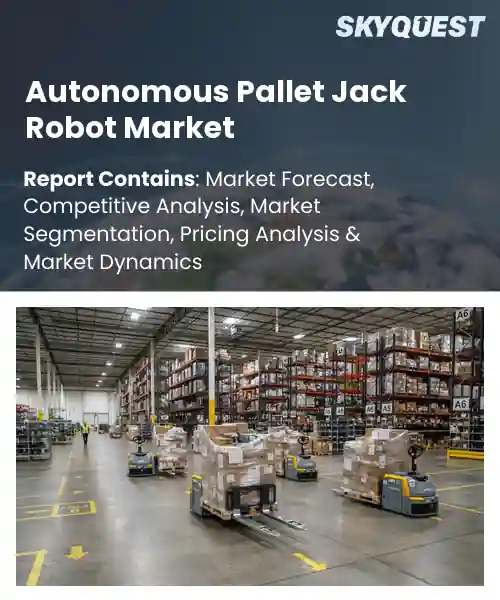
Autonomous Pallet Jack Robot Market
Report ID: SQMIG20I3808
Report ID: SQMIG20I3808
[email protected]
USA +1 351-333-4748
Report ID:
SQMIG20I3808 |
Region:
Global |
Published Date: August, 2026
Pages:
157
|Tables:
147
|Figures:
78


Global Autonomous Pallet Jack Robot Market size was valued at USD 1.38 Billion in 2024 and is poised to grow from USD 1.66 Billion in 2025 to USD 7.17 Billion by 2033, growing at a CAGR of 20.1% during the forecast period (2026-2033).
The global autonomous pallet jack robot market encompasses battery‑powered, sensor‑driven devices that move loads without human intervention across warehouses, distribution centers, and manufacturing floors. Its significance stems from the need to reduce labor costs while improving throughput in increasingly tight supply‑chain timelines; consequently, firms adopt self‑navigating jacks to free workers for value‑added tasks. Since the early 2010s, simple guided‑vehicle models have evolved into AI‑enabled units capable of dynamic path planning, exemplified by Toyota’s second‑generation Pallet Transporter introduced in 2021. The adoption curve accelerated as integration with warehouse management systems proved to cut order‑picking cycle times by up to fifteen percent. The secondary catalyst shaping market expansion is advances in computer‑vision and edge‑computing that enable obstacle detection and collaborative navigation among multiple robots. When sensors relay precise spatial data to on‑board processors, autonomous jacks can reroute instantly, preventing bottlenecks and reducing dwell time; this operational fluidity directly lifts facility capacity without floor space. Companies such as DHL have deployed fleets of Vision‑AI pallet jacks in European hubs, reporting a 12 % increase in load‑move efficiency and a measurable dip in workplace injuries. These outcomes illustrate how technology convergence creates opportunities for service‑based leasing models, fostering broader adoption across mid‑size distributors seeking automation.
How are AI and IoT integration transforming the autonomous pallet jack robot market?
AI and IoT are reshaping autonomous pallet jack robots by linking perception, decision‑making and connectivity into a seamless workflow. Sensors collect location, load and environmental data, while AI algorithms interpret this information to navigate crowded aisles and adjust speed for safety. IoT links each unit to a central platform, enabling real‑time monitoring, dynamic task assignment and predictive maintenance that reduces downtime. The market now sees fleets that learn from each operation, improving efficiency and adapting to changing warehouse layouts. This convergence creates a more responsive supply chain, where robots act as intelligent assets rather than static machines.Toyota Material Handling, March 2024, introduced an AI‑driven autonomous pallet jack that leverages cloud connectivity to optimize routing and automatically schedule service, illustrating how the technology accelerates adoption and boosts operational efficiency.
Market snapshot - (2026-2033)
Global Market Size
USD 1.38 Billion
Largest Segment
LiDAR SLAM
Fastest Growth
Vision Guidance
Growth Rate
20.1% CAGR
To get more insights on this market click here to Request a Free Sample Report
Global autonomous pallet jack robot market is segmented by product type, payload capacity, navigation technology, application, end user industry and region. Based on product type, the market is segmented into Standard Autonomous Pallet Jack Robots, High-Lift Autonomous Pallet Jack Robots and Heavy-Duty Autonomous Pallet Jack Robots. Based on payload capacity, the market is segmented into Below 1 Ton, 1–2 Tons and Above 2 Tons. Based on navigation technology, the market is segmented into LiDAR-Based Navigation, Vision-Based Navigation and Other Navigation Technologies. Based on application, the market is segmented into Warehousing, Manufacturing, Logistics and Distribution and Retail. Based on end user industry, the market is segmented into Automotive, Food and Beverage, E-commerce and Retail, Pharmaceuticals and Other Industries. Based on region, the market is segmented into North America, Europe, Asia Pacific, Latin America and Middle East & Africa.
High lift autonomous pallet jack robots segment dominates because they address the need for vertical mobility in dense storage environments, enabling operators to lift pallets to mezzanine levels without manual forklifts. Their integrated lifting mechanisms combine autonomy with height capability, reducing labor and equipment footprints. This alignment with space optimisation strategies drives their prominence in the market. Customers appreciate the seamless integration with existing warehouse management systems, which accelerates adoption across distribution centers.
However, standard autonomous pallet jack robots segment is witnessing the strongest growth momentum because their simplicity and cost efficiency make them attractive for small to mid size facilities seeking entry level automation. Ongoing improvements in battery life and plug and play interfaces are expanding their appeal, fueling market uptake and creating deployment opportunities.
Vision based navigation segment leads because its ability to interpret complex visual cues enables robots to operate safely among humans and irregular layouts. Advanced camera arrays combined with AI driven perception allow real time obstacle detection and adaptive path planning, reducing collision risk. This capability aligns with industry emphasis on collaborative workplaces, making vision solutions a preferred choice for operators prioritizing safety and flexible deployment and the ability to quickly adapt to changing inventory configurations.
Meanwhile, LiDAR based navigation segment is emerging as the key high growth area because its precise distance measurements excel in low light or dusty environments where vision struggles. Continuous improvements in sensor miniaturization and cost reduction are encouraging broader adoption across heavy duty and outdoor settings, unlocking new use cases and stimulating overall market expansion.
To get detailed segments analysis, Request a Free Sample Report
North America’s dominance stems from a convergence of advanced logistics infrastructure, strong technology adoption culture, and robust manufacturing ecosystems. The United States and Canada benefit from well‑developed e‑commerce networks that demand high‑efficiency material handling solutions. Research and development activities thrive within leading automotive and robotics clusters, fostering rapid innovation cycles. End‑user industries prioritize productivity gains and safety improvements, driving early implementation of autonomous pallet jack systems. Additionally, strategic partnerships between equipment manufacturers and logistics providers accelerate market penetration, reinforcing a leadership position that continues to shape global standards and best practices.
Autonomous Pallet Jack Robot Market in the United States is propelled by extensive investment in smart warehouse initiatives and a deep talent pool specializing in robotics engineering. Leading distribution centers adopt autonomous solutions to streamline order fulfillment, while regulatory frameworks support workplace safety enhancements. Collaborative ecosystems between technology startups and established manufacturers accelerate product refinement, positioning the United States as a benchmark for innovation and operational excellence.
Autonomous Pallet Jack Robot Market in Canada is characterized by a strong emphasis on sustainable logistics and government incentives that encourage automation adoption. The country’s diversified supply chain landscape, ranging from forestry to consumer goods, creates varied use cases for autonomous pallet jacks. Collaborative research programs between academic institutions and industry accelerate technology transfer, while a focus on workforce safety drives early acceptance across manufacturing and warehousing sectors.
Europe’s rapid expansion is fueled by a combination of stringent safety regulations, a push toward digital transformation, and an established tradition of engineering excellence. Countries such as Germany, the United Kingdom, and France are integrating autonomous pallet jack solutions to meet efficiency targets while reducing manual handling risks. Cross‑border logistics networks and harmonized standards facilitate technology deployment across the region. Moreover, a collaborative climate between original equipment manufacturers, system integrators, and logistics operators accelerates innovation, positioning Europe as a hub for advanced material handling concepts and fostering a competitive market environment.
Autonomous Pallet Jack Robot Market in Germany benefits from deep industrial expertise and a strong automotive supply chain that demands precise material handling. German manufacturers prioritize reliability and integration with existing automation frameworks, driving widespread adoption. Research institutions collaborate closely with technology firms, delivering cutting‑edge solutions that enhance throughput and safety. The emphasis on high‑quality engineering ensures that autonomous pallet jacks become a cornerstone of modern production facilities.
Autonomous Pallet Jack Robot Market in the United Kingdom is distinguished by a fast‑moving adoption curve driven by e‑commerce growth and a focus on warehouse modernization. Leading distribution centers implement autonomous pallet jacks to reduce labor intensity and improve order processing speed. The UK’s vibrant tech ecosystem supports rapid prototyping and customization, aligning solutions with specific industry needs. Regulatory emphasis on workplace safety further encourages deployment across logistics and retail sectors.
Autonomous Pallet Jack Robot Market in France is emerging through a blend of governmental support for industrial automation and a growing awareness of productivity gains. French manufacturers and logistics firms experiment with autonomous pallet jacks to streamline operations and meet sustainability objectives. Partnerships between startups and established equipment providers accelerate technology diffusion, while sector‑specific pilots demonstrate the versatility of autonomous solutions in diverse environments such as food processing and fashion distribution.
Asia Pacific is strengthening its position by leveraging rapid industrialization, extensive e‑commerce expansion, and a tradition of cost‑effective engineering. Nations such as Japan and South Korea are integrating autonomous pallet jack technology to address high‑volume warehouse demands and to enhance competitiveness on the global stage. The region’s focus on smart factory initiatives and robotic process automation creates a fertile environment for advanced material handling solutions. Collaborative ecosystems involving local manufacturers, research universities, and logistics firms accelerate technology refinement, positioning Asia Pacific as a dynamic hub for autonomous pallet jack innovation and deployment.
Autonomous Pallet Jack Robot Market in Japan is driven by a strong commitment to precision manufacturing and a mature logistics network. Japanese firms emphasize seamless integration of autonomous pallet jacks with existing automation lines, ensuring high reliability and minimal downtime. Collaborative research between industrial giants and technology institutes yields sophisticated solutions tailored to complex supply chain challenges. The cultural focus on efficiency and quality reinforces widespread adoption across automotive, electronics, and consumer goods sectors.
Autonomous Pallet Jack Robot Market in South Korea benefits from a vibrant technology sector and aggressive digital transformation strategies. Korean manufacturers prioritize rapid deployment of autonomous pallet jacks to boost warehouse throughput and reduce manual handling risks. Strong governmental support for smart manufacturing accelerates innovation, while partnerships between robotics startups and established equipment suppliers foster customized solutions. This dynamic environment positions South Korea as a leading adopter of advanced material handling automation within the region.
To know more about the market opportunities by region and country, click here to
Buy The Complete Report
Increasing Warehouse Automation Adoption
Advancements In Artificial Intelligence Integration
High Initial Capital Investment
Regulatory And Safety Compliance Challenges
Request Free Customization of this report to help us to meet your business objectives.
The autonomous pallet jack robot market is shaped by intense competition as manufacturers race to integrate AI navigation, IoT connectivity, and advanced safety systems. Recent activity includes strategic acquisitions to broaden sensor portfolios, joint ventures with logistics providers to pilot fleet deployments, and rapid rollout of next‑generation battery‑powered models that promise higher payload capacity and longer operating cycles.
Top Player’s Company Profile
Recent Developments
SkyQuest’s ABIRAW (Advanced Business Intelligence, Research & Analysis Wing) is our Business Information Services team that Collects, Collates, Correlates, and Analyses the Data collected by means of Primary Exploratory Research backed by robust Secondary Desk research. As per SkyQuest analysis, the global autonomous pallet jack robot market is being propelled primarily by the rapid adoption of warehouse automation, which enables firms to cut labor costs and boost throughput, while a second major catalyst is the continual advancement of artificial‑intelligence and sensor technologies that improve navigation precision and collaborative capability. The market’s growth is tempered by the high upfront capital required for robot acquisition and integration, which can deter smaller operators. North America remains the dominant region thanks to its mature logistics infrastructure and strong tech ecosystem, and the high‑lift autonomous pallet jack segment leads in revenue owing to its ability to address vertical storage needs in dense warehouses.
| Report Metric | Details |
|---|---|
| Market size value in 2024 | USD 1.38 Billion |
| Market size value in 2033 | USD 7.17 Billion |
| Growth Rate | 20.1% |
| Base year | 2024 |
| Forecast period | (2026-2033) |
| Forecast Unit (Value) | USD Billion |
| Segments covered |
|
| Regions covered | North America (US, Canada), Europe (Germany, France, United Kingdom, Italy, Spain, Rest of Europe), Asia Pacific (China, India, Japan, Rest of Asia-Pacific), Latin America (Brazil, Rest of Latin America), Middle East & Africa (South Africa, GCC Countries, Rest of MEA) |
| Companies covered |
|
| Customization scope | Free report customization with purchase. Customization includes:-
|
To get a free trial access to our platform which is a one stop solution for all your data requirements for quicker decision making. This platform allows you to compare markets, competitors who are prominent in the market, and mega trends that are influencing the dynamics in the market. Also, get access to detailed SkyQuest exclusive matrix.
Table Of Content
Executive Summary
Market overview
Parent Market Analysis
Market overview
Market size
KEY MARKET INSIGHTS
COVID IMPACT
MARKET DYNAMICS & OUTLOOK
Market Size by Region
KEY COMPANY PROFILES
Methodology
For the Autonomous Pallet Jack Robot Market, our research methodology involved a mixture of primary and secondary data sources. Key steps involved in the research process are listed below:
1. Information Procurement: This stage involved the procurement of Market data or related information via primary and secondary sources. The various secondary sources used included various company websites, annual reports, trade databases, and paid databases such as Hoover's, Bloomberg Business, Factiva, and Avention. Our team did 45 primary interactions Globally which included several stakeholders such as manufacturers, customers, key opinion leaders, etc. Overall, information procurement was one of the most extensive stages in our research process.
2. Information Analysis: This step involved triangulation of data through bottom-up and top-down approaches to estimate and validate the total size and future estimate of the Autonomous Pallet Jack Robot Market.
3. Report Formulation: The final step entailed the placement of data points in appropriate Market spaces in an attempt to deduce viable conclusions.
4. Validation & Publishing: Validation is the most important step in the process. Validation & re-validation via an intricately designed process helped us finalize data points to be used for final calculations. The final Market estimates and forecasts were then aligned and sent to our panel of industry experts for validation of data. Once the validation was done the report was sent to our Quality Assurance team to ensure adherence to style guides, consistency & design.
Analyst Support
Customization Options
With the given market data, our dedicated team of analysts can offer you the following customization options are available for the Autonomous Pallet Jack Robot Market:
Product Analysis: Product matrix, which offers a detailed comparison of the product portfolio of companies.
Regional Analysis: Further analysis of the Autonomous Pallet Jack Robot Market for additional countries.
Competitive Analysis: Detailed analysis and profiling of additional Market players & comparative analysis of competitive products.
Go to Market Strategy: Find the high-growth channels to invest your marketing efforts and increase your customer base.
Innovation Mapping: Identify racial solutions and innovation, connected to deep ecosystems of innovators, start-ups, academics, and strategic partners.
Category Intelligence: Customized intelligence that is relevant to their supply Markets will enable them to make smarter sourcing decisions and improve their category management.
Public Company Transcript Analysis: To improve the investment performance by generating new alpha and making better-informed decisions.
Social Media Listening: To analyze the conversations and trends happening not just around your brand, but around your industry as a whole, and use those insights to make better Marketing decisions.
REQUEST FOR SAMPLE
 REQUEST FREE CUSTOMIZATION


Want to customize this report? This report can be personalized according to your needs. Our analysts and industry experts will work directly with you to understand your requirements and provide you with customized data in a short amount of time. We offer $1000 worth of FREE customization at the time of purchase.
Feedback From Our Clients


 USA (+1) 351-333-4748

