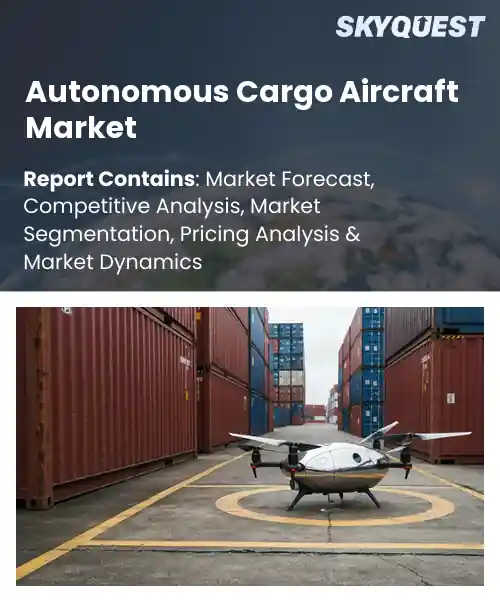
Autonomous Cargo Aircraft Market
Report ID: SQMIG20A2798
Report ID: SQMIG20A2798
[email protected]
USA +1 351-333-4748
Report ID:
SQMIG20A2798 |
Region:
Global |
Published Date: July, 2026
Pages:
157
|Tables:
145
|Figures:
78


Global Autonomous Cargo Aircraft Market size was valued at USD 2.92 Billion in 2024 and is poised to grow from USD 3.41 Billion in 2025 to USD 11.81 Billion by 2033, growing at a CAGR of 16.8% during the forecast period (2026-2033).
The Global Autonomous Cargo Aircraft market encompasses unmanned aircraft designed to transport freight without a crew, ranging from small drones to cargo planes. Its significance stems from the ability to lower labor costs, reduce turnaround time, and reach remote regions inaccessible to traditional logistics. The primary driver today is the surge in e‑commerce and the corresponding demand for rapid, last‑mile delivery, especially in Asian megacities and islands. Pilots in the United States used converted quadcopter drones for medical supplies, while Europe launched autonomous cargo trials on routes in 2020, showing the market’s significant evolution from experimental pilots to commercial scale. Regulatory acceptance now drives the market’s expansion because rules let airlines and logistics firms commit to autonomous fleets. When Europe’s Aviation Safety Agency issued the first certification standards for unmanned cargo aircraft in 2021, manufacturers rushed to produce electric vertical take‑off and landing (eVTOL) freighters, cutting emissions by roughly 30 % versus diesel counterparts. UPS has begun a pilot that moves high‑value electronics between hubs in under an hour, showing how compliance reduces operating costs and creates new revenue. This cause‑and‑effect loop attracts capital, prompting startups to partner with satellite providers to enable beyond‑visual‑line‑of‑sight flights and open remote‑area services previously unprofitable.
How is AI-driven automation influencing the growth of the autonomous cargo aircraft market?
AI‑driven automation is reshaping the autonomous cargo aircraft market by enabling real‑time route optimization, predictive maintenance, and adaptive load management. Advanced machine‑learning algorithms process weather data, air‑traffic patterns and cargo characteristics to generate efficient flight plans without human intervention. This reduces fuel consumption, shortens delivery times and lowers operational costs, making autonomous cargo solutions attractive to logistics providers. The technology also supports continuous health monitoring of aircraft systems, allowing issues to be addressed before they cause downtime. As regulators become more comfortable with proven safety records, airlines and freight companies are increasingly adopting these AI‑enhanced platforms, accelerating market adoption and expanding the ecosystem of service providers.In January 2026, a leading autonomous cargo aircraft developer announced a new AI‑driven flight‑control system, boosting operational efficiency and supporting market growth.
Market snapshot - (2026-2033)
Global Market Size
USD 2.92 Billion
Largest Segment
Fixed-Wing Aircraft
Fastest Growth
eVTOL Cargo Aircraft
Growth Rate
16.8% CAGR
To get more insights on this market click here to Request a Free Sample Report
Global autonomous cargo aircraft market is segmented by aircraft type, payload capacity, application, autonomy level, end user and region. Based on aircraft type, the market is segmented into Fixed-Wing Aircraft, eVTOL Cargo Aircraft and Hybrid VTOL Aircraft. Based on payload capacity, the market is segmented into Below 100 kg, 100–500 kg and Above 500 kg. Based on application, the market is segmented into Logistics & Parcel Delivery, Military Cargo, Humanitarian Aid and Medical Supply Transport. Based on autonomy level, the market is segmented into Remotely Piloted, Semi-Autonomous and Fully Autonomous. Based on end user, the market is segmented into Logistics Companies, Defense Organizations and Government Agencies. Based on region, the market is segmented into North America, Europe, Asia Pacific, Latin America and Middle East & Africa.
Fixed-Wing Aircraft segment dominates because the mature aerodynamics and proven air‑frame designs provide reliable long‑range performance, making them the preferred choice for high‑volume cargo routes. Operators benefit from existing certification pathways, lower development risk, and established maintenance infrastructure, which together reduce total cost of ownership. This reliability encourages early adopters to prioritize fixed‑wing platforms, cementing their leadership in the autonomous cargo aircraft market across diverse operational scenarios and evolving.
However, eVTOL Cargo Aircraft segment is witnessing the strongest growth momentum because vertical lift capability unlocks rapid point‑to‑point delivery in dense urban environments. Emerging regulatory frameworks and advances in electric propulsion are lowering barriers, while e‑commerce and same‑day logistics demand spur investment, positioning eVTOLs as a future growth engine.
100–500 kg segment dominates because this mid‑range capacity aligns with the sweet spot of most commercial parcel volumes, allowing operators to balance payload efficiency with aircraft size and operational cost. The weight class supports a variety of mission profiles, from regional distribution to time‑critical shipments, while fitting within existing cargo bays of many platforms, driving widespread adoption and market traction and enabling scalable business models for service providers.
On the other hand, Above 500 kg segment is emerging as the key high‑growth area because heavy‑load capability opens new opportunities in military logistics, humanitarian relief, and large‑scale industrial supply chains. Advances in structural materials and power‑dense propulsion are making higher payloads feasible, attracting investment that promises to broaden market horizons.
To get detailed segments analysis, Request a Free Sample Report
North America benefits from a mature aerospace ecosystem, extensive research collaboration, and a supportive regulatory environment that encourages innovation in unmanned logistics. Advanced manufacturing capabilities combined with strong investment from both public and private sectors create a fertile ground for rapid prototyping and deployment. Close proximity to major logistics hubs and a culture of early adoption among freight operators further solidify its leadership position, while robust safety standards and strategic partnerships across the supply chain reinforce confidence in autonomous cargo solutions.
Autonomous Cargo Aircraft Market in the United States is propelled by a deep pool of aerospace talent and a vibrant venture capital landscape that fuels start‑up growth. Integration with existing cargo networks and collaborative test sites near major airports accelerate real‑world validation, while federal agencies provide guidance that balances safety with flexibility. The confluence of cutting‑edge technology firms and established carriers creates a dynamic environment for scaling autonomous freight operations.
Autonomous Cargo Aircraft Market in Canada leverages a strong emphasis on sustainable transport and a collaborative approach between government research bodies and industry innovators. Strategic geographic positioning supports efficient north‑south trade routes, and a proactive regulatory framework encourages pilot projects in remote and challenging terrains. Partnerships with agricultural and resource sectors drive tailored solutions that showcase the versatility of autonomous cargo platforms across diverse operational contexts.
Europe’s expansion is driven by a concerted focus on green logistics, ambitious carbon reduction policies, and a network of highly integrated transportation corridors. Collaborative research initiatives across borders foster shared technology standards, while strong industrial clusters in key nations enable rapid scaling of manufacturing and services. Government incentives combined with a proactive stance on airspace modernization encourage early adoption by logistics providers, positioning Europe as a hub for innovative autonomous freight solutions that align with broader sustainability goals.
Autonomous Cargo Aircraft Market in Germany is anchored by a robust engineering tradition and a dense ecosystem of suppliers specialized in high‑precision components. Close alignment between research institutions and leading manufacturers accelerates technology transfer, while strong logistics hubs provide testbeds for operational trials. Commitment to environmental stewardship drives integration of electric propulsion concepts, reinforcing Germany’s role as a dominant player in the European autonomous cargo landscape.
Autonomous Cargo Aircraft Market in the United Kingdom is characterized by a fast‑moving regulatory environment that embraces experimental trials and digital airspace management. Thriving start‑up culture, supported by university spin‑outs, fuels rapid innovation, while major ports and e‑commerce distribution centers serve as early adopters. Strategic investment in connectivity infrastructure and collaborative pilots with defense and commercial stakeholders underline the United Kingdom’s position as the fastest‑growing market in Europe.
Autonomous Cargo Aircraft Market in France benefits from a strong emphasis on aerospace excellence and a supportive policy framework encouraging sustainable freight solutions. Collaborative clusters linking technology developers with logistics operators enable tailored applications for regional distribution. Governmental focus on reducing road congestion and emissions creates a favorable climate for adopting autonomous aerial cargo, positioning France as an emerging hub within the broader European market.
Asia Pacific advances its role through a blend of rapid urbanization, extensive island networks, and a growing appetite for efficient cargo movement across dispersed geographies. Nations in the region prioritize digital air traffic solutions and invest heavily in research partnerships that bridge local expertise with global technology leaders. The drive to alleviate surface congestion and meet rising demand for time‑critical deliveries fuels adoption of autonomous aerial platforms, reinforcing the region’s emerging prominence in the global autonomous cargo arena.
Autonomous Cargo Aircraft Market in Japan is propelled by a culture of precision engineering and a strategic focus on island logistics. Collaborative pilots between leading manufacturers and major freight carriers test autonomous operations in both urban and remote settings. Strong governmental support for airspace digitization and safety innovation encourages the integration of advanced navigation systems, highlighting Japan’s commitment to pioneering autonomous cargo solutions.
Autonomous Cargo Aircraft Market in South Korea is shaped by a dynamic technology sector and a proactive approach to smart city initiatives. Partnerships between semiconductor firms and aerospace developers accelerate sensor integration and data analytics capabilities for autonomous flight. Emphasis on rapid delivery services in dense metropolitan areas and emerging freight corridors drives the deployment of autonomous cargo aircraft, underscoring South Korea’s accelerating role in the regional market.
To know more about the market opportunities by region and country, click here to
Buy The Complete Report
Increasing E‑Commerce Demand
Advances In Autonomous Navigation
Regulatory Certification Challenges
High Infrastructure Investment Required
Request Free Customization of this report to help us to meet your business objectives.
The competitive landscape is shaped by rapid tech innovation, strategic partnerships, and selective M&A as firms race to secure autonomous cargo capabilities; Elroy Air’s logistics alliance, AIRO Group’s acquisition of advanced sensor firms, and Zelta Systems’ joint venture with a defense contractor illustrate how collaboration accelerates market entry while funding rounds for GridAero and Acodyne underscore the capital intensity driving competition.
Top Player’s Company Profile
Recent Developments
SkyQuest’s ABIRAW (Advanced Business Intelligence, Research & Analysis Wing) is our Business Information Services team that Collects, Collates, Correlates, and Analyses the Data collected by means of Primary Exploratory Research backed by robust Secondary Desk research. As per SkyQuest analysis, the autonomous cargo aircraft market is being propelled primarily by the surge in global e‑commerce demand which pushes logistics firms toward faster, point‑to‑point aerial delivery, while a second major driver is rapid progress in autonomous navigation technologies that improve safety and operational efficiency through AI‑powered sensor fusion. The market’s leading segment is the Fixed‑Wing Aircraft category, favored for its proven aerodynamics and long‑range capability, and North America remains the dominant region thanks to its mature aerospace ecosystem, strong investment climate, and supportive regulatory framework. However, the pace of market expansion is tempered by regulatory certification challenges that require lengthy testing and compliance, creating a notable restraint.
| Report Metric | Details |
|---|---|
| Market size value in 2024 | USD 2.92 Billion |
| Market size value in 2033 | USD 11.81 Billion |
| Growth Rate | 16.8% |
| Base year | 2024 |
| Forecast period | (2026-2033) |
| Forecast Unit (Value) | USD Billion |
| Segments covered |
|
| Regions covered | North America (US, Canada), Europe (Germany, France, United Kingdom, Italy, Spain, Rest of Europe), Asia Pacific (China, India, Japan, Rest of Asia-Pacific), Latin America (Brazil, Rest of Latin America), Middle East & Africa (South Africa, GCC Countries, Rest of MEA) |
| Companies covered |
|
| Customization scope | Free report customization with purchase. Customization includes:-
|
To get a free trial access to our platform which is a one stop solution for all your data requirements for quicker decision making. This platform allows you to compare markets, competitors who are prominent in the market, and mega trends that are influencing the dynamics in the market. Also, get access to detailed SkyQuest exclusive matrix.
Table Of Content
Executive Summary
Market overview
Parent Market Analysis
Market overview
Market size
KEY MARKET INSIGHTS
COVID IMPACT
MARKET DYNAMICS & OUTLOOK
Market Size by Region
KEY COMPANY PROFILES
Methodology
For the Autonomous Cargo Aircraft Market, our research methodology involved a mixture of primary and secondary data sources. Key steps involved in the research process are listed below:
1. Information Procurement: This stage involved the procurement of Market data or related information via primary and secondary sources. The various secondary sources used included various company websites, annual reports, trade databases, and paid databases such as Hoover's, Bloomberg Business, Factiva, and Avention. Our team did 45 primary interactions Globally which included several stakeholders such as manufacturers, customers, key opinion leaders, etc. Overall, information procurement was one of the most extensive stages in our research process.
2. Information Analysis: This step involved triangulation of data through bottom-up and top-down approaches to estimate and validate the total size and future estimate of the Autonomous Cargo Aircraft Market.
3. Report Formulation: The final step entailed the placement of data points in appropriate Market spaces in an attempt to deduce viable conclusions.
4. Validation & Publishing: Validation is the most important step in the process. Validation & re-validation via an intricately designed process helped us finalize data points to be used for final calculations. The final Market estimates and forecasts were then aligned and sent to our panel of industry experts for validation of data. Once the validation was done the report was sent to our Quality Assurance team to ensure adherence to style guides, consistency & design.
Analyst Support
Customization Options
With the given market data, our dedicated team of analysts can offer you the following customization options are available for the Autonomous Cargo Aircraft Market:
Product Analysis: Product matrix, which offers a detailed comparison of the product portfolio of companies.
Regional Analysis: Further analysis of the Autonomous Cargo Aircraft Market for additional countries.
Competitive Analysis: Detailed analysis and profiling of additional Market players & comparative analysis of competitive products.
Go to Market Strategy: Find the high-growth channels to invest your marketing efforts and increase your customer base.
Innovation Mapping: Identify racial solutions and innovation, connected to deep ecosystems of innovators, start-ups, academics, and strategic partners.
Category Intelligence: Customized intelligence that is relevant to their supply Markets will enable them to make smarter sourcing decisions and improve their category management.
Public Company Transcript Analysis: To improve the investment performance by generating new alpha and making better-informed decisions.
Social Media Listening: To analyze the conversations and trends happening not just around your brand, but around your industry as a whole, and use those insights to make better Marketing decisions.
REQUEST FOR SAMPLE
 REQUEST FREE CUSTOMIZATION


Want to customize this report? This report can be personalized according to your needs. Our analysts and industry experts will work directly with you to understand your requirements and provide you with customized data in a short amount of time. We offer $1000 worth of FREE customization at the time of purchase.
Feedback From Our Clients


 USA (+1) 351-333-4748

