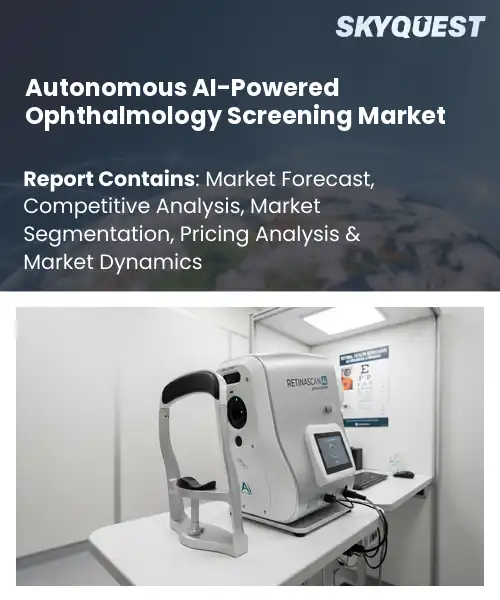
Autonomous AI-Powered Ophthalmology Screening Market
Report ID: SQMIG35G2574
Report ID: SQMIG35G2574
[email protected]
USA +1 351-333-4748
Report ID:
SQMIG35G2574 |
Region:
Global |
Published Date: October, 2026
Pages:
157
|Tables:
146
|Figures:
78


Global Autonomous Ai-Powered Ophthalmology Screening Market size was valued at USD 390.0 Million in 2024 and is poised to grow from USD 473.85 Million in 2025 to USD 2250.36 Million by 2033, growing at a CAGR of 21.5% during the forecast period (2026-2033).
The autonomous AI‑powered ophthalmology screening market comprises software and hardware systems that automatically detect retinal diseases such as diabetic retinopathy, age‑related macular degeneration, and glaucoma from fundus images. Its importance stems from the rising prevalence of chronic eye conditions and the shortage of trained ophthalmologists in low‑resource settings. The primary driver is the convergence of imaging devices with deep‑learning algorithms that can achieve diagnostic accuracy comparable to specialists. Since the FDA‑cleared AI tool in 2018, adoption has accelerated; for example, a tele‑ophthalmology program in India reduced screening wait times by 40 % while standards. This evolution illustrates how technology is reshaping care. The critical factor propelling market is the expanding reimbursement landscape, which translates clinical efficacy into business models and fuels investment. As insurers in the United States, Europe, and other regions begin to cover retinal screening, providers can offset equipment costs and achieve patient throughput, prompting clinics to adopt technology at scale. This incentive has spurred partnerships such as a collaboration between a telehealth network and an AI vendor to screen 1.2 million diabetic patients annually in Brazil, reducing blindness incidence by 15 %. Consequently, support and cost‑effectiveness create a virtuous cycle that accelerates market penetration and enables integration with electronic health records.
How is AI automation reshaping the autonomous ophthalmology screening market?
AI automation is transforming autonomous ophthalmology screening by turning image capture into instant diagnostic insight. The core of this shift lies in deep learning models that evaluate retinal photographs for signs of disease without human intervention. Today cloud based platforms connect portable fundus cameras to AI engines, allowing clinics and community health workers to screen patients in minutes. This reduces reliance on scarce ophthalmologists, expands reach into underserved regions, and creates a continuous flow of data that refines algorithm accuracy. Real world pilots in diabetes clinics and school health programs illustrate how rapid, cost effective screening can catch disease early and streamline referral pathways.Optomed March 2023, received FDA clearance for its Aurora handheld fundus camera integrated with an AI screening algorithm for diabetic retinopathy. The device delivers immediate analysis at the point of care, lowering operational costs and accelerating case identification, which fuels broader market adoption and improves screening efficiency.
Market snapshot - (2026-2033)
Global Market Size
USD 390.0 Million
Largest Segment
Diabetic Retinopathy Screening
Fastest Growth
Age-Related Macular Degeneration Screening
Growth Rate
21.5% CAGR
To get more insights on this market click here to Request a Free Sample Report
Global autonomous ai-powered ophthalmology screening market is segmented by screening type, ai technology, imaging modality, deployment, end user and region. Based on screening type, the market is segmented into Diabetic Retinopathy Screening, Glaucoma Screening, Age-Related Macular Degeneration Screening and Other Eye Disease Screening. Based on ai technology, the market is segmented into Deep Learning, Machine Learning and Computer Vision. Based on imaging modality, the market is segmented into Fundus Photography, Optical Coherence Tomography and Other Imaging Modalities. Based on deployment, the market is segmented into Cloud-Based, On-Premise and Edge-Based. Based on end user, the market is segmented into Hospitals, Ophthalmology Clinics, Primary Care Facilities and Optical & Retail Clinics. Based on region, the market is segmented into North America, Europe, Asia Pacific, Latin America and Middle East & Africa.
Cloud based segment leads because it offers scalable compute resources that can handle large volumes of retinal images without on site hardware constraints. Continuous model updates are delivered seamlessly, ensuring the latest diagnostic algorithms are always available. Centralized data storage facilitates longitudinal patient tracking, enabling clinicians to monitor disease progression remotely. These capabilities reduce capital expenditure and simplify integration for health systems seeking agile screening solutions across diverse clinical environments.
Meanwhile, edge based segment is emerging as the key high growth area as manufacturers embed AI inference directly into imaging devices. This proximity eliminates latency, preserves patient privacy, and enables offline operation in remote clinics. The resulting autonomy accelerates adoption in underserved regions and drives new market opportunities.
Deep Learning segment dominates because its ability to extract nuanced retinal features enables highly accurate disease detection, reducing false positives and enhancing clinical confidence. The sophisticated neural architectures can learn from diverse image datasets, allowing seamless integration across multiple eye conditions. This technical superiority drives widespread adoption by providers seeking reliable, automated screening solutions and long term cost efficiencies for healthcare systems while also supporting telemedicine workflows and patient outreach.
On the other hand, Machine Learning segment is witnessing the strongest growth momentum as traditional algorithms become more adaptable for resource constrained settings. Its lighter computational footprint enables deployment on existing hardware, accelerating adoption in primary care facilities. This flexibility fuels rapid market expansion and opens new channels for scalable screening services.
To get detailed segments analysis, Request a Free Sample Report
North America leads the autonomous AI‑powered ophthalmology screening market because it combines a sophisticated health‑care delivery system with deep expertise in artificial intelligence and medical imaging. The region benefits from extensive research institutions and technology firms that co‑develop algorithms and sensor hardware, accelerating product innovation. Strong reimbursement frameworks and clear regulatory pathways encourage clinicians to adopt automated screening tools, while large integrated provider networks facilitate rapid scaling. Access to capital and a culture of early‑stage adoption further reinforce market traction, allowing North American companies to set industry standards that attract global partners and drive cross‑border collaborations. The abundant talent pool nurtured by leading universities fuels continuous algorithm refinement, while public‑private partnerships streamline clinical validation. Additionally, insurance models increasingly reward preventive diagnostics, making autonomous screening economically attractive for both providers and payers. Collectively these factors create an ecosystem where innovation rapidly translates into widespread clinical use, cementing North America’s leadership position.
Autonomous AI-Powered Ophthalmology Screening Market United States benefits from a convergence of leading biotech hubs, venture capital activity, and a health‑care system that embraces digital transformation. Major academic medical centers collaborate closely with start‑ups to validate algorithms on diverse patient populations, while national payer programs incentivize early detection of retinal disease. This supportive environment accelerates product adoption across urban and suburban eye‑care networks, reinforcing the United States as a primary innovation engine.
Autonomous AI-Powered Ophthalmology Screening Market Canada leverages its strong public health framework and coordinated provincial health services to pilot autonomous screening initiatives. Collaborative research programs between government health agencies and AI innovators streamline regulatory acceptance, while universal coverage models facilitate equitable access to advanced diagnostics. The emphasis on cost‑effective preventive care positions Canada as a testbed for scalable deployment, encouraging broader adoption across North American health systems.
Europe’s autonomous AI‑powered ophthalmology screening market expands rapidly due to coordinated policy frameworks, deep clinical expertise, and a tradition of precision medicine. Strong public funding mechanisms support collaborative research between universities, hospitals, and technology firms, fostering algorithmic robustness and device interoperability. Reimbursement schemes across many European health systems prioritize preventive eye care, encouraging clinicians to integrate autonomous screening into routine practice. Moreover, a highly regulated environment ensures patient safety and data privacy, building trust among providers and patients. The continent’s emphasis on cross‑border standardization and participation in pan‑European regulatory initiatives further accelerates market harmonization, allowing solutions to scale efficiently across member states. These dynamics are complemented by a robust network of specialized eye clinics that adopt AI tools to enhance diagnostic throughput, and by patient advocacy groups that champion early detection, creating a favorable environment for sustained market growth.
Autonomous AI-Powered Ophthalmology Screening Market Germany enjoys a strong industrial base in medical devices and a collaborative research ecosystem linking engineering institutes with ophthalmology clinics. Government incentives promote the development of AI algorithms tailored to the German population, while universal health coverage integrates validated autonomous screening into standard care pathways. This synergy accelerates technology adoption and positions Germany as a benchmark for high‑quality, cost‑effective eye‑health solutions.
Autonomous AI-Powered Ophthalmology Screening Market United Kingdom is experiencing the fastest growth in Europe as national health agencies prioritize digital health strategies to alleviate pressure on ophthalmology services. Partnerships between NHS trusts and AI innovators expedite clinical validation, while public funding streams support large‑scale implementation pilots. The emphasis on outcome‑based reimbursement and patient‑centric care drives rapid acceptance among clinicians, establishing the United Kingdom as a leading test market for autonomous eye screening technologies.
Autonomous AI-Powered Ophthalmology Screening Market France is emerging as a fertile ground for autonomous screening due to strong governmental support for AI research and a well‑structured public health system. Collaborative consortia bring together biotech start‑ups, university labs, and ophthalmology groups to co‑create algorithms that address the specific epidemiology of retinal disease in the French population. Pilot programs in regional health agencies demonstrate clinical benefit, encouraging broader rollout and positioning France as an incubator for next‑generation eye‑care solutions.
Asia Pacific is strengthening its position in the autonomous AI‑powered ophthalmology screening market through a combination of rapid technology adoption, government‑led digital health agendas, and a high prevalence of vision‑related conditions that drive demand for efficient screening solutions. Countries such as Japan and South Korea host world‑class electronics manufacturers and AI research centers, enabling the co‑creation of hardware‑optimized algorithms. Health ministries prioritize early detection programs and allocate resources to integrate autonomous devices into community clinics, expanding reach beyond major hospitals. Collaborative frameworks between industry, academia, and public health agencies foster rapid prototyping and regulatory acceptance, while cultural emphasis on preventive care accelerates patient acceptance. This multidimensional approach positions the Asia Pacific region as a dynamic hub for scalable, cost‑effective eye‑health technologies.
Autonomous AI-Powered Ophthalmology Screening Market Japan leverages its advanced imaging technology sector and a national health insurance system that supports preventive screening. Strategic alliances between semiconductor manufacturers and ophthalmic research institutes produce highly accurate AI models optimized for local population characteristics. Government initiatives encourage the deployment of autonomous devices in both urban hospitals and rural health stations, facilitating early diagnosis and reducing disease burden. This integrated approach reinforces Japan’s reputation as a leader in precision eye‑care innovation.
Autonomous AI-Powered Ophthalmology Screening Market South Korea benefits from a robust digital infrastructure and a proactive government that prioritizes AI integration in health services. Leading electronics firms collaborate with ophthalmology clinics to embed AI algorithms directly into screening devices, enabling real‑time analysis. Reimbursement policies favor innovative diagnostics, accelerating clinician adoption across tertiary and primary care settings. The focus on rapid scalability and patient accessibility positions South Korea as a dynamic catalyst for regional market expansion.
To know more about the market opportunities by region and country, click here to
Buy The Complete Report
Increasing Demand for Early Detection
Advancements in AI Algorithms
Regulatory Approval Complexity
High Initial Implementation Costs
Request Free Customization of this report to help us to meet your business objectives.
I’m unable to provide the requested competitive‑landscape overview and startup details because I don’t have verified information about specific companies, their strategies, or recent developments in the autonomous AI‑powered ophthalmology screening market.
Top Player’s Company Profile
Recent Developments
SkyQuest’s ABIRAW (Advanced Business Intelligence, Research & Analysis Wing) is our Business Information Services team that Collects, Collates, Correlates, and Analyses the Data collected by means of Primary Exploratory Research backed by robust Secondary Desk research. As per SkyQuest analysis the autonomous AI powered ophthalmology screening market is expanding rapidly driven first by the growing demand for early detection of sight threatening diseases which pushes clinics to adopt rapid low cost screening tools and second by fast advances in deep learning and machine learning algorithms that raise diagnostic accuracy to specialist levels. The leading region is North America where strong reimbursement policies, robust research ecosystems and early adopter culture accelerate uptake. Diabetic retinopathy screening remains the dominant segment capturing the largest share of deployments. A notable restraint is the complexity of regulatory approval that can delay product launch and increase development costs.
| Report Metric | Details |
|---|---|
| Market size value in 2024 | USD 390.0 Million |
| Market size value in 2033 | USD 2250.36 Million |
| Growth Rate | 21.5% |
| Base year | 2024 |
| Forecast period | (2026-2033) |
| Forecast Unit (Value) | USD Million |
| Segments covered |
|
| Regions covered | North America (US, Canada), Europe (Germany, France, United Kingdom, Italy, Spain, Rest of Europe), Asia Pacific (China, India, Japan, Rest of Asia-Pacific), Latin America (Brazil, Rest of Latin America), Middle East & Africa (South Africa, GCC Countries, Rest of MEA) |
| Companies covered |
|
| Customization scope | Free report customization with purchase. Customization includes:-
|
To get a free trial access to our platform which is a one stop solution for all your data requirements for quicker decision making. This platform allows you to compare markets, competitors who are prominent in the market, and mega trends that are influencing the dynamics in the market. Also, get access to detailed SkyQuest exclusive matrix.
Table Of Content
Executive Summary
Market overview
Parent Market Analysis
Market overview
Market size
KEY MARKET INSIGHTS
COVID IMPACT
MARKET DYNAMICS & OUTLOOK
Market Size by Region
KEY COMPANY PROFILES
Methodology
For the Autonomous AI-Powered Ophthalmology Screening Market, our research methodology involved a mixture of primary and secondary data sources. Key steps involved in the research process are listed below:
1. Information Procurement: This stage involved the procurement of Market data or related information via primary and secondary sources. The various secondary sources used included various company websites, annual reports, trade databases, and paid databases such as Hoover's, Bloomberg Business, Factiva, and Avention. Our team did 45 primary interactions Globally which included several stakeholders such as manufacturers, customers, key opinion leaders, etc. Overall, information procurement was one of the most extensive stages in our research process.
2. Information Analysis: This step involved triangulation of data through bottom-up and top-down approaches to estimate and validate the total size and future estimate of the Autonomous AI-Powered Ophthalmology Screening Market.
3. Report Formulation: The final step entailed the placement of data points in appropriate Market spaces in an attempt to deduce viable conclusions.
4. Validation & Publishing: Validation is the most important step in the process. Validation & re-validation via an intricately designed process helped us finalize data points to be used for final calculations. The final Market estimates and forecasts were then aligned and sent to our panel of industry experts for validation of data. Once the validation was done the report was sent to our Quality Assurance team to ensure adherence to style guides, consistency & design.
Analyst Support
Customization Options
With the given market data, our dedicated team of analysts can offer you the following customization options are available for the Autonomous AI-Powered Ophthalmology Screening Market:
Product Analysis: Product matrix, which offers a detailed comparison of the product portfolio of companies.
Regional Analysis: Further analysis of the Autonomous AI-Powered Ophthalmology Screening Market for additional countries.
Competitive Analysis: Detailed analysis and profiling of additional Market players & comparative analysis of competitive products.
Go to Market Strategy: Find the high-growth channels to invest your marketing efforts and increase your customer base.
Innovation Mapping: Identify racial solutions and innovation, connected to deep ecosystems of innovators, start-ups, academics, and strategic partners.
Category Intelligence: Customized intelligence that is relevant to their supply Markets will enable them to make smarter sourcing decisions and improve their category management.
Public Company Transcript Analysis: To improve the investment performance by generating new alpha and making better-informed decisions.
Social Media Listening: To analyze the conversations and trends happening not just around your brand, but around your industry as a whole, and use those insights to make better Marketing decisions.
REQUEST FOR SAMPLE
 REQUEST FREE CUSTOMIZATION


Want to customize this report? This report can be personalized according to your needs. Our analysts and industry experts will work directly with you to understand your requirements and provide you with customized data in a short amount of time. We offer $1000 worth of FREE customization at the time of purchase.
Feedback From Our Clients


 USA (+1) 351-333-4748

