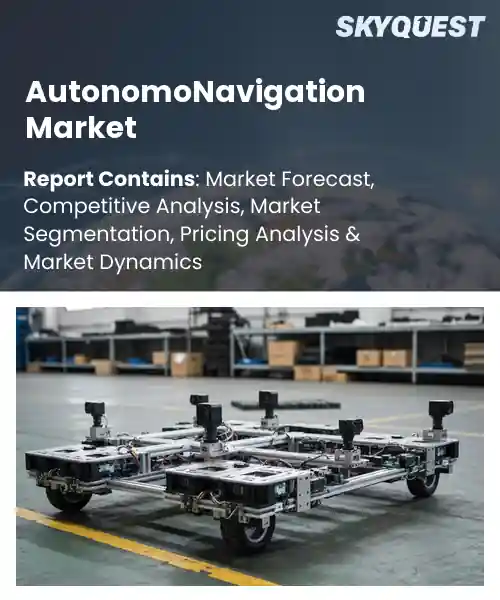
AutonomoNavigation Market
Report ID: SQMIG45E3147
Report ID: SQMIG45E3147
[email protected]
USA +1 351-333-4748
Report ID:
SQMIG45E3147 |
Region:
Global |
Published Date: August, 2026
Pages:
157
|Tables:
172
|Figures:
79


Global Autonomonavigation Market size was valued at USD 7.46 Billion in 2024 and is poised to grow from USD 8.51 Billion in 2025 to USD 24.46 Billion by 2033, growing at a CAGR of 14.1% during the forecast period (2026-2033).
The autonomous navigation market revolves around technologies that enable vehicles, drones, and robots to move without human intervention by processing sensor data, maps, and artificial intelligence. Its significance stems from the promise of safer roads, lower logistics costs, and new services such as on‑demand delivery. Historically, the sector emerged from early robotics labs in the 1990s, gained momentum with GPS‑based fleet tracking in the 2000s, and accelerated after deep‑learning breakthroughs that improved perception in complex environments. Companies like Waymo and DJI illustrate this evolution, turning research prototypes into commercially viable platforms that are reshaping transportation and supply‑chain ecosystems worldwide today. Regulatory endorsement emerges as the pivotal catalyst propelling the global autonomous navigation market, because legal frameworks reduce investment risk and stimulate funding for solutions. When governments issue standards for sensor calibration and liability, manufacturers accelerate vehicle certification, which in turn unlocks fleets and pilot programs. This dynamic is evident in Singapore’s autonomous bus trials, where policy support generated partnerships between local transit agencies and firms such as Navya, leading to expanded route deployments. Simultaneously, the rise of edge‑computing hardware lowers latency, enabling decision making that fuels growth in warehouse robotics and delivery, creating a virtuous loop of adoption and refinement.
How is AI-driven sensor fusion enhancing autonomous navigation market adoption across automotive and drone sectors?
AI driven sensor fusion combines data from cameras lidar radar and inertial units to create a unified perception of the environment. In the automotive sector this integration enables vehicles to anticipate obstacles and adjust trajectories with greater confidence, reducing reliance on any single sensor type. Drone manufacturers benefit from the same principle, allowing lightweight platforms to navigate complex airspace while maintaining stability in variable lighting and weather. Recent pilots show that the technology shortens testing cycles and builds trust among regulators and end users. As the ecosystem matures, partnerships between chip makers software firms and OEMs accelerate adoption across both markets.Skydio March 2024, introduced an autonomous navigation suite that fuses visual and depth data through AI driven algorithms, allowing its drones to operate safely in cluttered urban environments. This breakthrough demonstrates how sensor fusion can cut development time and improve reliability, reinforcing market momentum for both automotive and aerial autonomy.
Market snapshot - (2026-2033)
Global Market Size
USD 7.46 Billion
Largest Segment
Hardware
Fastest Growth
Software
Growth Rate
14.1% CAGR
To get more insights on this market click here to Request a Free Sample Report
Global autonomonavigation market is segmented by component, platform, technology, application, end user, deployment and region. Based on component, the market is segmented into Hardware, Software and Services. Based on platform, the market is segmented into Ground Vehicles, Aerial Vehicles, Marine Vehicles and Others. Based on technology, the market is segmented into GNSS Navigation, LiDAR Navigation, Vision-Based Navigation and Others. Based on application, the market is segmented into Defense, Logistics, Agriculture and Others. Based on end user, the market is segmented into Commercial and Government. Based on deployment, the market is segmented into On-Premises and Cloud-Based. Based on region, the market is segmented into North America, Europe, Asia Pacific, Latin America and Middle East & Africa.
Hardware segment dominates because it forms the physical backbone required for precise autonomous navigation, integrating sensors, processors, and actuators that enable real time decision making. The reliability of ruggedized units, advances in miniaturization, and the need for mission critical durability drive its leadership. As vehicles become more capable, demand for high performance computing and power efficient designs fuels continuous investment, cementing hardware’s central role in market growth.
However, Services segment is witnessing the strongest growth momentum as fleet operators seek end to end support for integration, maintenance and data analytics. Subscription models and remote diagnostic capabilities lower operational barriers, encouraging broader adoption across vehicle classes. This service centric approach accelerates market expansion by unlocking new revenue streams and enhancing reliability.
Vision based navigation segment dominates because it delivers centimeter level positioning by interpreting visual cues, allowing autonomous platforms to operate where satellite signals are obstructed. Advances in camera resolution, AI driven perception algorithms, and edge computing enhance reliability and reduce latency. These capabilities satisfy critical safety requirements for complex environments, prompting manufacturers to prioritize visual systems as the core of autonomous guidance solutions.
Meanwhile, GNSS navigation segment emerges as the fastest expanding area as global satellite networks proliferate and regulatory frameworks endorse precise positioning for autonomous operations. Continuous improvements in signal integrity, multi constellation access, and integration with correction services boost confidence in satellite based routes. This momentum broadens adoption across logistics and defense domains, fueling overall market acceleration.
To get detailed segments analysis, Request a Free Sample Report
North America benefits from a mature ecosystem where leading technology firms, automotive manufacturers, and research institutions collaborate closely. Substantial venture capital and government funding accelerate development of autonomous navigation algorithms and sensor platforms. A proactive regulatory environment encourages real‑world testing while maintaining safety standards. Extensive data collection networks across urban and highway corridors provide rich training material for machine‑learning models. Strong defense and aerospace programs further push high‑precision navigation capabilities. Consumer acceptance is reinforced by early deployments in logistics and ride‑hailing services, creating feedback loops that refine system performance. These combined factors cement North America’s leadership in the global market.
AutonomoNavigation Market in United States thrives on dense clusters of technology innovators, major automotive OEMs, and a robust venture capital landscape. Regulatory frameworks support incremental testing on public roads, while extensive test tracks enable high‑speed validation. Integration with smart‑city initiatives and advanced data‑sharing platforms accelerates deployment across logistics, mobility‑as‑a‑service, and consumer vehicles. Collaborative research between universities and industry fuels continuous algorithmic improvement and sensor integration, ensuring scalability and reliability for future autonomous fleets.
AutonomoNavigation Market in Canada benefits from world‑class research universities, government incentives, and a collaborative approach between public agencies and private firms. Emphasis on safety standards and rigorous testing environments supports confidence in autonomous freight and passenger services. Proximity to United States supply chains enables technology transfer and joint pilot projects. Emerging deployments in remote logistics, mining operations, and urban transit showcase adaptability of navigation solutions across diverse terrains and regulatory contexts.
Asia Pacific experiences a confluence of factors that accelerate autonomous navigation adoption across multiple sectors. Strong manufacturing capabilities provide a steady supply of high‑precision sensors, actuators, and computing hardware essential for sophisticated navigation stacks. Government roadmaps emphasize smart mobility, integrating autonomous vehicles into national transportation strategies and offering regulatory sandboxes for controlled trials. Rapid urbanization creates demand for efficient, low‑emission transport solutions, prompting cities to pilot autonomous shuttles and freight corridors. Advanced telecommunications, particularly 5G rollout, enable low‑latency data exchange critical for real‑time decision making. Collaborative ecosystems linking automotive OEMs, technology startups, and academic research centers foster rapid innovation and knowledge transfer. Together, these dynamics position Asia Pacific as a vibrant hub for scaling autonomous navigation technologies.
AutonomoNavigation Market in Japan leverages a legacy of robotics excellence and world‑renowned automotive engineering. Government initiatives prioritize safety‑centric autonomous solutions, encouraging rigorous certification processes and public‑road trials. Strong sensor manufacturing expertise ensures high‑resolution perception capabilities, while advanced AI research institutions contribute cutting‑edge algorithmic developments. Integration with existing public‑transport networks, such as autonomous buses and last‑mile shuttles, demonstrates practical deployment pathways. Collaborative projects between major carmakers, technology firms, and municipal authorities accelerate real‑world validation and consumer acceptance.
AutonomoNavigation Market in South Korea benefits from a robust electronics and telecommunications foundation that underpins high‑performance computing and sensor integration. National policies actively promote autonomous mobility, offering incentives for pilot deployments in smart‑city districts. Leading automotive manufacturers collaborate with local chipmakers to embed advanced perception and decision‑making modules into vehicle platforms. The widespread 5G infrastructure enables ultra‑low latency communication essential for coordinated platooning and dynamic routing. Ongoing public‑road trials in urban and logistics corridors showcase the practicality of autonomous navigation solutions for both passenger and freight applications.
Europe reinforces its autonomous navigation standing through coordinated regulatory frameworks, sustainability commitments, and deep automotive expertise. The European Union promotes harmonized standards that streamline cross‑border testing and deployment, reducing legal fragmentation for manufacturers. Significant public‑private research consortia focus on safety, ethical AI, and resilient sensor fusion, leveraging world‑class engineering institutions. Emphasis on low‑emission mobility aligns autonomous solutions with broader climate objectives, encouraging integration with electric vehicle platforms. Robust funding mechanisms support pilot corridors linking major cities, facilitating real‑world data collection and system refinement. Strong data‑privacy regulations ensure responsible handling of sensor and vehicle data, building public trust. Collectively, these initiatives position Europe as a leader in safe, sustainable, and interoperable autonomous navigation ecosystems.
AutonomoNavigation Market in Germany draws on a heritage of precision engineering and a dense network of automotive manufacturers. Collaborative research centers specialize in high‑accuracy sensor calibration, robust control algorithms, and rigorous safety validation. Government‑backed pilot corridors across major metropolitan regions enable large‑scale field testing of autonomous freight and passenger services. Integration with advanced manufacturing processes ensures seamless production of navigation hardware. The focus on reliability and regulatory compliance strengthens confidence among industry stakeholders and accelerates market adoption.
AutonomoNavigation Market in United Kingdom benefits from a vibrant artificial‑intelligence research community and a proactive regulatory sandbox approach. Dedicated autonomous‑vehicle test zones in several cities provide controlled environments for real‑world validation of navigation algorithms. Partnerships between leading universities, technology startups, and legacy automotive firms foster rapid prototyping and knowledge exchange. Emphasis on urban mobility solutions, such as autonomous taxis and delivery robots, aligns with city congestion mitigation strategies. This collaborative ecosystem accelerates technology maturation and public acceptance across diverse transportation scenarios.
AutonomoNavigation Market in France is shaped by strong governmental support for sustainable mobility and a focus on integrating autonomous solutions into public‑transport networks. Collaborative projects between national rail operators, automotive manufacturers, and technology firms develop autonomous shuttles and last‑mile connectors that complement existing services. Emphasis on energy transition drives the pairing of autonomous navigation with electric propulsion, enhancing environmental performance. Research clusters in key regions advance sensor fusion and AI safety frameworks, while regulatory initiatives streamline certification pathways. This holistic approach positions France as a leader in socially responsible autonomous navigation deployment.
To know more about the market opportunities by region and country, click here to
Buy The Complete Report
Growing Demand For Autonomous Vehicles
Adopting Advanced Sensor Fusion
Regulatory Uncertainty Around Liability
High Development Costs and Training
Request Free Customization of this report to help us to meet your business objectives.
The global AutonomoNavigation market is shaped by fierce competition among automotive OEMs, technology giants, and specialist startups, driving rapid innovation and strategic alliances; Toyota’s partnership with Aurora to embed its navigation stack, Mercedes‑Benz’s collaboration with NVIDIA for AI‑powered mapping, and Mobileye’s acquisition of Israeli perception startup PerceptIn illustrate how M&A and joint ventures are accelerating technology rollout and market share battles.
Top Player’s Company Profile
Recent Developments
SkyQuest’s ABIRAW (Advanced Business Intelligence, Research & Analysis Wing) is our Business Information Services team that Collects, Collates, Correlates, and Analyses the Data collected by means of Primary Exploratory Research backed by robust Secondary Desk research. As per SkyQuest analysis, the market’s momentum is powered primarily by regulatory endorsement that lowers investment risk and spurs funding, while a second driver comes from the rapid adoption of advanced sensor‑fusion techniques that combine lidar, radar, cameras and GNSS to boost perception reliability across vehicles and drones. The principal restraint remains regulatory uncertainty around liability, which dampens full‑scale roll‑outs as manufacturers await clearer legal frameworks. North America emerges as the dominant region, benefitting from a mature tech ecosystem, strong venture capital, and supportive testing regulations. Within the market, the hardware segment leads, providing the essential sensors, processors and actuators that form the backbone of autonomous navigation solutions.
| Report Metric | Details |
|---|---|
| Market size value in 2024 | USD 7.46 Billion |
| Market size value in 2033 | USD 24.46 Billion |
| Growth Rate | 14.1% |
| Base year | 2024 |
| Forecast period | (2026-2033) |
| Forecast Unit (Value) | USD Billion |
| Segments covered |
|
| Regions covered | North America (US, Canada), Europe (Germany, France, United Kingdom, Italy, Spain, Rest of Europe), Asia Pacific (China, India, Japan, Rest of Asia-Pacific), Latin America (Brazil, Rest of Latin America), Middle East & Africa (South Africa, GCC Countries, Rest of MEA) |
| Companies covered |
|
| Customization scope | Free report customization with purchase. Customization includes:-
|
To get a free trial access to our platform which is a one stop solution for all your data requirements for quicker decision making. This platform allows you to compare markets, competitors who are prominent in the market, and mega trends that are influencing the dynamics in the market. Also, get access to detailed SkyQuest exclusive matrix.
Table Of Content
Executive Summary
Market overview
Parent Market Analysis
Market overview
Market size
KEY MARKET INSIGHTS
COVID IMPACT
MARKET DYNAMICS & OUTLOOK
Market Size by Region
KEY COMPANY PROFILES
Methodology
For the AutonomoNavigation Market, our research methodology involved a mixture of primary and secondary data sources. Key steps involved in the research process are listed below:
1. Information Procurement: This stage involved the procurement of Market data or related information via primary and secondary sources. The various secondary sources used included various company websites, annual reports, trade databases, and paid databases such as Hoover's, Bloomberg Business, Factiva, and Avention. Our team did 45 primary interactions Globally which included several stakeholders such as manufacturers, customers, key opinion leaders, etc. Overall, information procurement was one of the most extensive stages in our research process.
2. Information Analysis: This step involved triangulation of data through bottom-up and top-down approaches to estimate and validate the total size and future estimate of the AutonomoNavigation Market.
3. Report Formulation: The final step entailed the placement of data points in appropriate Market spaces in an attempt to deduce viable conclusions.
4. Validation & Publishing: Validation is the most important step in the process. Validation & re-validation via an intricately designed process helped us finalize data points to be used for final calculations. The final Market estimates and forecasts were then aligned and sent to our panel of industry experts for validation of data. Once the validation was done the report was sent to our Quality Assurance team to ensure adherence to style guides, consistency & design.
Analyst Support
Customization Options
With the given market data, our dedicated team of analysts can offer you the following customization options are available for the AutonomoNavigation Market:
Product Analysis: Product matrix, which offers a detailed comparison of the product portfolio of companies.
Regional Analysis: Further analysis of the AutonomoNavigation Market for additional countries.
Competitive Analysis: Detailed analysis and profiling of additional Market players & comparative analysis of competitive products.
Go to Market Strategy: Find the high-growth channels to invest your marketing efforts and increase your customer base.
Innovation Mapping: Identify racial solutions and innovation, connected to deep ecosystems of innovators, start-ups, academics, and strategic partners.
Category Intelligence: Customized intelligence that is relevant to their supply Markets will enable them to make smarter sourcing decisions and improve their category management.
Public Company Transcript Analysis: To improve the investment performance by generating new alpha and making better-informed decisions.
Social Media Listening: To analyze the conversations and trends happening not just around your brand, but around your industry as a whole, and use those insights to make better Marketing decisions.
REQUEST FOR SAMPLE
 REQUEST FREE CUSTOMIZATION


Want to customize this report? This report can be personalized according to your needs. Our analysts and industry experts will work directly with you to understand your requirements and provide you with customized data in a short amount of time. We offer $1000 worth of FREE customization at the time of purchase.
Feedback From Our Clients


 USA (+1) 351-333-4748

