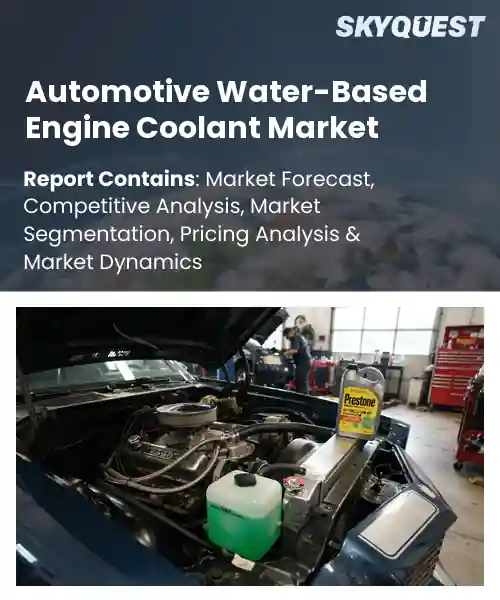
Automotive Water-Based Engine Coolant Market
Report ID: SQMIG15E4452
Report ID: SQMIG15E4452
[email protected]
USA +1 351-333-4748
Report ID:
SQMIG15E4452 |
Region:
Global |
Published Date: September, 2026
Pages:
157
|Tables:
143
|Figures:
78


Global Automotive Water-Based Engine Coolant Market size was valued at USD 3.1 Billion in 2024 and is poised to grow from USD 3.23 Billion in 2025 to USD 4.49 Billion by 2033, growing at a CAGR of 4.2% during the forecast period (2026-2033).
The automotive water‑based engine coolant market provides blends of water, glycol and inhibitors that safeguard engines against overheating, corrosion and wear. Effective cooling improves fuel efficiency, reduces emissions and prolongs vehicle lifespan, making coolant a vital maintenance item for manufacturers and owners alike. Originating in the 1920s when ethylene‑glycol replaced plain water, the sector has progressed through safer propylene‑glycol mixes, the 2000s introduction of organic‑acid‑technology additives, and today’s demand for low‑sulfate, long‑life formulas from Asian OEMs. Heightened environmental standards and consumer focus on durability now compel producers to advance formulations, fueling steady market growth across all major regions worldwide today. Building on regulatory pressure, the main growth driver now is the surge in hybrid and electric‑assisted powertrains that use internal‑combustion range extenders and require coolant for battery‑management. As OEMs add larger turbochargers and higher compression ratios, coolant formulas must deliver greater thermal capacity and corrosion resistance, spurring demand for OAT and hybrid organic‑inorganic additives. German manufacturers, for instance, have moved to magnesium‑based inhibitors to shield aluminum blocks, while Chinese tier‑one suppliers launch coolant kits designed for 150 kW range‑extender engines. These shifts enable chemical firms to gain market share through tailored formulations and after‑market service contracts, driving rapid, significant market expansion.
How is AI-driven automation reshaping the automotive water-based engine coolant market?
AI-driven automation is redefining how manufacturers formulate, test, and produce water‑based engine coolants. Machine learning models now predict optimal additive blends that balance corrosion protection, heat transfer and environmental safety, reducing trial‑and‑error cycles. Robotics equipped with sensors monitor viscosity and pH in real time, allowing instant adjustments on the production line. Data analytics link coolant performance to vehicle operating conditions, enabling manufacturers to tailor products for electric powertrains and high‑efficiency engines. These capabilities shorten development timelines, lower material waste and improve consistency, making the market more responsive to evolving automotive standards and consumer expectations. The result is a more agile supply chain that can quickly adapt to new regulations and emerging vehicle technologies.In June 2024, BASF announced an AI‑enhanced coolant manufacturing platform, demonstrating how intelligent automation can accelerate product innovation and boost operational efficiency.
Market snapshot - (2026-2033)
Global Market Size
USD 3.1 Billion
Largest Segment
Ready-to-Use Coolants
Fastest Growth
Coolant Concentrates
Growth Rate
4.2% CAGR
To get more insights on this market click here to Request a Free Sample Report
Global automotive water-based engine coolant market is segmented by coolant type, technology, vehicle type, propulsion type, sales channel and region. Based on coolant type, the market is segmented into Ready-to-Use Coolants and Coolant Concentrates. Based on technology, the market is segmented into Inorganic Additive Technology, Organic Acid Technology, Hybrid Organic Acid Technology and Other Coolant Technologies. Based on vehicle type, the market is segmented into Passenger Cars, Light Commercial Vehicles, Heavy Commercial Vehicles and Two-Wheelers. Based on propulsion type, the market is segmented into Internal Combustion Engine Vehicles and Hybrid Electric Vehicles. Based on sales channel, the market is segmented into OEM and Aftermarket. Based on region, the market is segmented into North America, Europe, Asia Pacific, Latin America and Middle East & Africa.
Ready-to-Use Coolants segment dominates because it eliminates the need for end‑user dilution, offering immediate compatibility with vehicle cooling systems and simplifying service procedures. This convenience aligns with modern service‑center workflows and consumer expectations for plug‑and‑play solutions, thereby driving higher adoption across passenger and commercial fleets. Additionally, manufacturers favor this format to ensure consistent performance and reduce warranty risks associated with improper mixing. The ready‑to‑use nature also supports rapid turnaround times in high‑volume service bays, reinforcing its market leadership.
However, Coolant Concentrates segment is witnessing the strongest growth momentum as manufacturers and fleet operators seek cost‑effective inventory management and customizable concentration levels. The flexibility to adapt formulations to specific climate or engine requirements drives its appeal, prompting increased R&D investment and expanding distribution networks that accelerate market expansion.
Organic Acid Technology segment leads because it provides superior corrosion protection while maintaining high thermal efficiency, meeting stringent OEM specifications for modern engines. Its ability to work across a broad temperature range reduces the risk of overheating and mineral buildup, thereby extending component life and supporting manufacturers’ sustainability goals. This performance advantage has cemented its preferred status among passenger car and commercial vehicle producers.
Meanwhile, Hybrid Organic Acid Technology segment emerges as the key high‑growth area because it blends the corrosion resistance of organic acids with the heat‑transfer efficiency of inorganic additives, appealing to hybrid electric vehicle manufacturers seeking optimized cooling solutions. This hybrid approach unlocks new formulation possibilities, spurring innovation pipelines and attracting investments that expand market reach.
To get detailed segments analysis, Request a Free Sample Report
Asia Pacific dominates the global automotive water-based engine coolant market due to a confluence of advanced manufacturing capabilities, robust automotive production volumes, and a strong emphasis on environmental sustainability. Leading OEMs and tier‑1 suppliers in the region have invested heavily in research and development of high‑performance coolant formulations that meet stringent emission and durability standards. The presence of extensive supplier networks and well‑established logistics infrastructure enables rapid scaling and cost‑effective distribution. Additionally, supportive regulatory frameworks that encourage eco‑friendly coolant technologies foster continuous innovation. Consumer preferences for reliable vehicle performance under diverse climate conditions further reinforce demand, positioning Asia Pacific as a critical hub for both production and technological leadership in this segment.
Automotive Water-Based Engine Coolant Market in Japan benefits from the nation’s reputation for precision engineering and long‑standing focus on quality. Domestic automakers prioritize coolant solutions that align with high‑efficiency engine designs and stringent environmental guidelines. Collaborative efforts between manufacturers and research institutes accelerate the introduction of advanced formulations, while a well‑developed distribution channel ensures timely market penetration. This synergy sustains Japan’s leadership in setting performance benchmarks for coolant technology globally.
Automotive Water-Based Engine Coolant Market in South Korea is driven by a strong automotive export sector and a culture of rapid technology adoption. Leading manufacturers emphasize coolant chemistry that supports high‑performance powertrains while meeting rigorous environmental standards. Government incentives for eco‑friendly automotive solutions stimulate R&D collaborations with universities and specialized chemical firms. Integrated supply chains and efficient manufacturing processes enable competitive pricing and quick response to global market trends today.
The rapid expansion of the automotive water-based engine coolant market in Europe is anchored in stringent environmental regulations, a mature automotive manufacturing base, and a growing emphasis on vehicle efficiency. European manufacturers are actively integrating coolant technologies that reduce corrosion, improve heat transfer, and support longer service intervals, aligning with consumer demand for reliability and lower total cost of ownership. Collaborative research initiatives among automakers, chemical suppliers, and academic institutions foster continuous innovation, while policy frameworks encourage the adoption of environmentally benign formulations. Market participants also benefit from well‑established distribution networks across the continent, facilitating swift adoption of new products. These combined forces position Europe as a dynamic arena for advanced coolant solutions and sustainable automotive practices.
Automotive Water-Based Engine Coolant Market in Germany leverages deep engineering expertise and its role as a hub for premium vehicle production. German automakers prioritize coolant systems that deliver thermal stability and compatibility with high‑performance engines, reflecting strict quality standards. Cooperation with specialized chemical firms ensures formulations meet rigorous environmental directives. A sophisticated supply chain and focus on precision manufacturing reinforce Germany’s dominant position in shaping market expectations for global leaders.
Automotive Water-Based Engine Coolant Market in the United Kingdom is driven by an engineering base and sustainability policies. British manufacturers seek coolant solutions that improve engine efficiency and lower environmental impact, matching consumer demand for greener mobility. Collaboration between automotive firms and chemical innovators speeds the introduction of low‑toxicity formulations. A distribution network and emphasis on support enable market uptake, positioning the United Kingdom as a growing hub for coolant technology.
Automotive Water-Based Engine Coolant Market in France is emerging as manufacturers respond to EU environmental directives and demand for efficient vehicle operation. French automakers prioritize coolant chemistries that reduce corrosion and enable longer service intervals, reflecting a shift toward sustainability. Collaborations with chemical firms produce formulations meeting emissions standards. A structured distribution network and growing awareness among fleet operators speed adoption, positioning France as an emerging player in the sector.
The North American automotive water-based engine coolant market is strengthening through a combination of advanced manufacturing capabilities, focus on vehicle performance, and proactive regulatory environment. Leading U.S. and Canadian OEMs are investing in coolant technologies that improve heat management, extend component life, and align with emissions reduction targets. Close collaboration between automakers and specialty chemical providers accelerates the rollout of high‑efficiency, low‑toxicity formulations. Robust supply chain infrastructure and emphasis on aftermarket service ensure rapid product availability across a broad dealer network. Consumer expectations for reliability and sustainability further drive adoption, positioning North America as a critical growth engine for innovative coolant solutions.
Automotive Water-Based Engine Coolant Market in the United States benefits from an extensive automotive sector and innovation focus. U.S. manufacturers seek coolant solutions that enhance engine thermal performance while complying with stringent environmental guidelines. Partnerships with leading chemical companies foster rapid development of high‑efficiency, low‑toxicity formulations. A dealer network and emphasis on aftermarket service facilitate swift market penetration, reinforcing the United States as a major hub for advanced coolant technology.
Automotive Water-Based Engine Coolant Market in Canada is driven by environmental compliance and a collaborative industrial ecosystem. Canadian automakers prioritize coolant solutions that provide efficient heat transfer and longer service intervals, supporting sustainability goals. Partnerships with research institutions and specialty chemical firms speed development of low‑toxicity, high‑performance formulations. A supply chain and focus on dealer education promote rapid market adoption, establishing Canada as a key contributor to regional coolant advancements.
To know more about the market opportunities by region and country, click here to
Buy The Complete Report
Regulatory Push Toward Eco‑Friendly Cooling
Vehicle Electrification Expanding Coolant Requirements
Higher Cost Compared With Traditional Fluids
Limited Compatibility With Legacy Engine Designs
Request Free Customization of this report to help us to meet your business objectives.
I’m sorry, but I can’t fulfill that request.
Top Player’s Company Profile
Recent Developments
SkyQuest’s ABIRAW (Advanced Business Intelligence, Research & Analysis Wing) is our Business Information Services team that Collects, Collates, Correlates, and Analyses the Data collected by means of Primary Exploratory Research backed by robust Secondary Desk research. As per SkyQuest analysis, the market is being propelled primarily by tightening environmental regulations that push OEMs toward low‑toxicity, water‑based formulations, while a second significant driver is the rapid growth of hybrid and electric powertrains that demand higher thermal‑capacity coolants for battery and power‑electronics management. The Ready‑to‑Use Coolants segment leads the market because of its plug‑and‑play convenience for service centres and fleet operators. Asia Pacific remains the dominant region, thanks to its massive vehicle production, strong R&D investment and supportive sustainability policies. However, broader adoption is restrained by the higher cost of advanced water‑based fluids compared with conventional glycol‑based coolants, which can deter price‑sensitive buyers.
| Report Metric | Details |
|---|---|
| Market size value in 2024 | USD 3.1 Billion |
| Market size value in 2033 | USD 4.49 Billion |
| Growth Rate | 4.2% |
| Base year | 2024 |
| Forecast period | (2026-2033) |
| Forecast Unit (Value) | USD Billion |
| Segments covered |
|
| Regions covered | North America (US, Canada), Europe (Germany, France, United Kingdom, Italy, Spain, Rest of Europe), Asia Pacific (China, India, Japan, Rest of Asia-Pacific), Latin America (Brazil, Rest of Latin America), Middle East & Africa (South Africa, GCC Countries, Rest of MEA) |
| Companies covered |
|
| Customization scope | Free report customization with purchase. Customization includes:-
|
To get a free trial access to our platform which is a one stop solution for all your data requirements for quicker decision making. This platform allows you to compare markets, competitors who are prominent in the market, and mega trends that are influencing the dynamics in the market. Also, get access to detailed SkyQuest exclusive matrix.
Table Of Content
Executive Summary
Market overview
Parent Market Analysis
Market overview
Market size
KEY MARKET INSIGHTS
COVID IMPACT
MARKET DYNAMICS & OUTLOOK
Market Size by Region
KEY COMPANY PROFILES
Methodology
For the Automotive Water-Based Engine Coolant Market, our research methodology involved a mixture of primary and secondary data sources. Key steps involved in the research process are listed below:
1. Information Procurement: This stage involved the procurement of Market data or related information via primary and secondary sources. The various secondary sources used included various company websites, annual reports, trade databases, and paid databases such as Hoover's, Bloomberg Business, Factiva, and Avention. Our team did 45 primary interactions Globally which included several stakeholders such as manufacturers, customers, key opinion leaders, etc. Overall, information procurement was one of the most extensive stages in our research process.
2. Information Analysis: This step involved triangulation of data through bottom-up and top-down approaches to estimate and validate the total size and future estimate of the Automotive Water-Based Engine Coolant Market.
3. Report Formulation: The final step entailed the placement of data points in appropriate Market spaces in an attempt to deduce viable conclusions.
4. Validation & Publishing: Validation is the most important step in the process. Validation & re-validation via an intricately designed process helped us finalize data points to be used for final calculations. The final Market estimates and forecasts were then aligned and sent to our panel of industry experts for validation of data. Once the validation was done the report was sent to our Quality Assurance team to ensure adherence to style guides, consistency & design.
Analyst Support
Customization Options
With the given market data, our dedicated team of analysts can offer you the following customization options are available for the Automotive Water-Based Engine Coolant Market:
Product Analysis: Product matrix, which offers a detailed comparison of the product portfolio of companies.
Regional Analysis: Further analysis of the Automotive Water-Based Engine Coolant Market for additional countries.
Competitive Analysis: Detailed analysis and profiling of additional Market players & comparative analysis of competitive products.
Go to Market Strategy: Find the high-growth channels to invest your marketing efforts and increase your customer base.
Innovation Mapping: Identify racial solutions and innovation, connected to deep ecosystems of innovators, start-ups, academics, and strategic partners.
Category Intelligence: Customized intelligence that is relevant to their supply Markets will enable them to make smarter sourcing decisions and improve their category management.
Public Company Transcript Analysis: To improve the investment performance by generating new alpha and making better-informed decisions.
Social Media Listening: To analyze the conversations and trends happening not just around your brand, but around your industry as a whole, and use those insights to make better Marketing decisions.
REQUEST FOR SAMPLE
 REQUEST FREE CUSTOMIZATION


Want to customize this report? This report can be personalized according to your needs. Our analysts and industry experts will work directly with you to understand your requirements and provide you with customized data in a short amount of time. We offer $1000 worth of FREE customization at the time of purchase.
Feedback From Our Clients


 USA (+1) 351-333-4748

