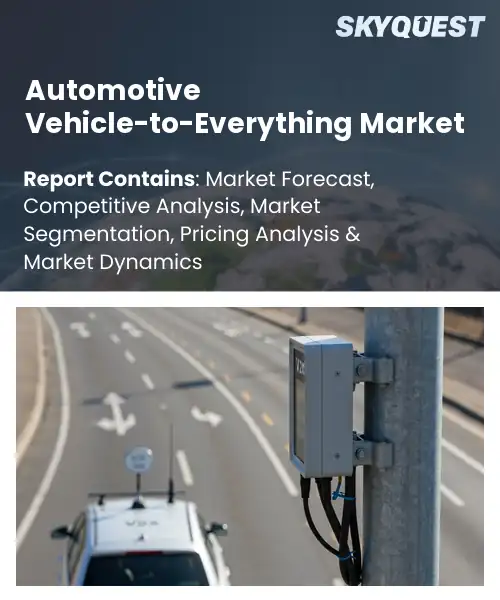
Automotive Vehicle-to-Everything Market
Report ID: SQMIG25A2665
Report ID: SQMIG25A2665
[email protected]
USA +1 351-333-4748
Report ID:
SQMIG25A2665 |
Region:
Global |
Published Date: May, 2026
Pages:
157
|Tables:
184
|Figures:
79


Global Automotive Vehicle-To-Everything Market size was valued at USD 4.3 Billion in 2024 and is poised to grow from USD 5.95 Billion in 2025 to USD 80.11 Billion by 2033, growing at a CAGR of 38.4% during the forecast period (2026-2033).
The primary driver of the automotive vehicle-to-everything market as the urgent need to improve road safety and efficiency through connectivity, which has reshaped expectations for mobility and accelerated investment. The V2X market encompasses vehicle-to-vehicle, vehicle-to-infrastructure, vehicle-to-pedestrian and vehicle-to-network communications, enabling real-time data exchange to prevent collisions, optimize traffic and support autonomous functions. Over the last decade this market evolved from simple dedicated short-range communications pilots into multi-protocol deployments incorporating cellular V2X and 5G, exemplified by smart city projects in Europe and cooperative adaptive cruise control trials in Japan and a growing ecosystem of suppliers.
Building on these technological foundations, regulatory alignment and spectrum allocation act as a key trend driving the global automotive vehicle-to-everything sector because coordinated policy reduces fragmentation and allows economies of scale, which in turn lowers hardware costs and accelerates deployment across fleets. OEMs integrating V2X into passenger cars and commercial trucks enable platooning and intersection management use cases that cut fuel consumption and delay times, while insurers and municipalities leverage aggregated telemetry to design dynamic pricing and adaptive traffic signals. Creating recurring revenue streams through 5G campus network investments and over-the-air updating ecosystems has led suppliers to invest in modular and scalable platforms that will allow them to capture a significant portion of the present market very quickly.
How Will AI Enhance Safety in the Automotive Vehicle-to-Everything Market?
AI will enhance safety in the vehicle to everything market by improving perception prediction and cooperative decision making. Key aspects include AI enabled sensor fusion that combines camera radar and V2X messages predictive models that anticipate road user behavior and intelligent orchestration between vehicles and infrastructure. In the current market many systems exchange basic safety messages and use rule based warnings. Adding AI brings context aware filtering prioritization and adaptive responses that reduce false alerts and speed correct actions. For instance AI can distinguish vulnerable road users from background clutter and help roadside units offer targeted warnings in complex urban scenes.
In June 2025, Qualcomm completed the acquisition of Autotalks bringing established V2X chipsets into its automotive platform and enabling tighter integration of AI powered safety functions with direct vehicle communication. This accelerates deployment of cooperative safety features and improves efficiency across the V2X ecosystem.
Market snapshot - (2026-2033)
Global Market Size
USD 4.3 Billion
Largest Segment
Vehicle-to-Vehicle Communication
Fastest Growth
Vehicle-to-Grid Communication
Growth Rate
38.4% CAGR
To get more insights on this market click here to Request a Free Sample Report
Global automotive vehicle-to-everything market is segmented by communication type, technology, component, vehicle type, application, end user and region. Based on communication type, the market is segmented into Vehicle-to-Vehicle Communication, Vehicle-to-Infrastructure Communication, Vehicle-to-Pedestrian Communication, Vehicle-to-Network Communication, Vehicle-to-Grid Communication, Vehicle-to-Home Communication and Others. Based on technology, the market is segmented into Dedicated Short-range Communication, Cellular V2X, 5G-based V2X, Wi-Fi-based V2X and Others. Based on component, the market is segmented into Hardware, Software and Services. Based on vehicle type, the market is segmented into Passenger Vehicles, Commercial Vehicles, Electric Vehicles and Autonomous Vehicles. Based on application, the market is segmented into Traffic Safety, Autonomous Driving, Fleet Management, Infotainment, Smart Parking, Emergency Vehicle Notification and Others. Based on end user, the market is segmented into Automotive OEMs, Fleet Operators, Government & Smart City Authorities, Transportation Service Providers and Others. Based on region, the market is segmented into North America, Europe, Asia Pacific, Latin America and Middle East & Africa.
Based on the global automotive vehicle-to-everything market growth, vehicle-to-vehicle communication segment dominates because it provides the most direct, low-latency exchange of critical safety and maneuvering data between nearby road users, forming the foundational layer for collision avoidance and cooperative driving. Its dominance is driven by industry prioritization of crash prevention, integration with ADAS ecosystems, standardized message sets, and OEM focus on interoperable vehicle behavior, which together accelerate deployment and build trust in connected vehicle interactions.
However, vehicle-to-infrastructure communication is the fastest growing area thanks to accelerating infrastructure upgrades and smart traffic management adoption. Deployment of roadside units and signal integration, supported by municipal and industry initiatives to optimize traffic flow and reduce congestion, is expanding use cases and unlocking new service models that extend V2X utility beyond individual vehicles.
5G-based V2X segment leads because it delivers ultra low latency, high bandwidth, and network capabilities that enable advanced cooperative perception, real time sensor sharing, and cloud assisted driving services, unlocking enhanced autonomy and rich infotainment. 5G operator investments, edge computing and network slicing support, and the OEM move to using cloud-native architecture are all drivers of integrated ecosystems and will allow operators to create new mobility business models.
Conversely, cellular V2X is witnessing the strongest growth momentum due to its compatibility with existing cellular networks and pragmatic upgrade path for vehicle fleets. Continued enhancements to LTE based V2X standards, broad vendor support, and incremental deployment models enable widespread uptake among OEMs and fleet operators, catalyzing scalable V2X services and practical rollout opportunities.
To get detailed segments analysis, Request a Free Sample Report
As per the global automotive vehicle-to-everything market share, Asia Pacific dominates the industry due to a convergence of manufacturing strength, advanced telecommunications infrastructure and proactive policy frameworks that accelerate deployment. The region's major original equipment manufacturers (OEMs) and top suppliers are focused on developing integrated connected and safety technologies, backed up by a dense automotive electronics supply chain coupled with strong cooperation among industry, academics and research institutions. Rapidly growing urban populations and high consumer acceptance of connected mobility result in a significant amount of demand for cross-platform interoperable technologies. Investments in high speed wireless networks, as well as pilot projects on smart corridors, serve to reinforce these technologies and companies' positions as leaders in the market. Harmonization of regulations across critical geographic markets, coupled with a supply base that is export-focused, allow for rapid scaling and cross-market adoption of vehicle-to-everything solutions.
Automotive vehicle-to-everything market in Japan leverages deep automotive engineering capabilities and advanced telecommunications leadership to advance vehicle-to-everything solutions. Domestic OEMs, electronics suppliers and research institutions collaborate through focused trials and standards work. Government programmes and urban mobility initiatives stress safety and interoperability while resilient domestic demand for connected vehicles supports commercialization. Japan benefits from mature supplier networks and a pragmatic innovation culture that facilitates deployment across passenger and commercial vehicle segments.
Automotive vehicle-to-everything market in South Korea capitalizes on leadership in semiconductor manufacturing, high-speed wireless networks and a dynamic mobility startup ecosystem to drive vehicle-to-everything advancement. Prototyping and systems integration will benefit from collaboration between manufacturers and their leading suppliers and technology partners. Initiatives on a national scale are prioritizing connected mobility and promoting traffic efficiency. The ability to develop prototype or production-ready vehicles will be supported by continued public and private investment funding priorities and a growing pool of highly-skilled engineering talent across both passenger and commercial vehicle applications.
Based on global automotive vehicle-to-everything regional forecast, North America is experiencing rapid expansion in the industry driven by a confluence of technology innovation, strong private investment and robust commercialization pathways. The vehicle-to-everything integration will benefit from the software and semiconductor sectors and the established automotive manufacturing with the expanding mobility services sector. Regulatory attention to road safety and data governance, along with targeted infrastructure initiatives, stimulates partnerships among OEMs, suppliers, city authorities and telecom operators. Advanced pilot programmes in urban and highway contexts demonstrate operational benefits and reduce barriers to adoption. Flexible funding mechanisms, active venture ecosystems and aftermarket supplier networks accelerate commercialization and enable cross-border scale between the United States and Canada.
Automotive vehicle-to-everything market in United States benefits from a dense ecosystem of software developers, semiconductor manufacturers and mobility service providers that drive innovation. Collaboration between OEMs, technology firms and municipal authorities supports trials and deployment strategies focused on safety and congestion management. A venture landscape and supplier base facilitate commercialization of hardware and software platforms. Integration of passenger and commercial vehicles will be influenced by emphasis on interoperability, over-the-air (OTA) updates, and data-driven services.
Automotive vehicle-to-everything market in Canada features collaborative initiatives between OEMs, technology providers and authorities to advance connected mobility solutions. The focus on safe driving and connecting different types of roads between cities (urban) and rural areas, as well as having the same standards for vehicles, and helping to create a safe and connected driving environment, encourages testing different technologies within a variety of different roadways. A strong and successful supply chain provides the necessary backbone to commercializing the use of these new technologies.
As per global automotive vehicle-to-everything regional outlook, Europe is strengthening its position in the industry through coordinated regulatory action, strong automotive manufacturing capabilities and cross-border infrastructure initiatives. Safety-critical systems and their robust integration into automotive platforms are a key focus of collaboration between automakers (OEMs), engineering firms and research institutes. Additionally, the development of national and regional infrastructure provides testing grounds to validate interoperability among multiple systems/technologies, irrespective of the specific conditions in which they are operating. Supporting scalable commercialization in both domestic and international markets broadly, strong emphasis is also placed on engineering quality, establishing long-term relationships with suppliers, and developing an export-oriented product.
Automotive vehicle-to-everything market in Germany builds on a deep automotive manufacturing base and comprehensive supplier ecosystem to advance vehicle-to-everything solutions. Collaboration between OEMs and engineering firms and research institutes centers around building safe and reliable systems for vehicles, including their integration into the vehicle platform. Generally, National and regional infrastructure projects create test beds for developing vehicle interoperability in a variety of conditions. With a focus on engineering excellence, nurturing long-term relationships with suppliers and an export-driven focus of development.
Automotive vehicle-to-everything market in United Kingdom emphasizes interoperability, urban mobility integration and partnerships between technology firms and transport authorities. Focus on smart city initiatives and multimodal transport solutions creates practical use cases for vehicle-to-everything deployment. Collaborative testing programmes and funding frameworks encourage demonstrations that highlight safety and congestion benefits. A strong software and services sector complements vehicle manufacturing capabilities, enabling solutions that can be integrated into fleets and municipal transport systems.
Automotive vehicle-to-everything market in France advances vehicle-to-everything through strong ties between automotive manufacturers, telecom operators and public research organisations. National initiatives focus on integrating connectivity into broader mobility strategies, including urban traffic management and fleet optimisation. Increased focus on security, standardisation, and safe communication is making it easier for different parts of the industry to work together. Various technology companies are joining together around a common technology to work as a group to set research into a form that can be put into production and then when purchased by transport operators creates a route for their commercial use.
To know more about the market opportunities by region and country, click here to
Buy The Complete Report
Expansion Of Connected Infrastructure
Advancements In Communication Standards
High Implementation and Integration Complexity
Data Privacy and Security Concerns
Request Free Customization of this report to help us to meet your business objectives.
The competitive landscape in global automotive vehicle-to-everything market outlook is defined by M&A, corporate venture investments, and supplier and OEM partnerships that accelerate C-V2X standard adoption and integrated safety stacks; regulatory mandates and OEM demand for certified low-latency connectivity are key market drivers, exemplified by Qualcomm’s acquisition of Autotalks, Brembo’s investment in Spoke Safety, and Bosch collaborations with V2X specialists.
Top Player’s Company Profile
Recent Developments
SkyQuest’s ABIRAW (Advanced Business Intelligence, Research & Analysis Wing) is our Business Information Services team that Collects, Collates, Correlates, and Analyses the Data collected by means of Primary Exploratory Research backed by robust Secondary Desk research.
As per SkyQuest analysis, the global automotive vehicle-to-everything industry is propelled primarily by the urgent need to improve road safety and efficiency through connectivity, driving investment in real time communication and collision avoidance. However high implementation and integration complexity across fragmented vehicle architectures and legacy systems remains a major restraint that slows rollout. Asia Pacific leads the global market due to manufacturing depth and advanced telecom infrastructure while vehicle-to-vehicle communication dominates as the foundational low latency safety layer. Regulatory alignment and spectrum allocation act as a second key driver by reducing fragmentation and enabling economies of scale that lower costs and accelerate commercial deployment.
| Report Metric | Details |
|---|---|
| Market size value in 2024 | USD 4.3 Billion |
| Market size value in 2033 | USD 80.11 Billion |
| Growth Rate | 38.4% |
| Base year | 2024 |
| Forecast period | (2026-2033) |
| Forecast Unit (Value) | USD Billion |
| Segments covered |
|
| Regions covered | North America (US, Canada), Europe (Germany, France, United Kingdom, Italy, Spain, Rest of Europe), Asia Pacific (China, India, Japan, Rest of Asia-Pacific), Latin America (Brazil, Rest of Latin America), Middle East & Africa (South Africa, GCC Countries, Rest of MEA) |
| Companies covered |
|
| Customization scope | Free report customization with purchase. Customization includes:-
|
To get a free trial access to our platform which is a one stop solution for all your data requirements for quicker decision making. This platform allows you to compare markets, competitors who are prominent in the market, and mega trends that are influencing the dynamics in the market. Also, get access to detailed SkyQuest exclusive matrix.
Table Of Content
Executive Summary
Market overview
Parent Market Analysis
Market overview
Market size
KEY MARKET INSIGHTS
COVID IMPACT
MARKET DYNAMICS & OUTLOOK
Market Size by Region
KEY COMPANY PROFILES
Methodology
For the Automotive Vehicle-to-Everything Market, our research methodology involved a mixture of primary and secondary data sources. Key steps involved in the research process are listed below:
1. Information Procurement: This stage involved the procurement of Market data or related information via primary and secondary sources. The various secondary sources used included various company websites, annual reports, trade databases, and paid databases such as Hoover's, Bloomberg Business, Factiva, and Avention. Our team did 45 primary interactions Globally which included several stakeholders such as manufacturers, customers, key opinion leaders, etc. Overall, information procurement was one of the most extensive stages in our research process.
2. Information Analysis: This step involved triangulation of data through bottom-up and top-down approaches to estimate and validate the total size and future estimate of the Automotive Vehicle-to-Everything Market.
3. Report Formulation: The final step entailed the placement of data points in appropriate Market spaces in an attempt to deduce viable conclusions.
4. Validation & Publishing: Validation is the most important step in the process. Validation & re-validation via an intricately designed process helped us finalize data points to be used for final calculations. The final Market estimates and forecasts were then aligned and sent to our panel of industry experts for validation of data. Once the validation was done the report was sent to our Quality Assurance team to ensure adherence to style guides, consistency & design.
Analyst Support
Customization Options
With the given market data, our dedicated team of analysts can offer you the following customization options are available for the Automotive Vehicle-to-Everything Market:
Product Analysis: Product matrix, which offers a detailed comparison of the product portfolio of companies.
Regional Analysis: Further analysis of the Automotive Vehicle-to-Everything Market for additional countries.
Competitive Analysis: Detailed analysis and profiling of additional Market players & comparative analysis of competitive products.
Go to Market Strategy: Find the high-growth channels to invest your marketing efforts and increase your customer base.
Innovation Mapping: Identify racial solutions and innovation, connected to deep ecosystems of innovators, start-ups, academics, and strategic partners.
Category Intelligence: Customized intelligence that is relevant to their supply Markets will enable them to make smarter sourcing decisions and improve their category management.
Public Company Transcript Analysis: To improve the investment performance by generating new alpha and making better-informed decisions.
Social Media Listening: To analyze the conversations and trends happening not just around your brand, but around your industry as a whole, and use those insights to make better Marketing decisions.
REQUEST FOR SAMPLE
 REQUEST FREE CUSTOMIZATION
Global Automotive Vehicle-To-Everything Market size was valued at USD 4.3 Billion in 2024 and is poised to grow from USD 5.95 Billion in 2025 to USD 80.11 Billion by 2033, growing at a CAGR of 38.4% during the forecast period (2026-2033).
The competitive landscape in global automotive V2X is defined by M&A, corporate venture investments, and supplier and OEM partnerships that accelerate C-V2X standard adoption and integrated safety stacks; regulatory mandates and OEM demand for certified low-latency connectivity are key market drivers, exemplified by Qualcomm’s acquisition of Autotalks, Brembo’s investment in Spoke Safety, and Bosch collaborations with V2X specialists. 'Qualcomm', 'Huawei Technologies', 'Continental', 'Bosch', 'Denso Corporation', 'Harman International', 'NXP Semiconductors', 'Intel', 'Cisco Systems', 'LG Electronics', 'Autotalks', 'Cohda Wireless', 'Commsignia', 'Ericsson', 'Infineon Technologies', 'Mitsubishi Electric', 'Thales Group', 'ZF Friedrichshafen', 'Quectel Wireless Solutions', 'Savari'
The expansion of roadside units, traffic management systems, and urban connectivity infrastructure enhances the practical utility of vehicle-to-everything solutions by enabling more reliable communications and broader geographic coverage. This connectivity reduces communication gaps, supports lower latency interactions, and allows vehicles to access contextual data essential for cooperative driving and traffic optimization. As cities and transportation authorities deploy interoperable platforms, ecosystem participants find clearer value propositions, stimulating investment from automotive manufacturers and service providers and encouraging coordinated deployment strategies that support market growth.
Connectivity Monetization Strategies: Automotive stakeholders are increasingly shifting from hardware-centric business models to recurring revenue streams driven by connected services. OEMs, tier suppliers and software providers collaborate to offer tailored subscription packages, OTA updates and data-driven value-added features that extend vehicle lifecycles and customer engagement. Strategic partnerships across industries enable bundled mobility, entertainment and maintenance services while flexible pricing and modular architectures facilitate customer choice. This trend accelerates platform-centric thinking and redefines aftermarket revenue pools through continuous service innovation and ecosystem orchestration globally.
Why does Asia Pacific Dominate the Global Automotive Vehicle-to-Everything Market? |@12


Want to customize this report? This report can be personalized according to your needs. Our analysts and industry experts will work directly with you to understand your requirements and provide you with customized data in a short amount of time. We offer $1000 worth of FREE customization at the time of purchase.
Feedback From Our Clients


 USA (+1) 351-333-4748

