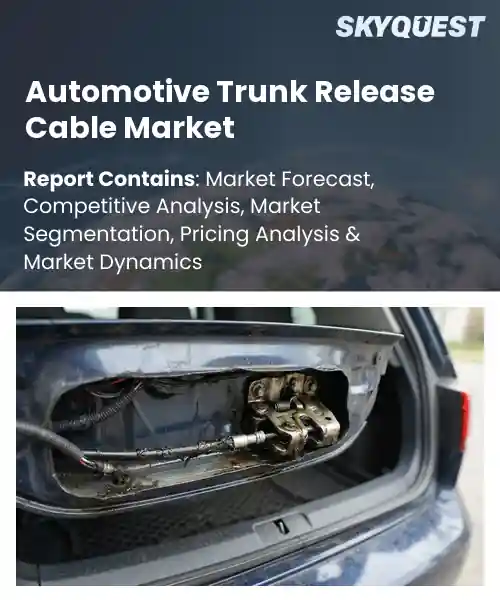
Automotive Trunk Release Cable Market
Report ID: SQMIG25A2931
Report ID: SQMIG25A2931
[email protected]
USA +1 351-333-4748
Report ID:
SQMIG25A2931 |
Region:
Global |
Published Date: August, 2026
Pages:
157
|Tables:
151
|Figures:
78


Global Automotive Trunk Release Cable Market size was valued at USD 2.84 Billion in 2024 and is poised to grow from USD 3.02 Billion in 2025 to USD 4.89 Billion by 2033, growing at a CAGR of 6.2% during the forecast period (2026-2033).
Automotive trunk release cables are components that link an interior release switch to the latch of a rear door or hatch, enabling occupants to open the cargo compartment without leaving the cabin. This market has grown alongside the trend toward convenience‑focused vehicle interiors, as manufacturers seek to differentiate models through features. Early examples can be seen in sedans of the 1990s, where pull‑type levers gave way to button‑activated cables, and the shift accelerated with the rise of electric‑actuated trunks in crossovers. The evolution reflects consumer demand for access, pressure for safety, and the integration of control modules across vehicle platforms. The growth engine for the trunk release cable market is the integration of assistance technologies that require actuation of access mechanisms. When manufacturers place sensors and cameras inside the cargo space to enable parking aid or rear‑view monitoring, the cable must convey signals instantly and endure frequent cycles, prompting suppliers to introduce stronger alloys and diagnostics. This shift creates partnership opportunities for Tier‑one firms and OEMs, exemplified by a project in which a European automaker adopted a smart cable that warns of obstructions before opening. As autonomous features become mandatory in regions, demand for these cables rises, driving market expansion.
How is IoT integration influencing the automotive trunk release cable market?
IoT integration is reshaping the automotive trunk release cable market by turning a simple mechanical link into a connected component. Sensors embedded in the cable communicate with the vehicle’s telematics unit, allowing drivers to open the trunk from a smartphone or voice assistant. This connectivity supports remote diagnostics, so manufacturers can detect wear before failure and schedule service proactively. OEMs are embedding firmware that can be updated over the air, reducing the need for physical recalls. Aftermarket suppliers are adding wireless modules that retrofit existing cables, expanding the addressable market and improving overall vehicle convenience.In March 2024, a leading vehicle manufacturer launched a connected trunk release cable that integrates with its infotainment platform, enabling users to trigger opening through the mobile app. This rollout illustrates how IoT features are driving adoption and streamlining the user experience while reducing maintenance visits for owners.
Market snapshot - (2026-2033)
Global Market Size
USD 2.84 Billion
Largest Segment
Mechanical Trunk Release Cables
Fastest Growth
Electronic Trunk Release Cables
Growth Rate
6.2% CAGR
To get more insights on this market click here to Request a Free Sample Report
Global automotive trunk release cable market is segmented by cable type, vehicle type, mechanism, application, end user and region. Based on cable type, the market is segmented into Mechanical Trunk Release Cables, Electronic Trunk Release Cables, Bowden Cables, Push-Pull Cables and Others. Based on vehicle type, the market is segmented into Passenger Cars, Light Commercial Vehicles, Heavy Commercial Vehicles, Electric Vehicles and Others. Based on mechanism, the market is segmented into Manual Release, Remote Release, Electric Release and Keyless Release. Based on application, the market is segmented into Trunk Lids, Tailgates, Liftgates and Other Rear Closure Systems. Based on end user, the market is segmented into Automotive OEMs, Automotive Tier 1 Suppliers, Automotive Aftermarket and Others. Based on region, the market is segmented into North America, Europe, Asia Pacific, Latin America and Middle East & Africa.
Mechanical Trunk Release Cables segment dominates because its proven reliability and low cost make it the preferred choice for volume vehicle manufacturers. The straightforward design integrates easily with existing chassis architectures, reducing engineering complexity and warranty risk. Car makers prioritize durability under diverse load conditions, and mechanical cables satisfy these requirements while supporting high production speeds, reinforcing their market leadership across global supply chains and aftermarket support networks today overall.
However, Electronic Trunk Release Cables segment is witnessing the strongest growth momentum because automakers embed smart connectivity and remote actuation into vehicle exteriors. Advances in low power actuation modules and seamless CAN integration fuel demand, while consumer expectations for keyless convenience drive adoption. This creates design opportunities and expands future market size.
Electric Vehicles segment leads because its zero‑emission propulsion demands compact, lightweight rear closure solutions that minimize overall vehicle mass. Designers prioritize integrated release mechanisms that do not interfere with battery packaging, prompting cable engineers to develop minimalist, corrosion‑resistant systems. The need for high efficiency and reduced maintenance aligns with EV platform strategies, cementing this segment’s leadership in shaping cable specifications across multiple model generations and supporting diverse charging infrastructures worldwide.
Meanwhile, Light Commercial Vehicles segment is witnessing the fastest expansion because fleet operators seek versatile rear access for cargo loading and unloading. Emerging telematics platforms integrate remote trunk release functions, prompting manufacturers to adopt robust cables that accommodate higher payload cycles. This trend accelerates market penetration and creates new value propositions for commercial vehicle suppliers.
To get detailed segments analysis, Request a Free Sample Report
Asia Pacific dominates due to strong manufacturing ecosystems, high adoption of advanced vehicle technologies, and deep supplier networks. Original equipment manufacturers in the region integrate trunk release solutions early in design cycles, leveraging cost‑effective production capabilities. Consumer demand for convenience features in compact and premium cars fuels sustained volume. Government incentives for safety and lightweight components accelerate component innovation, while a skilled workforce ensures rapid prototyping and scale. In addition, regional trade agreements reduce tariff barriers, enabling smoother cross‑border supply flows. Collaborative research institutions provide continuous improvements in cable materials, enhancing durability and reducing weight. The combined effect of cost efficiency, technological depth, and supportive policy environment consolidates Asia Pacific’s pre‑eminence in the global automotive trunk release cable landscape.
Automotive Trunk Release Cable Market in Japan benefits from a heritage of precision engineering and a dense network of tier‑one suppliers. Local manufacturers emphasize high reliability and compact design to suit both domestic compact models and export‑oriented platforms. Close collaboration between component producers and vehicle assemblers accelerates integration of new actuation mechanisms, while stringent safety standards drive continuous refinement of cable performance and durability through systematic testing protocols and feedback loops.
Automotive Trunk Release Cable Market in South Korea is propelled by a vibrant automotive component sector that prioritizes rapid innovation and cost competitiveness. Domestic OEMs integrate advanced cable systems to support a growing portfolio of SUVs and electric models, reflecting consumer preference for versatile storage solutions. Strong government support for smart vehicle technologies encourages investment in lightweight actuation components, while close supplier relationships enable swift adaptation to evolving design requirements.
North America experiences rapid expansion of the automotive trunk release cable market due to heightened consumer expectations for convenience and safety across a broad vehicle mix. OEMs in the United States and Canada embed sophisticated release mechanisms to meet regulatory emphasis on easy egress and to differentiate premium offerings. The shift toward larger crossovers and electric vehicles creates demand for robust, lightweight cable assemblies that accommodate reconfigured cargo spaces. Collaborative engineering ecosystems foster integration of electronic controls with mechanical cables, delivering smart release functions. Meanwhile, strong aftermarket infrastructure supports replacement and upgrade cycles, reinforcing sustained market momentum. In addition, rising focus on vehicle weight reduction encourages manufacturers to adopt high‑strength, low‑profile cable designs, while sustainability initiatives promote recyclable material use throughout the supply chain, further amplifying market growth.
Automotive Trunk Release Cable Market in United States thrives on a mature automotive ecosystem that balances high‑volume production with cutting‑edge technology adoption. Tier‑one suppliers collaborate closely with a diverse set of OEMs to deliver cables that satisfy stringent durability standards and integrate with advanced infotainment systems, while growing demand for electric crossovers prompts development of compact, high‑strength cable solutions, while a robust aftermarket network sustains demand for replacements and upgrades.
Automotive Trunk Release Cable Market in Canada benefits from an emphasis on safety compliance and a preference for versatile vehicle platforms. Local manufacturers align with North American OEM standards to produce cables that meet rigorous durability testing while incorporating lightweight materials suited to cold performance. Collaboration with institutes accelerates adoption of smart release technologies, and an expanding dealer network ensures availability of OEM‑approved components for new builds and service operations.
Europe strengthens its position in the automotive trunk release cable market through a combination of rigorous engineering standards, collaborative innovation networks, and a focus on sustainable product development. Leading manufacturers in Germany, United Kingdom and France integrate advanced material sciences to produce cables that deliver high performance while reducing weight and environmental impact. Harmonized regulatory frameworks promote safety and reliability, encouraging OEMs to adopt uniform specifications across the continent. Strong emphasis on electrification and modular vehicle architectures drives demand for adaptable cable solutions that can be easily reconfigured for varying cargo configurations. Additionally, deep expertise in precision machining and a well‑established aftermarket ensure continuous supply of high‑quality replacements, reinforcing Europe’s reputation as a hub for durable and technologically advanced trunk release components.
Automotive Trunk Release Cable Market in Germany is driven by a legacy of precision engineering and a dense cluster of automotive suppliers that emphasize reliability and advanced functionality. German OEMs demand cable assemblies that meet stringent durability criteria while supporting integration with electronic control units for smart release features. Ongoing collaboration with research institutes accelerates adoption of high‑strength alloys and lightweight composites, reinforcing the market’s commitment to performance and sustainability.
Automotive Trunk Release Cable Market in United Kingdom benefits from ties between component makers and a vehicle manufacturing base that values interior solutions. UK suppliers focus on delivering cables with high tensile strength and corrosion resistance to suit both passenger cars and commercial vans. Emphasis on prototyping and design tools enables swift adaptation to safety standards, while partnerships with academic centers foster innovation in smart actuation and lightweight material usage.
Automotive Trunk Release Cable Market in France is shaped by an automotive heritage and a focus on luxury vehicles that demand refined interior components. French manufacturers prioritize cable designs that combine elegance with durability, often integrating finishes that complement cabin environments. Collaboration with European research networks promotes use of innovative alloys and polymer blends, while a robust aftermarket ensures availability of compliant replacement parts for both new and older models.
To know more about the market opportunities by region and country, click here to
Buy The Complete Report
Increasing Vehicle Safety Standards
Adoption Of Lightweight Materials
High Production Cost Concerns
Complex Integration With Vehicle Systems
Request Free Customization of this report to help us to meet your business objectives.
The competitive landscape is shaped by OEMs forming strategic alliances with cable specialists and pursuing technology integration to meet higher safety standards, while several manufacturers are consolidating through acquisitions to broaden product portfolios and streamline supply chains, driving faster time‑to‑market for advanced trunk release cable solutions.
Top Player’s Company Profile
Recent Developments
SkyQuest’s ABIRAW (Advanced Business Intelligence, Research & Analysis Wing) is our Business Information Services team that Collects, Collates, Correlates, and Analyses the Data collected by means of Primary Exploratory Research backed by robust Secondary Desk research. As per SkyQuest analysis the global automotive trunk release cable market is being propelled primarily by rising vehicle safety standards that push OEMs to adopt reliable release mechanisms, while the rapid shift toward lightweight materials offers a second boost by encouraging lighter yet durable cable designs. The mechanical trunk release cable segment remains dominant because of its proven cost‑effectiveness and ease of integration. However, high production costs present a restraint, especially for premium electronic solutions. Asia Pacific leads the market thanks to its strong manufacturing ecosystem and early technology adoption, reinforcing the region’s pivotal role in market growth.
| Report Metric | Details |
|---|---|
| Market size value in 2024 | USD 2.84 Billion |
| Market size value in 2033 | USD 4.89 Billion |
| Growth Rate | 6.2% |
| Base year | 2024 |
| Forecast period | (2026-2033) |
| Forecast Unit (Value) | USD Billion |
| Segments covered |
|
| Regions covered | North America (US, Canada), Europe (Germany, France, United Kingdom, Italy, Spain, Rest of Europe), Asia Pacific (China, India, Japan, Rest of Asia-Pacific), Latin America (Brazil, Rest of Latin America), Middle East & Africa (South Africa, GCC Countries, Rest of MEA) |
| Companies covered |
|
| Customization scope | Free report customization with purchase. Customization includes:-
|
To get a free trial access to our platform which is a one stop solution for all your data requirements for quicker decision making. This platform allows you to compare markets, competitors who are prominent in the market, and mega trends that are influencing the dynamics in the market. Also, get access to detailed SkyQuest exclusive matrix.
Table Of Content
Executive Summary
Market overview
Parent Market Analysis
Market overview
Market size
KEY MARKET INSIGHTS
COVID IMPACT
MARKET DYNAMICS & OUTLOOK
Market Size by Region
KEY COMPANY PROFILES
Methodology
For the Automotive Trunk Release Cable Market, our research methodology involved a mixture of primary and secondary data sources. Key steps involved in the research process are listed below:
1. Information Procurement: This stage involved the procurement of Market data or related information via primary and secondary sources. The various secondary sources used included various company websites, annual reports, trade databases, and paid databases such as Hoover's, Bloomberg Business, Factiva, and Avention. Our team did 45 primary interactions Globally which included several stakeholders such as manufacturers, customers, key opinion leaders, etc. Overall, information procurement was one of the most extensive stages in our research process.
2. Information Analysis: This step involved triangulation of data through bottom-up and top-down approaches to estimate and validate the total size and future estimate of the Automotive Trunk Release Cable Market.
3. Report Formulation: The final step entailed the placement of data points in appropriate Market spaces in an attempt to deduce viable conclusions.
4. Validation & Publishing: Validation is the most important step in the process. Validation & re-validation via an intricately designed process helped us finalize data points to be used for final calculations. The final Market estimates and forecasts were then aligned and sent to our panel of industry experts for validation of data. Once the validation was done the report was sent to our Quality Assurance team to ensure adherence to style guides, consistency & design.
Analyst Support
Customization Options
With the given market data, our dedicated team of analysts can offer you the following customization options are available for the Automotive Trunk Release Cable Market:
Product Analysis: Product matrix, which offers a detailed comparison of the product portfolio of companies.
Regional Analysis: Further analysis of the Automotive Trunk Release Cable Market for additional countries.
Competitive Analysis: Detailed analysis and profiling of additional Market players & comparative analysis of competitive products.
Go to Market Strategy: Find the high-growth channels to invest your marketing efforts and increase your customer base.
Innovation Mapping: Identify racial solutions and innovation, connected to deep ecosystems of innovators, start-ups, academics, and strategic partners.
Category Intelligence: Customized intelligence that is relevant to their supply Markets will enable them to make smarter sourcing decisions and improve their category management.
Public Company Transcript Analysis: To improve the investment performance by generating new alpha and making better-informed decisions.
Social Media Listening: To analyze the conversations and trends happening not just around your brand, but around your industry as a whole, and use those insights to make better Marketing decisions.
REQUEST FOR SAMPLE
 REQUEST FREE CUSTOMIZATION


Want to customize this report? This report can be personalized according to your needs. Our analysts and industry experts will work directly with you to understand your requirements and provide you with customized data in a short amount of time. We offer $1000 worth of FREE customization at the time of purchase.
Feedback From Our Clients


 USA (+1) 351-333-4748

