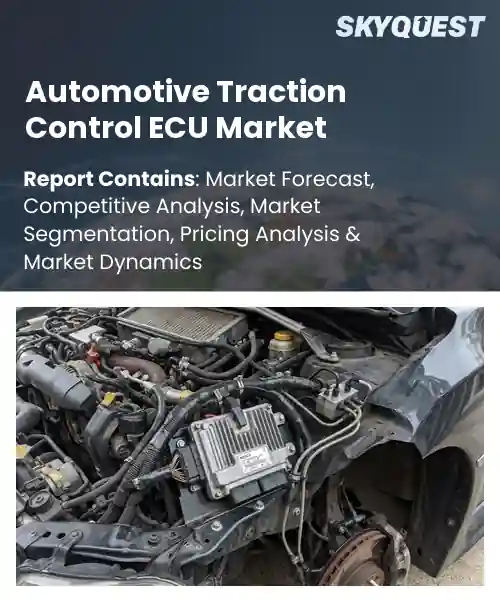
Automotive Traction Control ECU Market
Report ID: SQMIG25A2936
Report ID: SQMIG25A2936
[email protected]
USA +1 351-333-4748
Report ID:
SQMIG25A2936 |
Region:
Global |
Published Date: August, 2026
Pages:
157
|Tables:
142
|Figures:
78


Global Automotive Traction Control Ecu Market size was valued at USD 9.42 Billion in 2024 and is poised to grow from USD 10.23 Billion in 2025 to USD 19.8 Billion by 2033, growing at a CAGR of 8.6% during the forecast period (2026-2033).
Building on the regulatory foundation, the next decisive factor for the traction‑control ECU market is the convergence of electrification and autonomous driving, which drives demand for torque‑management. Electric powertrains deliver instantaneous torque, making slip control essential to preserve battery efficiency and avoid wheel spin; manufacturers such as BYD and Volkswagen therefore integrate dedicated ECUs that link to vehicle networks. Autonomous functions like lane‑keeping and emergency‑braking also depend on accurate traction data, so suppliers offering scalable, software‑defined ECUs gain a edge. Consequently, investment in modular hardware and over‑the‑air update capability becomes a lucrative opportunity, allowing OEMs to retrofit legacy models and accelerate safety‑suite rollouts.
How are AI and IoT technologies reshaping the automotive traction control ECU market?
AI and IoT are turning traction control ECUs into smart nodes that sense wheel slip, process vehicle dynamics and communicate with other vehicle systems. The sensors feed real‑time data to embedded AI models that predict loss of traction before it occurs. The models adjust brake pressure and engine torque instantly, delivering smoother handling. IoT connectivity lets the ECU receive over‑the‑air software updates, integrate with cloud analytics and share performance metrics with service centers. This continuous learning loop reduces warranty claims and shortens development cycles. As vehicles become more electrified, the demand for adaptive, data‑rich control units rises, reshaping the market landscape.In March 2024 a leading automotive supplier launched an AI driven IoT enabled traction control ECU that optimizes torque distribution in real time and shortens response latency, boosting efficiency and supporting market growth.
Market snapshot - (2026-2033)
Global Market Size
USD 9.42 Billion
Largest Segment
Passenger Vehicles
Fastest Growth
Light Commercial Vehicles
Growth Rate
8.6% CAGR
To get more insights on this market click here to Request a Free Sample Report
Global automotive traction control ecu market is segmented by vehicle type, propulsion type, technology, application, sales channel and region. Based on vehicle type, the market is segmented into Passenger Vehicles, Light Commercial Vehicles and Heavy Commercial Vehicles. Based on propulsion type, the market is segmented into Internal Combustion Engine Vehicles, Hybrid Electric Vehicles and Battery Electric Vehicles. Based on technology, the market is segmented into Hydraulic-Based Traction Control and Electronic Traction Control. Based on application, the market is segmented into Front-Wheel Drive, Rear-Wheel Drive and All-Wheel Drive. Based on sales channel, the market is segmented into OEM and Aftermarket. Based on region, the market is segmented into North America, Europe, Asia Pacific, Latin America and Middle East & Africa.
Passenger vehicles segment dominates because manufacturers prioritize comfort and safety features, making traction control ECUs a core component for enhancing vehicle stability. The high volume of passenger car production creates economies of scale, encouraging suppliers to focus development efforts on this market. As consumer expectations for seamless driving experience rise, demand for sophisticated traction management solutions intensifies, reinforcing the segment’s leadership. Regulatory safety standards also push OEMs to adopt these systems widely.
However, light commercial vehicles segment emerges as the most rapidly expanding area as e commerce logistics demand intensifies, prompting manufacturers to equip vans and small trucks with electronic traction control for load stability. This surge drives new ECU architectures tailored to variable payload conditions, opening fresh growth opportunities and encourages suppliers to prioritize modular designs for quick integration.
Battery electric vehicles segment dominates because the absence of a conventional engine requires precise torque management, making traction control ECUs essential for delivering smooth acceleration and regenerative braking coordination. Automakers integrate advanced control strategies to maximize efficiency and extend driving range, prompting suppliers to invest heavily in software and sensor fusion capabilities. The push toward zero emission mobility further cements this segment’s pre eminence in the market.
On the other hand, hybrid electric vehicles segment witnesses the strongest growth momentum as manufacturers blend internal combustion and electric powertrains, creating a need for dual mode traction control solutions. The transitional market status drives demand for ECUs capable of seamless mode switching, stimulating innovation and expanding the addressable customer base across a wide range of vehicle classes.
To get detailed segments analysis, Request a Free Sample Report
Asia Pacific leads the global automotive traction control ECU market due to a confluence of advanced manufacturing capabilities, strong supplier ecosystems, and aggressive adoption of electronic safety systems by original equipment manufacturers. The region benefits from a deep pool of engineering talent and a culture of continuous innovation, enabling rapid development of high‑performance control units. Close collaboration between tier‑one suppliers and vehicle makers accelerates product integration, while supportive regulatory frameworks encourage the inclusion of traction control features across vehicle segments. Additionally, the presence of major automotive hubs fosters economies of scale, reducing component costs and enhancing competitiveness in export markets. These factors collectively reinforce Asia Pacific’s position as the dominant force shaping technology standards and market dynamics worldwide for global.
Automotive Traction Control ECU Market in Japan is driven by a legacy of precision engineering and a robust supplier network that emphasizes quality and reliability. Domestic manufacturers prioritize integration of advanced control algorithms, supporting the nation’s focus on safety and performance. Strong collaboration between research institutions and automotive firms accelerates technology transfer, while government initiatives promote the adoption of electronic stability systems across passenger and commercial vehicle lines. This environment sustains a competitive edge in both local and export markets globally today.
Automotive Traction Control ECU Market in South Korea benefits from an integrated supply chain and emphasis on electronic innovation. Leading semiconductor manufacturers provide cutting‑edge components that enhance processing speed and reliability of traction control units. Collaborative R&D programs between automakers and technology firms foster prototyping, while domestic policies encourage deployment of driver assistance features across new vehicle models. This environment sustains a competitive edge in both local and export markets.
North America experiences rapid expansion of the automotive traction control ECU market fueled by a strong emphasis on vehicle safety, advanced driver assistance integration, and a mature automotive manufacturing base. Leading original equipment manufacturers prioritize electronic stability solutions to meet stringent safety expectations, prompting extensive adoption across passenger and commercial fleets. The region’s robust semiconductor sector supplies high‑performance microcontrollers, while a culture of innovation encourages continuous refinement of control algorithms. Collaborative ecosystems linking suppliers, research institutions, and technology firms accelerate time‑to‑market for next‑generation units. Additionally, consumer demand for reliable handling in diverse driving conditions reinforces market momentum, positioning North America as a key growth engine for traction control technologies. The regulatory environment also supports proactive safety standards, encouraging manufacturers to embed traction control as a standard feature across new vehicle lineups.
Automotive Traction Control ECU Market in the United States is propelled by a large fleet of advanced vehicles and a safety culture. Major automakers collaborate closely with domestic semiconductor firms to develop high‑precision control units that meet safety standards. Federal safety guidelines incentivize the inclusion of traction control across new models, while consumer expectations for performance and reliability drive adoption. This synergy sustains a dynamic ecosystem of innovation and production.
Automotive Traction Control ECU Market in Canada reflects an emphasis on safety regulations and a growing demand for electric and hybrid vehicles. Canadian manufacturers partner with European suppliers to integrate traction control solutions that enhance vehicle stability in varied climate conditions. Government incentives for clean‑energy transportation encourage the adoption of electronic systems, while research collaborations with universities drive improvement of control algorithms. This environment supports steady market growth and advancement.
Europe strengthens its position in the automotive traction control ECU market through a combination of stringent safety legislation, deep engineering expertise, and a collaborative industrial landscape. The region’s regulatory framework mandates advanced stability systems, prompting manufacturers to embed sophisticated traction control units across vehicle lineups. Renowned automotive engineering hubs in Germany, the United Kingdom, and France foster continuous innovation, leveraging high‑precision manufacturing and cutting‑edge software development. Strong ties between tier‑one suppliers, research universities, and technology clusters accelerate the transfer of emerging algorithms and sensor integration techniques. Moreover, a growing emphasis on electric mobility drives the adaptation of traction control solutions to new powertrain architectures, ensuring Europe remains at the forefront of safety‑centric vehicle technology. Collaborative standards bodies also play a pivotal role in harmonizing specifications, facilitating cross‑border component compatibility and fostering a unified market approach across the continent.
Automotive Traction Control ECU Market in Germany is anchored by engineering firms and a network of precision component suppliers. German automakers prioritize integration of high‑performance control units to meet rigorous safety standards and consumer expectations for handling excellence. Close cooperation with research institutes accelerates development of advanced algorithms, while the country’s strong automotive manufacturing base ensures scale‑up of production. This ecosystem sustains Germany’s leadership in delivering reliable traction control solutions.
Automotive Traction Control ECU Market in the United Kingdom benefits from a heritage of research and a supplier community. British manufacturers focus on integrating traction control units that complement assistance technologies. Partnerships with universities and technology parks accelerate innovation in sensor fusion and algorithmic precision. Government initiatives supporting vehicle development encourage the adoption of control systems. This environment reinforces the United Kingdom’s role as a contributor to traction control advancements.
Automotive Traction Control ECU Market in France is driven by a blend of heritage and a focus on mobility solutions. French manufacturers integrate traction control units that align with stringent European safety directives and electric vehicle platforms. Collaboration with research agencies and engineering firms accelerates development of lightweight control modules. Incentives for low‑emission vehicles stimulate demand, positioning France as a player in the evolution of traction control technology across the continent.
To know more about the market opportunities by region and country, click here to
Buy The Complete Report
Increasing Vehicle Safety Regulations
Growing Consumer Preference for Stability
High Development Cost Barriers
Stringent Emission Standards Impact
Request Free Customization of this report to help us to meet your business objectives.
The competitive landscape is shaped by aggressive M&A, strategic partnerships and rapid tech innovation as legacy ECU suppliers and new entrants vie for traction‑control dominance. Bosch accelerated its portfolio by acquiring a sensor‑fusion startup in 2023, while Continental sealed a joint‑development pact with a silicon‑chip maker to embed AI‑based slip detection in 2024. ZF launched a next‑generation, over‑the‑air‑updatable traction control ECU platform in early 2025, prompting rivals to fast‑track similar capabilities.
Top Player’s Company Profile
Recent Developments
SkyQuest’s ABIRAW (Advanced Business Intelligence, Research & Analysis Wing) is our Business Information Services team that Collects, Collates, Correlates, and Analyses the Data collected by means of Primary Exploratory Research backed by robust Secondary Desk research. As per SkyQuest analysis, the market is propelled primarily by increasing vehicle safety regulations that compel manufacturers to embed traction‑control ECUs across new models, while the high development cost barrier restrains smaller players from entering the space. Asia Pacific dominates the market thanks to its strong supply chain and early adoption of electronic safety systems, and passenger vehicles remain the largest segment due to volume and consumer demand for stability. A second driver is the convergence of electrification and autonomous driving, which pushes demand for AI‑enabled, over‑the‑air updatable units that can manage instant torque in electric powertrains. This blend of regulatory push and technology convergence shapes growth.
| Report Metric | Details |
|---|---|
| Market size value in 2024 | USD 9.42 Billion |
| Market size value in 2033 | USD 19.8 Billion |
| Growth Rate | 8.6% |
| Base year | 2024 |
| Forecast period | (2026-2033) |
| Forecast Unit (Value) | USD Billion |
| Segments covered |
|
| Regions covered | North America (US, Canada), Europe (Germany, France, United Kingdom, Italy, Spain, Rest of Europe), Asia Pacific (China, India, Japan, Rest of Asia-Pacific), Latin America (Brazil, Rest of Latin America), Middle East & Africa (South Africa, GCC Countries, Rest of MEA) |
| Companies covered |
|
| Customization scope | Free report customization with purchase. Customization includes:-
|
To get a free trial access to our platform which is a one stop solution for all your data requirements for quicker decision making. This platform allows you to compare markets, competitors who are prominent in the market, and mega trends that are influencing the dynamics in the market. Also, get access to detailed SkyQuest exclusive matrix.
Table Of Content
Executive Summary
Market overview
Parent Market Analysis
Market overview
Market size
KEY MARKET INSIGHTS
COVID IMPACT
MARKET DYNAMICS & OUTLOOK
Market Size by Region
KEY COMPANY PROFILES
Methodology
For the Automotive Traction Control ECU Market, our research methodology involved a mixture of primary and secondary data sources. Key steps involved in the research process are listed below:
1. Information Procurement: This stage involved the procurement of Market data or related information via primary and secondary sources. The various secondary sources used included various company websites, annual reports, trade databases, and paid databases such as Hoover's, Bloomberg Business, Factiva, and Avention. Our team did 45 primary interactions Globally which included several stakeholders such as manufacturers, customers, key opinion leaders, etc. Overall, information procurement was one of the most extensive stages in our research process.
2. Information Analysis: This step involved triangulation of data through bottom-up and top-down approaches to estimate and validate the total size and future estimate of the Automotive Traction Control ECU Market.
3. Report Formulation: The final step entailed the placement of data points in appropriate Market spaces in an attempt to deduce viable conclusions.
4. Validation & Publishing: Validation is the most important step in the process. Validation & re-validation via an intricately designed process helped us finalize data points to be used for final calculations. The final Market estimates and forecasts were then aligned and sent to our panel of industry experts for validation of data. Once the validation was done the report was sent to our Quality Assurance team to ensure adherence to style guides, consistency & design.
Analyst Support
Customization Options
With the given market data, our dedicated team of analysts can offer you the following customization options are available for the Automotive Traction Control ECU Market:
Product Analysis: Product matrix, which offers a detailed comparison of the product portfolio of companies.
Regional Analysis: Further analysis of the Automotive Traction Control ECU Market for additional countries.
Competitive Analysis: Detailed analysis and profiling of additional Market players & comparative analysis of competitive products.
Go to Market Strategy: Find the high-growth channels to invest your marketing efforts and increase your customer base.
Innovation Mapping: Identify racial solutions and innovation, connected to deep ecosystems of innovators, start-ups, academics, and strategic partners.
Category Intelligence: Customized intelligence that is relevant to their supply Markets will enable them to make smarter sourcing decisions and improve their category management.
Public Company Transcript Analysis: To improve the investment performance by generating new alpha and making better-informed decisions.
Social Media Listening: To analyze the conversations and trends happening not just around your brand, but around your industry as a whole, and use those insights to make better Marketing decisions.
REQUEST FOR SAMPLE
 REQUEST FREE CUSTOMIZATION


Want to customize this report? This report can be personalized according to your needs. Our analysts and industry experts will work directly with you to understand your requirements and provide you with customized data in a short amount of time. We offer $1000 worth of FREE customization at the time of purchase.
Feedback From Our Clients


 USA (+1) 351-333-4748

