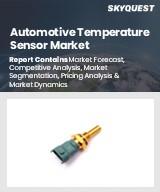
Automotive Temperature Sensor Market
Report ID: SQMIG25A2559
Report ID: SQMIG25A2559
[email protected]
USA +1 351-333-4748
Report ID:
SQMIG25A2559 |
Region:
Global |
Published Date: January, 2026
Pages:
195
|Tables:
63
|Figures:
67


Global Automotive Temperature Sensor Market size was valued at USD 7.33 Billion in 2024 and is poised to grow from USD 7.8 Billion in 2025 to USD 12.71 Billion by 2033, growing at a CAGR of 6.3% during the forecast period (2026–2033).
The major growth drivers of the automotive temperature sensor market strategies are the growing use of electric and hybrid cars demanding accurate battery and powertrain control, growing adoption of advanced driver-assistance systems (ADAS), more stringent emissions regulations mandating effective thermal management, development of autonomous vehicle technology, and the need to enhance in-cabin comfort via HVAC and thermal seat systems.
The automotive temperature sensor market growth is being driven by a number of key factors. The surge in sales of electric and hybrid vehicles has increased the demand for accurate temperature control of batteries and powertrains, which is driving market growth directly. Robust thermal monitoring capabilities are needed for advanced driver-assistance systems (ADAS) and autonomous car technologies, further increasing demand. Tighter emission standards worldwide are forcing manufacturers to adopt effective engine and exhaust temperature management systems. Also driving growth are consumer demands for improved in-cabin comfort, such as HVAC and heated seats. Together, these factors are encouraging long-term market growth in regions and vehicle segments.
High costs of production, technical issues in maintaining accuracy, and rapid technological obsolescence are some of the key restraints hindering automotive temperature sensor market penetration across the study period and beyond.
How MEMS Sensors are Transforming the Automotive Temperature Sensor Industry?
MEMS sensors are gaining traction among automotive companies owing to their high precision, rapid responsiveness, and extremely small form factors. These functions are especially valuable in vehicles such as electric/EV and autonomous cars where thermal management would be vital for performance and safety. In summary, MEMS technology is accelerating innovation, improving reliability, and enabling new applications that are driving development for the automotive temperature sensor market. Modern vehicles can directly integrate MEMS sensors into engine systems, batteries, and HVAC systems while making thermal management more effective.
Market snapshot - 2026-2033
Global Market Size
USD 6.9 billion
Largest Segment
MEMS
Fastest Growth
Infrared Temperature Sensors
Growth Rate
6.3% CAGR
To get more insights on this market click here to Request a Free Sample Report
Global Automotive Temperature Sensor Market is segmented by Product Type, Vehicle Type, Application and region. Based on Product Type, the market is segmented into MEMS, IC sensors and Infrared Temperature Sensors. Based on Vehicle Type, the market is segmented into Passenger Car and Commercial Vehicle. Based on Application, the market is segmented into Engine, Exhaust and Seats. Based on region, the market is segmented into North America, Europe, Asia Pacific, Latin America and Middle East & Africa.
Of the types, MEMS sensors are the leading segment and generate the highest automotive temperature sensor market revenue. Their small size, high precision, and quick response make them essential for use in powertrain, battery management, and HVAC systems. MEMS technology also provides the scope for integration with wireless and intelligent features, allowing predictive maintenance and enhancement of vehicle efficiency. As electric and self-driving cars continue to see increased adoption, MEMS sensors are propelling steady growth, solidifying themselves as the largest revenue-generating category in the market.
Infrared temperature sensors are the highest-growing category, driven by rising demand for contactless measurement in advanced driver-assistance systems (ADAS), battery safety, and cabin climate monitoring. Their capability to provide accurate readings without physical contact makes them extremely well-fitted for new-generation vehicles, especially EVs, encouraging swift adoption.
Within applications, the engine segment is the leading category, driving the automotive temperature sensor market statistics strongly. Engines require constant temperature monitoring for optimal combustion, emission control, and fuel efficiency. This category of advanced sensors helps producers comply with stringent emissions regulations, while ensuring long-lasting durability and performance. Employing MEMS-based solutions facilitates more accuracy and response time; making the engine category a fundamental need.
The seating segment is emerging as the most rapidly growing segment. Rising consumer demand for comfort and luxury features is helping this segment generate new opportunities going forward. Heated and ventilated seats with temperature sensors provide improved in-cabin experience, especially in premium cars. Increasing uptake across mid-range models is fueling this segment's growth in the market.
To get detailed segments analysis, Request a Free Sample Report
North America is a leader because of strong emission regulations, high penetration of electric and hybrid cars, and the presence of top automotive OEMs and sensor suppliers. This leadership is underpinned by superior R&D strengths and robust technological backbone. As per automotive temperature sensor market analysis, the region remains to establish standards in terms of innovation, safety, and efficiency standards, and it is a strategic hub for the deployment of global sensors and is influencing heavy investments in future automotive technologies.
In the US, leadership is driven by widespread EV adoption, strong regulatory environments imposing emission standards, and significant investments in automotive R&D. The existence of multinational players such as Tesla and General Motors increases demand for high-end sensors. Furthermore, government support for clean mobility fuels broader use of high-precision temperature sensors across vehicle types.
In Canada, growth in the market is facilitated by rising demand for electric and hybrid cars, compliance with stringent North American emission regulations, and the growing consumer preference for greater in-cabin comfort. Close partnerships among domestic research institutions and international sensor companies further encourage adoption. These all contribute to ranking Canada as a favorable market in the region's emerging automotive temperature sensor market.
Asia Pacific is the growth region with the highest speed, fueled by fast growth of automotive production, booming adoption of electric vehicles, and government policies promoting cleaner transport. Availability of low-cost production bases such as India and China also speeds up adoption of premium sensors. Rising consumer preference for safety, comfort, and fuel efficiency is driving mass-scale integration as per automotive temperature sensor market penetration. This synergy of industrial capability and policy backing guarantees the region's position as a pioneer in future automotive sensors.
Strong emphasis on electric and hybrid cars in Japan, combined with state-supported emission reduction policies, fuels high demand for temperature sensors there. Highly developed R&D environments and the market leadership of prime manufacturers such as Toyota and Honda facilitate easy integration of MEMS and infrared sensors. Increased user expectations of vehicle safety and comfort enhance Japan's position as a high-value market even further.
In South Korea, global automakers like Hyundai and Kia dominate leadership, placing significant investment in EVs and connected cars. Presence of a massive semiconductor and electronics manufacturing base is also expected to play in favor of market players operating in this country. Encouragement from the government towards green mobility and consumer demand for technology-centric cars add to adoption, making South Korea a leading growth center.
In Europe, adoption is being spurred by stringent EU emission regulations, fast-paced electrification of vehicle fleets, and increasing consumer demand for sophisticated safety and comfort features. Firm cooperation among automotive OEMs and sensor makers promotes innovation. Based on automotive temperature sensor market forecast, Europe will experience consistent demand, as premium and mass-market automakers install sophisticated thermal management systems to meet regulations and changing expectations for efficiency, reliability, and sustainability in motor vehicles.
In the UK, it is driven by accelerating electric vehicle adoption led by government subsidies, heavy emphasis on sustainability policies, and the availability of high-end automotive R&D facilities. Domestic spending on intelligent mobility solutions also fuels demand for high-performance sensors. All these places the UK as a key market for next-generation sensor applications in both traditional and electric vehicles.
Germany takes the lead with its powerful automotive manufacturing sector, where industry leaders such as BMW, Volkswagen, and Mercedes-Benz are based. Emission reduction and strict regulation in the EU ensure that manufacturing companies will utilize advanced thermal management technology. In addition, Germany's emphasis on Industry 4.0 technologies ultimately increases innovation in sensors, meaning it is the largest and most important market in Europe.
Sales of automotive temperature sensors in France are backed by public electrification programs, an increase in demand for comfort features within the cabin, and the activity of tier-one players, such as Renault and PSA Group. Partnerships between French research organizations and global sensor suppliers also spur innovation. Continued emphasis on green mobility in France implies steady growth in the number of temperature sensors in passenger or commercial vehicles.
To know more about the market opportunities by region and country, click here to
Buy The Complete Report
Growing Use of Electric and Hybrid Cars
Growing Adoption of Advanced Driver-Assistance Systems (ADAS)
Exorbitant Production and Integration Costs
Technical Challenges in Accuracy and Durability
Request Free Customization of this report to help us to meet your business objectives.
Automotive temperature sensor vendors are expected to invest in strategic collaborations with vehicle manufacturers to boost their sales potential in the long run. With demand for smart mobility and connectivity increasing, companies are increasingly putting intelligence and connectivity features into their sensors.
As noted through analysis of the global automotive temperature sensor market, opportunities in the aftermarket segment are also unfolding, with retrofit solutions increasing popularity. Moreover, new companies entering the market should stress cost effectiveness as well as scalability while complying with progressive safety and emission regulations. Here are some startups that are expected to boost demand for automotive temperature sensors.
SkyQuest’s ABIRAW (Advanced Business Intelligence, Research & Analysis Wing) is our Business Information Services team that Collects, Collates, Correlates, and Analyses the Data collected by means of Primary Exploratory Research backed by robust Secondary Desk research.
As per SkyQuest analysis, growing demand for environmental monitoring and rising investments in research and development are key drivers of the automotive temperature sensor market share. The increasing adoption of electric and hybrid vehicles and advanced driver-assistance systems (ADAS) further accelerates growth. Nevertheless, high production and integration costs and technical specifications, which affect precision and longevity, serve as the limiting factors. North America is ahead of the market where stringent regulations aimed at emissions, combined with a strong research and development infrastructure, have meant that automotive manufacturers adopt technologies earlier. Directions in the market include the integration of sensors into IoT systems connecting technology, which could be used to predict impending maintenance, as well as the emergence of AI-enabled thermal management technology to increase vehicle safety.
| Report Metric | Details |
|---|---|
| Market size value in 2024 | USD 7.33 Billion |
| Market size value in 2033 | USD 12.71 Billion |
| Growth Rate | 6.3% |
| Base year | 2024 |
| Forecast period | 2026-2033 |
| Forecast Unit (Value) | USD Billion |
| Segments covered |
|
| Regions covered | North America (US, Canada), Europe (Germany, France, United Kingdom, Italy, Spain, Rest of Europe), Asia Pacific (China, India, Japan, Rest of Asia-Pacific), Latin America (Brazil, Rest of Latin America), Middle East & Africa (South Africa, GCC Countries, Rest of MEA) |
| Companies covered |
|
| Customization scope | Free report customization with purchase. Customization includes:-
|
To get a free trial access to our platform which is a one stop solution for all your data requirements for quicker decision making. This platform allows you to compare markets, competitors who are prominent in the market, and mega trends that are influencing the dynamics in the market. Also, get access to detailed SkyQuest exclusive matrix.
Table Of Content
Executive Summary
Market overview
Parent Market Analysis
Market overview
Market size
KEY MARKET INSIGHTS
COVID IMPACT
MARKET DYNAMICS & OUTLOOK
Market Size by Region
KEY COMPANY PROFILES
Methodology
For the Automotive Temperature Sensor Market, our research methodology involved a mixture of primary and secondary data sources. Key steps involved in the research process are listed below:
1. Information Procurement: This stage involved the procurement of Market data or related information via primary and secondary sources. The various secondary sources used included various company websites, annual reports, trade databases, and paid databases such as Hoover's, Bloomberg Business, Factiva, and Avention. Our team did 45 primary interactions Globally which included several stakeholders such as manufacturers, customers, key opinion leaders, etc. Overall, information procurement was one of the most extensive stages in our research process.
2. Information Analysis: This step involved triangulation of data through bottom-up and top-down approaches to estimate and validate the total size and future estimate of the Automotive Temperature Sensor Market.
3. Report Formulation: The final step entailed the placement of data points in appropriate Market spaces in an attempt to deduce viable conclusions.
4. Validation & Publishing: Validation is the most important step in the process. Validation & re-validation via an intricately designed process helped us finalize data points to be used for final calculations. The final Market estimates and forecasts were then aligned and sent to our panel of industry experts for validation of data. Once the validation was done the report was sent to our Quality Assurance team to ensure adherence to style guides, consistency & design.
Analyst Support
Customization Options
With the given market data, our dedicated team of analysts can offer you the following customization options are available for the Automotive Temperature Sensor Market:
Product Analysis: Product matrix, which offers a detailed comparison of the product portfolio of companies.
Regional Analysis: Further analysis of the Automotive Temperature Sensor Market for additional countries.
Competitive Analysis: Detailed analysis and profiling of additional Market players & comparative analysis of competitive products.
Go to Market Strategy: Find the high-growth channels to invest your marketing efforts and increase your customer base.
Innovation Mapping: Identify racial solutions and innovation, connected to deep ecosystems of innovators, start-ups, academics, and strategic partners.
Category Intelligence: Customized intelligence that is relevant to their supply Markets will enable them to make smarter sourcing decisions and improve their category management.
Public Company Transcript Analysis: To improve the investment performance by generating new alpha and making better-informed decisions.
Social Media Listening: To analyze the conversations and trends happening not just around your brand, but around your industry as a whole, and use those insights to make better Marketing decisions.
REQUEST FOR SAMPLE
 REQUEST FREE CUSTOMIZATION


Want to customize this report? This report can be personalized according to your needs. Our analysts and industry experts will work directly with you to understand your requirements and provide you with customized data in a short amount of time. We offer $1000 worth of FREE customization at the time of purchase.
Feedback From Our Clients


 USA (+1) 351-333-4748

