
Automotive Telematics Market
Report ID: SQMIG45F2219
Report ID: SQMIG45F2219
[email protected]
USA +1 351-333-4748
Report ID:
SQMIG45F2219 |
Region:
Global |
Published Date: July, 2025
Pages:
185
|Tables:
90
|Figures:
71


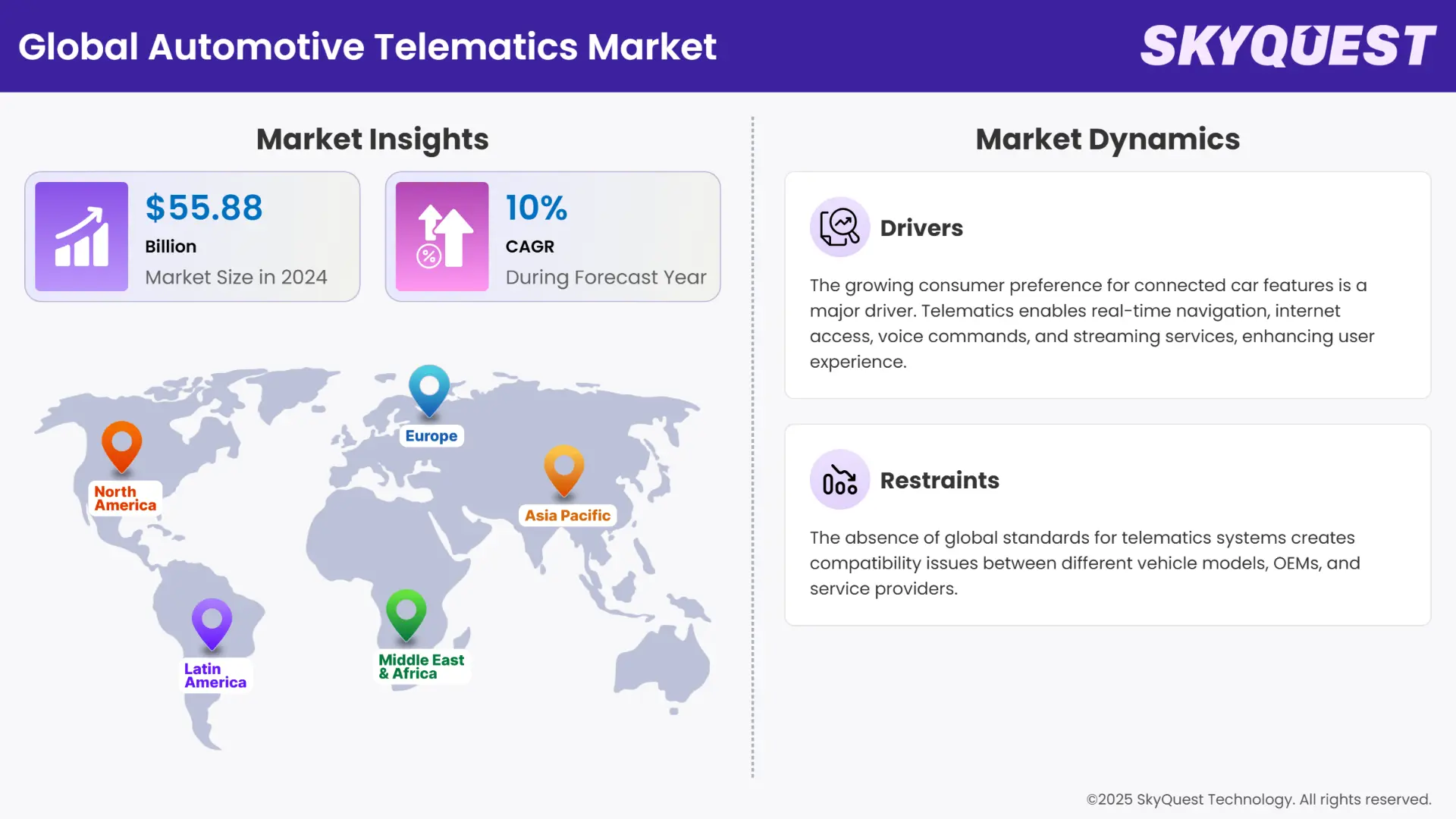
Global Automotive Telematics Market size was valued at USD 55.88 Billion in 2024 poised to grow between USD 61.47 Billion in 2025 to USD 131.76 Billion by 2033, growing at a CAGR of 10% in the forecast period 10%.
The increasing consumer preference for connected vehicles is a primary driver of the global automotive telematics market. Modern drivers expect seamless digital experiences like smartphones, including real-time GPS navigation, voice-assisted infotainment, remote vehicle diagnostics, and over-the-air software updates. This growing demand pushes automakers to integrate advanced telematics systems into their vehicle designs. Additionally, fleet operators leverage telematics for route optimization, fuel management, and driver behaviour monitoring, enhancing operational efficiency. As connectivity becomes central to user experience and brand differentiation, automotive companies view telematics not just as an add-on but as a core component of future mobility solutions.
Government regulations focused on vehicle safety, emissions control, and emergency response has been a key trend driving the global automotive telematics market. Policies such as the European Union’s eCall mandate require vehicles to be equipped with telematics systems that automatically contact emergency services in the event of a crash. Similarly, emission monitoring regulations in regions like North America and Asia-Pacific necessitate real-time data collection on vehicle performance and pollution levels. These requirements drive automakers to incorporate telematics solutions for compliance. As governments prioritize public safety and environmental sustainability, such regulatory measures continue to serve as critical catalysts for telematics technology adoption across global automotive markets.
What Types of Real-Time Decisions can AI make in Automotive Telematics?
Artificial Intelligence (AI) directly impacts the global automotive telematics market by enabling predictive analytics, intelligent navigation, driver behavior analysis, and real-time decision-making. AI algorithms process vast telematics data to anticipate maintenance needs, optimize fuel efficiency, and personalize in-vehicle experiences. Indirectly, AI supports autonomous driving and advanced driver-assistance systems (ADAS), which rely heavily on telematics for data input and communication. For example, in March 2024, Qualcomm partnered with Salesforce to integrate AI-driven customer insights into connected vehicle platforms, enhancing user engagement through telematics. As AI capabilities expand, telematics systems become smarter, more responsive, and integral to vehicle intelligence and connectivity strategies.
In February 2025, Stellantis expanded its strategic AI partnership with French AI specialist Mistral. By integrating Mistral’s generative models into its telematics framework, Stellantis now processes vehicle and customer data in minutes instead of weeks—driving faster product planning and real‑time service adaptation in connected vehicles.
To get more insights on this market click here to Request a Free Sample Report
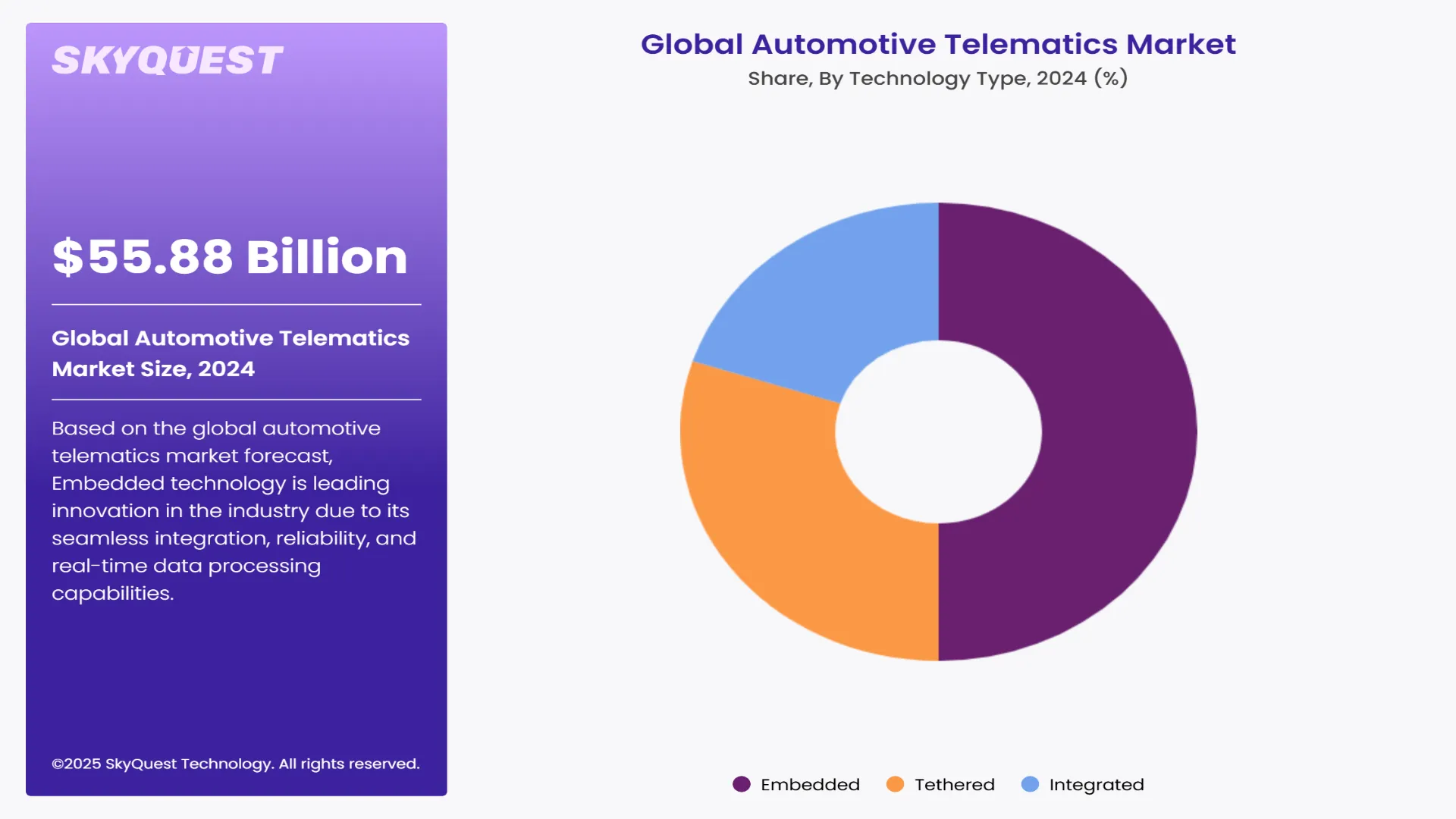
The global automotive telematics market is segmented based on technology type, solution, application type, and region. In terms of technology type, the market is trifurcated into embedded, tethered, and integrated. Based on a solution, the market is bifurcated into components and services. Based on application type, the market is segmented into information & navigation, safety & security, fleet management, insurance telematics, and others. Based on region, the market is segmented into North America, Europe, Asia-Pacific, Central & South America and the Middle East & Africa.
Based on the global automotive telematics market forecast, Embedded technology is leading innovation in the industry due to its seamless integration, reliability, and real-time data processing capabilities. These systems are built directly into vehicles, enabling continuous connectivity, over-the-air updates, and advanced diagnostics. Automakers prefer embedded telematics for enhanced control, regulatory compliance, and superior user experience. Their dominance stems from rising demand for connected services, improved safety features, and OEM-driven standardization across modern vehicle platforms.
Integrated telematics systems are poised to be the fastest-growing segment in the global automotive telematics market due to their hybrid architecture that combines built-in modules for critical safety and diagnostics with smartphone-based connectivity for infotainment and navigation. This synergy offers OEMs and fleet operators the flexibility to deliver rich, multifunctional services while reducing hardware costs.
Component solutions dominate the global automotive telematics market and focus on advanced hardware—miniaturized sensors, GPS units, OBD devices, and black boxes—delivering real-time vehicle diagnostics and behavior data. These components underpin usage-based insurance, predictive maintenance, and fleet management systems, while improvements in accuracy and integration enhance system reliability. Component solutions dominate due to mandates on road safety and smart transportation, plus rising aftermarket demand that enables older vehicles to gain telematics functionality cost-effectively, driving widespread adoption.
Service solutions are projected to be the fastest-growing segment in the global automotive telematics market due to rising demand for subscription-based offerings like fleet management, predictive maintenance, remote diagnostics, and emergency assistance. Automakers and service providers benefit from recurring revenue models, while customers gain cost-effective, continuously updated services.
To get detailed segments analysis, Request a Free Sample Report
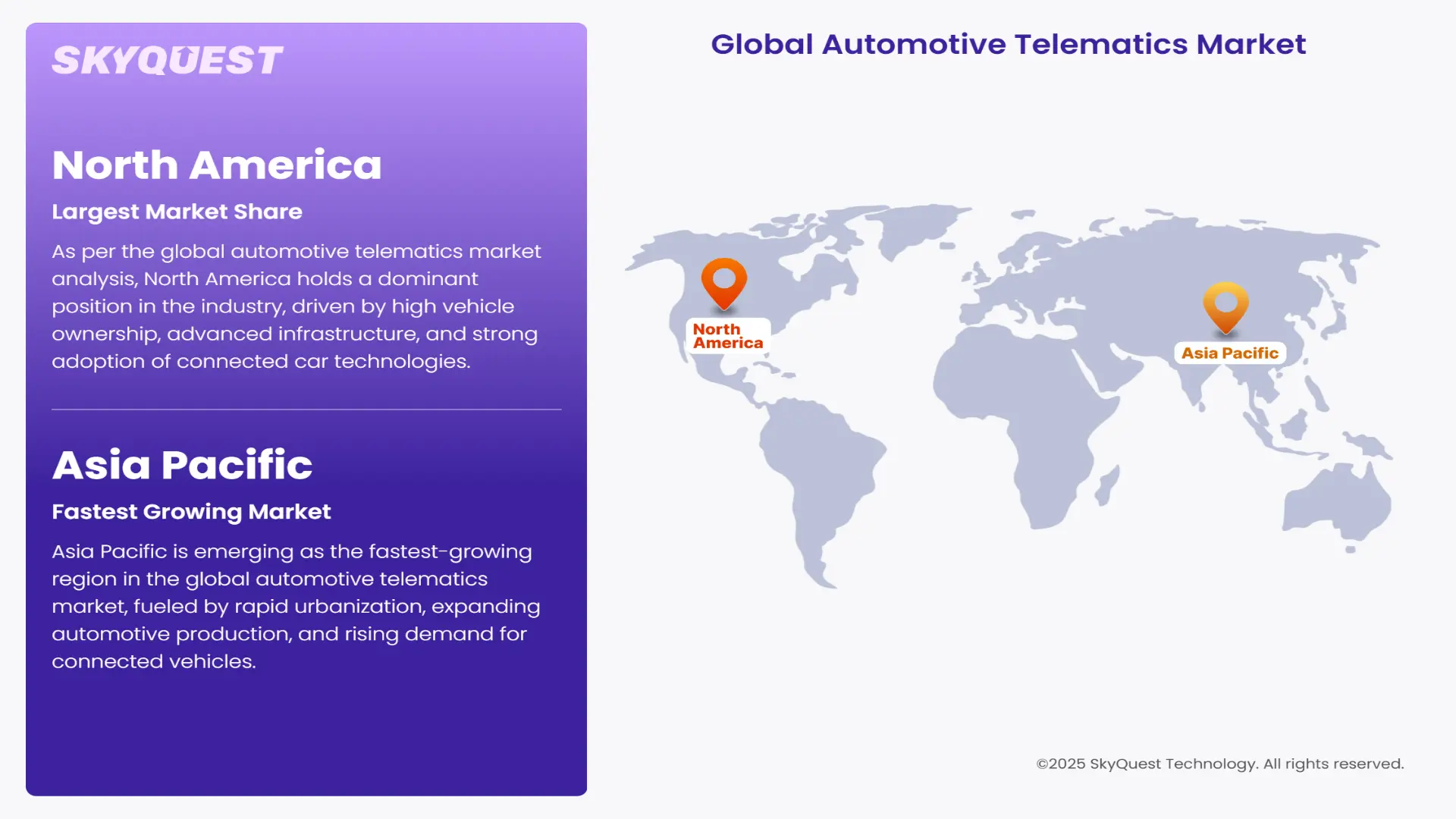
As per the global automotive telematics market analysis, North America holds a dominant position in the industry, driven by high vehicle ownership, advanced infrastructure, and strong adoption of connected car technologies. The region benefits from stringent government regulations like the ELD mandate in the U.S., promoting fleet telematics. Additionally, leading OEMs and tech firms actively invest in telematics innovation, while growing demand for safety, navigation, and infotainment services fuels continued market growth.
The United States significantly contributes to North America’s automotive telematics market through widespread adoption of connected vehicles, advanced driver-assistance systems (ADAS), and usage-based insurance models. Strong OEM presence, robust infrastructure, and regulatory mandates like the ELD rule drive telematics integration in commercial fleets. Additionally, high consumer demand for real-time navigation, remote diagnostics, and infotainment services fuels continued investment and innovation in embedded and service-based telematics platforms.
Canada supports the North America’s automotive telematics market with a strong focus on fleet management, OEM partnerships, and aftermarket telematics solutions. Companies like Geotab have positioned Canada as a leader in intelligent fleet analytics. Government-backed smart mobility initiatives and rising demand for vehicle tracking, fuel efficiency, and compliance solutions encourage wider telematics adoption. Canada’s growing connected vehicle ecosystem and cross-border logistics with the U.S. also bolster market development.
Asia Pacific is emerging as the fastest-growing region in the global automotive telematics market, fueled by rapid urbanization, expanding automotive production, and rising demand for connected vehicles. Countries like China, Japan, South Korea, and India are driving growth through strong government support, smart mobility initiatives, and widespread adoption of embedded telematics. Increasing investments in 5G infrastructure, electric vehicles, and AI-powered services further accelerate telematics innovation and deployment across the region.
Japan contributes significantly to the Asia Pacific automotive telematics market through its advanced automotive industry and early adoption of connected technologies. Leading automakers like Toyota, Nissan, and Honda offer embedded telematics systems with features like real-time navigation, safety alerts, and predictive maintenance. The country’s strong 5G infrastructure, focus on autonomous vehicles, and government-backed smart mobility initiatives further accelerate telematics deployment across both consumer and commercial vehicle segments, reinforcing Japan’s leadership in telematics innovation.
South Korea plays a vital role in the Asia Pacific telematics market with its advanced ICT infrastructure and strong automotive OEM presence. Companies like Hyundai and Kia integrate AI-powered telematics solutions for remote diagnostics, infotainment, and V2X communication. Government regulations promoting connected vehicle technologies and usage-based insurance boost adoption. Additionally, South Korea’s leadership in 5G deployment and smart city development supports rapid growth and innovation in telematics services and vehicle connectivity.
Europe plays a crucial role in the global automotive telematics market, driven by strong regulatory frameworks, advanced automotive manufacturing, and rapid adoption of connected car technologies. The European Union’s eCall mandate and CO₂ emission targets push OEMs to integrate telematics into vehicles. Countries like Germany, the UK, and France lead innovation, while growing demand for EVs, fleet solutions, and safety services continues to accelerate telematics deployment across the region.
Germany is a key player in the Europe automotive telematics market due to its robust automotive manufacturing sector and early adoption of Industry 4.0. Leading OEMs like BMW, Mercedes-Benz, and Volkswagen integrate advanced telematics for vehicle diagnostics, navigation, and driver assistance. The country also supports connected vehicle research, 5G rollout, and smart mobility initiatives, making it a hub for innovation and adoption of embedded and service-based telematics solutions.
France contributes significantly through its strong automotive industry and government-backed digital mobility strategies. French automakers like Renault and PSA Group actively deploy telematics in connected and electric vehicles to enhance performance, safety, and compliance. France’s focus on smart transportation, emission reduction, and eCall integration supports growth. Additionally, local startups and partnerships with telecom providers fuel innovation in telematics hardware, AI-based services, and fleet optimization tools.
The UK plays a vital role in advancing telematics adoption, particularly in insurance telematics, fleet tracking, and connected vehicle trials. The rise of usage-based insurance, supported by favorable regulations and strong digital infrastructure, drives demand. OEMs and telematics providers collaborate on R&D and data security initiatives, while government projects like smart road trials and EV integration reinforce the UK’s position as a leader in telematics innovation.
To know more about the market opportunities by region and country, click here to
Buy The Complete Report
Rising Demand for Vehicle Connectivity and Infotainment
Government Regulations and Safety Mandates
Lack of Standardization Across Platforms
Limited Internet Connectivity in Developing Regions
Request Free Customization of this report to help us to meet your business objectives.
The global automotive telematics market outlook is highly competitive, with key players including Verizon Connect, Geotab, Continental AG, Robert Bosch GmbH, and Trimble Inc. Companies focus on strategic partnerships, AI integration, and service expansion to enhance offerings. For example, Geotab emphasizes fleet optimization through AI analytics, while Bosch invests in V2X communication. Verizon Connect strengthens its presence through cloud-based fleet solutions, aiming to improve real-time data tracking and operational efficiency globally.
As per the global automotive telematics market analytics, the startup landscape is thriving, driven by innovations in AI, edge computing, and vehicle connectivity. Startups are disrupting traditional models with real-time video analytics, predictive maintenance, and V2X communication. Their agility in R&D enables faster product development, offering scalable, intelligent solutions for fleet safety and smart mobility. These young companies are crucial in accelerating the shift toward safer, more efficient, and data-driven transportation ecosystems worldwide.
SkyQuest’s ABIRAW (Advanced Business Intelligence, Research & Analysis Wing) is our Business Information Services team that Collects, Collates, Correlates, and Analyses the Data collected by means of Primary Exploratory Research backed by robust Secondary Desk research.
As per SkyQuest analysis, the global automotive telematics industry is undergoing rapid transformation, driven by growing consumer demand for connected vehicles, stringent safety and emissions regulations, and the integration of advanced technologies like AI and 5G. Automakers and fleet operators are increasingly adopting telematics for real-time diagnostics, navigation, predictive maintenance, and driver behavior monitoring.
AI enhances system intelligence, while evolving service models offer scalable, subscription-based solutions. Regional markets like North America, Europe, and Asia-Pacific contribute significantly through innovation, regulatory support, and strategic partnerships. Startups and global players alike are shaping a competitive and dynamic landscape through R&D breakthroughs and collaborative developments. As vehicles become smarter and more connected, the global automotive telematics market strategies are positioned as a foundational pillar for future mobility and digital transportation ecosystems.
| Report Metric | Details |
|---|---|
| Market size value in 2024 | USD 55.88 Billion |
| Market size value in 2033 | USD 131.76 Billion |
| Growth Rate | 10% |
| Base year | 2024 |
| Forecast period | 10% |
| Forecast Unit (Value) | USD Billion |
| Segments covered |
|
| Regions covered | North America (US, Canada), Europe (Germany, France, United Kingdom, Italy, Spain, Rest of Europe), Asia Pacific (China, India, Japan, Rest of Asia-Pacific), Latin America (Brazil, Rest of Latin America), Middle East & Africa (South Africa, GCC Countries, Rest of MEA) |
| Companies covered |
|
| Customization scope | Free report customization with purchase. Customization includes:-
|
To get a free trial access to our platform which is a one stop solution for all your data requirements for quicker decision making. This platform allows you to compare markets, competitors who are prominent in the market, and mega trends that are influencing the dynamics in the market. Also, get access to detailed SkyQuest exclusive matrix.
Table Of Content
Executive Summary
Market overview
Parent Market Analysis
Market overview
Market size
KEY MARKET INSIGHTS
COVID IMPACT
MARKET DYNAMICS & OUTLOOK
Market Size by Region
KEY COMPANY PROFILES
Methodology
For the Automotive Telematics Market, our research methodology involved a mixture of primary and secondary data sources. Key steps involved in the research process are listed below:
1. Information Procurement: This stage involved the procurement of Market data or related information via primary and secondary sources. The various secondary sources used included various company websites, annual reports, trade databases, and paid databases such as Hoover's, Bloomberg Business, Factiva, and Avention. Our team did 45 primary interactions Globally which included several stakeholders such as manufacturers, customers, key opinion leaders, etc. Overall, information procurement was one of the most extensive stages in our research process.
2. Information Analysis: This step involved triangulation of data through bottom-up and top-down approaches to estimate and validate the total size and future estimate of the Automotive Telematics Market.
3. Report Formulation: The final step entailed the placement of data points in appropriate Market spaces in an attempt to deduce viable conclusions.
4. Validation & Publishing: Validation is the most important step in the process. Validation & re-validation via an intricately designed process helped us finalize data points to be used for final calculations. The final Market estimates and forecasts were then aligned and sent to our panel of industry experts for validation of data. Once the validation was done the report was sent to our Quality Assurance team to ensure adherence to style guides, consistency & design.
Analyst Support
Customization Options
With the given market data, our dedicated team of analysts can offer you the following customization options are available for the Automotive Telematics Market:
Product Analysis: Product matrix, which offers a detailed comparison of the product portfolio of companies.
Regional Analysis: Further analysis of the Automotive Telematics Market for additional countries.
Competitive Analysis: Detailed analysis and profiling of additional Market players & comparative analysis of competitive products.
Go to Market Strategy: Find the high-growth channels to invest your marketing efforts and increase your customer base.
Innovation Mapping: Identify racial solutions and innovation, connected to deep ecosystems of innovators, start-ups, academics, and strategic partners.
Category Intelligence: Customized intelligence that is relevant to their supply Markets will enable them to make smarter sourcing decisions and improve their category management.
Public Company Transcript Analysis: To improve the investment performance by generating new alpha and making better-informed decisions.
Social Media Listening: To analyze the conversations and trends happening not just around your brand, but around your industry as a whole, and use those insights to make better Marketing decisions.
REQUEST FOR SAMPLE
 REQUEST FREE CUSTOMIZATION
Global Automotive Telematics Market size was valued at USD 55.88 Billion in 2024 poised to grow between USD 61.47 Billion in 2025 to USD 131.76 Billion by 2033, growing at a CAGR of 10% in the forecast period 10%.
The global automotive telematics market outlook is highly competitive, with key players including Verizon Connect, Geotab, Continental AG, Robert Bosch GmbH, and Trimble Inc. Companies focus on strategic partnerships, AI integration, and service expansion to enhance offerings. For example, Geotab emphasizes fleet optimization through AI analytics, while Bosch invests in V2X communication. Verizon Connect strengthens its presence through cloud-based fleet solutions, aiming to improve real-time data tracking and operational efficiency globally. 'Verizon Connect (USA)', 'Geotab Inc. (Canada)', 'Continental AG (Germany)', 'Robert Bosch GmbH (Germany)', 'Trimble Inc. (USA)', 'Teletrac Navman (USA)', 'TomTom N.V. (Netherlands)', 'Octo Telematics (Italy)', 'Harman International Industries (USA)', 'MiX Telematics (South Africa)', 'Vodafone Automotive S.p.A. (Italy)', 'Valeo S.A. (France)', 'Netradyne (USA)', 'Nexar (Israel)', 'Inseego Corp. (USA)'
The growing consumer preference for connected car features is a major driver. Telematics enables real-time navigation, internet access, voice commands, and streaming services, enhancing user experience. Automakers are integrating these systems to meet evolving expectations, fuelling demand across both passenger and commercial vehicle segments globally.
Surge in Usage-Based Insurance (UBI) Adoption: Insurance providers increasingly leverage telematics to offer UBI models, where premiums are based on actual driving behavior. This trend enhances driver accountability and provides cost savings, especially for safe drivers. Rising demand for personalized insurance and real-time risk assessment is propelling telematics integration across global insurance and automotive sectors.
As per the global automotive telematics market analysis, North America holds a dominant position in the industry, driven by high vehicle ownership, advanced infrastructure, and strong adoption of connected car technologies. The region benefits from stringent government regulations like the ELD mandate in the U.S., promoting fleet telematics. Additionally, leading OEMs and tech firms actively invest in telematics innovation, while growing demand for safety, navigation, and infotainment services fuels continued market growth.


Want to customize this report? This report can be personalized according to your needs. Our analysts and industry experts will work directly with you to understand your requirements and provide you with customized data in a short amount of time. We offer $1000 worth of FREE customization at the time of purchase.
Feedback From Our Clients


 USA (+1) 351-333-4748

