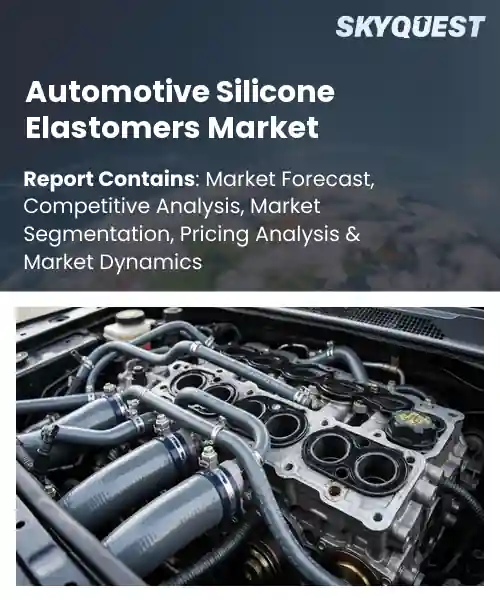
Automotive Silicone Elastomers Market
Report ID: SQMIG15E3205
Report ID: SQMIG15E3205
[email protected]
USA +1 351-333-4748
Report ID:
SQMIG15E3205 |
Region:
Global |
Published Date: February, 2026
Pages:
157
|Tables:
149
|Figures:
78


Global Automotive Silicone Elastomers Market size was valued at USD 3.28 Billion in 2024 and is poised to grow from USD 3.41 Billion in 2025 to USD 4.65 Billion by 2033, growing at a CAGR of 3.95% during the forecast period (2026-2033).
The global automotive silicone elastomers market growth is driven because of increased demand for materials which offer thermal stability and chemical resistance and long-lasting elasticity in complex powertrain systems. Automotive silicone elastomers serve as specialized polymers which perform sealing and gasketing and insulation and vibration damping functions across engine bays and transmissions and electrified power modules.
Moreover, the global automotive silicone elastomers market outlook transitioned from general-purpose rubber materials to engineered siloxane formulations during the past two decades because silicone seals for turbochargers and EV battery pack gaskets demonstrated their ability to withstand both underhood oils and battery electrolyte contact and thermal cycling.
The foremost growth factor for durable heat-resistant seals development exists because vehicle electrification advances while emissions regulations become more stringent because these two trends create a demand for silicone parts used in battery enclosures and high-voltage cable insulation and thermal interface components. The automotive industry pushes for greater energy density in battery packs, which leads to increased thermal output in battery modules. The growing technical requirements compel tier-1 suppliers to allocate funds toward liquid silicone rubber processing and co-molding development. This investment strategy will help them decrease production expenses while creating new market possibilities in sensor housings and LED lighting and HVAC systems, which will benefit both OEMs and aftermarket businesses around the world.
How is Automation Enhancing Production Efficiency in the Automotive Silicone Elastomers Market?
The global automotive silicone elastomers market has improved production efficiency through automation that uses robotic handling and automated dosing and closed loop process control to create manufacturing processes which operate with better consistency and reliability. The two key elements which achieve waste reduction while enabling faster automotive parts qualification are precision mixing and molding together with inline inspection and digital traceability. Suppliers now use flexible automation cells to enhance their ability to make fast production changes while working with the complex formulation needs of electrified vehicle manufacturing.
The automated injection molding lines together with the smart material handling systems enable technicians to dedicate their work to critical tasks while achieving higher equipment availability and maintaining steady production of each batch. The WACKER site expanded its automation capabilities through autonomous delivery robot deployment which operates together with automated molding technologies to enhance internal logistics and process repeatability. The development creates more reliable supply chains for automotive customers who need qualified silicone elastomer components while also shortening production cycles and driving the automotive silicone elastomers market penetration.
Market snapshot - (2026-2033)
Global Market Size
USD 3.0 Billion
Largest Segment
Elastomers
Fastest Growth
Gels
Growth Rate
5.0% CAGR
To get more insights on this market click here to Request a Free Sample Report
The global automotive silicone elastomers market is segmented by type, product type, curing mechanism, application, end-use industry, and region. By type, the market includes elastomers, resins, gels, and other types. By product type, it is categorized into high consistency silicone rubber, liquid silicone rubber, room temperature vulcanized rubber, and fluorosilicone rubber. By curing mechanism, the market comprises heat-cured, condensation-cured, peroxide-cured, and platinum-cured systems. By application, it covers automotive components and electrical components. By end-use industry, the market serves automotive & transportation, construction, electrical & electronics, medical, food & beverage, and consumer products sectors. Geographically, the market is segmented into North America, Europe, Asia Pacific, Latin America, and the Middle East & Africa.
As per the global automotive silicone elastomers market analysis, the elastomers segment dominated the market because these materials provided better heat protection and engine performance during high engine stress situations. The materials are common in various parts like hoses and gaskets which serve to minimize vibrations and endure both extreme heat and lubrication conditions. Current passenger vehicles use silicone elastomers to produce engine sealing rings and turbocharger hoses which maintain their performance during continuous thermal stress. The production of auto parts depends on silicone elastomers which serve as the essential material used in their creation.
However, the demand for silicone gels will experience rapid growth because more drivers nowadays choose electric vehicles. Electric vehicles need soft protective materials which can shield their sensors and battery electronics from both moisture and vibration damage. The need for protective gel materials in automotive electronics is rising because more people use advanced driver-assistance systems and battery management modules.
According to the global automotive silicone elastomers market forecast, the high consistency silicone rubber dominated the market as this can create extremely strong molded parts for automotive production. The material is commonly used to create lasting intake ducts and spark-plug boots and sealing profiles. High-consistency silicone rubber seals the under-hood parts of internal combustion engines. The material will provide extended service life because it can endure constant exposure to heat and fuel vapors and mechanical pressure.
However, the liquid silicone rubber category is anticipated to have the largest automotive silicone elastomers market share. This will result from its applications in automated injection molding and small and precise component manufacturing. The automotive industry uses the material to create electric vehicle sensors and connectors and component insulation. The automotive industry requires electrified powertrains and next-generation automotive electronics, and this product meets those requirements through its rapid curing process and ability to produce high-volume automated production.
To get detailed segments analysis, Request a Free Sample Report
As per the automotive silicone elastomers market regional forecast, Asia Pacific achieves its dominant position through three main factors which include centralized vehicle manufacturing, complete supply chain networks and ongoing research into material technologies. The local original equipment manufacturer and tier supplier ecosystem enables fast adoption of advanced silicone materials which provide sealing solutions and thermal management and electrical insulation functions. The manufacturing process benefits from cost advantages and design flexibility because of its location near major assembly plants which handle high volume production. The research capabilities of Japan and South Korea enable scientists to develop new formulations which meet both electrification requirements and high-performance standards. Material producers and automakers work together to develop new materials which lead to fast prototyping and technical support services that help both organizations maintain their market position while developing new applications in powertrain and electronics and interior systems.
The Japanese automotive silicone elastomers industry benefits from advanced engineering knowledge which enables partnerships with high-end original equipment manufacturers and their tier one suppliers. The materials used in electrified powertrains and advanced electronics must follow strict requirements which require high-performance materials with superior durability and complete material purity. Local research centres and material specialists create custom silicone systems which provide thermal stability and sustain long operational periods. Companies achieve fast validation and new elastomer solution integration into vehicle programs through its design center proximity and strong prototyping capabilities.
The South Korean automotive silicone elastomers market develops through two factors which include its powerful manufacturing sector and quick adoption of new materials for electrification and electronics with high density. The electronics and semiconductor supply chains require silicone grades which provide precise electrical insulation and thermal conductivity characteristics for their safe operation. Local tier suppliers work together with original equipment manufacturers to develop material formulas which improve assembly operations for export-oriented vehicle projects while their local technical assistance helps them meet their changing operational requirements.
The European automotive silicone elastomers sector expands quickly because customers demand high-performance products which meet eco-friendly standards while engineering experts work near automotive hubs. The demand for advanced sealing solutions and thermal management products with electrical insulation properties increases because electrification and weight reduction initiatives become more important. The regulatory system which establishes requirements for durability and safety and environmental sustainability pushes companies to replace existing materials with new eco-friendly chemical formulations. Research centers build strong connections with companies that develop innovative specialty silicone elastomers which can handle severe working conditions. The market growth in major European countries arises because regional suppliers invest in local manufacturing while original equipment manufacturers need dependable materials and adaptable supply chain solutions.
The German automotive silicone elastomers market creates a strong base because engineering-focused original equipment manufacturers and tier suppliers require high-performance products and strict product quality standards. The selection process of materials requires thermal stability and long-lasting sealing performance and the ability to work with different powertrain systems and chassis components. Material manufacturers and automotive engineers work together to create elastomer grades which meet specific applications through detailed validation processes. The German industrial sector demands high-precision and reliable products which maintain their performance throughout their entire service life.
The United Kingdom automotive silicone elastomers market grows rapidly because established manufacturers work alongside new electrified vehicle developers. The demand for rapid prototyping and lightweight products and electronic systems needs flexible silicone formulations which can adapt to multiple functions. Research institutions work with supply chain partners to create development cycles while their policy focuses on low-emission systems drives material advancements. The market advantages from an ecosystem which prioritizes tailored solutions and quick product launch times for customized elastomer implementations.
The French automotive silicone elastomers market grows because OEMs and suppliers adopt new materials to fulfill changing automotive standards. The focus areas for research include the environmental compatibility of materials and their ability to create lightweight designs through integration with composite materials and durability testing. The material qualification process and supplier training program improvement needs in regional supply chains and joint research initiatives to establish their supply chain operations. The rising demand for electrification and thermal management solutions drives companies to obtain specialized silicone materials from domestic sources while they collaborate with automotive engineers to develop new materials.
North America strengthens its position by investing in production facilities, establishing technology partnerships, and matching its operations with OEMs electrification plans. Manufacturers develop regional capacity for specialty elastomers which seal and insulate and control thermal energy because of nearshoring and supply chain resilience demands. Material innovators research institutions and tier suppliers work together to create formulations which function in extreme weather and tough work environments. The combination of advanced testing facilities and prototyping equipment improves testing times while vehicle manufacturers develop partnerships to include silicone materials in their upcoming car designs.
The United States automotive silicone elastomers market benefits from its location near major OEM programs and its innovation ecosystem which enables development of new advanced materials. The market exists because customers need electrical components, advanced electronic systems, and materials which provide both insulation and sealing functions at high performance levels. Testing facilities and supplier networks enable quick development of new elastomer grades through testing and approval processes. The partnership between research centres and industry organizations produces customized thermal management solutions which withstand extreme operational conditions while maintaining durability over time.
The Canadian automotive silicone elastomers market depends on established automotive parts clusters which operate together with North American supply networks. Customers choose materials according to their requirements for cold climate performance and corrosion resistance and reliable sealing performance. Research institutions partner with regional suppliers to develop collaborative programs which enhance local manufacturing through silicone formulation customization. The combination of major export market proximity and reliable tested materials leads to consistent material adoption throughout assembly and aftermarket operations.
To know more about the market opportunities by region and country, click here to
Buy The Complete Report
Rising Demand For Lightweight Materials
Silicone elastomers help create lightweight vehicle designs by substituting heavier materials with their ability to produce slimmer sealing and damping products which decrease vehicle weight while enhancing packaging options. The material possesses three important properties which allow engineers to achieve weight reduction while ensuring product durability and vehicle safety. because of its material properties and design capabilities, automotive manufacturers increasingly choose to use silicone elastomers in their vehicle design for body and powertrain and interior parts.
Increasing Focus on Emissions Reduction
The automotive sector requires sealing materials which maintain their performance during extreme underhood and exhaust conditions because manufacturers want to decrease emissions through better sealing and thermal management and longer-lasting components. The automotive industry requires materials which maintain their performance during extreme underhood and exhaust conditions because they want to reduce emissions through better sealing and thermal management and longer-lasting components. The material properties of silicone elastomers allow protection of seals and gaskets during their entire service period while enduring extreme temperatures and chemical contact.
Fluctuating Raw Material Pricing
Silicone elastomer producers face procurement challenges because their precursors and feedstock availability changes which result in increased production costs and creates financial pressure, which manufacturers cannot afford. Some automotive manufacturers refuse to expand their specifications because they doubt their suppliers will remain stable and their costs will not change over time, which leads to extended qualification periods and preference for established, lower-cost alternatives. The procurement teams want to establish dependable sources of materials which will result in manageable total ownership expenses, but material instability prevents broader adoption of silicone elastomer solutions throughout vehicle programs.
The high price of specialty silicone elastomers arises from their complex chemical compositions and processing requirements, which results in higher initial expenses for components that make them unattractive to budget-conscious vehicle segments. Engineering teams evaluate materials based on their total lifecycle benefits, which need" extensive validation and qualification before manufacturers will use specialty silicones despite their product advantages. The need for extensive validation and qualification further amplifies total program costs, which causes some manufacturers to hesitate about using specialty silicones despite their proven capabilities. The market delays because of this hesitation and people begin developing alternative solutions.
Request Free Customization of this report to help us to meet your business objectives.
The global automotive silicone elastomers market is facing stronger competition because companies are merging through specific mergers and acquisitions together with their original equipment manufacturer partnerships which develop electric vehicle production and the growing market need for advanced thermal management and sealing products. Elkem completed its acquisition of Polysil while KCC now fully controls Momentive operations because major development activities occur throughout the market.
SkyQuest’s ABIRAW (Advanced Business Intelligence, Research & Analysis Wing) is our Business Information Services team that Collects, Collates, Correlates, and Analyses the Data collected by means of Primary Exploratory Research backed by robust Secondary Desk research.
As per SkyQuest analysis, the automotive silicone elastomers market experiences growth because increasing vehicle electrification creates a higher demand for battery gaskets and thermal interface materials while the demand for lightweight materials which enhance vehicle efficiency functions as the second market driver. The primary market driver is electrification while the market experiences constraints from fluctuating raw material costs which damage profit margins and hinder market growth. The market operates under Asian Pacific control because of its concentrated vehicle manufacturing sites and complete supply chain operations while liquid silicone rubber products hold market dominance because their processing capabilities allow precise molding which meets automotive design specifications. The OEMs and aftermarket market will expand for suppliers who adopt sustainable formulations and automation technology.
| Report Metric | Details |
|---|---|
| Market size value in 2024 | USD 3.0 Billion |
| Market size value in 2033 | USD 4.65 Billion |
| Growth Rate | 5.0% |
| Base year | 2024 |
| Forecast period | (2026-2033) |
| Forecast Unit (Value) | USD Billion |
| Segments covered |
|
| Regions covered | North America (US, Canada), Europe (Germany, France, United Kingdom, Italy, Spain, Rest of Europe), Asia Pacific (China, India, Japan, Rest of Asia-Pacific), Latin America (Brazil, Rest of Latin America), Middle East & Africa (South Africa, GCC Countries, Rest of MEA) |
| Companies covered |
|
| Customization scope | Free report customization with purchase. Customization includes:-
|
To get a free trial access to our platform which is a one stop solution for all your data requirements for quicker decision making. This platform allows you to compare markets, competitors who are prominent in the market, and mega trends that are influencing the dynamics in the market. Also, get access to detailed SkyQuest exclusive matrix.
Table Of Content
Executive Summary
Market overview
Parent Market Analysis
Market overview
Market size
KEY MARKET INSIGHTS
COVID IMPACT
MARKET DYNAMICS & OUTLOOK
Market Size by Region
KEY COMPANY PROFILES
Methodology
For the Automotive Silicone Elastomers Market, our research methodology involved a mixture of primary and secondary data sources. Key steps involved in the research process are listed below:
1. Information Procurement: This stage involved the procurement of Market data or related information via primary and secondary sources. The various secondary sources used included various company websites, annual reports, trade databases, and paid databases such as Hoover's, Bloomberg Business, Factiva, and Avention. Our team did 45 primary interactions Globally which included several stakeholders such as manufacturers, customers, key opinion leaders, etc. Overall, information procurement was one of the most extensive stages in our research process.
2. Information Analysis: This step involved triangulation of data through bottom-up and top-down approaches to estimate and validate the total size and future estimate of the Automotive Silicone Elastomers Market.
3. Report Formulation: The final step entailed the placement of data points in appropriate Market spaces in an attempt to deduce viable conclusions.
4. Validation & Publishing: Validation is the most important step in the process. Validation & re-validation via an intricately designed process helped us finalize data points to be used for final calculations. The final Market estimates and forecasts were then aligned and sent to our panel of industry experts for validation of data. Once the validation was done the report was sent to our Quality Assurance team to ensure adherence to style guides, consistency & design.
Analyst Support
Customization Options
With the given market data, our dedicated team of analysts can offer you the following customization options are available for the Automotive Silicone Elastomers Market:
Product Analysis: Product matrix, which offers a detailed comparison of the product portfolio of companies.
Regional Analysis: Further analysis of the Automotive Silicone Elastomers Market for additional countries.
Competitive Analysis: Detailed analysis and profiling of additional Market players & comparative analysis of competitive products.
Go to Market Strategy: Find the high-growth channels to invest your marketing efforts and increase your customer base.
Innovation Mapping: Identify racial solutions and innovation, connected to deep ecosystems of innovators, start-ups, academics, and strategic partners.
Category Intelligence: Customized intelligence that is relevant to their supply Markets will enable them to make smarter sourcing decisions and improve their category management.
Public Company Transcript Analysis: To improve the investment performance by generating new alpha and making better-informed decisions.
Social Media Listening: To analyze the conversations and trends happening not just around your brand, but around your industry as a whole, and use those insights to make better Marketing decisions.
REQUEST FOR SAMPLE
 REQUEST FREE CUSTOMIZATION
Global Automotive Silicone Elastomers Market size was valued at USD 3.0 Billion in 2024 and is poised to grow from USD 3.15 Billion in 2025 to USD 4.65 Billion by 2033, growing at a CAGR of 5.0% during the forecast period (2026-2033).
Competition in the global automotive silicone elastomers market is intensifying through consolidation, targeted M&A and OEM collaborations, driven by EV electrification and rising demand for high performance thermal management and sealing solutions. Major moves include Elkem’s acquisition of Polysil and the full integration of Momentive into KCC, while leading suppliers launch new LSR grades and expand capacity to secure automotive contracts. 'Dow', 'Wacker Chemie AG', 'Momentive Performance Materials', 'Shin-Etsu Chemical Co., Ltd.', 'Elkem ASA', 'Kraton Corporation', 'Hexpol AB', 'Silicone Solutions', 'Siltech Corporation', 'Primasil Silicones', 'Evonik Industries AG', 'KCC Corporation', 'Henkel AG', 'TECNARO GmbH', 'Reiss Manufacturing', 'Saint-Gobain', '3M', 'Covestro AG', 'Huntsman Corporation', 'Mitsui Chemicals, Inc.'
Silicone elastomers contribute to lightweight vehicle design by replacing heavier components and enabling thinner, more efficient sealing and damping solutions that reduce overall vehicle mass and improve packaging flexibility. Their combination of low density, high elongation, and sustained performance at varied temperatures allows engineers to meet weight reduction objectives while maintaining durability and safety; this compatibility with modern materials and design approaches encourages automotive manufacturers to specify silicone elastomers more frequently, thereby supporting expanded use across body, powertrain, and interior applications.
As per the automotive silicone elastomers market regional forecast, Asia Pacific achieves its dominant position through three main factors which include centralized vehicle manufacturing, complete supply chain networks and ongoing research into material technologies.


Want to customize this report? This report can be personalized according to your needs. Our analysts and industry experts will work directly with you to understand your requirements and provide you with customized data in a short amount of time. We offer $1000 worth of FREE customization at the time of purchase.
Feedback From Our Clients


 USA (+1) 351-333-4748

