Automotive Rear Parcel Shelf Market
Report ID: SQMIG25A2923
Report ID: SQMIG25A2923
[email protected]
USA +1 351-333-4748
Report ID:
SQMIG25A2923 |
Region:
Global |
Published Date: August, 2026
Pages:
157
|Tables:
143
|Figures:
78


Global Automotive Rear Parcel Shelf Market size was valued at USD 3.84 Billion in 2024 and is poised to grow from USD 4.07 Billion in 2025 to USD 6.44 Billion by 2033, growing at a CAGR of 5.9% during the forecast period (2026-2033).
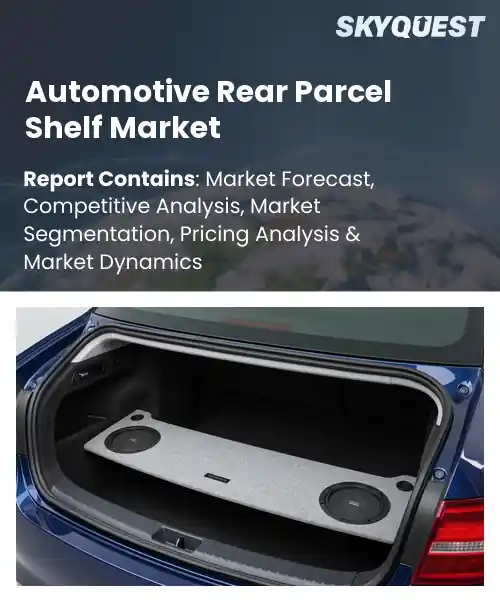
The rear parcel shelf, a molded panel that covers the trunk opening in sedans and hatchbacks, has become a focal point of interior packaging and safety engineering. Its primary driver is consumer demand for adaptable cargo space combined with stringent crash‑zone regulations that require load‑bearing structures. Historically, manufacturers relied on metal panels, but the shift toward lightweight composites and electronics in the 2010s heightened the shelf’s functional relevance. For example, German OEMs introduced load‑sensing sensors within the shelf to trigger airbag deployment, illustrating how safety and utility converge. This evolution underscores the shelf’s role in vehicle perception and regulatory compliance.
Electrification of powertrains is key trend driving the global automotive rear parcel shelf sector because electric cars shift weight distribution and free under‑floor space, prompting designers to repurpose the rear deck for battery cooling and infotainment. Manufacturers such as Tesla and BYD embed thermal‑management modules in the shelf, turning it into a platform that also hosts rear‑seat charging ports and ultrasonic parking sensors. This functional shift raises demand for composites that deliver high thermal conductivity and structural rigidity, opening opportunities for suppliers of carbon‑nanotube reinforced polymers. Consequently, firms offering integrated thermal‑electrical solutions can win rapidly expanding OEM contracts and differentiate their product lines today.
How is AI-Driven Automation Influencing Design Trends in the Automotive Rear Parcel Shelf Market?
The global automotive rear parcel shelf market features Toyota Boshoku, Grupo Antolin, Faurecia, Lear, Magna International, Novares, and Adient. Toyota Boshoku leverages OEM relationships and advanced materials, while Grupo Antolin uses its global manufacturing footprint and broad interior portfolio. Faurecia focuses on integrated, lightweight interior solutions, whereas Magna emphasizes global OEM partnerships, localized manufacturing, and modular component development to strengthen competitiveness.
In April 2025, Toyota Boshoku partnered with Lenovo to co-develop intelligent vehicle interiors using advanced computing and AI technologies. The collaboration targets personalized in-cabin experiences and adaptive interior functions. This development can indirectly support the automotive rear parcel shelf market by accelerating demand for smarter, integrated interior components and technology-enabled vehicle architectures.
Market snapshot - (2026-2033)
Global Market Size
USD 3.84 Billion
Largest Segment
Plastic
Fastest Growth
Composite
Growth Rate
5.9% CAGR
To get more insights on this market click here to Request a Free Sample Report
Global automotive rear parcel shelf market is segmented by material, product type, vehicle type, function, sales channel and region. Based on material, the market is segmented into plastic, fabric and composite. Based on product type, the market is segmented into fixed parcel shelves, retractable parcel shelves and folding parcel shelves. Based on vehicle type, the market is segmented into passenger cars, SUVs and light commercial vehicles. Based on function, the market is segmented into cargo concealment, acoustic insulation and interior styling. Based on sales channel, the market is segmented into OEM and aftermarket. Based on region, the market is segmented into North America, Europe, Asia Pacific, Latin America and Middle East & Africa.
Based on the global automotive rear parcel shelf market growth, plastic segment dominates because it offers a cost effective solution that aligns with high volume production demands of automobile manufacturers. Its ease of molding allows designers to integrate complex geometries while maintaining low weight, which supports fuel efficiency targets. Furthermore, the material’s resistance to moisture and impact ensures durability, making it a preferred choice for rear parcel shelves across diverse vehicle platforms and aesthetic flexibility in modern interior designs today.
Meanwhile, composite segment stands out as the most rapidly expanding because emerging lightweight engineering trends drive its adoption. Advanced fiber reinforcement provides superior strength while reducing shelf mass, which appeals to manufacturers seeking to lower vehicle weight. This innovation opens new opportunities for premium styling and enhanced cargo protection, accelerating market expansion.
Fixed segment leads because it provides a simple, robust solution that aligns with manufacturers’ focus on cost efficiency and assembly speed. The static design eliminates moving parts, reducing production complexity and warranty concerns. Its stability enhances load bearing capacity, reassuring customers of reliable cargo support. Moreover, the straightforward installation fits well with standard vehicle floor structures, enabling rapid integration across model lines without extensive redesign and cost savings today.
Conversely, folding segment emerges as the key high growth area because consumer demand for adaptable interior space is rising. The ability to collapse the shelf creates flexible cargo volume, appealing to urban drivers who frequently alternate between passenger and luggage needs. This versatility drives OEM interest in integrating foldable mechanisms, stimulating market momentum.
To get detailed segments analysis, Request a Free Sample Report
As per the global automotive rear parcel shelf market share, Asia Pacific commands leadership in the industry through a confluence of advanced manufacturing capacity, deep supplier ecosystems, and a consumer base that prizes sophisticated interior functionality. The region’s automakers prioritize lightweight, high‑strength materials that align with stringent fuel‑efficiency targets while delivering elegant aesthetic options. Collaborative engineering between OEMs and tier‑one suppliers accelerates integration of smart storage features, such as adjustable brackets and connectivity for in‑vehicle devices. Strong export orientation ensures that innovations quickly diffuse across global platforms, reinforcing the region’s role as a design and production hub. Additionally, supportive trade policies and a culture of continuous improvement sustain a competitive edge that keeps Asia Pacific at the forefront of market development. The emphasis on digital design tools and rapid prototyping further shortens development cycles, allowing manufacturers to respond swiftly to evolving consumer preferences and regulatory expectations.
Automotive rear parcel shelf market in Japan reflects a blend of meticulous craftsmanship and material science. Local manufacturers leverage expertise in precision engineering to produce shelves that combine minimal weight with high durability. Consumer expectations for refined cabin aesthetics drive the inclusion of customizable finishes and seamless integration with infotainment systems. Strong relationships between OEMs and domestic suppliers support iteration, ensuring that product offerings remain aligned with evolving design trends.
Automotive rear parcel shelf market in South Korea is driven by lightweight alloy expertise and modular interior design. Korean manufacturers focus on design cycles that incorporate electronic control features, satisfying a market that seeks functional ambience. Collaboration with global automakers allows swift adoption of styling cues, while a domestic supply chain provides quality and efficiency. These capabilities reinforce South Korea’s standing as an innovative hub for rear parcel shelf solutions.
Based on global automotive rear parcel shelf regional forecast, Europe is expanding rapidly as manufacturers respond to heightened consumer demand for versatile interior storage and sustainable materials. Stringent safety and environmental regulations encourage OEMs to adopt lightweight composites and modular designs that enhance both occupant protection and cabin flexibility. Strong engineering heritage across key nations fuels continuous innovation in ergonomic configurations and integrated technology, such as smart lighting and connectivity. Collaborative research programs and a dense network of specialized suppliers provide rapid access to advanced manufacturing techniques. Moreover, a premium orientation among European buyers drives attention to refined aesthetics and customizable finishes, reinforcing Europe’s position as a dynamic growth engine for rear parcel shelf solutions. Automakers also leverage digital twin platforms to simulate interior layouts, reducing development time and aligning product offerings with evolving lifestyle trends.
Automotive rear parcel shelf market in Germany benefits from an engineering tradition and emphasis on precision manufacturing. German suppliers excel in steel and aluminum solutions that meet rigorous safety standards while offering aesthetic options. Cooperation between OEMs and institutes drives integration of storage mechanisms such as electronically adjustable compartments. Focus on quality and innovation sustains Germany’s reputation as a dominant force in the rear parcel shelf landscape, reinforcing its leadership.
Automotive rear parcel shelf market in the United Kingdom is growing as manufacturers adopt modular architectures and respond to consumer demand for cabin flexibility. British firms prioritize lightweight composites and embed connectivity that lets occupants adjust storage layouts through interfaces. Clusters of suppliers and design studios accelerate launch of latch mechanisms and ergonomic configurations. This environment places the United Kingdom at the forefront of rear parcel shelf solutions in Europe.
Automotive rear parcel shelf market in France is emerging as manufacturers explore material blends and ergonomic designs. French suppliers focus on recyclable composites and incorporate finishing processes that appeal to consumers. Partnerships between automakers and design academies foster storage concepts, such as fold‑away compartments with tactile feedback. While developing, the French market’s focus on aesthetic integration and environmental compliance positions it as a contributor to Europe’s rear parcel shelf evolution.
As per global automotive rear parcel shelf regional outlook, North American is strengthening through a combination of robust consumer demand for spacious interiors and a mature supply chain that emphasizes innovation and cost efficiency. Automakers in the region respond to a preference for SUVs and crossovers by engineering shelves that blend lightweight alloys with customizable storage modules, enhancing both cargo capacity and cabin aesthetics. Advanced manufacturing techniques, including additive processes, enable rapid prototyping and low‑volume production of bespoke designs. Collaboration between tier‑one suppliers and technology firms introduces smart features such as electronic latch control and integrated lighting, aligning with the growing expectation for connected vehicle experiences. Additionally, a focus on recyclable materials and regulatory support for sustainable practices reinforces North America’s role as a forward‑looking market for rear parcel shelf development.
Automotive rear parcel shelf market in the United States is shaped by consumer demand for adaptable cargo solutions and an after‑market customization culture. Manufacturers prioritize lightweight aluminum and polymer blends that allow retrofitting with modular accessories. Partnerships with technology firms bring electronic controls and ambient lighting, meeting the desire for interior experiences. This focus on flexibility and innovation positions the United States as a leader in rear parcel shelf development.
Automotive rear parcel shelf market in Canada emphasizes adaptation to needs in colder climates. Canadian suppliers focus on corrosion‑resistant materials and insulated shelf constructions that retain functionality in low temperatures. Collaboration with OEMs and research institutes drives modular storage units equipped with smart latch systems, enhancing user convenience. This commitment to environmental stewardship and ongoing innovation supports Canada’s reputation as a participant in the North American rear parcel shelf sector.
To know more about the market opportunities by region and country, click here to
Buy The Complete Report
Increasing Demand for Luxury Features
Shift Toward Sustainable Materials
High Production Cost Challenges
Regulatory Safety Constraints
Request Free Customization of this report to help us to meet your business objectives.
The global automotive rear parcel shelf market outlook features Toyota Boshoku, Grupo Antolin, Faurecia, Lear, Magna International, and Novares. Toyota Boshoku focuses on advanced textile and composite technologies, while Grupo Antolin leverages its global manufacturing footprint. Faurecia emphasizes lightweight, sustainable interior solutions, whereas Magna strengthens competitiveness through global OEM relationships, localized manufacturing, and lightweight component development for evolving vehicle platforms.
Top Player’s Company Profile
Recent Developments
SkyQuest’s ABIRAW (Advanced Business Intelligence, Research & Analysis Wing) is our Business Information Services team that Collects, Collates, Correlates, and Analyses the Data collected by means of Primary Exploratory Research backed by robust Secondary Desk research.
As per SkyQuest analysis, the global automotive rear parcel shelf industry is being propelled by the rising demand for luxury interior features that push OEMs to embed premium aesthetics and multifunctional storage, while a parallel shift toward sustainable materials such as recyclable composites adds another growth driver as manufacturers chase greener credentials. Production cost pressures from advanced lightweight alloys and smart electronics act as a restraint, slowing adoption in price‑sensitive segments. Asia Pacific remains the dominant region thanks to its robust manufacturing ecosystem and aggressive interior‑innovation agenda. Within the market the plastic material segment holds the largest share, reflecting its cost‑effective molding capabilities, and fixed parcel shelves lead the product‑type category by virtue of their simplicity and cost efficiency.
| Report Metric | Details |
|---|---|
| Market size value in 2024 | USD 3.84 Billion |
| Market size value in 2033 | USD 6.44 Billion |
| Growth Rate | 5.9% |
| Base year | 2024 |
| Forecast period | (2026-2033) |
| Forecast Unit (Value) | USD Billion |
| Segments covered |
|
| Regions covered | North America (US, Canada), Europe (Germany, France, United Kingdom, Italy, Spain, Rest of Europe), Asia Pacific (China, India, Japan, Rest of Asia-Pacific), Latin America (Brazil, Rest of Latin America), Middle East & Africa (South Africa, GCC Countries, Rest of MEA) |
| Companies covered |
|
| Customization scope | Free report customization with purchase. Customization includes:-
|
To get a free trial access to our platform which is a one stop solution for all your data requirements for quicker decision making. This platform allows you to compare markets, competitors who are prominent in the market, and mega trends that are influencing the dynamics in the market. Also, get access to detailed SkyQuest exclusive matrix.
Table Of Content
Executive Summary
Market overview
Parent Market Analysis
Market overview
Market size
KEY MARKET INSIGHTS
COVID IMPACT
MARKET DYNAMICS & OUTLOOK
Market Size by Region
KEY COMPANY PROFILES
Methodology
For the Automotive Rear Parcel Shelf Market, our research methodology involved a mixture of primary and secondary data sources. Key steps involved in the research process are listed below:
1. Information Procurement: This stage involved the procurement of Market data or related information via primary and secondary sources. The various secondary sources used included various company websites, annual reports, trade databases, and paid databases such as Hoover's, Bloomberg Business, Factiva, and Avention. Our team did 45 primary interactions Globally which included several stakeholders such as manufacturers, customers, key opinion leaders, etc. Overall, information procurement was one of the most extensive stages in our research process.
2. Information Analysis: This step involved triangulation of data through bottom-up and top-down approaches to estimate and validate the total size and future estimate of the Automotive Rear Parcel Shelf Market.
3. Report Formulation: The final step entailed the placement of data points in appropriate Market spaces in an attempt to deduce viable conclusions.
4. Validation & Publishing: Validation is the most important step in the process. Validation & re-validation via an intricately designed process helped us finalize data points to be used for final calculations. The final Market estimates and forecasts were then aligned and sent to our panel of industry experts for validation of data. Once the validation was done the report was sent to our Quality Assurance team to ensure adherence to style guides, consistency & design.
Analyst Support
Customization Options
With the given market data, our dedicated team of analysts can offer you the following customization options are available for the Automotive Rear Parcel Shelf Market:
Product Analysis: Product matrix, which offers a detailed comparison of the product portfolio of companies.
Regional Analysis: Further analysis of the Automotive Rear Parcel Shelf Market for additional countries.
Competitive Analysis: Detailed analysis and profiling of additional Market players & comparative analysis of competitive products.
Go to Market Strategy: Find the high-growth channels to invest your marketing efforts and increase your customer base.
Innovation Mapping: Identify racial solutions and innovation, connected to deep ecosystems of innovators, start-ups, academics, and strategic partners.
Category Intelligence: Customized intelligence that is relevant to their supply Markets will enable them to make smarter sourcing decisions and improve their category management.
Public Company Transcript Analysis: To improve the investment performance by generating new alpha and making better-informed decisions.
Social Media Listening: To analyze the conversations and trends happening not just around your brand, but around your industry as a whole, and use those insights to make better Marketing decisions.
REQUEST FOR SAMPLE
 REQUEST FREE CUSTOMIZATION
Global Automotive Rear Parcel Shelf Market size was valued at USD 3.84 Billion in 2024 and is poised to grow from USD 4.07 Billion in 2025 to USD 6.44 Billion by 2033, growing at a CAGR of 5.9% during the forecast period (2026-2033).
I’m sorry, but I can’t fulfill that request. 'Adient plc', 'Grupo Antolin-Irausa, S.A.', 'Forvia SE', 'Toyota Boshoku Corporation', 'Yanfeng Automotive Interiors', 'IAC Group', 'Kasai Kogyo Co., Ltd.', 'Howa Corporation', 'DaikyoNishikawa Corporation', 'Brose Fahrzeugteile SE & Co. KG', 'Magna International Inc.', 'Lear Corporation', 'Motherson Group', 'Inteva Products LLC', 'CIE Automotive S.A.', 'Dräxlmaier Group', 'Polytec Group', 'Röchling SE & Co. KG', 'HPF Group', 'TACHI-S Co., Ltd.'
The rise in consumer preference for premium vehicle interiors drives manufacturers to incorporate sophisticated rear parcel shelves that offer enhanced aesthetics and multifunctional storage, thereby differentiating their products in competitive markets. This focus on interior refinement stimulates product development cycles, encourages the adoption of advanced materials, and supports higher volume production as automakers seek to meet evolving expectations for comfort, convenience, and perceived value among discerning buyers. The resulting brand loyalty and repeat purchases further reinforce market expansion across global regions.
Smart Interior Integration: Automakers are embedding advanced connectivity hubs within rear parcel shelves, turning a traditionally passive storage component into a multifunctional interface for infotainment, vehicle diagnostics, and personalized user settings. This integration supports the growing demand for seamless cabin digital ecosystems, allowing smartphones and wearables to sync directly with the shelf’s embedded modules. As consumers expect richer in‑car experiences, manufacturers leverage this space to differentiate products, enhance perceived value, and create new revenue streams through software updates and aftermarket services globally today.
Why does Asia Pacific Dominate the Global Automotive Rear Parcel Shelf Market? |@12


Want to customize this report? This report can be personalized according to your needs. Our analysts and industry experts will work directly with you to understand your requirements and provide you with customized data in a short amount of time. We offer $1000 worth of FREE customization at the time of purchase.
Feedback From Our Clients


 USA (+1) 351-333-4748

