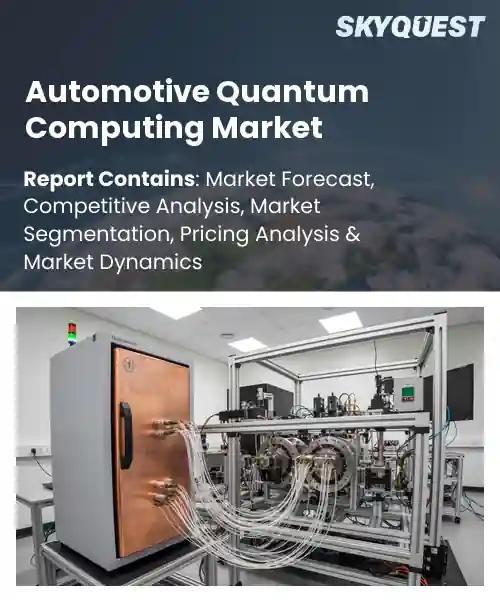
Automotive Quantum Computing Market
Report ID: SQMIG45B2325
Report ID: SQMIG45B2325
[email protected]
USA +1 351-333-4748
Report ID:
SQMIG45B2325 |
Region:
Global |
Published Date: June, 2026
Pages:
157
|Tables:
179
|Figures:
79


Global Automotive Quantum Computing Market size was valued at USD 245.61 Million in 2024 and is poised to grow from USD 340.66 Million in 2025 to USD 4665.89 Million by 2033, growing at a CAGR of 38.7% during the forecast period (2026-2033).
Growing demand for advanced vehicle optimization, increasing investments in next-generation computing technologies, rising focus on battery innovation and autonomous mobility, expanding collaborations between automotive and quantum technology companies, and advancements in quantum hardware and software are driving sales of automotive quantum computing solutions.
The increasing need to solve highly complex optimization, simulation, and computational challenges is expected to primarily drive automotive quantum computing market growth. Initial applications for route optimization, material research and manufacturing process enhancement showed quantum computing's power for automotive innovation, but improving quantum hardware performance and the evolution of hybrid quantum-classical computing systems are also playing a key role for market growth. As more qubits are achieved with better error rates researchers and automotive manufacturers will be enabled to tackle ever more complicated business issues. Carmakers and suppliers have started using the accessible cloud-based quantum platforms for battery chemical optimization, logistics network efficiency and for autonomous mobility as well as automotive engineering tasks. Pilot projects are driving investment while increasing a community of software companies and hardware makers in the sector are now offering services and support for carmakers and their suppliers, alongside more traditional consulting companies who have embraced quantum as a new key technology. Commercialization efforts and technical innovation will ensure new business scope.
However, high implementation costs, limited availability of large-scale quantum hardware, technical challenges related to error correction and scalability, and uncertainty regarding commercial deployment timelines are anticipated to slow down automotive quantum computing market penetration in the long run.
How Will Quantum Computing And AI Accelerate Automotive Supply Chain Optimization?
The combination of sophisticated optimization techniques and intelligent forecasting is a driving force behind the use of quantum computing and AI to solve difficult supply chain problems. Where classical systems struggle with highly combinatorial optimization challenges in routing, scheduling, and inventory optimization, quantum computing comes in. AI enables better demand prediction, error detection and rapid real-time decisions in these systems. These technologies are shifting from pure research to pilot tests and industry pilots, with automotive companies and suppliers beginning to experiment with hybrid quantum-AI workflows. Use cases currently being tested range from battery material simulation and manufacturing and planning and logistics to supply chain optimization. AI provides a platform which can react to disruption events and quantum algorithms can find highly efficient solutions for large scale operational challenges.
Market snapshot - (2026-2033)
Global Market Size
USD 245.61 Million
Largest Segment
Quantum Software & Algorithms
Fastest Growth
Quantum Hardware
Growth Rate
38.7% CAGR
To get more insights on this market click here to Request a Free Sample Report
Global automotive quantum computing market is segmented by component, deployment model, technology, application, vehicle type, end user, and region. Based on component, the market is segmented into quantum hardware, quantum software & algorithms, and quantum computing services. Based on deployment model, the market is segmented into cloud-based quantum computing, on-premises quantum computing, and hybrid quantum computing. Based on technology, the market is segmented into quantum annealing, gate-based quantum computing, and topological quantum computing. Based on application, the market is segmented into autonomous driving & ADAS optimization, traffic & route optimization, battery chemistry & energy storage simulation, vehicle design & engineering simulation, manufacturing & supply chain optimization, predictive maintenance, cybersecurity & automotive encryption, and others. Based on vehicle type, the market is segmented into passenger vehicles, commercial vehicles, electric vehicles, and autonomous vehicles. Based on end user, the market is segmented into automotive OEMs, automotive suppliers & tier-1 companies, mobility service providers, automotive research institutes & universities, and others. Based on region, the market is segmented into North America, Europe, Asia Pacific, Latin America, and Middle East & Africa.
The quantum software & algorithms segment is expected to lead the global automotive quantum computing market revenue generation over the coming years. It offers the necessary abstraction layer that transforms complicated automotive issues into quantum-ready descriptions, to facilitate optimization, simulation, and machine learning pipelines for vehicle design, battery chemistries, and traffic systems. With middleware, hybrid orchestration, error mitigation, and domain specific toolkits it reduces the integration burden with classical systems, accelerates time to solution and enhances the use among OEMs and suppliers that are focused on tangible application results.
However, quantum hardware segment is emerging as the most rapidly expanding segment as per this automotive quantum computing market forecast. Since advances in qubit coherence connectivity and application-specific device architectures are enabling larger problem sizes that are more relevant to auto workloads. Increasing hardware performance brings in business and VC capital encourages pilot deployments with actual industry data and increases the need for integration and verification services that broaden the total market.
The quantum annealing segment is slated to account for the highest global automotive quantum computing market share in the long run. The physics-based approach lends itself well to the combinatorial optimization tasks often encountered in the automotive industry: routing, fleet scheduling and production planning. The commercial annealers that currently exist provide us with "ready-to-use" programmability and embedding facilities that ease the programming complexity, so that the manufacturers and mobility services can test solutions rapidly and extract value from these constrained optimization problems in the short term.
Meanwhile, gate-based quantum computing segment is witnessing the strongest growth momentum due to improvements in qubit quality, algorithmic breakthroughs and simulation methods expanding applicability to vehicle dynamics, materials discovery and battery chemistry. Developments towards error correction and universal programmability is fueling partnership and funding and gate-based systems are emerging as the end game platform for ultimate automotive applications.
To get detailed segments analysis, Request a Free Sample Report
North America dominates the global automotive quantum computing market due to a convergence of technological leadership, industry partnerships, and robust commercialization pathways. The region benefits from a dense ecosystem where original equipment manufacturers, tier suppliers, cloud providers, and quantum hardware and software startups collaborate closely with leading research institutions. Access to specialized talent pools and venture capital enables faster translation of laboratory advances into applied automotive use cases such as complex system simulation and materials discovery. Strategic alliances between automotive firms and quantum service providers foster early pilots and iterative refinement. Supporting infrastructure, including high-performance computing and semiconductor expertise, further accelerates solution integration. Regulatory and defense-driven research priorities also channel resources into quantum projects that can be adapted for commercial mobility applications.
Automotive quantum computing market in the United States centers on collaboration between major automakers, cloud service providers, and quantum research centers. Innovations focus on complex simulation, route optimization, and materials modeling, supported by investment and technological infrastructure. Pilot projects occur in established automotive clusters where cross-sector partnerships accelerate commercialization pathways. Talent concentration and proximity to semiconductor and software ecosystems facilitate integration of experimental quantum algorithms into vehicle development workflows.
Collaborative research between academic institutions, technology startups, and automotive suppliers are helping shape demand for automotive quantum computing in Canada. Focusing on simulation for materials, battery creation, algorithm implementation, and secured communications for connected mobility. Public research initiatives, alongside innovation centers, enable pilot programs to connect local companies with overseas actors. Emphasis on the creation of talent and collaborations will assist in moving from quantum prototypes to engineering implementations, while being co-located to the automotive clusters in North America helps in the commercialization process.
Concentrated industrial research and development efforts, strong semiconductor and electronics manufacturing capabilities, and coordinated public-private strategies are helping create new business scope in the region. Regional automotive manufacturers and suppliers are joining forces with domestic quantum research organizations and start ups to find use cases for quantum technologies in materials discovery, battery optimization, traffic management, and secure vehicle communications. National innovation agendas along with corporate research investments encourage collaboration across sectors, while a dense advanced electronics supply chain facilitates practical testing and integration. Strong partnerships with international quantum service providers, and the availability of more engineering expertise to support the development of quantum technologies into practical automotive solutions in the Asia-Pacific Region, will promote pilot deployments and help translate quantum algorithms into manufacturable automotive solutions throughout the region. Funding programs from government agencies and regional testbed facilities are providing practical experimentation environments for iterative testing and validation.
Integration between established automakers, semiconductor manufacturers, and national research institutions helps boost automotive quantum computing R&D in Japan. The focus on materials modeling, battery systems and detailed simulation is directed to enhancing vehicle efficiency and manufacturing. Companies' research centers and startups work on pilot projects with precision engineering facilities. The collaboration is sustained by an industrial partnership culture and applied research approach that facilitate the quantum prototypes transition into industrial tools for the car design and manufacturing processes.
Automotive quantum computing demand in South Korea leverages a strong electronics and semiconductor base with industry-academia collaboration. Automakers and their supply chain collaborate with tech companies to investigate use cases for quantum technologies ranging from battery materials, vehicle system optimization to factory automation. Avenues of innovation from government initiatives and research labs for the business are available to pilot quantum algorithms into AI workflows for fast iterations between prototype and manufacturing tooling. This is bolstered by collaboration across boundaries.
Coordinated research networks, strategic industrial partnerships, and targeted innovation ecosystems that link automakers, suppliers, and quantum technology providers are creating new opportunities in the region. Strong engineering heritage and several advanced production clusters provide the ability to conduct applied research in the areas of vehicle design, materials development, and optimization of systems. The establishment of cross-border consortia and academic collaborations strengthens the ability to share knowledge and develop common standards and test bed facilities for mobility applications. Start-up companies that specialize in quantum technologies are being incubated and are partnering with cloud-based quantum service providers to allow for scalable access to hardware and software resources. Public funding mechanisms and industry led activities are directing the activities towards use cases that align with broader digitalization and decarbonization priorities, thus providing a pragmatic path from laboratory experimentation to demonstrator projects to the development of commercial engineering tools. Regulatory engagement and standards development enhance interoperability and provide assurance to the industry regarding the implementation of early-stage deployments.
Adoption of automotive quantum computing in Germany is rooted in a mature automotive engineering ecosystem where OEMs, suppliers, and research institutes collaborate on quantum projects. Focus areas include complex system simulation, materials modeling, and production optimization to support manufacturing. Industry-led testbeds and specialized startups enable pilots, while engineering expertise facilitates integration of quantum algorithms into existing development toolchains. Strong industrial collaboration supports practical validation and progression to demonstrator projects globally.
Automotive quantum computing market in the United Kingdom is anchored by leading quantum research centers, university-industry collaboration, and startup scene. Cloud strategy and partnerships with service providers allow the car companies to access quantum computing resources. Co-operative test beds and industrial groups will support translating research to demonstrator projects and engineering tools. The focus will be on developing algorithms, secure communications for connected vehicles and advanced modeling for materials and systems integration.
Automotive quantum computing demand in France combines research laboratories, automotive manufacturers, and startups to pursue materials research, vehicle systems simulation, and secure communication protocols for connected mobility. Public innovation initiatives and regional centers offer a space to conduct pilot projects and cross-sectorial collaboration networks linking universities and companies. The French know-how on engineering and specialized software houses help to adapt quantum algorithms to be integrated in workflows and to reach validation level that directly fit in the automotive development loop.
To know more about the market opportunities by region and country, click here to
Buy The Complete Report
Quantum Enhanced Optimization Capabilities
Improved Autonomous Driving Algorithms
High Technical Complexity And Integration
Limited Availability Of Skilled Talent
Request Free Customization of this report to help us to meet your business objectives.
Competition in the global automotive quantum computing market is driven by automakers acquiring or partnering with quantum specialists to capture optimization, materials discovery and cybersecurity advantages. Strategic moves include hardware software mergers exemplified by the Quantinuum tie up, commercial pilots such as Volkswagen with D Wave and BMW with Honeywell and Entropica, and industry collaborations like Multiverse Computing with Bosch to embed quantum tools in manufacturing.
SkyQuest’s ABIRAW (Advanced Business Intelligence, Research & Analysis Wing) is our Business Information Services team that Collects, Collates, Correlates, and Analyses the Data collected by means of Primary Exploratory Research backed by robust Secondary Desk research.
As per SkyQuest analysis, high demand for advanced vehicle optimization, increasing investments in next-generation computing technologies, rising focus on battery innovation and autonomous mobility, expanding collaborations between automotive and quantum technology companies, and advancements in quantum hardware and software are anticipated to drive the demand for automotive quantum computing solutions going forward. However, high implementation costs, limited availability of large-scale quantum hardware, technical challenges related to error correction and scalability, and uncertainty regarding commercial deployment timelines are slated to slow down the adoption of automotive quantum computing solutions in the future. North America is slated to spearhead the demand for automotive quantum computing owing to strong investments in quantum research, presence of leading technology providers, and increasing collaborations between automotive manufacturers and computing companies. Development of hybrid quantum-AI optimization platforms, growing use of quantum computing for battery material discovery and supply chain management, and expansion of cloud-accessible quantum computing services are anticipated to be key trends driving the automotive quantum computing market in the future.
| Report Metric | Details |
|---|---|
| Market size value in 2024 | USD 245.61 Million |
| Market size value in 2033 | USD 4665.89 Million |
| Growth Rate | 38.7% |
| Base year | 2024 |
| Forecast period | (2026-2033) |
| Forecast Unit (Value) | USD Million |
| Segments covered |
|
| Regions covered | North America (US, Canada), Europe (Germany, France, United Kingdom, Italy, Spain, Rest of Europe), Asia Pacific (China, India, Japan, Rest of Asia-Pacific), Latin America (Brazil, Rest of Latin America), Middle East & Africa (South Africa, GCC Countries, Rest of MEA) |
| Companies covered |
|
| Customization scope | Free report customization with purchase. Customization includes:-
|
To get a free trial access to our platform which is a one stop solution for all your data requirements for quicker decision making. This platform allows you to compare markets, competitors who are prominent in the market, and mega trends that are influencing the dynamics in the market. Also, get access to detailed SkyQuest exclusive matrix.
Table Of Content
Executive Summary
Market overview
Parent Market Analysis
Market overview
Market size
KEY MARKET INSIGHTS
COVID IMPACT
MARKET DYNAMICS & OUTLOOK
Market Size by Region
KEY COMPANY PROFILES
Methodology
For the Automotive Quantum Computing Market, our research methodology involved a mixture of primary and secondary data sources. Key steps involved in the research process are listed below:
1. Information Procurement: This stage involved the procurement of Market data or related information via primary and secondary sources. The various secondary sources used included various company websites, annual reports, trade databases, and paid databases such as Hoover's, Bloomberg Business, Factiva, and Avention. Our team did 45 primary interactions Globally which included several stakeholders such as manufacturers, customers, key opinion leaders, etc. Overall, information procurement was one of the most extensive stages in our research process.
2. Information Analysis: This step involved triangulation of data through bottom-up and top-down approaches to estimate and validate the total size and future estimate of the Automotive Quantum Computing Market.
3. Report Formulation: The final step entailed the placement of data points in appropriate Market spaces in an attempt to deduce viable conclusions.
4. Validation & Publishing: Validation is the most important step in the process. Validation & re-validation via an intricately designed process helped us finalize data points to be used for final calculations. The final Market estimates and forecasts were then aligned and sent to our panel of industry experts for validation of data. Once the validation was done the report was sent to our Quality Assurance team to ensure adherence to style guides, consistency & design.
Analyst Support
Customization Options
With the given market data, our dedicated team of analysts can offer you the following customization options are available for the Automotive Quantum Computing Market:
Product Analysis: Product matrix, which offers a detailed comparison of the product portfolio of companies.
Regional Analysis: Further analysis of the Automotive Quantum Computing Market for additional countries.
Competitive Analysis: Detailed analysis and profiling of additional Market players & comparative analysis of competitive products.
Go to Market Strategy: Find the high-growth channels to invest your marketing efforts and increase your customer base.
Innovation Mapping: Identify racial solutions and innovation, connected to deep ecosystems of innovators, start-ups, academics, and strategic partners.
Category Intelligence: Customized intelligence that is relevant to their supply Markets will enable them to make smarter sourcing decisions and improve their category management.
Public Company Transcript Analysis: To improve the investment performance by generating new alpha and making better-informed decisions.
Social Media Listening: To analyze the conversations and trends happening not just around your brand, but around your industry as a whole, and use those insights to make better Marketing decisions.
REQUEST FOR SAMPLE
 REQUEST FREE CUSTOMIZATION
Global Automotive Quantum Computing Market size was valued at USD 245.61 Million in 2024 and is poised to grow from USD 340.66 Million in 2025 to USD 4665.89 Million by 2033, growing at a CAGR of 38.7% during the forecast period (2026-2033).
Competition in the global automotive quantum computing market is driven by automakers acquiring or partnering with quantum specialists to capture optimization, materials discovery and cybersecurity advantages. Strategic moves include hardware software mergers exemplified by the Quantinuum tie up, commercial pilots such as Volkswagen with D Wave and BMW with Honeywell and Entropica, and industry collaborations like Multiverse Computing with Bosch to embed quantum tools in manufacturing. 'IBM Corporation', 'D-Wave Quantum Inc.', 'Rigetti Computing, Inc.', 'IonQ, Inc.', 'Quantinuum Ltd.', 'Microsoft Corporation', 'Amazon Web Services, Inc.', 'Google LLC', 'Intel Corporation', 'NVIDIA Corporation', 'Classiq Technologies Ltd.', 'Xanadu Quantum Technologies Inc.', 'Pasqal SAS', 'QuEra Computing Inc.', 'Bosch Quantum Sensing GmbH', 'BMW AG', 'Mercedes-Benz Group AG', 'Volkswagen AG', 'Hyundai Motor Company', 'Toyota Motor Corporation'
Quantum computing enables more effective optimization of complex vehicle design, supply chain scheduling, and real-time routing by exploring large solution spaces and identifying better outcomes than classical methods. This capability attracts automotive companies seeking competitive advantage through improved efficiency and reduced development cycles, encouraging investment and collaboration with quantum technology providers. As a result, demand for quantum hardware, software, and services in automotive contexts increases, supporting ecosystem growth, fostering innovation, and accelerating market adoption across vehicle design and operational functions.
Quantum Accelerated Vehicle Simulation: Automakers are increasingly adopting quantum computing to simulate complex vehicle systems and materials with higher fidelity, enabling faster virtual prototyping across propulsion, thermal management, and crashworthiness. This trend reduces reliance on iterative physical testing, shortens development cycles, and promotes design innovation by exploring broader parameter spaces. Collaboration between OEMs, suppliers, and quantum providers is accelerating deployment of specialized simulation workflows that integrate classical and quantum resources, facilitating risk reduction, greater design confidence, and more sustainable engineering choices and market acceleration.
Why does North America Dominate the Global Automotive Quantum Computing Market? |@12


Want to customize this report? This report can be personalized according to your needs. Our analysts and industry experts will work directly with you to understand your requirements and provide you with customized data in a short amount of time. We offer $1000 worth of FREE customization at the time of purchase.
Feedback From Our Clients


 USA (+1) 351-333-4748

