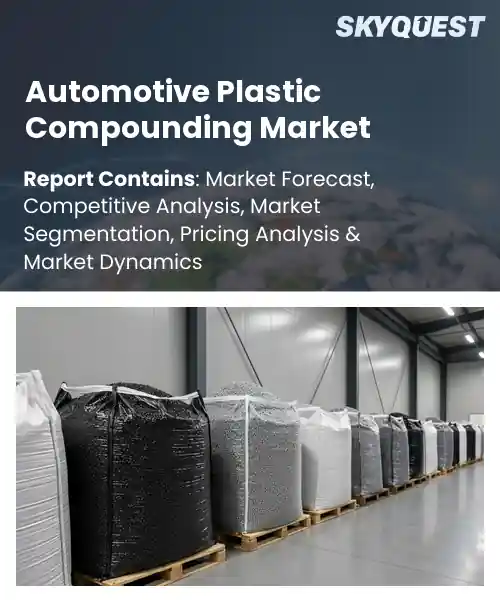
Automotive Plastic Compounding Market
Report ID: SQMIG15E3702
Report ID: SQMIG15E3702
[email protected]
USA +1 351-333-4748
Report ID:
SQMIG15E3702 |
Region:
Global |
Published Date: June, 2026
Pages:
157
|Tables:
121
|Figures:
77


Global Automotive Plastic Compounding Market size was valued at USD 22.00 Billion in 2024 and is poised to grow from USD 23.21 Billion in 2025 to USD 35.62 Billion by 2033, growing at a CAGR of 5.5% during the forecast period (2026-2033).
Automotive plastic compounding market trends creates mixes of resins with additives and reinforcements designed to meet the specifications of various vehicle subsystem applications. Lightweighting is the primary driver of this market since reducing vehicle mass will reduce fuel consumption and increase the distance that an electric vehicle can travel using thermoplastics instead of metals. The importance of this market is that the compounds enable complex shapes, corrosion resistance, and cost advantages that most metal components do not provide. Over the years, compounding has progressed from filler loaded grades to highly customised formulations such as glass fibre reinforced polyamides for structural brackets and flame retardant blends for electrical modules.
An example of this is manufacturers replacing metal air intake manifolds with moulded polyamide components to improve efficiency and simplify mass production while reducing assembly costs. Electrification has also increased demand for compounds that provide properties necessary to manage heat and electrically insulate high voltage systems. As a result, suppliers have developed flame-retardant, thermally conductive grades for protective battery enclosures. Therefore, automotive manufacturers are specifying the use of glass fibre reinforced polyamides for structural brackets and thermoplastic elastomers for sealing cables to help achieve lighter assemblies with improved safety. New legislation governing emissions and material recovery has led to increased investments in the use of recycled material content and the use of bio-based compounds as manufacturers must meet sustainability targets and lifecycle reporting requirements.
How is AI Optimizing Material Formulation in the Automotive Plastic Compounding Market?
Artificial Intelligence is revolutionizing materials formulation through the integration of data-driven models with established principles of materials science. An example of how we're achieving this can be found in how we are using predictive models to determine the performance of blends, virtual screening of fillers and polymers, and the acceleration of lab-to-line transfers. Overall, materials and tier suppliers are using artificial intelligence to lower iteration cycles while improving the recyclability and performance of their products, while still conforming to the specifications of the original equipment manufacturer.
Currently, the marketplace is supporting the advancement of these technologies due to the increasing demand for engineered plastics with more complex tradeoffs due to both the electrification of products and the more stringent sustainability criteria imposed by governments on the manufacture and usage of these products. The examples of digital material platforms and increasing levels of research and development (R&D) are examples of how we can speed up the process of formulating materials and reduce the time needed to qualify new materials.
In March 2026, Konica Minolta provided an example of using an AI system to optimize compounding and molding conditions that allowed formulators to adjust recipes for both recycled and biobased feedstock more quickly, thereby ultimately helping the industry to gain efficiencies during manufacturing and further supporting the growth of the adoption of sustainable plastics used in the automotive industry.
Market snapshot - (2026-2033)
Global Market Size
USD 22.0 Billion
Largest Segment
Polypropylene
Fastest Growth
Polyamide
Growth Rate
5.5% CAGR
To get more insights on this market click here to Request a Free Sample Report
Global automotive plastic compounding market is segmented by polymer type, process, vehicle type, end-use and region. Based on polymer type, the market is segmented into polypropylene, polyamide, polyurethane, polyvinyl chloride, acrylonitrile butadiene styrene and polycarbonate. Based on process, the market is segmented into injection molding, extrusion, blow molding and compression molding. Based on vehicle type, the market is segmented into passenger vehicles, light commercial vehicles, heavy commercial vehicles and two-wheelers. Based on end-use, the market is segmented into OEM and Aftermarket. Based on region, the market is segmented into North America, Europe, Asia Pacific, Latin America and Middle East & Africa.
The polypropylene continues to grow automotive plastic compounding market share steadily due to its combination of low weight, ease of manufacture, and wide variety of ways to customize formulations, all of which match the requirements of automotive manufacturers to build lightweight, long-lasting, and inexpensive automotive parts. Because polypropylene can be combined with so many types of additives, fillers, and surface coatings to achieve custom mechanical properties as well as aesthetic properties, polypropylene will continue to gain acceptance in automotive interior and exterior applications. The availability of polypropylene as a raw material that is less expensive and has established recycling methods will continue to add to its appeal for Tier manufacturers who seek more economical and scalable compound alternatives.
The polyamide segment of the automotive plastic compounding market forecast is now experiencing the fastest growth, primarily due to polyamide's superior resistance to heat and high-level mechanical performance in under-the-hood and structural applications. The availability of new/advanced formulations of toughened polyamides and improved processing methods have stimulated increased usage, resulting in investment by compounders in specialty grades of polyamides that enable higher performance applications and new opportunities in the aftermarket.
The injection molding segment has a dominant role in the automotive plastic compounding market growth due to its capability of creating complex shapes in a controlled manner as required by automakers worldwide based on their demand for precision and tight tolerances on a repeatable basis at high volume production rates. Injection molding also has a broad range of compound plastic materials with reinforced formulations, which allows designers to combine both aesthetic and structural functions into one piece. This reduces assembly time, which ultimately improves overall performance. The well-established tooling ecosystems along with established process controls further enhance the supplier’s preference for using injection molded compound solutions.
In contrast, both extrusion and co-extrusion processing technologies are showing rapid growth as innovative processing technology develops the ability to produce profile lengths and consistencies over multiple processing runs with multi-material profile construction used for trim and seals as well as structural reinforcement. Technology advancements in the area of co-extrusion and surface finishing along with faster developing compound formulations are expanding their application range and encouraging compounders to increase production capacity while developing custom grades that will lead to improved design and assembly efficiencies for the end-user.
To get detailed segments analysis, Request a Free Sample Report
The automotive plastic compounding market application for this area dominates because of various factors. These factors include a large number of manufacturing facilities expanding product supply as well as providing OEMs the ability to produce their products faster due to the existing infrastructure already in place. The automotive industry is supported through regional suppliers having established long outcoating processes as well as providing their own technical expertise to help produce faster production rates of composite materials and reduce the total cost of producing automotive components. Moreover, manufacturing costs will be significantly lower because of the number of existing supply chains with completed parts already developed by the supplier and found close enough together allowing for easy transportation. Government policies and other efforts by government, automobile manufacturers and associates continue to promote lightweighting and electrification, which will provide more opportunities for auto production functions, which will create cooperation and new business for both the material providers and the automobile manufacturers. These combined factors will continue to support the development of advanced automotive plastic solutions in the Asia Pacific region through cooperative measures established through the vertical supply chains and other global supply chains which will continue to support a strong supply chain with excellent growth potential.
Automotive plastic compounding market outlook in Japan is supported by a culture of precision engineering, close collaboration between material developers and automakers, and a focus on high-performance compounds for safety and fuel efficiency. Established supply chains enable rapid prototyping and scale up of specialized formulations. Emphasis on durability, recyclability, and integration with advanced manufacturing processes positions domestic compounds as preferred solutions for premium vehicle programs and components requiring high quality standards.
Automotive plastic compounding market regional forecast in South Korea is shaped by agile supply networks, automotive manufacturing clusters, and focus on lightweighting and high-strength compounds for electrified platforms. Local compounders emphasize rapid formulation cycles and close technical support to original equipment manufacturers, enabling tailored solutions for complex interior and structural components. Collaboration with research institutes and investments in processing technology enhance material performance and recyclability, bolstering competitiveness in regional and global programs.
The automotive plastic compounding industry in Europe is rapidly expanding. The compounding industry is growing because of strict environmental regulations, the presence of large-scale manufacturing for premium automotive products, and a collaborative supply chain focused on material performance and sustainability. Vehicle manufacturers are looking for lightweight vehicles and materials that can be recycled at the end of their life and have less impact on the environment throughout their lifecycle. As a result, manufacturers need advanced compounds that take into consideration mechanical performance and lightweighting, along with high-value formulations and bio-based/recyclable alternatives. A network of specialized compounding companies, material science centers, and tiered suppliers is working together to develop these types of products. There is also a strong push by governments and consumers for greener transportation solutions, which has led to investment in circular materials and designing for recycling. The presence of OEMs focused on quality and safety has created an even greater need to create and utilize customized compounds manufactured for applications on the inside, outside, and structural parts of vehicles, regardless of the vehicle end market.
Automotive plastic compounding market regional outlook in Germany benefits from a dense cluster of premium automakers, a well-developed supplier base, and a culture of engineering excellence that prioritize material performance and durability. Compounders work closely with manufacturers to deliver high-spec formulations for structural and powertrain-adjacent components. Emphasis on efficiency, safety, and recyclability supports development of specialized compounds and closed-loop initiatives. Industry research and testing infrastructure reinforces technology transfer from laboratories to manufacturing.
Automotive plastic compounding market penetration in United Kingdom is driven by dynamic innovation clusters, flexible compounders, and close ties between automotive designers and material scientists. Interest in lightweight multifunctional and recyclable materials that meet safety and performance expectations supports rapid uptake. Small enterprises play an active role in commercialization of novel formulations. Collaboration with academic centers and specialty processors supports niche applications in electrified mobility and interior systems, enhancing market responsiveness.
Automotive plastic compounding market analysis in France is characterized by growing emphasis on sustainable feedstocks, design applications, and collaboration between material innovators and vehicle designers. Emerging compounders focus on bio-based and easily recyclable formulations that respond to mobility trends and urban vehicle needs. Research institutions and specialized processors support pilot programs and technology validation. The market trajectory prioritizes circularity, design integration, and lightweight solutions that complement manufacturing capabilities and electrified architectures.
Through a combination of technological advancements, reshoring of supply chains, and close relationships with automotive suppliers and manufacturers, North America is growing its role in the automotive plastic compounding industry. High-performance, recyclable and light-weight compounds are in agreement with vehicle manufacturers as they look for components that will meet their safety/cost targets while also supporting electrified vehicles. Increased investments for domestic processing capabilities and advanced compound technology provide greater responsiveness to design changes and reduce reliance on global supplies. Working with universities and applied research institutes will speed the commercialization processes for bio-based/circular materials. Additionally, increased service and customization opportunities in the aftermarket provide any specialty compounder, with the ability to deliver customized formulations and/or solutions. These two market forces increase regional competitiveness and enable much greater integration of materials and vehicle design cycles.
Automotive plastic compounding industry in United States is driven by a large automotive ecosystem, research infrastructure, and a diverse supplier community capable of scaling advanced formulations. Compounders collaborate closely with original equipment manufacturers to develop high-performance, recyclable, and lightweight materials tailored to electrified platforms. Emphasis on process innovation and domestic production enhances supply chain resilience. Aftermarket demand and customization trends support development of specialized compounds for interior and exterior applications.
Automotive plastic compounding industry trends in Canada leverages a focus on sustainable materials, specialist compounders, and ties to North American supply chains. Producers emphasize recyclable formulations and material systems optimized for climate and durability requirements. Collaboration with research institutions and proximity to automotive design centers supports production and validation. Niche capabilities in high-performance composites and circular material streams enable Canadian compounders to serve regional OEMs and aftermarket channels with tailored solutions.
To know more about the market opportunities by region and country, click here to
Buy The Complete Report
Lightweighting Trends Driving Demand
Shift To Electric Vehicles
Volatile Raw Material Prices
Stringent Regulatory Compliance Requirements
Request Free Customization of this report to help us to meet your business objectives.
The competitive landscape of the global automotive plastic compounding market is defined by industry consolidation, OEM sustainability mandates, and faster engineering cycles that favor specialty compounders and recyclers. Companies pursue M&A and minority investments, form partnerships for molecular recycling and tailored low emission grades, and invest in in-house formulation labs and rapid color matching to secure OEM contracts.
Top Player’s Company Profile
Recent Developments in the Automotive Plastic Compounding Market
SkyQuest’s ABIRAW (Advanced Business Intelligence, Research & Analysis Wing) is our Business Information Services team that Collects, Collates, Correlates, and Analyses the Data collected by means of Primary Exploratory Research backed by robust Secondary Desk research. As per SkyQuest analysis, the global automotive plastic compounding market is driven primarily by lightweighting initiatives that push substitution of metals with engineered thermoplastics to reduce vehicle mass and improve efficiency, and a second driver is electrification which increases demand for flame retardant, thermally conductive and insulating compounds for battery and power electronics. The key driver is lightweighting, while the restraint is volatile raw material prices that create margin pressure and slow adoption of novel grades. The dominating region is Asia Pacific due to concentrated OEM and supplier networks, and the dominating segment is polypropylene given its low density, processing ease and established recycling pathways.
| Report Metric | Details |
|---|---|
| Market size value in 2024 | USD 22.0 Billion |
| Market size value in 2033 | USD 35.62 Billion |
| Growth Rate | 5.5% |
| Base year | 2024 |
| Forecast period | (2026-2033) |
| Forecast Unit (Value) | USD Billion |
| Segments covered |
|
| Regions covered | North America (US, Canada), Europe (Germany, France, United Kingdom, Italy, Spain, Rest of Europe), Asia Pacific (China, India, Japan, Rest of Asia-Pacific), Latin America (Brazil, Rest of Latin America), Middle East & Africa (South Africa, GCC Countries, Rest of MEA) |
| Companies covered |
|
| Customization scope | Free report customization with purchase. Customization includes:-
|
To get a free trial access to our platform which is a one stop solution for all your data requirements for quicker decision making. This platform allows you to compare markets, competitors who are prominent in the market, and mega trends that are influencing the dynamics in the market. Also, get access to detailed SkyQuest exclusive matrix.
Table Of Content
Executive Summary
Market overview
Parent Market Analysis
Market overview
Market size
KEY MARKET INSIGHTS
COVID IMPACT
MARKET DYNAMICS & OUTLOOK
Market Size by Region
KEY COMPANY PROFILES
Methodology
For the Automotive Plastic Compounding Market, our research methodology involved a mixture of primary and secondary data sources. Key steps involved in the research process are listed below:
1. Information Procurement: This stage involved the procurement of Market data or related information via primary and secondary sources. The various secondary sources used included various company websites, annual reports, trade databases, and paid databases such as Hoover's, Bloomberg Business, Factiva, and Avention. Our team did 45 primary interactions Globally which included several stakeholders such as manufacturers, customers, key opinion leaders, etc. Overall, information procurement was one of the most extensive stages in our research process.
2. Information Analysis: This step involved triangulation of data through bottom-up and top-down approaches to estimate and validate the total size and future estimate of the Automotive Plastic Compounding Market.
3. Report Formulation: The final step entailed the placement of data points in appropriate Market spaces in an attempt to deduce viable conclusions.
4. Validation & Publishing: Validation is the most important step in the process. Validation & re-validation via an intricately designed process helped us finalize data points to be used for final calculations. The final Market estimates and forecasts were then aligned and sent to our panel of industry experts for validation of data. Once the validation was done the report was sent to our Quality Assurance team to ensure adherence to style guides, consistency & design.
Analyst Support
Customization Options
With the given market data, our dedicated team of analysts can offer you the following customization options are available for the Automotive Plastic Compounding Market:
Product Analysis: Product matrix, which offers a detailed comparison of the product portfolio of companies.
Regional Analysis: Further analysis of the Automotive Plastic Compounding Market for additional countries.
Competitive Analysis: Detailed analysis and profiling of additional Market players & comparative analysis of competitive products.
Go to Market Strategy: Find the high-growth channels to invest your marketing efforts and increase your customer base.
Innovation Mapping: Identify racial solutions and innovation, connected to deep ecosystems of innovators, start-ups, academics, and strategic partners.
Category Intelligence: Customized intelligence that is relevant to their supply Markets will enable them to make smarter sourcing decisions and improve their category management.
Public Company Transcript Analysis: To improve the investment performance by generating new alpha and making better-informed decisions.
Social Media Listening: To analyze the conversations and trends happening not just around your brand, but around your industry as a whole, and use those insights to make better Marketing decisions.
REQUEST FOR SAMPLE
 REQUEST FREE CUSTOMIZATION
Global Automotive Plastic Compounding Market size was valued at USD 22.0 Billion in 2024 and is poised to grow from USD 23.21 Billion in 2025 to USD 35.62 Billion by 2033, growing at a CAGR of 5.5% during the forecast period (2026-2033).
The competitive landscape of the global automotive plastic compounding market is defined by industry consolidation, OEM sustainability mandates, and faster engineering cycles that favor specialty compounders and recyclers. Companies pursue M&A and minority investments, form partnerships for molecular recycling and tailored low emission grades, and invest in in-house formulation labs and rapid color matching to secure OEM contracts. 'BASF SE', 'SABIC', 'Dow Inc.', 'LyondellBasell Industries', 'DuPont de Nemours Inc.', 'Covestro AG', 'Lanxess AG', 'Celanese Corporation', 'RTP Company', 'Avient Corporation', 'Ravago Group', 'Teijin Limited', 'EMS-GRIVORY', 'Solvay S.A.', 'Ascend Performance Materials', 'Chevron Phillips Chemical Company', 'Washington Penn Plastics', 'Plastics Color Corporation', 'Adell Plastics Inc.', 'Mitsubishi Chemical Group'
Lightweighting initiatives across the automotive sector encourage substitution of metal parts with engineered plastic components, increasing demand for specialized compounded materials that deliver strength, heat resistance, and dimensional stability. OEMs seek tailored resin blends to meet crash, durability, and assembly requirements while achieving weight reduction targets, which stimulates innovation in compounding formulations and capacity expansion. The adaptability of plastic compounds for complex geometries and integration with other materials further supports their selection, creating sustained growth opportunities for compounding suppliers focused on automotive applications.
𝐂𝐢𝐫𝐜𝐮𝐥𝐚𝐫 𝐄𝐜𝐨𝐧𝐨𝐦𝐲 𝐈𝐧𝐭𝐞𝐠𝐫𝐚𝐭𝐢𝐨𝐧: Automotive plastic compounders are shifting toward closed-loop systems that prioritize reuse, refurbishment, and high-quality recycling of polymer streams. Manufacturers and tier suppliers collaborate to design for disassembly, implement material passports, and establish takeback networks. Emphasis on traceability and certified recycled feedstocks supports brand sustainability goals while reducing environmental footprint. This trend encourages innovation in compatible additives and formulations that maintain performance from recycled content, enabling circular supply chains and new partnerships across OEMs, recyclers, and compounders collectively driving systemic change.
Why does Asia Pacific Dominate the Global Automotive Plastic Compounding Market? |@12


Want to customize this report? This report can be personalized according to your needs. Our analysts and industry experts will work directly with you to understand your requirements and provide you with customized data in a short amount of time. We offer $1000 worth of FREE customization at the time of purchase.
Feedback From Our Clients


 USA (+1) 351-333-4748

