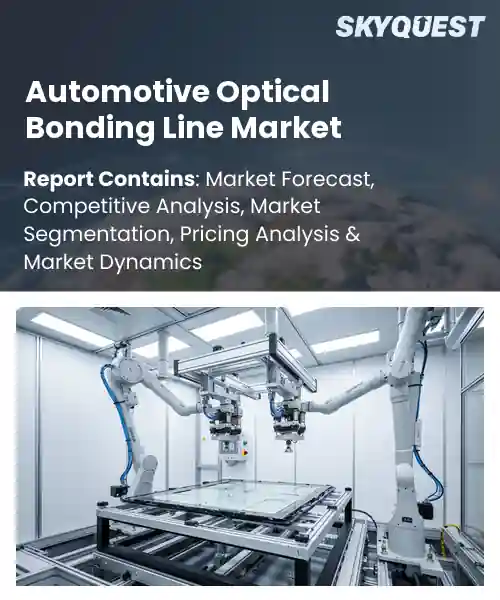
Automotive Optical Bonding Line Market
Report ID: SQMIG20I3171
Report ID: SQMIG20I3171
[email protected]
USA +1 351-333-4748
Report ID:
SQMIG20I3171 |
Region:
Global |
Published Date: June, 2026
Pages:
157
|Tables:
173
|Figures:
79


Global Automotive Optical Bonding Line Market size was valued at USD 847.4 Million in 2024 and is poised to grow from USD 928.75 Million in 2025 to USD 1933.68 Million by 2033, growing at a CAGR of 9.6% during the forecast period (2026-2033).
Demand for higher‑resolution head‑up displays and augmented‑reality windshields drives the catalyst for the optical bonding line market because these applications need flawless optical paths that only bonded assemblies can provide. Companies such as Bosch and Continental have built bonding cells to integrate 4K HUD modules onto curved glass, cutting weight and eliminating reflection losses. The boost in driver awareness prompts regulators to encourage HUD adoption, which in turn pushes OEMs to purchase bonded components in larger volumes, creating economies of scale for equipment makers. This cycle generates business for UV‑curable adhesive producers, precision alignment robot vendors, and predictive‑maintenance software providers.
How are AI and automation improving yield in the automotive optical bonding line market?
AI and automation are reshaping the automotive optical bonding line by turning every step into a data driven operation. Machine vision inspects each wafer and lens in real time, while algorithms predict where adhesive will spread unevenly. Robotics place components with repeatable precision, eliminating human variation. The control system continuously tweaks temperature and pressure based on sensor feedback, which keeps cure cycles optimal and reduces waste. Predictive maintenance alerts technicians before a tool fails, keeping line uptime high. Together these technologies create a tighter loop of monitoring, adjustment and learning that lifts overall yield and product consistency.
Mitsui in April 2026, highlighted AI as a key technology for automotive optical bonding lines, showing how intelligent process control can raise yield and streamline production for vehicle manufacturers. The announcement included a pilot plant that uses machine vision and adaptive dispensing to reduce defect rates and improve cycle consistency.
Market snapshot - (2026-2033)
Global Market Size
USD 847.4 Million
Largest Segment
Fastest Growth
Growth Rate
9.6% CAGR
To get more insights on this market click here to Request a Free Sample Report
Global automotive optical bonding line market is segmented by equipment type, display application, vehicle type, bonding material, automation level, end user, and region. Based on equipment type, the market is segmented into UV curing systems, laser bonding modules, vacuum lamination systems, dispensing systems, alignment and inspection systems, and automated optical bonding lines. Based on display application, the market is segmented into infotainment displays, digital instrument clusters, head-up displays (HUDs), rear-seat entertainment displays, central control displays, and passenger displays. Based on vehicle type, the market is segmented into passenger cars, light commercial vehicles (LCVs), heavy commercial vehicles (HCVs), and electric vehicles (EVs). Based on bonding material, the market is segmented into optically clear adhesives (OCA), liquid optically clear adhesives (LOCA), silicone-based adhesives, epoxy-based adhesives, acrylic adhesives, and nanocomposite adhesives. Based on automation level, the market is segmented into manual, semi-automatic, and fully automatic systems. Based on end user, the market is segmented into automotive OEMs, Tier 1 suppliers, automotive display manufacturers, and contract manufacturing organizations (CMOs). Based on region, the market is segmented into North America, Europe, Asia Pacific, Latin America and Middle East & Africa.
UV curing systems segment leads with large global automotive optical bonding line market share because they deliver rapid polymerization essential for high throughput automotive glass assembly lines. Their ability to cure at low temperatures protects sensitive display components, while the flexibility to integrate with existing production lines reduces capital barriers. Manufacturers favor them for consistent bond quality, enabling tighter tolerances and supporting the shift toward slimmer vehicle interiors. This reliability and adaptability reinforce their leadership within the optical bonding line market.
As per global automotive optical bonding line market outlook, laser bonding modules segment is witnessing the strongest growth momentum as manufacturers pursue precision alignment for head up displays. Laser technology enables localized heating, minimizing thermal stress on delicate electronics and allowing finer bond lines. This capability opens design possibilities, driving rapid adoption and expanding market opportunities for high resolution automotive displays.
As per global automotive optical bonding line market forecast, optically clear adhesives segment stands out because they provide transparency essential for driver displays while maintaining mechanical integrity. Their formulation balances flexibility and durability, enabling reliable performance under temperature fluctuations and vibration typical in vehicles. Designers rely on these adhesives to achieve seamless visual integration, and suppliers benefit from processing methods that integrate smoothly with bonding equipment. This blend of optical quality and performance sustains their leadership in automotive optical bonding lines.
As per global automotive optical bonding line market analysis, nanocomposite adhesives segment is emerging as the key high growth area as manufacturers seek thermal management and strength for curved displays. Nano fillers improve heat dissipation and bond rigidity, enabling thinner glass packages and supporting infotainment designs. This innovation drives market uptake and creates opportunities for advanced vehicle interior solutions.
To get detailed segments analysis, Request a Free Sample Report
Asia Pacific leads the global automotive optical bonding line market because it combines extensive automotive manufacturing capacity with deep expertise in precision optics and advanced materials. The region benefits from a dense network of original equipment manufacturers that embed bonding technology early in vehicle design to meet stringent safety and aesthetic requirements. Strong collaboration between research institutions accelerates innovation in adhesive chemistry and laser processing, while competitive labor costs and mature supply chains lower production barriers. Government initiatives encouraging electric vehicle adoption further boost demand for high‑performance bonding solutions. Together these factors create a self‑reinforcing ecosystem that sustains leadership in technology development, scale production, and rapid response to evolving market expectations.
As per global automotive optical bonding line market regional outlook, Japan is driven by a legacy of precision engineering and a collaborative ecosystem linking automakers, component suppliers, and research universities. The emphasis on high‑quality surface finish and durability aligns with consumer expectations for premium vehicles, prompting continuous refinement of bonding processes. Close proximity of advanced adhesive producers enables rapid prototyping and seamless integration of new optical modules into vehicle interiors and exteriors.
As per global automotive optical bonding line market regional forecast, South Korea benefits from a strong electronics heritage and aggressive adoption of smart‑vehicle technologies. Automakers leverage the country’s expertise in thin‑film coatings and laser precision to embed lighting and sensor assemblies with minimal thickness. Close ties with semiconductor and display manufacturers foster cross‑industry knowledge sharing, accelerating the development of high‑performance adhesives that meet both optical clarity and thermal resilience requirements.
Europe experiences rapid expansion of the automotive optical bonding line market as manufacturers respond to strict safety regulations, heightened consumer demand for premium interior aesthetics, and a strategic shift toward sustainable vehicle platforms. The region’s strong network of research institutes and technology clusters accelerates breakthroughs in low‑emission adhesives and eco‑friendly bonding processes. Collaboration between automakers and specialized suppliers ensures integration of advanced lighting and sensor modules that meet both performance and environmental criteria. Government incentives that promote electric mobility further encourage the adoption of lightweight optical bonding solutions, reinforcing Europe’s reputation as a hub for high‑quality, innovation‑driven automotive components.
As per global automotive optical bonding line industry analysis, Germany is anchored by world‑class engineering expertise and a robust supplier base that emphasizes precision and reliability. German automakers prioritize integration of high‑definition lighting and driver‑assistance optics, driving continuous refinement of bonding techniques. Close cooperation with chemical firms fosters development of high‑performance adhesives that satisfy stringent durability and thermal management standards, supporting the production of premium vehicles with sophisticated optical features.
United Kingdom gains momentum through a vibrant mix of advanced manufacturing hubs and a strong focus on research collaboration. The market benefits from close links between automotive firms and universities that specialize in material science, accelerating the creation of innovative bonding solutions for emerging vehicle technologies. Emphasis on lightweight construction and rapid deployment of connected car features fuels demand for optical bonding processes that combine clarity, strength, and ease of integration.
France is emerging as a focal point for sustainable automotive design, driven by a collaborative ecosystem that blends design studios, material innovators, and niche suppliers. French manufacturers emphasize elegant interior lighting and sensor integration, encouraging the development of adhesives that deliver both visual refinement and environmental compliance. Government support for green mobility amplifies interest in bonding technologies that reduce weight while maintaining optical performance, positioning France as a growing contributor to the European market.
North America strengthens its position in the automotive optical bonding line market through a combination of strong automotive manufacturing presence, rapid adoption of advanced driver‑assistance systems, and a culture of innovation driven by technology firms. The region leverages extensive research capabilities in both private and academic sectors to develop high‑performance adhesives that meet demanding optical clarity and thermal stability requirements. Strategic partnerships between tier‑one suppliers and vehicle makers accelerate the rollout of sophisticated lighting and sensor assemblies across a diverse vehicle portfolio. Investment in sustainable manufacturing practices further enhances the appeal of optical bonding solutions, aligning with broader industry goals of efficiency and reduced environmental impact.
United States is propelled by a large network of OEMs that integrate advanced lighting and sensor technologies early in vehicle development. Close collaboration with Silicon Valley innovators enables the use of cutting‑edge materials and process automation, delivering high‑precision bonding for both luxury and mass‑market models. Emphasis on lightweight construction and electric vehicle platforms fuels demand for adhesive solutions that balance optical performance with durability.
Canada reflects a strategic focus on advanced manufacturing and environmental stewardship, supported by close ties between automotive firms and research institutions in key technology corridors. The market benefits from expertise in nanomaterial adhesives that deliver superior clarity and resistance to harsh climatic conditions. Growing emphasis on electric and autonomous vehicle development encourages adoption of lightweight optical bonding techniques that enhance system integration while meeting stringent performance and sustainability criteria
To know more about the market opportunities by region and country, click here to
Buy The Complete Report
Increasing Adoption Of Advanced Sensors
Growth In Electric Vehicle Production
High Capital Investment Requirements
Stringent Regulatory Compliance Standards
Request Free Customization of this report to help us to meet your business objectives.
Intense rivalry among equipment suppliers and component makers fuels rapid innovation in automotive optical bonding lines, with capital inflows driving new product roll‑outs and strategic alliances. Recent large funding rounds, such as Axelera’s $72 million raise and Great Sky’s $14 million seed, exemplify how firms are leveraging financial strength to accelerate technology development, secure OEM partnerships, and expand production capacity.
SkyQuest’s ABIRAW (Advanced Business Intelligence, Research & Analysis Wing) is our Business Information Services team that Collects, Collates, Correlates, and Analyses the Data collected by means of Primary Exploratory Research backed by robust Secondary Desk research.
As per SkyQuest analysis, the global automotive optical bonding line market growth driven primarily by the surge in advanced driver‑assistance sensors that demand flawless optical assemblies. A second catalyst is the rise of AI‑enabled automation which boosts yield, reduces waste and shortens cycle times across bonding lines. High upfront capital requirements remain the main restraint, tempering adoption for smaller players. Asia Pacific dominates the market due to its extensive vehicle production base and strong optics expertise, while UV‑curing systems hold the largest share of equipment sales due to their rapid, low‑temperature cure capabilities. The global automotive optical bonding line market trend driven by rising production of connected, electric, and autonomous vehicles that incorporate large digital displays, infotainment systems, digital instrument clusters, and head-up displays (HUDs).
| Report Metric | Details |
|---|---|
| Market size value in 2024 | USD 847.4 Million |
| Market size value in 2033 | USD 1933.68 Million |
| Growth Rate | 9.6% |
| Base year | 2024 |
| Forecast period | (2026-2033) |
| Forecast Unit (Value) | USD Million |
| Segments covered |
|
| Regions covered | North America (US, Canada), Europe (Germany, France, United Kingdom, Italy, Spain, Rest of Europe), Asia Pacific (China, India, Japan, Rest of Asia-Pacific), Latin America (Brazil, Rest of Latin America), Middle East & Africa (South Africa, GCC Countries, Rest of MEA) |
| Companies covered |
|
| Customization scope | Free report customization with purchase. Customization includes:-
|
To get a free trial access to our platform which is a one stop solution for all your data requirements for quicker decision making. This platform allows you to compare markets, competitors who are prominent in the market, and mega trends that are influencing the dynamics in the market. Also, get access to detailed SkyQuest exclusive matrix.
Table Of Content
Executive Summary
Market overview
Parent Market Analysis
Market overview
Market size
KEY MARKET INSIGHTS
COVID IMPACT
MARKET DYNAMICS & OUTLOOK
Market Size by Region
KEY COMPANY PROFILES
Methodology
For the Automotive Optical Bonding Line Market, our research methodology involved a mixture of primary and secondary data sources. Key steps involved in the research process are listed below:
1. Information Procurement: This stage involved the procurement of Market data or related information via primary and secondary sources. The various secondary sources used included various company websites, annual reports, trade databases, and paid databases such as Hoover's, Bloomberg Business, Factiva, and Avention. Our team did 45 primary interactions Globally which included several stakeholders such as manufacturers, customers, key opinion leaders, etc. Overall, information procurement was one of the most extensive stages in our research process.
2. Information Analysis: This step involved triangulation of data through bottom-up and top-down approaches to estimate and validate the total size and future estimate of the Automotive Optical Bonding Line Market.
3. Report Formulation: The final step entailed the placement of data points in appropriate Market spaces in an attempt to deduce viable conclusions.
4. Validation & Publishing: Validation is the most important step in the process. Validation & re-validation via an intricately designed process helped us finalize data points to be used for final calculations. The final Market estimates and forecasts were then aligned and sent to our panel of industry experts for validation of data. Once the validation was done the report was sent to our Quality Assurance team to ensure adherence to style guides, consistency & design.
Analyst Support
Customization Options
With the given market data, our dedicated team of analysts can offer you the following customization options are available for the Automotive Optical Bonding Line Market:
Product Analysis: Product matrix, which offers a detailed comparison of the product portfolio of companies.
Regional Analysis: Further analysis of the Automotive Optical Bonding Line Market for additional countries.
Competitive Analysis: Detailed analysis and profiling of additional Market players & comparative analysis of competitive products.
Go to Market Strategy: Find the high-growth channels to invest your marketing efforts and increase your customer base.
Innovation Mapping: Identify racial solutions and innovation, connected to deep ecosystems of innovators, start-ups, academics, and strategic partners.
Category Intelligence: Customized intelligence that is relevant to their supply Markets will enable them to make smarter sourcing decisions and improve their category management.
Public Company Transcript Analysis: To improve the investment performance by generating new alpha and making better-informed decisions.
Social Media Listening: To analyze the conversations and trends happening not just around your brand, but around your industry as a whole, and use those insights to make better Marketing decisions.
REQUEST FOR SAMPLE
 REQUEST FREE CUSTOMIZATION
Global Automotive Optical Bonding Line Market size was valued at USD 847.4 Million in 2024 and is poised to grow from USD 928.75 Million in 2025 to USD 1933.68 Million by 2033, growing at a CAGR of 9.6% during the forecast period (2026-2033).
Intense rivalry among equipment suppliers and component makers fuels rapid innovation in automotive optical bonding lines, with capital inflows driving new product roll‑outs and strategic alliances. Recent large funding rounds, such as Axelera’s $72 million raise and Great Sky’s $14 million seed, exemplify how firms are leveraging financial strength to accelerate technology development, secure OEM partnerships, and expand production capacity. '3M Company', 'Henkel AG & Co. KGaA', 'Saint-Gobain S.A.', 'Panasonic Industry Co., Ltd.', 'LOCA Corporation', 'Dymax Corporation', 'H.B. Fuller Company', 'Master Bond Inc.', 'Nitto Denko Corporation', 'LINTEC Corporation', 'Mitsubishi Chemical Group Corporation', 'Tesa SE', 'DELO Industrie Klebstoffe GmbH & Co. KGaA', 'Dow Inc.', 'Momentive Performance Materials Inc.', 'Shin-Etsu Chemical Co., Ltd.', 'Toray Industries, Inc.', 'Hitachi Chemical Co., Ltd.', 'Bostik SA', 'Sika AG'
The automotive industry is shifting toward sophisticated driver‑assistance systems that rely on high‑resolution cameras and lidar, which require flawless optical assemblies. Optical bonding lines provide superior sealing, reduced reflection, and enhanced durability, meeting the stringent performance criteria of these sensors. By enabling thinner, lighter, and more reliable sensor modules, optical bonding supports vehicle design flexibility and improves safety features, prompting manufacturers to invest in dedicated bonding equipment and processes, thereby fueling market expansion. This trend also aligns with regulatory pressures for higher safety standards across global markets.
Advanced Lightweight Glass Integration: Automakers are increasingly adopting advanced lightweight glass that combines structural strength with optical clarity, enabling thinner pillars and larger transparent surfaces without compromising safety. This shift supports vehicle weight reduction targets, improves fuel efficiency, and enhances passenger experience through expanded sightlines. Optical bonding processes are being refined to accommodate the new glass formulations, ensuring reliable adhesion and durability under varied thermal and mechanical stresses, thereby creating a competitive advantage for suppliers offering tailored bonding solutions in the global automotive market today.
Why does Asia Pacific Dominate the Global Automotive Optical Bonding Line Market? |@12


Want to customize this report? This report can be personalized according to your needs. Our analysts and industry experts will work directly with you to understand your requirements and provide you with customized data in a short amount of time. We offer $1000 worth of FREE customization at the time of purchase.
Feedback From Our Clients


 USA (+1) 351-333-4748

