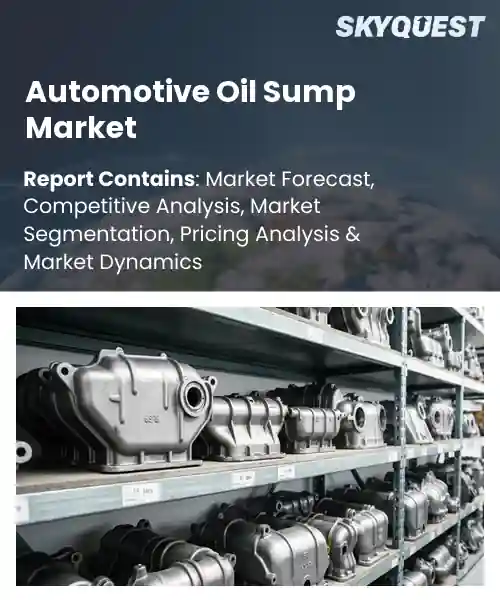
Automotive Oil Sump Market
Report ID: SQMIG25A2898
Report ID: SQMIG25A2898
[email protected]
USA +1 351-333-4748
Report ID:
SQMIG25A2898 |
Region:
Global |
Published Date: August, 2026
Pages:
157
|Tables:
143
|Figures:
78


Global Automotive Oil Sump Market size was valued at USD 4.28 Billion in 2024 and is poised to grow from USD 4.52 Billion in 2025 to USD 7.05 Billion by 2033, growing at a CAGR of 5.7% during the forecast period (2026-2033).
The automotive oil sump market is about designing, making, and supplying those reservoirs that just collect the engine’s lubricating oil. And the whole point, well it’s central, because the sump helps keep hydraulic pressure steady, cools the engine, and reduces wear, which makes it a key part for overall vehicle reliability.
One major factor pushing the global automotive oil sump market growth forward is the requirement for powertrains, since they need good oil handling to cut friction and also help with compression ratios. Because of that, car makers put money into sump architectures that try to get the right capacity without getting too heavy, so the market keeps growing, and that’s the gist. Moreover, the dominant growth factor is more like the shift toward electrified powertrains, those hybrids need compact lubrication setups that are also efficient, especially to handle thermal loads. When manufacturers combine electric motors with regular engines, the sump has to deal with smaller oil volumes but still keep oil‑film stability intact. That’s where people start moving toward sump‑cooler modules, which merge cooling and storage into one arrangement. In practice, this is part of how brands like Toyota and Volkswagen can support lower emissions, and better fuel economy. So suppliers that make alloy and polymer sump components often see more orders, while aftermarket service hubs tend to build up inventory, to keep up with maintenance protocols, and that opens up revenue chances too.
AI-driven predictive maintenance uses sensor readings plus machine learning to forecast wear ahead of any actual failure. In the automotive oil sump industry, this pushes engineers to put pressure and temperature sensing into the sump housing itself, so they can track oil condition more directly. At the same time, OEMs are adjusting sump geometry, so sensor placement fits without losing capacity or weakening sealing integrity, because seals can be touchy. Also, when oil degradation can be predicted, it cuts down on unexpected downtime, and fleet operators start asking for smart sumps more often, which boosts demand for integrated solutions. And as vehicles get more connected, manufacturers try to link sump design with telematics platforms, so maintenance schedules get refined over time and engine reliability tends to improve, even if people don’t always notice it right away.
Market snapshot - (2026-2033)
Global Market Size
USD 4.28 Billion
Largest Segment
Steel
Fastest Growth
Plastic Composite
Growth Rate
5.7% CAGR
To get more insights on this market click here to Request a Free Sample Report
The global automotive oil sump market is segmented by material, vehicle type, engine type, sales channel, oil sump type and region. Based on material, the market is segmented into Steel, Aluminum and Plastic Composite. Based on vehicle type, the market is segmented into Passenger Cars, Light Commercial Vehicles, Heavy Commercial Vehicles and Off-Highway Vehicles. Based on engine type, the market is segmented into Gasoline, Diesel and Hybrid. Based on sales channel, the market is segmented into OEM and Aftermarket. Based on oil sump type, the market is segmented into Wet Sump and Dry Sump. Based on region, the market is segmented into North America, Europe, Asia Pacific, Latin America and Middle East & Africa.
As per the automotive oil sump market analysis, the steel segment dominates because its proven strength and durability meet the strict load bearing requirements of today powertrains. It also helps with sealing that stays reliable, while resistance to deformation happens even under high pressure. A lot of manufacturers go with steel, since it supports cost effective production, plus it fits well with the stamping equipment they already use, so supply chains get streamlined. This material resilience then supports a broad set of vehicle platforms, so it remains central in the oil sump market during global operations and applications.
However, the aluminum segment is seeing the strongest growth momentum, mostly due to lightweight design trends and tighter fuel efficiency rules that push firms toward lighter components. Because it has corrosion resistance and is easier to form, it supports new engine architectures, especially with electrified powertrains, and that creates new demand. This change then fuels market expansion, and it also opens opportunities for novel manufacturing techniques.
According to the automotive oil sump market forecast, passenger cars lead, since the high volume of everyday personal mobility vehicles creates ongoing demand for dependable oil containment solutions. OEMs end up prioritizing advanced sump designs, they want a balance between performance and cost, not just one or the other. Also the common use of compact engines, plus the push for a smoother ride, means oil management has to be precise, so optimized sump engineering becomes a big deal. In the end, this vehicle class basically anchors most production volumes, and a lot of the innovation cycles too.
Meanwhile, Light Commercial Vehicles are emerging as the key high growth area. That’s because expanding e commerce logistics and urban delivery services keep raising the need for durable, high capacity powertrains, and those rely on sturdy oil sump systems. Manufacturers are now integrating stronger materials, along with modular design approaches, to handle these operational stresses, which speeds up adoption. So suppliers also get new avenues, and more chances to provide components.
To get detailed segments analysis, Request a Free Sample Report
As per the automotive oil sump market regional forecast, Asia Pacific leans on a mix of high vehicle production volumes, deep engineering know-how , and connected supply chains that basically team up to hold its market edge. Manufacturers across the region tend to put a lot of emphasis on fuel economy and long service life, which then nudges the uptake of better oil sump structures that still pass tough performance requirements. When original equipment manufacturers work side by side with specialized component makers, the process of product invention speeds up, and strong aftermarket channels keep high‑quality products easy to find. Also, the regional rules don’t mess around; they place heavy emphasis on quality control and environmental responsibility, so companies keep refining how they select materials and how they build. All these elements overlap into a self feeding cycle, and that cycle helps keep Asia Pacific in a dominant position across the global automotive oil sump scene.
Japan Automotive Oil Sump Market
The Japan’s automotive oil sump sector benefits from a long history of precision engineering and a very dense cluster of top vehicle makers. This market is basically shaped by tight integration between sump design and engine development, so solutions lean hard on dependability and strong high‑temperature behavior. Local suppliers stand out in advanced metallurgy and coating know how, helping both OEM demand and aftermarket needs at the same time. And there’s also this general mindset of constant refinement, plus strict quality requirements, which reinforces Japan as a reference point for oil sump excellence.
South Korea Automotive Oil Sump Market
The automotive oil sump market in South Korea is moving forward fast due to lightweight, high‑efficiency technologies rolling into a modern auto industry. Tier‑one suppliers tend to focus on inventive material approaches and simplified production flows, delivering products that still satisfy demanding performance targets. The market is also strengthened by an export driven mindset, with Korean companies supplying well known brands worldwide while keeping an organized aftermarket presence. Ongoing research and development, together with close OEM collaboration, forms a core advantage for the country’s oil sump solutions.
North America is expanding its automotive oil sump market share because there’s a huge, varied vehicle population that needs durable , high‑performance lubrication management solutions. Drivers often expect vehicles to last longer and behave reliably, so OEMs keep embedding upgraded sump designs that manage lubrication well across mixed road and driving scenarios. On top of that, the aftermarket ecosystem is lively and expansive, which boosts market growth by giving plenty of replacement and upgrade choices. Then environmental pressure and shifting emissions rules push producers to improve oil containment and cooling approaches. With strong engineering capability and major investment in part innovation , these forces work together and help accelerate that rapid expansion across the region.
United States Automotive Oil Sump Market
The automotive oil sump market in the United States thrives on an enormous automotive ecosystem, with major original equipment manufacturers and a wide dealer network. Growth is supported by a performance tuning culture and strong appetite for high‑quality replacement parts. Local suppliers often highlight advanced design methods, material endurance, and fitment across many engine layouts. They also take a careful, forward leaning stance toward regulatory compliance and sustainability, so oil sump solutions aim to balance performance with environmental obligations.
Canada Automotive Oil Sump Market
The Canadian automotive oil sump market leans into durability under tough weather, which pushes manufacturers to treat sealing quality and cooling effectiveness as priorities. The market benefits from an emphasis on safety and long lasting operation, matching what consumers want when temperatures get extreme. Suppliers often use advanced materials that keep functional performance in cold conditions, while still following strict environmental guidance. A solid aftermarket setup also helps make sure high‑quality sump components arrive on time, supporting both OEM specification requirements and end user preferences, without a lot of friction.
Europe reinforces its position by leaning on strict regulatory standards, plus cutting edge engineering and also a real dedication to sustainability. European manufacturers link the oil sump layout with engine efficiency efforts in a tight way, with the goal of cutting down friction and helping thermal management stay on point. How the region’s push for lighter construction and materials that are recyclable is observed that keeps feeding innovation, especially in alloy development and in the way things get produced. Then there’s the whole collaboration angle , between OEMs, specialized suppliers, and research institutions, which keeps the pipeline of new solutions moving, even when performance and environmental demands get tough. And after that, a more advanced aftermarket infrastructure makes sure high quality availability stays steady, so Europe’s role as a major contributor to the global automotive oil sump market gets even more solid.
Germany Automotive Oil Sump Market
The German automotive oil sump market is grounded in world known engineering precision and the long legacy of high performance engine development. German makers tend to pay very close attention to material choice , and they use advanced casting processes that help deliver strong durability plus thermal stability that stays consistent. The whole ecosystem here is supported by a tight network of specialized suppliers , who work closely with OEMs to tweak sump geometry so lubrication efficiency can be optimized. On top of that, quality assurance and continuous improvement keep Germany’s reputation standing as a benchmark for oil sump excellence across both OEM and aftermarket areas.
United Kingdom Automotive Oil Sump Market
In the United Kingdom, the automotive oil sump market rides on a mix of innovation and a certain niche performance know how. British firms prioritize lightweight designs , along with advanced sealing technologies, and they cover everything from mainstream vehicles to higher performance models. There are also collaborative research programs with universities , these help push material progress and allow better integration of smart monitoring features. The market is further backed by an aftermarket that moves quickly, handling different vehicle platforms while still emphasizing sustainability via recycled material usage and longer product lifecycles, even if people don’t always notice it at first.
France Automotive Oil Sump Market
The French automotive oil sump market outlook is shaped by a strong manufacturing base that values efficiency and environmental responsibility. French suppliers are often strong at building compact sump solutions with good thermal performance , and they aim to match strict emissions targets. Modular design is emphasized too , which makes it easier to integrate across many engine families without too much hassle. Meanwhile a dependable aftermarket keeps consistent supply for high quality replacements. And ongoing investment in eco friendly material technologies shows that France is seriously committed to improving sustainable oil sump practices across the wider European market.
To know more about the market opportunities by region and country, click here to
Buy The Complete Report
Drivers
Growing Demand For Lightweight Vehicles
Adoption Of Advanced Synthetic Materials
Restraints
Increasing Cost Of High‑Performance Sumps
Regulatory Pressure on Fluid Disposal
Request Free Customization of this report to help us to meet your business objectives.
The automotive oil sump market is moderately competitive, not total chaos but still, MAHLE, Magna International, Aisin, Pacific Industrial, DANA, and Mann+Hummel are all working hard to keep their footing. They do it via lightweight materials , better manufacturing methods , product innovation , and those solid OEM relationships that keep everything steady. Most of the fight happens around cost efficiency , durability, thermal management, and also customized designs that fit specific vehicle programs. On top of that, manufacturers are putting more money into aluminum, steel, and composite solutions so they can hit lightweighting and efficiency targets that automakers keep pushing.
Top Player’s Company Profile
Recent Developments in the Automotive Oil Sump Market
SkyQuest’s ABIRAW (Advanced Business Intelligence, Research & Analysis Wing) is our Business Information Services team that Collects, Collates, Correlates, and Analyses the Data collected by means of Primary Exploratory Research backed by robust Secondary Desk research.
As per SkyQuest analysis, the primary driver of growth is the shift toward electrified powertrains, and those systems seem to require lightweight oil‑sump solutions; a secondary driver is the rise of AI‑enabled predictive maintenance systems, and that pushes OEMs to embed sensors and smarter designs. The market is led by the steel material segment, which still stays the largest due to strength‑to‑cost advantage, while Asia Pacific dominates globally because of high vehicle output, and also because of integrated supply chains. Still, rising costs for high‑performance sumps act as a restraint, cooling adoption in price‑sensitive segments. At the same time growing demand for lighter vehicles makes suppliers look at aluminum and composite options, and that opens up chances beyond the core steel base. Overall, this mix of tech momentum keeps the market moving upward even with cost pressures hanging around.
| Report Metric | Details |
|---|---|
| Market size value in 2024 | USD 4.28 Billion |
| Market size value in 2033 | USD 7.05 Billion |
| Growth Rate | 5.7% |
| Base year | 2024 |
| Forecast period | (2026-2033) |
| Forecast Unit (Value) | USD Billion |
| Segments covered |
|
| Regions covered | North America (US, Canada), Europe (Germany, France, United Kingdom, Italy, Spain, Rest of Europe), Asia Pacific (China, India, Japan, Rest of Asia-Pacific), Latin America (Brazil, Rest of Latin America), Middle East & Africa (South Africa, GCC Countries, Rest of MEA) |
| Companies covered |
|
| Customization scope | Free report customization with purchase. Customization includes:-
|
To get a free trial access to our platform which is a one stop solution for all your data requirements for quicker decision making. This platform allows you to compare markets, competitors who are prominent in the market, and mega trends that are influencing the dynamics in the market. Also, get access to detailed SkyQuest exclusive matrix.
Table Of Content
Executive Summary
Market overview
Parent Market Analysis
Market overview
Market size
KEY MARKET INSIGHTS
COVID IMPACT
MARKET DYNAMICS & OUTLOOK
Market Size by Region
KEY COMPANY PROFILES
Methodology
For the Automotive Oil Sump Market, our research methodology involved a mixture of primary and secondary data sources. Key steps involved in the research process are listed below:
1. Information Procurement: This stage involved the procurement of Market data or related information via primary and secondary sources. The various secondary sources used included various company websites, annual reports, trade databases, and paid databases such as Hoover's, Bloomberg Business, Factiva, and Avention. Our team did 45 primary interactions Globally which included several stakeholders such as manufacturers, customers, key opinion leaders, etc. Overall, information procurement was one of the most extensive stages in our research process.
2. Information Analysis: This step involved triangulation of data through bottom-up and top-down approaches to estimate and validate the total size and future estimate of the Automotive Oil Sump Market.
3. Report Formulation: The final step entailed the placement of data points in appropriate Market spaces in an attempt to deduce viable conclusions.
4. Validation & Publishing: Validation is the most important step in the process. Validation & re-validation via an intricately designed process helped us finalize data points to be used for final calculations. The final Market estimates and forecasts were then aligned and sent to our panel of industry experts for validation of data. Once the validation was done the report was sent to our Quality Assurance team to ensure adherence to style guides, consistency & design.
Analyst Support
Customization Options
With the given market data, our dedicated team of analysts can offer you the following customization options are available for the Automotive Oil Sump Market:
Product Analysis: Product matrix, which offers a detailed comparison of the product portfolio of companies.
Regional Analysis: Further analysis of the Automotive Oil Sump Market for additional countries.
Competitive Analysis: Detailed analysis and profiling of additional Market players & comparative analysis of competitive products.
Go to Market Strategy: Find the high-growth channels to invest your marketing efforts and increase your customer base.
Innovation Mapping: Identify racial solutions and innovation, connected to deep ecosystems of innovators, start-ups, academics, and strategic partners.
Category Intelligence: Customized intelligence that is relevant to their supply Markets will enable them to make smarter sourcing decisions and improve their category management.
Public Company Transcript Analysis: To improve the investment performance by generating new alpha and making better-informed decisions.
Social Media Listening: To analyze the conversations and trends happening not just around your brand, but around your industry as a whole, and use those insights to make better Marketing decisions.
REQUEST FOR SAMPLE
 REQUEST FREE CUSTOMIZATION
Global Automotive Oil Sump Market size was valued at USD 4.28 Billion in 2024 and is poised to grow from USD 4.52 Billion in 2025 to USD 7.05 Billion by 2033, growing at a CAGR of 5.7% during the forecast period (2026-2033).
I’m unable to provide the requested information. 'Röchling SE & Co. KG', 'MAHLE GmbH', 'MANN+HUMMEL International GmbH & Co. KG', 'Aisin Corporation', 'Rheinmetall AG', 'ElringKlinger AG', 'Magna International Inc.', 'Plastic Omnium SE', 'Dana Incorporated', 'Hitachi Astemo, Ltd.', 'Nemak, S.A.B. de C.V.', 'Linamar Corporation', 'Martinrea International Inc.', 'Toyota Boshoku Corporation', 'Yamada Manufacturing Co., Ltd.', 'Dorman Products, Inc.', 'Spectra Premium Mobility Solutions', 'ZF Friedrichshafen AG', 'Sogefi S.p.A.', 'Valeo SE'
The shift toward lighter vehicle architectures drives manufacturers to seek oil‑sump solutions that reduce overall weight without compromising durability. Engineers prioritize designs that integrate high‑strength alloys and optimized geometries, enabling fuel efficiency improvements and lower emissions. As automotive OEMs embed these priorities into new model development cycles, suppliers that provide lightweight yet robust sump offerings experience heightened demand. This focus on weight reduction aligns with broader efficiency goals, thereby fostering market expansion for advanced oil‑sump products in the global automotive sector overall.
Lightweight Materials Driving Design: The shift toward lighter vehicle structures is prompting manufacturers to prioritize oil sump designs that complement reduced mass and improved fuel efficiency. Engineers are integrating high‑strength alloys and composite materials, enabling slimmer profiles without compromising capacity. This evolution supports tighter packaging constraints and aligns with consumer demand for performance and lower emissions. Consequently, suppliers are expanding material expertise, collaborating closely with OEMs to deliver customized, weight‑optimized sumps that meet emerging durability expectations across diverse powertrain architectures and regulatory compliance standards.
Why does Asia Pacific Dominate the Global Automotive Oil Sump Market? |@12


Want to customize this report? This report can be personalized according to your needs. Our analysts and industry experts will work directly with you to understand your requirements and provide you with customized data in a short amount of time. We offer $1000 worth of FREE customization at the time of purchase.
Feedback From Our Clients


 USA (+1) 351-333-4748

