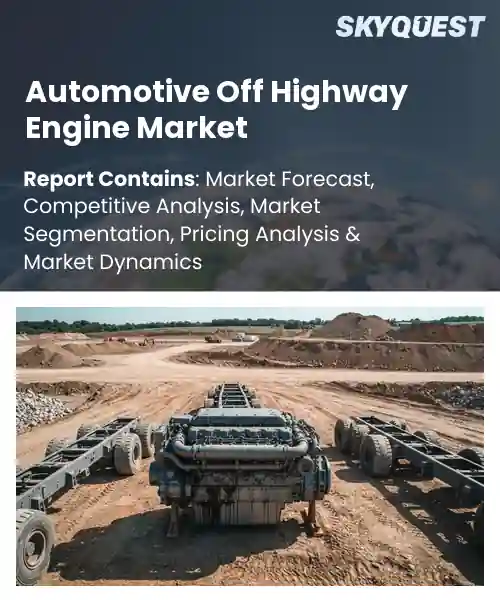
Automotive Off Highway Engine Market
Report ID: SQMIG20F2092
Report ID: SQMIG20F2092
[email protected]
USA +1 351-333-4748
Report ID:
SQMIG20F2092 |
Region:
Global |
Published Date: July, 2026
Pages:
157
|Tables:
178
|Figures:
79


Global Automotive Off Highway Engine Market size was valued at USD 17.2 Billion in 2024 and is poised to grow from USD 17.85 Billion in 2025 to USD 24.06 Billion by 2033, growing at a CAGR of 3.8% during the forecast period (2026-2033).
Increasing infrastructure development, increasing mechanization in construction and agriculture, rising mining activities, stringent emission regulations, and advancements in engine technologies are driving sales of automotive off-highway engines.
High investments in infrastructure projects and increasing demand for high-performance construction and agricultural equipment, coupled with stricter emission standards, are expected to primarily drive automotive off-highway engine market growth. Growth in adoption of new generation engines across excavators, tractors, loaders, haul trucks and other heavy machinery is expected to bolster industry expansion. Rising investments in fuel-efficient engine technologies, electric turbocharging, exhaust aftertreatment, hybrid powertrain and electronic engine controls are expected to drive industry development. Persistent technological innovations in predictive maintenance, telematics, engine remanufacturing and low-emission equipment technologies are projected to enhance equipment efficacy and operational performance. Moreover, increasing investments in mining industry, infrastructure and equipment rental fleets are anticipated to generate new growth opportunities.
On the contrary, high manufacturing and maintenance costs, stringent emission compliance requirements, fluctuations in raw material prices, and growing adoption of electric off-highway equipment are predicted to impede automotive off-highway engine market penetration across the study period and beyond.
How is IoT Improving Predictive Maintenance For Automotive Off-highway Engines?
Internet of Things is helping to transform the automotive off-highway engine market by providing visibility of equipment conditions for predictive maintenance and remote monitoring of equipment. Utilizing sensors placed on-board engines and machines, telematics and cloud-based analytics provide continuous data on engines vibration, oil condition and temperature providing early warning of impending failures. Remote monitoring is helping fleet owners move away from downtime-based component repairs to condition-based maintenance, leading to maintain cost savings and greater engine reliability, as well as providing technicians with advance diagnostics and scheduling.
Market snapshot - (2026-2033)
Global Market Size
USD 17.2 Billion
Largest Segment
Diesel Engines
Fastest Growth
Hybrid Engines
Growth Rate
3.8% CAGR
To get more insights on this market click here to Request a Free Sample Report
Global automotive off highway engine market is segmented by engine type, power output, application, emission standard, sales channel, cooling type, and region. Based on engine type, the market is segmented into diesel engines, gasoline engines, natural gas engines, hybrid engines, and others. Based on power output, the market is segmented into Below 100 HP, 100–300 HP, 301–500 HP, and Above 500 HP. Based on application, the market is segmented into construction equipment, agricultural equipment, mining equipment, material handling equipment, forestry equipment, industrial equipment, and others. Based on emission standard, the market is segmented into non-compliant/legacy engines, stage III/Tier 3, Stage IV/Tier 4 Final, Stage V, and others. Based on sales channel, the market is segmented into OEM and aftermarket. Based on cooling type, the market is segmented into liquid-cooled and air-cooled. Based on region, the market is segmented into North America, Europe, Asia Pacific, Latin America, and Middle East & Africa.
The diesel engines segment is forecasted to lead the global automotive off highway engine market revenue generation across the study period. Reliability and high torque bring Heavy Duty Off Highway applications to mind and therefore fire OEM's fleet managers choosing the diesel architecture over other options for their consistent performance. Established fueling and maintenance systems remove the risk of down time, while established combustion and durability lower life of machine operating costs, therefore construction, agriculture and mining applications selecting the ideal performance and serviceability package.
However, hybrid engines are the most rapidly expanding subsegment as per this automotive off highway engine industry analysis, as electrified auxiliaries and energy recovery address increasingly stringent emissions mandates, while enhancing fuel efficiency and variable duty cycles. Increasing OEM investment in hybrid integration, the cost benefits of a lower operating expenditure, and the need to optimize duty cycles via telematics are a rapidly growing forces that encourage adoption and enable modular powertrain business models and new aftermarket opportunities for growth.
The Stage V segment is slated to account for the highest global automotive off highway engine market share in the future. In response to tough exhaust standards, OEMs are building powertrains with better use of aftertreatment and combustion control and a higher degree of sensing accuracy; effectively rendering Stage V compliance a fundamental parameter of design. This regulatory-driven evolution influences package architectures by favoring integrated systems and architecture, downstream supplier consolidation and OEM procurement decision-making, all with an eye toward future regulatory stability and performance repeatability.
However, Stage IV/Tier 4 Final is witnessing the strongest growth momentum as cost conscious operators choose proven aftertreatment packages that meet stringent emissions standards while compromising investment. Well Known components--trustworthy service procedures and retrofit pathways, make repowering easier for OEMs and niche market retrofit suppliers to create customized upgrade packages that extend plant life and opens additional markets.
To get detailed segments analysis, Request a Free Sample Report
Asia Pacific remain the most dominant region in the global automotive off highway engine market by having the combination of high manufacturing expertise, dense supply chain and diversified end market demand from agriculture, construction and mining industries. Strong OEM base and tiered up supply chain allow rapid product availability for solutions development as well as scale up production and customization. Investment into engine technology development such as fuel flexibility, powertrain integration allows product excellence. Trade flow of engine products across regions also increases operational efficiency while global cost advantage supports the export led engine demand. Local service distribution networks sustain long-term lifecycle exchange at competitive prices. Industrial modernization in emerging economies, however, leads to continuous upgrade cycle supports the region having one of the highest longevity replacement cycles. These structural flexibilities provide an ecosystem for convergence of innovation, manufacturing scale and regional proximity for sustainable growth, where new technologies are developed and test bed in the region with far-flung global manufacturing scale and supply chain base, attracting continually more investment.
Automotive off highway engine market in Japan benefits from a dense ecosystem of precision engineers, long established OEMs, and integrated supplier networks that emphasize reliability and efficiency. Close business relationship with research institutes enables continuous improvements in engine technology. Commitment to topnotch production quality and design as well as rigorous testing regulations contribute to high regard of these engines among global aftermarket distributors. The local service industry provides lifecycle upkeep and customized engines design for off highway industry.
Automotive off highway engine demand in South Korea leverages advanced manufacturing technologies, strong component supplier clusters, and competitive automation to deliver robust engine solutions. Close collaboration between manufacturers and specialized suppliers accelerates product adaptation for rugged operating conditions. Focus on material innovation, compact high torque designs, and integrated aftertreatment systems enhances durability and emissions compliance. Expansive service networks and export strategies support aftermarket availability and service for off highway customers.
Strong industrial demand, extensive infrastructure activity, and a mature OEM ecosystem that prioritizes innovation and quality supports high sales of automotive off-highway engines across the region. Strengthening aftermarket distribution channels and easy availability of financial support through lease packages enables fleet upgrade and customization. Expertise in advanced power pack systems, integration of emission control and availability of a variety of power pack fuel systems accelerated adoption of newer engines. Co-ordination between manufacturers, dealers, and engineering workshops gained significant momentum in driving product acceptance and life cycle support. Focus on durability, operator comfort and diagnostics responded to needs of operators of agriculture, construction and mining equipment. Regional ecosystem strength in resilient supply chain management and strategic investments in modular manufacturing systems are poised to deliver scale and agility to capitalize on replacement and customized solutions.
Automotive off highway engine market in United States is supported by a diverse industrial base and access to technology providers that emphasize robustness and serviceability. Large fleets and rental markets generate demand for durable, easily maintained engines. Integration with telematics and diagnostics enhances uptime and maintenance planning. Established dealer and parts networks provide aftermarket responsiveness, while OEM and supplier collaboration drives tailored solutions for agricultural, construction, and energy equipment applications.
Automotive off highway engine market in Canada focuses on robustness for remote operations, cold start reliability, and alignment with resource sector demands. Distribution of parts and regional service networks allow continuous uptime. OEMs design for long lasting operation, fuel flexibility and ease of maintenance in widely dispersed duty cycles. Cooperation between local parts suppliers and International OEMs allows for optimized engine variants. Improved aftermarket training and on-field support boosts operational sustainability and in-the-field operators confidence in harsh conditions.
Engineering excellence, coordinated regulation, and focused investment in emissions and efficiency technologies are expected to help boost sales of automotive off-highway engines in the region. Growing retrofit and upgrade markets put increasing premium on modular architectures and adaptable platforms. Operator comfort ergonomics and diagnostics strive for service optimization, extending lifecycle ownership costs. A persistent diverse aftermarket advantage, combined with increasing cross border trade synergies, empowers supply chain responsiveness, providing a unique niche positioning with differentiated, compliant powertrain options in varied industrial applications globally. Digital born products and intelligent know how systematically elevate uptime, and reduce the lifetime operation complexity mastery. The combination of manufacturing recesses of deep technical expertise, can deliver advanced architectures, integrated aftertreatment systems, and combinations of characteristics that satisfy increasingly strict regulatory requirements, while maintaining market leading operational performance and efficiency. In parallel, alliance of OEMs, tier 1s and research centers through collaborative focused ecosystem secures rapid application specific adaptability through early prototyping and evolving platform modernization opportunities.
Automotive off highway engine market in Germany is anchored by engineering capability, precision manufacturing, and supplier ecosystems that prioritize durability and performance. Integration between OEMs and component specialists accelerates combustion and aftertreatment development. Modular architectures support customization for varied industrial applications. Skills development and rigorous quality protocols underpin reliability. Strong export channels and proactive service networks provide aftermarket reach and lifecycle support for diverse end users and sustained operational performance.
Automotive off highway engine demand in United Kingdom benefits from strong engineering research capabilities, niche specialist manufacturers, and a focus on retrofit and modular upgrade solutions. Collaboration between academic institutions and industry drives innovation in efficient powertrains and control systems. Dealer networks and service providers enable rapid field support and component availability. Attention to operator ergonomics and diagnostic integration enhances usability, supporting tailored engine offerings for agricultural, construction, maritime applications.
Automotive off highway engine market in France focuses on integrated equipment solutions, strong collaboration between engine makers and machine builders, and compact high torque designs suited to agricultural and construction applications. Joint development with research centers advances emissions management and fuel flexibility. Established service networks and specialized aftermarket providers support maintenance and retrofit needs. French manufacturers provide application specific engine packages prioritizing operator comfort, ease of service, and lifecycle support.
To know more about the market opportunities by region and country, click here to
Buy The Complete Report
Increasing Demand For Power Density
Integration Of Hybrid Powertrains
Fluctuating Fuel Quality Standards
Escalating Development and Certification Costs
Request Free Customization of this report to help us to meet your business objectives.
Competitive pressure in the global automotive off highway engine market is intensifying as emissions rules and customer demand for low emission powertrains force incumbents and newcomers into concrete plays such as acquisitions, strategic OEM alliances, and powertrain innovation. For example Caterpillar signed a strategic electrification agreement with CRH for electric off highway trucks and charging, Cummins partnered with Komatsu on a mining hybrid development, and ClearFlame advanced renewable fuel conversion technology.
SkyQuest’s ABIRAW (Advanced Business Intelligence, Research & Analysis Wing) is our Business Information Services team that Collects, Collates, Correlates, and Analyses the Data collected by means of Primary Exploratory Research backed by robust Secondary Desk research.
As per SkyQuest analysis, increasing mechanization in construction and agriculture, rising mining activities, and stringent emission regulations are anticipated to drive the demand for automotive off-highway engines going forward. However, high manufacturing and maintenance costs and growing adoption of electric off-highway equipment are slated to slow down the adoption of automotive off-highway engines in the future. Asia Pacific is slated to spearhead the demand for automotive off-highway engines owing to substantial investments in construction and mining projects, high adoption of advanced engine technologies, stringent emission standards, and the presence of leading equipment manufacturers. IoT-enabled predictive maintenance and integration of telematics-based engine monitoring systems are anticipated to be key trends driving the automotive off-highway engine industry going forward.
| Report Metric | Details |
|---|---|
| Market size value in 2024 | USD 17.2 Billion |
| Market size value in 2033 | USD 24.06 Billion |
| Growth Rate | 3.8% |
| Base year | 2024 |
| Forecast period | (2026-2033) |
| Forecast Unit (Value) | USD Billion |
| Segments covered |
|
| Regions covered | North America (US, Canada), Europe (Germany, France, United Kingdom, Italy, Spain, Rest of Europe), Asia Pacific (China, India, Japan, Rest of Asia-Pacific), Latin America (Brazil, Rest of Latin America), Middle East & Africa (South Africa, GCC Countries, Rest of MEA) |
| Companies covered |
|
| Customization scope | Free report customization with purchase. Customization includes:-
|
To get a free trial access to our platform which is a one stop solution for all your data requirements for quicker decision making. This platform allows you to compare markets, competitors who are prominent in the market, and mega trends that are influencing the dynamics in the market. Also, get access to detailed SkyQuest exclusive matrix.
Table Of Content
Executive Summary
Market overview
Parent Market Analysis
Market overview
Market size
KEY MARKET INSIGHTS
COVID IMPACT
MARKET DYNAMICS & OUTLOOK
Market Size by Region
KEY COMPANY PROFILES
Methodology
For the Automotive Off Highway Engine Market, our research methodology involved a mixture of primary and secondary data sources. Key steps involved in the research process are listed below:
1. Information Procurement: This stage involved the procurement of Market data or related information via primary and secondary sources. The various secondary sources used included various company websites, annual reports, trade databases, and paid databases such as Hoover's, Bloomberg Business, Factiva, and Avention. Our team did 45 primary interactions Globally which included several stakeholders such as manufacturers, customers, key opinion leaders, etc. Overall, information procurement was one of the most extensive stages in our research process.
2. Information Analysis: This step involved triangulation of data through bottom-up and top-down approaches to estimate and validate the total size and future estimate of the Automotive Off Highway Engine Market.
3. Report Formulation: The final step entailed the placement of data points in appropriate Market spaces in an attempt to deduce viable conclusions.
4. Validation & Publishing: Validation is the most important step in the process. Validation & re-validation via an intricately designed process helped us finalize data points to be used for final calculations. The final Market estimates and forecasts were then aligned and sent to our panel of industry experts for validation of data. Once the validation was done the report was sent to our Quality Assurance team to ensure adherence to style guides, consistency & design.
Analyst Support
Customization Options
With the given market data, our dedicated team of analysts can offer you the following customization options are available for the Automotive Off Highway Engine Market:
Product Analysis: Product matrix, which offers a detailed comparison of the product portfolio of companies.
Regional Analysis: Further analysis of the Automotive Off Highway Engine Market for additional countries.
Competitive Analysis: Detailed analysis and profiling of additional Market players & comparative analysis of competitive products.
Go to Market Strategy: Find the high-growth channels to invest your marketing efforts and increase your customer base.
Innovation Mapping: Identify racial solutions and innovation, connected to deep ecosystems of innovators, start-ups, academics, and strategic partners.
Category Intelligence: Customized intelligence that is relevant to their supply Markets will enable them to make smarter sourcing decisions and improve their category management.
Public Company Transcript Analysis: To improve the investment performance by generating new alpha and making better-informed decisions.
Social Media Listening: To analyze the conversations and trends happening not just around your brand, but around your industry as a whole, and use those insights to make better Marketing decisions.
REQUEST FOR SAMPLE
 REQUEST FREE CUSTOMIZATION
Global Automotive Off Highway Engine Market size was valued at USD 17.2 Billion in 2024 and is poised to grow from USD 17.85 Billion in 2025 to USD 24.06 Billion by 2033, growing at a CAGR of 3.8% during the forecast period (2026-2033).
Competitive pressure in the global automotive off highway engine market is intensifying as emissions rules and customer demand for low emission powertrains force incumbents and newcomers into concrete plays such as acquisitions, strategic OEM alliances, and powertrain innovation. For example Caterpillar signed a strategic electrification agreement with CRH for electric off highway trucks and charging, Cummins partnered with Komatsu on a mining hybrid development, and ClearFlame advanced renewable fuel conversion technology. 'Cummins Inc.', 'DEUTZ AG', 'Yanmar Holdings Co., Ltd.', 'Kubota Corporation', 'Perkins Engines Company Limited', 'Caterpillar Inc.', 'John Deere Power Systems', 'Volvo Penta AB', 'FPT Industrial S.p.A.', 'Isuzu Motors Limited', 'Mitsubishi Heavy Industries Engine & Turbocharger, Ltd.', 'Kohler Co.', 'Hatz GmbH & Co. KG', 'Weichai Power Co., Ltd.', 'Doosan Bobcat Inc.', 'Scania CV AB', 'MAN Truck & Bus SE', 'J C Bamford Excavators Limited', 'Ashok Leyland Limited', 'Mahindra Powerol Limited'
The increasing demand for higher power density from agricultural, construction, and industrial equipment compels engine manufacturers to invest in compact, more efficient designs and robust materials. This demand supports market expansion by encouraging innovation in engine architecture and component integration, enabling engines to deliver greater output without proportionate increases in size or mass. Manufacturers respond by refining combustion, boosting thermal management, and enhancing durability, which broadens application possibilities and stimulates procurement by fleet operators seeking machines that offer superior performance and operational flexibility under varying field conditions.
Electrified Powertrain Adoption: Manufacturers and equipment operators are accelerating integration of electric and hybrid powertrains into off-highway platforms to meet sustainability goals and operational efficiency demands. Emphasis is on modular architectures, duty-cycle tailored electrification, and partnerships between engine suppliers and battery specialists to ensure seamless integration. This shift encourages innovation in thermal management, torque delivery systems and aftermarket support, while reshaping training requirements. Adoption is driven by fleet customer preference, regulatory direction and pursuit of lower lifecycle operational impact across diverse industrial applications.
Why does Asia Pacific Dominate the Global Automotive Off Highway Engine Market? |@12


Want to customize this report? This report can be personalized according to your needs. Our analysts and industry experts will work directly with you to understand your requirements and provide you with customized data in a short amount of time. We offer $1000 worth of FREE customization at the time of purchase.
Feedback From Our Clients


 USA (+1) 351-333-4748

