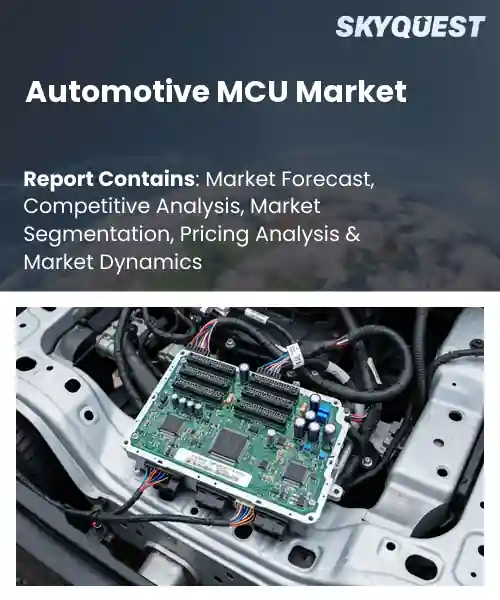
Automotive MCU Market
Report ID: SQMIG45O2160
Report ID: SQMIG45O2160
[email protected]
USA +1 351-333-4748
Report ID:
SQMIG45O2160 |
Region:
Global |
Published Date: June, 2026
Pages:
157
|Tables:
175
|Figures:
79


Global Automotive Mcu Market size was valued at USD 18.99 Billion in 2024 and is poised to grow from USD 21.12 Billion in 2025 to USD 49.37 Billion by 2033, growing at a CAGR of 11.2% during the forecast period (2026-2033).
The automotive microcontroller unit (MCU) market consists of semiconductor chips that control vehicle functions, from engine timing to advanced driver-assist systems. This is important because of the transition to electric and connected cars, where dozens of electronic control nodes take the place of traditional mechanical components. Previously, MCUs were restricted to powertrain and body-control modules, but the addition of infotainment, safety and autonomous features have proliferated demand. For example, Tesla’s Model 3 uses more than 100 different MCUs, while legacy models now have at least 30, which shows rapid proliferation. This evolution is driven by regulatory emissions targets and consumer expectations for smarter, safer mobility today globally.
Today, the biggest growth driver is the convergence of vehicle electrification and autonomy, which calls for MCUs to provide computing power and real-time processing. The replacement of internal combustion engines by electric powertrains increases the complexity of control algorithms for battery management, thermal regulation and regenerative braking, demanding MCUs with higher integration and reliability. Meanwhile, Level 3 and Level 4 autonomous prototypes employ sensor fusion and over-the-air updates developing a market for MCUs that enable communication protocols such as CAN-FD and Ethernet. Consequently, manufacturers like NXP and Renesas are expanding production lines, while automotive OEMs forge partnerships to secure supply chains, unlocking revenue streams worth billions.
How is AI-driven automation influencing the design of automotive MCUs for autonomous vehicles?
AI-driven automation is changing the game for automotive MCU design by moving intelligence from the software layers into silicon. Now, designers embed neural inference engines, optimize memory hierarchies for sensor data, and focus on low latency and power efficiency. The current landscape has perception, planning and control modular blocks that are reprogrammable. This approach reduces development cycles and enables rapid updates as autonomous algorithms evolve. The demand for autonomous vehicles and the lack of semiconductors are driving manufacturers to these integrated solutions. In the real world, we are seeing major suppliers offering MCUs with built-in AI accelerators to meet these needs.
A leading chip maker announced in April 2026 an AI-optimized MCU platform that combines sensor fusion cores and on-chip learning support, exemplifying how AI-driven automation speeds up time to market and enhances vehicle safety while supporting the upward trend of the automotive MCU sector.
Market snapshot - (2026-2033)
Global Market Size
USD 18.99 Billion
Largest Segment
32-Bit Microcontrollers
Fastest Growth
32-Bit Microcontrollers
Growth Rate
11.2% CAGR
To get more insights on this market click here to Request a Free Sample Report
Global automotive mcu market is segmented by bit class configuration, functional application domain, process node technology, core processor architecture, vehicle propulsion type, network connectivity interface and region. Based on bit class configuration, the market is segmented into 8-Bit Microcontrollers, 16-Bit Microcontrollers and 32-Bit Microcontrollers. Based on functional application domain, the market is segmented into Powertrain and Chassis, Safety and Security Systems, Advanced Driver Assistance Systems, Body Electronics and Infotainment and Telematics. Based on process node technology, the market is segmented into Fine Architecture Nodes Below 16 nm, Mid Range Nodes Between 40 nm and 22 nm and Legacy Nodes Above 40 nm. Based on core processor architecture, the market is segmented into ARM Cortex-M Series, ARM Cortex-R and Cortex-A Series, RISC-V Open Architecture and Proprietary Core Architectures. Based on vehicle propulsion type, the market is segmented into Passenger Internal Combustion Engine Vehicles, Commercial Internal Combustion Engine Vehicles, Battery Electric Vehicles and Plug-In Hybrid Electric Vehicles. Based on network connectivity interface, the market is segmented into Vehicle-to-Vehicle Module Systems, Vehicle-to-Infrastructure Systems and Vehicle-to-Cloud Integration. Based on region, the market is segmented into North America, Europe, Asia Pacific, Latin America and Middle East & Africa.
ARM Cortex M series segment is the dominant one as it provides good combination of processing power, power efficiency and mature software ecosystem to meet automotive safety and real time needs. Its broad tool support and proven reliability makes integration easier across powertrain, chassis and body electronics, making it the default choice for designers looking for cost effective yet robust control solutions in the automotive MCU market and future proof scalability across emerging connectivity functions.
However, the RISC-V open architecture segment is showing the strongest growth momentum as its customizable instruction set and royalty-free licensing allow automakers to tailor silicon for advanced driver assistance and vehicle-to-cloud features. This flexibility accelerates innovation cycles, unlocks new revenue streams and drives MCU adoption in next-generation electric and autonomous vehicles.
The mid-range node segment between 40 nm and 22 nm dominates, because it delivers a good trade-off between integration density and manufacturing affordability, with sufficient performance for powertrain, chassis and body control and low thermal footprints. Their demonstrated yield, existing supply chains and compatibility with automotive qualification standards lower development risk, enabling OEMs to meet stringent functional safety requirements without high silicon cost and future-proof scalability for emerging functions in vehicle domains.
Meanwhile, fine architecture nodes below 16 nm segment is emerging as the key high growth area, because its ultra dense transistor designs enable compute capability for advanced driver assistance and autonomous driving workloads. “Increasing demand for higher bandwidth sensor fusion and AI inference is driving rapid adoption, making these nodes enablers of next generation vehicle intelligence.
To get detailed segments analysis, Request a Free Sample Report
Asia Pacific benefits from a combination of advanced manufacturing, strong talent pools in electronics engineering, and a mature supply chain that connects semiconductor manufacturing to vehicle assembly. The region’s leading automakers are spending big on next-generation vehicle architectures, fueling demand for highly integrated microcontrollers to enable connectivity, autonomy and electrification. Government policies encouraging smart mobility, and significant R&D incentives further accelerate the innovation. With OEMs, Tier-1 suppliers and local foundries in the collaborative ecosystems, rapid prototyping and cost-effective scaling are possible, ensuring the region’s leadership in automotive MCU development and adoption.
Automotive MCU Market in Japan benefits from the country’s legacy of precision engineering and a strong emphasis on reliability. Domestic automakers are targeting embedded solutions that improve safety systems and enable advanced driver assistance features. The continuous progress of low-power, high-performance microcontrollers is being supported by intimate collaboration with national research institutes, and the steady supply of cutting-edge components for traditional and electric vehicle platforms is guaranteed by long-standing supplier partnerships.
The automotive MCU market in South Korea is driven by a dynamic blend of automotive manufacturing and semiconductor expertise. Leading car manufacturers are working on integrating high-density microcontrollers to enable vehicle-to-infrastructure communication and advanced infotainment features. South Korea is a hotbed for next-generation automotive electronics with world-class chip fabs in the country, fast access to custom solutions, and the government’s supportive initiatives to develop autonomous driving technologies.
Strict safety and emission standards in Europe are compelling automakers to invest in highly reliable and efficient control solutions, propelling the automotive MCU market. Established OEMs in the region are quickly adopting electrified powertrains, autonomous driving prototypes and connected car services, all of which require sophisticated microcontrollers. “Automakers, semiconductor companies and research consortia are working closely together to accelerate innovation in the areas of functional safety standards and over-the-air update capabilities.” Europe’s strong ecosystem of specialized suppliers and its emphasis on sustainability also strengthen its role as a catalyst for MCU developments in the automotive sector.
The Automotive MCU market in Germany is a reflection of the country’s strength in high-performance vehicle engineering and commitment to precision manufacturing. German carmakers are on the lookout for microcontrollers with more processing power for advanced driver assistance systems that are seamlessly integrated with electric drivelines. Partnerships with major chip makers are speeding up the development of robust, safety-certified solutions, while the country’s strong engineering education pipeline ensures a steady supply of expertise to keep innovation in automotive electronics alive.
The United Kingdom automotive MCU market is characterized by the fast adoption of connected and autonomous vehicle technologies. The UK’s vibrant tech ecosystem and supportive policy environment drive investment in next-generation microcontroller platforms that enable real-time data processing and over-the-air software updates. Automakers are partnering with chip pioneers in research hubs that enable quick prototyping and deployment of advanced control units across legacy and emerging vehicle platforms.
France Automotive MCU Market is evolving with its strong automotive heritage and increasing focus on electrified mobility. For new electric vehicle models, French manufacturers are focusing on microcontrollers that provide efficient power management and advanced telematics. In the European automotive MCU landscape, France’s influence is growing, with partnerships with regional semiconductor startups and academic institutions driving the development of tailored, low-power solutions.
North America’s rich talent pool of technology and a culture of disruptive innovation support its growing automotive MCU capabilities. Top automakers and technology companies collaborate to embed artificial intelligence, high-definition mapping and over-the-air update capabilities into vehicle control architectures. The deep base of semiconductor manufacturing in the region provides fast access to custom microcontroller designs, and strong venture capital activity is driving the growth of specialized startups focused on autonomous driving and connectivity. This fast-paced environment promotes a resilient supply chain and accelerates the implementation of complex MCU solutions throughout the automotive industry.
The United States’ Automotive MCU Market is propelled by the convergence of automotive engineering and Silicon Valley’s software expertise. U.S. manufacturers use microcontrollers that allow advanced sensor fusion, machine learning inference at the edge, and seamless integration with cloud services. Strong focus on open standards, to promote interoperability across a diverse set of vehicle platforms Strategic partnerships with top chip designers enable quick iteration of safety-critical firmware Bolstering the United States’ leadership in automotive MCU innovation.
Canada’s automotive MCU market is supported by a collaborative ecosystem that links the automotive manufacturing sector with a flourishing semiconductor research community. Canadian companies are working on microcontrollers that are optimized for performance in cold climates and robust connectivity, which are crucial for conventional and electric vehicles operating in a range of environments. Government incentives are pushing automakers and academic labs to work together on projects that speed the development of rugged, low-power control units tailored to the unique challenges of the North American market.
To know more about the market opportunities by region and country, click here to
Buy The Complete Report
Electrification Trends Driving Demand
Advanced ADAS Features Leveraging MCUs
High Development Costs Limiting Adoption
Supply Chain Constraints Affecting Availability
Request Free Customization of this report to help us to meet your business objectives.
Automotive MCU vendors are chasing M&A, foundry partnerships and fast tech innovation like advanced ADAS and EV power train solutions due to memory shortages and global supply chain risks, rising competition. Industry research shows companies are merging niche MCU assets and working together on next-generation silicon to ensure component availability and meet growing demand.
SkyQuest’s ABIRAW (Advanced Business Intelligence, Research & Analysis Wing) is our Business Information Services team that Collects, Collates, Correlates, and Analyses the Data collected by means of Primary Exploratory Research backed by robust Secondary Desk research. As per SkyQuest analysis, the market is being propelled primarily by the electrification of vehicles, which forces manufacturers to embed sophisticated MCUs for battery management and power‑train control, while the growing demand for advanced driver‑assistance systems that require high‑speed data processing serves as a second powerful catalyst. The ARM Cortex‑M series remains the dominant segment because of its balance of performance, low power and strong safety ecosystem. Asia Pacific leads the market thanks to its deep manufacturing base and aggressive EV adoption. However, high development costs for automotive‑grade silicon pose a significant restraint, slowing broader MCU rollout. Supply‑chain pressures also add uncertainty to timelines.
| Report Metric | Details |
|---|---|
| Market size value in 2024 | USD 18.99 Billion |
| Market size value in 2033 | USD 49.37 Billion |
| Growth Rate | 11.2% |
| Base year | 2024 |
| Forecast period | (2026-2033) |
| Forecast Unit (Value) | USD Billion |
| Segments covered |
|
| Regions covered | North America (US, Canada), Europe (Germany, France, United Kingdom, Italy, Spain, Rest of Europe), Asia Pacific (China, India, Japan, Rest of Asia-Pacific), Latin America (Brazil, Rest of Latin America), Middle East & Africa (South Africa, GCC Countries, Rest of MEA) |
| Companies covered |
|
| Customization scope | Free report customization with purchase. Customization includes:-
|
To get a free trial access to our platform which is a one stop solution for all your data requirements for quicker decision making. This platform allows you to compare markets, competitors who are prominent in the market, and mega trends that are influencing the dynamics in the market. Also, get access to detailed SkyQuest exclusive matrix.
Table Of Content
Executive Summary
Market overview
Parent Market Analysis
Market overview
Market size
KEY MARKET INSIGHTS
COVID IMPACT
MARKET DYNAMICS & OUTLOOK
Market Size by Region
KEY COMPANY PROFILES
Methodology
For the Automotive MCU Market, our research methodology involved a mixture of primary and secondary data sources. Key steps involved in the research process are listed below:
1. Information Procurement: This stage involved the procurement of Market data or related information via primary and secondary sources. The various secondary sources used included various company websites, annual reports, trade databases, and paid databases such as Hoover's, Bloomberg Business, Factiva, and Avention. Our team did 45 primary interactions Globally which included several stakeholders such as manufacturers, customers, key opinion leaders, etc. Overall, information procurement was one of the most extensive stages in our research process.
2. Information Analysis: This step involved triangulation of data through bottom-up and top-down approaches to estimate and validate the total size and future estimate of the Automotive MCU Market.
3. Report Formulation: The final step entailed the placement of data points in appropriate Market spaces in an attempt to deduce viable conclusions.
4. Validation & Publishing: Validation is the most important step in the process. Validation & re-validation via an intricately designed process helped us finalize data points to be used for final calculations. The final Market estimates and forecasts were then aligned and sent to our panel of industry experts for validation of data. Once the validation was done the report was sent to our Quality Assurance team to ensure adherence to style guides, consistency & design.
Analyst Support
Customization Options
With the given market data, our dedicated team of analysts can offer you the following customization options are available for the Automotive MCU Market:
Product Analysis: Product matrix, which offers a detailed comparison of the product portfolio of companies.
Regional Analysis: Further analysis of the Automotive MCU Market for additional countries.
Competitive Analysis: Detailed analysis and profiling of additional Market players & comparative analysis of competitive products.
Go to Market Strategy: Find the high-growth channels to invest your marketing efforts and increase your customer base.
Innovation Mapping: Identify racial solutions and innovation, connected to deep ecosystems of innovators, start-ups, academics, and strategic partners.
Category Intelligence: Customized intelligence that is relevant to their supply Markets will enable them to make smarter sourcing decisions and improve their category management.
Public Company Transcript Analysis: To improve the investment performance by generating new alpha and making better-informed decisions.
Social Media Listening: To analyze the conversations and trends happening not just around your brand, but around your industry as a whole, and use those insights to make better Marketing decisions.
REQUEST FOR SAMPLE
 REQUEST FREE CUSTOMIZATION
Global Automotive Mcu Market size was valued at USD 18.99 Billion in 2024 and is poised to grow from USD 21.12 Billion in 2025 to USD 49.37 Billion by 2033, growing at a CAGR of 11.2% during the forecast period (2026-2033).
The competitive landscape is intensifying as memory shortages and global supply‑chain risks push automotive MCU vendors to pursue M&A, forge partnerships with foundries, and accelerate technology innovation such as advanced ADAS and EV power‑train solutions. Industry analyses highlight that firms are consolidating niche MCU assets and collaborating on next‑generation silicon to secure component availability and meet rising demand. 'Infineon Technologies AG', 'NXP Semiconductors N.V.', 'Renesas Electronics Corporation', 'STMicroelectronics N.V.', 'Texas Instruments Incorporated', 'Microchip Technology Inc.', 'Toshiba Corporation', 'onsemi', 'Analog Devices Inc.', 'Rohm Co. Ltd.', 'Nexperia B.V.', 'Silicon Laboratories Inc.', 'Intel Corporation', 'Qualcomm Incorporated', 'Elmos Semiconductor SE', 'Melexis NV', 'GigaDevice Semiconductor Inc.', 'Broadcom Inc.', 'Sony Semiconductor Solutions Corporation', 'Cypress Semiconductor Corporation'
Electrification of vehicles is prompting manufacturers to integrate sophisticated control units for battery management, motor control, and safety functions. These emerging requirements increase the functional complexity of automotive electronic architectures, thereby expanding the need for microcontroller units that can handle higher processing loads while maintaining reliability. As OEMs transition to electric powertrains, the demand for MCUs that support flexible firmware updates and modular design intensifies, fostering market growth through expanded application scopes across vehicle platforms. This broader integration encourages supplier‑automaker collaboration, spurring innovative solutions.
Electric Powertrain Integration: The shift toward fully electric vehicles is prompting automakers to embed MCUs directly within powertrain modules, enabling real‑time torque management, battery thermal regulation, and predictive maintenance. By consolidating functions that previously required separate controllers, manufacturers reduce wiring complexity, improve system reliability, and accelerate software updates over‑the‑air. This integration also supportsmodular vehicle architectures, allowing platforms to be swiftly adapted for diverse market segments while delivering a more seamless driving experience and fostering tighter coordination between hardware and firmware development teams.
Why does Asia Pacific Dominate the Global Automotive MCU Market? |@12


Want to customize this report? This report can be personalized according to your needs. Our analysts and industry experts will work directly with you to understand your requirements and provide you with customized data in a short amount of time. We offer $1000 worth of FREE customization at the time of purchase.
Feedback From Our Clients


 USA (+1) 351-333-4748

