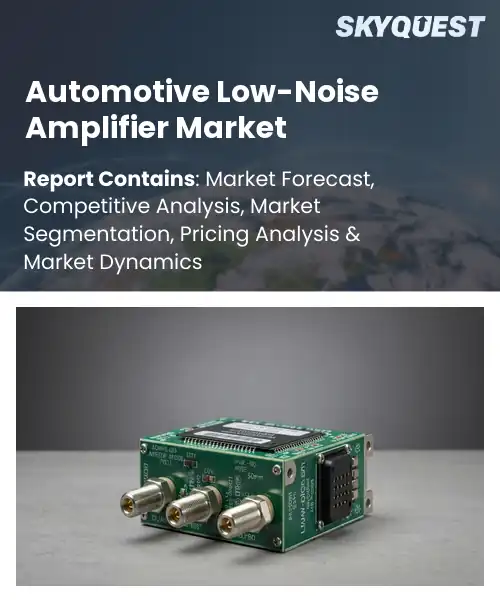
Automotive Low-Noise Amplifier Market
Report ID: SQMIG45N2200
Report ID: SQMIG45N2200
[email protected]
USA +1 351-333-4748
Report ID:
SQMIG45N2200 |
Region:
Global |
Published Date: March, 2026
Pages:
157
|Tables:
117
|Figures:
77


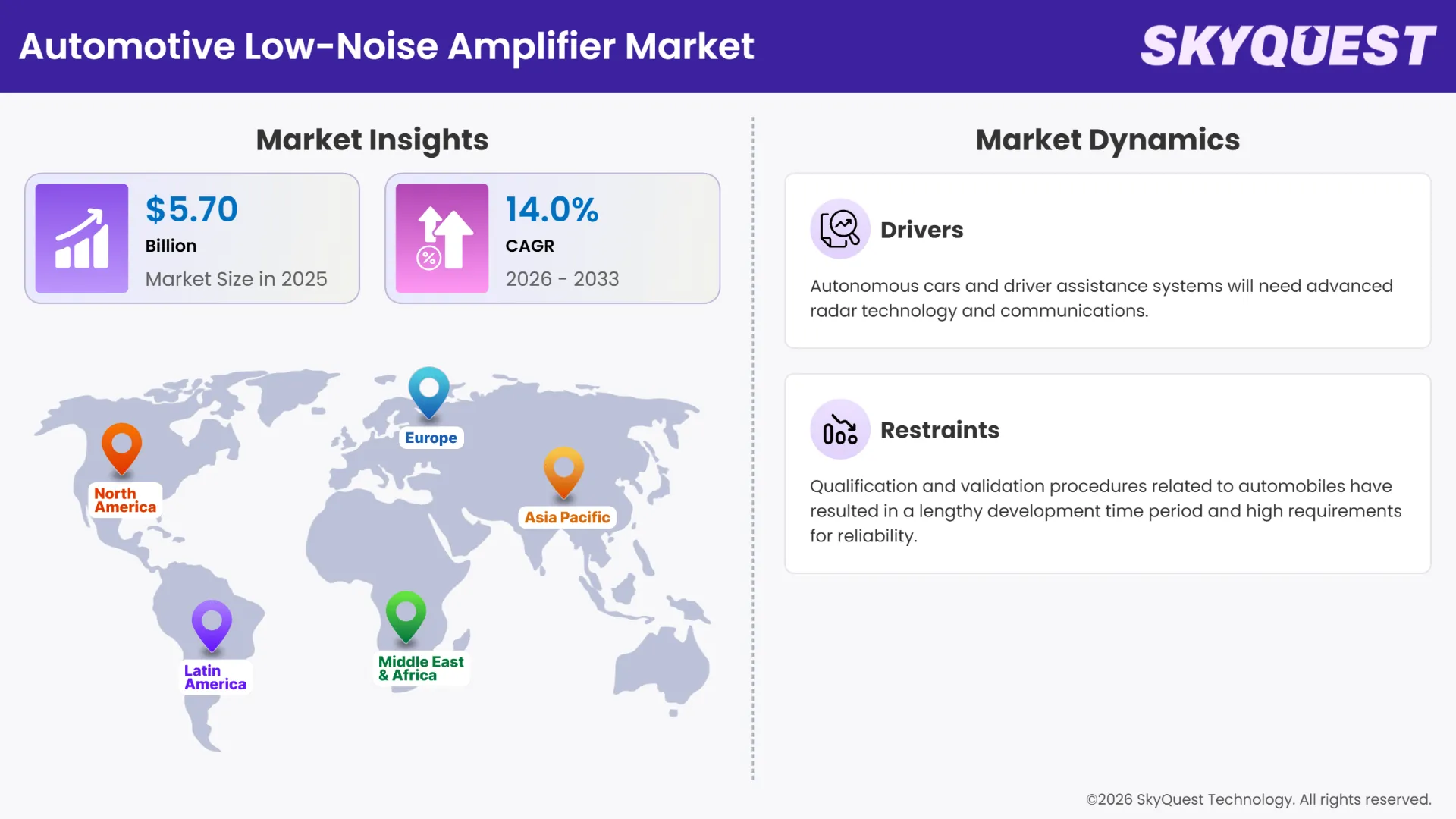
Global Automotive Low-Noise Amplifier Market size was valued at USD 5.00 Billion in 2024 and is poised to grow from USD 5.70 Billion in 2025 to USD 16.26 Billion by 2033, growing at a CAGR of 14.0% during the forecast period (2026-2033).
Key Takeaways: Market Trends & Insights
Rising integration of advanced driver assistance systems (ADAS), increasing adoption of autonomous driving technologies, growing demand for high-frequency radar and V2X communication, and advancements in semiconductor technologies are driving sales of automotive low-noise amplifiers.
The shift in vehicle technology from sensing to autonomous driving will lead to the evolution of LNAs from universal devices to specialized, robust wideband automotive devices. The increased electromagnetic interference and signal weakening caused by the increasing electrification and the increase in sensor bandwidth. Additionally, developments in semiconductor materials such as silicon germanium and GaAs along with increasing funding in the automotive sector have helped improve the performance of ADAS and other applications such as adaptive cruise control. Growing demand for connected and autonomous vehicles around the world coupled with a strong shift toward enhanced vehicle safety and performance is expected to primarily drive automotive low-noise amplifier market growth.
On the contrary, high costs of automotive-grade low-noise amplifiers, lack of standardization, performance validation and reliability challenges, and risks associated with signal interference and component inconsistencies are anticipated to slow down automotive low-noise amplifier market penetration through 2033.
How is AI Improving Performance and Reliability of Automotive Low-noise Amplifiers?
AI is facilitating the better design and real-time performance of LNAs. In terms of design, using machine learning algorithms accelerates the synthesis process of mmWave LNAs and biasing. At runtime, equalization calibration ensures the stability of the LNA despite the temperature variations and interfering signals, thus making the LNAs resilient against the demanding conditions of their usage within the automotive industry. The increased demand for radar-based security technologies for autonomous cars makes suppliers incorporate.
In May 2024, Altum RF introduced an E-band LNA for automotive radar. When paired with AI-driven design automation and adaptive calibration, such innovations enhance the reliability of high-frequency radar systems and significantly shorten development cycles.
To get more insights on this market click here to Request a Free Sample Report
Global automotive low-noise amplifier market is segmented by frequency range, application domain, semiconductor material, vehicle type, and region. Based on frequency range, the market is segmented into Sub-6 GHz, Millimeter Wave, and GPS/GNSS frequency bands. Based on application domain, the market is segmented into infotainment & telematics units, ADAS & autonomous sensor suites, and satellite radio & digital audio broadcasting (DAB). Based on semiconductor material, the market is segmented into Silicon-Germanium (SiGe), Gallium Arsenide (GaAs), and CMOS Based LNAs. Based on vehicle type, the market is segmented into passenger vehicles, electric vehicles, and commercial & fleet vehicles. Based on region, the market is segmented into North America, Europe, Asia Pacific, Latin America, and Middle East & Africa.
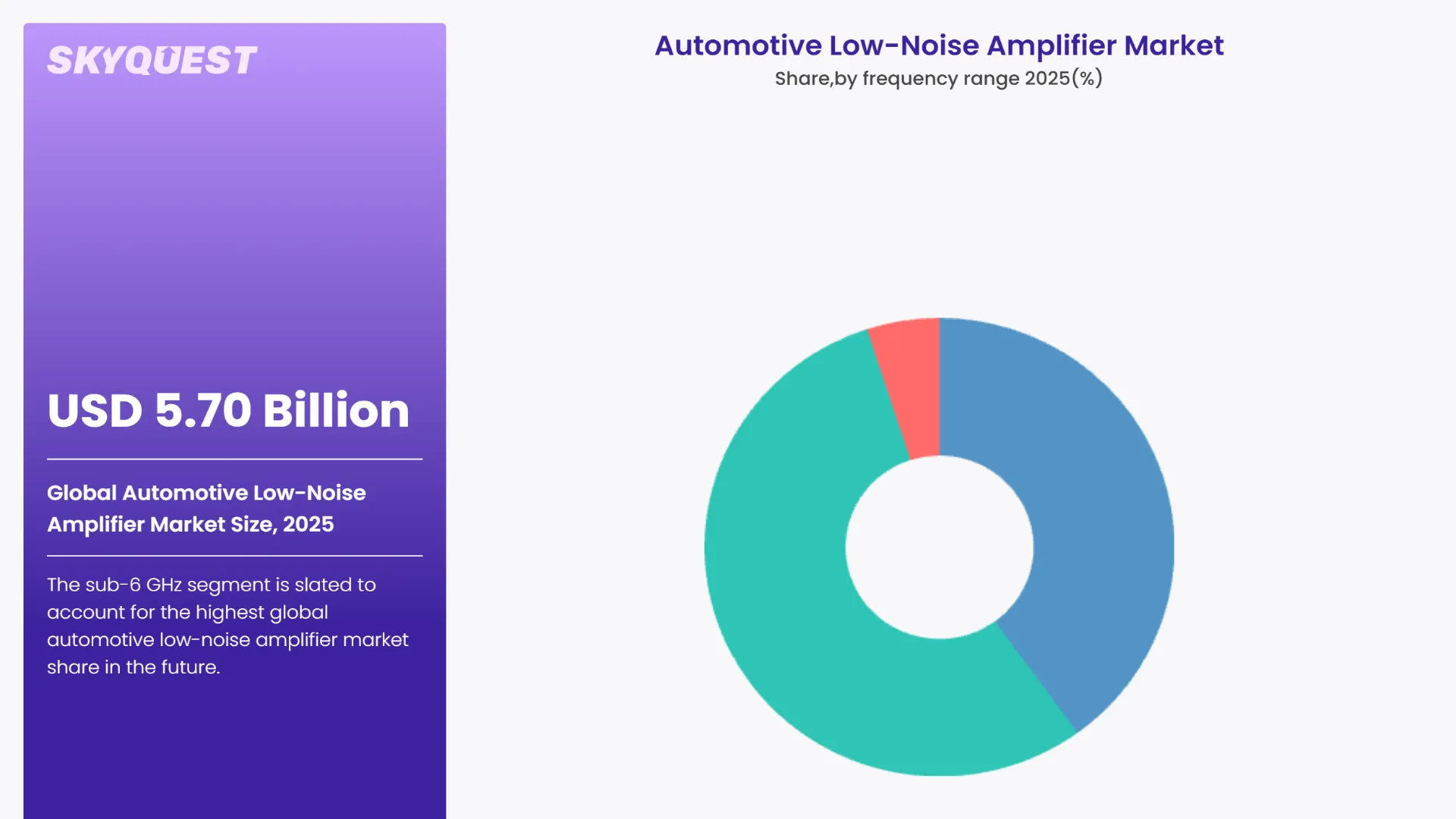
The sub-6 GHz segment is slated to account for the highest global automotive low-noise amplifier market share in the future. The compatibility of its frequency range with the primary applications of vehicular wireless communications and the well-established RF environment makes it possible for this market to dominate over other markets. The designers of automobiles are inclined towards amplifiers which provide excellent sensitivity, low power consumption, and cost-effective implementation to support telematics and entertainment purposes. Such engineering priorities will motivate component manufacturers to focus on sub-6 GHz, which underscores its importance within automotive radio frequency roadmaps.
Meanwhile, Millimeter Wave is emerging as the most rapidly expanding segment as per this automotive low-noise amplifier market forecast. Demand for greater spectral capacity and resolution among vehicles is slated to create new business scope via this segment. Advances in materials, packaging, and noise reduction technology for the millimeter-wave range allow for practical high-frequency LNAs, which will lead to valuable applications in radar, high-speed V2X, and sensor technologies.
The Gallium Arsenide (GaAs) segment is expected to lead the global automotive low-noise amplifier market revenue generation potential over the coming years. These devices provide intrinsic high-frequency gain and exceptionally low noise, which is expected to help cement the dominance of this segment. The use of GaAs in radar front ends and high-performance wireless subsystems is preferred by vehicle OEMs and component providers due to their suitability for applications requiring high-quality signals and good thermal stability. The perfect match between these requirements and material characteristics will facilitate dedicated development efforts toward GaAs technology improvement and supply chain management.
Nevertheless, CMOS-Based LNAs segment appear to be on the path toward the most dynamic growth due to their ability to integrate with existing silicon technologies and deeper integration with digital/mixed-signal systems. Fast progress in optimizing noise in CMOS circuits and their integration opens up cost-effective and energy-efficient LNAs for mass infotainment and telematics applications.
To get detailed segments analysis, Request a Free Sample Report
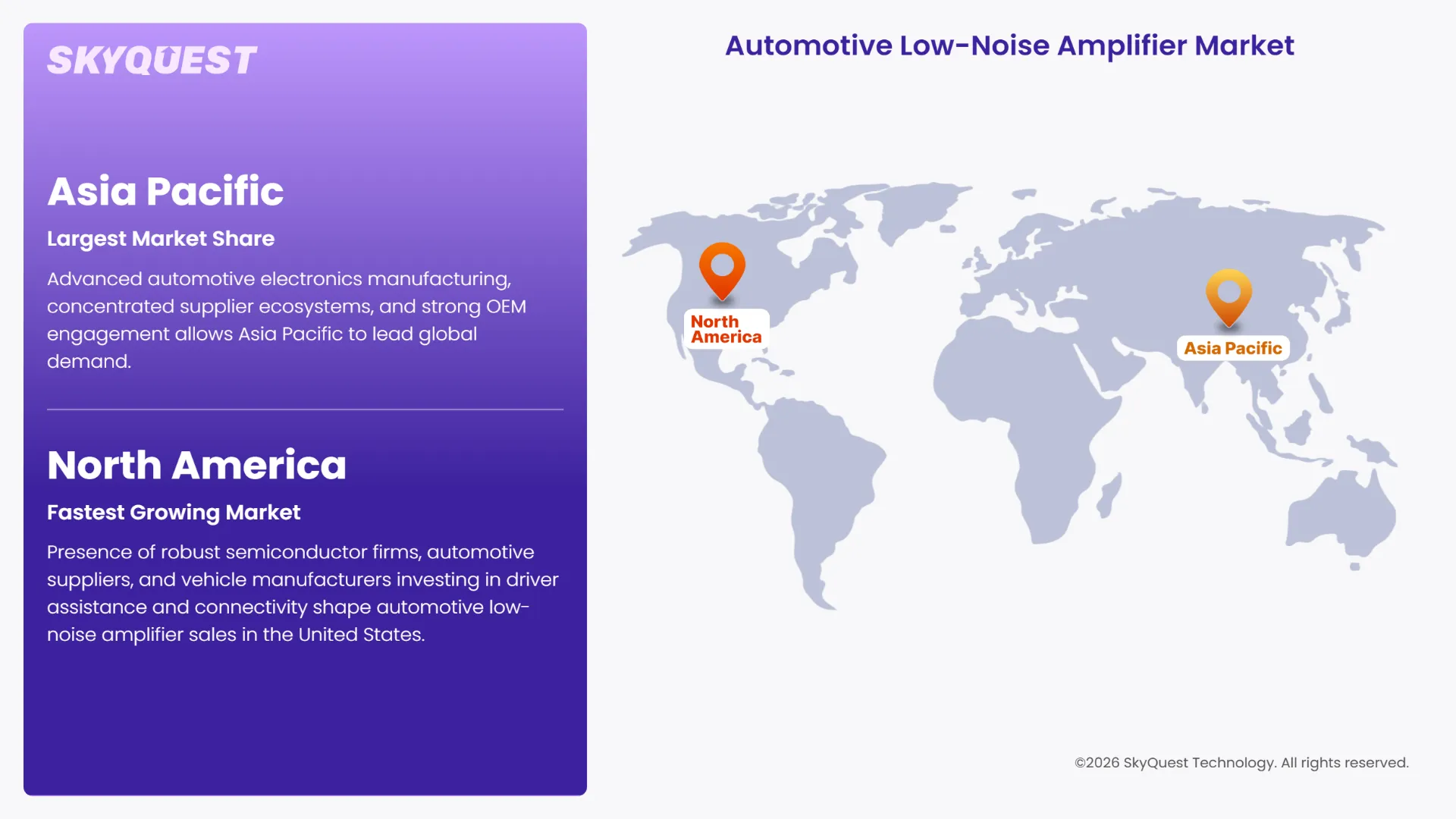
Advanced automotive electronics manufacturing, concentrated supplier ecosystems, and strong OEM engagement allows Asia Pacific to lead global demand. Local suppliers have the advantage of local, integrated supply chains that enable them to develop prototypes quickly, provide them with components tailored specifically for their customers, and provide them with collaborative engineering services with the vehicle manufacturers they work with. The support from government agencies through EV policies and investments into semiconductor fabs also members of support and innovating that improve availability and access to those components. All of these structural advantages work together to create a stable, durable environment where design experience and expertise, scale of manufacturing, and efficiency in logistics are working in unison to maintain Asia Pacific's position as an industry leader; as well as continue to draw investment from both domestic and international sources. Close collaboration between semiconductor suppliers and systems integrators further drives faster product improvements and overall market responsiveness.
Presence of a dense network of OEMs, suppliers, and electronics firms that prioritize signal integrity and thermal performance makes Japan a top market in this region. Scientific groups aid in ensuring the reliability of the process and its optimization. The awareness of how semiconductors for cars have been developed is motivation for improving amplifiers' design. Collaboration between car companies and their suppliers makes it possible to design amplifiers for small and hybrid engines.
Strong electronics manufacturing, semiconductor integration, and connections between component manufacturers and car manufacturers contribute positively towards the growth in sales of automotive low-noise amplifiers in South Korea. Partnership in research and development, as well as the use of specific laboratories, aids in the development of efficient technology that can reduce noise and be more energy efficient. Integration partnerships involving chipsets guarantee that the manufacturing process is feasible.
Advanced automotive electronics demand, systems integration expertise, and significant investments by OEMs are boosting sales of automotive low-noise amplifiers in this region. High emphasis on vehicle safety and in-vehicle connectivity translates to an increased demand for low-noise front-end solutions such as automotive low-noise amplifier. Collaborative engineering alliances between automakers and component manufacturers reduces the cycle time of validating and integrating into mass production vehicles. The demand for reliable electronics to provide signal fidelity when operating in a variety of environments is spurred by regulatory agencies focusing on vehicle safety and emissions, which makes North America a hub for innovation and adoption in the long run.
Presence of robust semiconductor firms, automotive suppliers, and vehicle manufacturers investing in driver assistance and connectivity shape automotive low-noise amplifier sales in the United States. Cooperation with research bodies assists in the prototype development process and validation of their amplifying abilities. Reliable components used in sensors and communication systems have led to modularization and competitive trends among suppliers. Cooperation with manufacturers helps to transition from development to production and market strategies.
Advanced research skills, engineering centers, and a steady growth of electronics supply in the country are some of the factors facilitating the implementation of low-noise amplifiers in the Canadian automotive industry. The synergy between the academic sector and the industry sector helps to fast track the implementation process. The focus of the integration in this case includes sensors and wireless communication technologies.
Concentrated engineering expertise, strong supplier networks, and emphasis on robust regulatory compliance are shaping automotive low-noise amplifier demand in Europe. Through collaborative clusters of universities, research institutions, and industry members, Europe is creating an environment conducive to developing innovative materials, packaging, and testing methods to improve noise performance in automotive applications. Increasing efforts to boost electrification, as well as advanced driver assistance systems (ADAS), will require a reliable signal chain, including a broad range of amplifier technologies. In addition to collaborative clusters, Europe has developed a strong network of regional suppliers that provide innovative sourcing strategies to take advantage of specialized manufacturing capabilities and a culture of rigorous validation. Furthermore, Europe benefits from investing in localized supply chains and standardizing testing regimes, both of which will reduce time to market and increase interoperability among suppliers.
Presence of top vehicle manufacturers and a mature supplier ecosystem focused on high-reliability components shapes automotive low-noise amplifier procurement in Germany. Testing facilities and manufacturing capabilities allow for quick iterations and verification. Suppliers can work with OEM engineers to design components which can perform at higher levels consistently. With focus placed on engineering excellence and vehicle integration, there is incentive to create amplifiers which fulfil electromagnetic compliance requirements and can withstand high temperatures.
Expertise in electronics design and testing services that address complex signal environments help boost automotive low-noise amplifier adoption in the United Kingdom. Partnership with original equipment manufacturers ensures the creation of customized products based on local needs. Focus on connected vehicles boosts the need for low noise parts that can be used efficiently in small packages under different conditions. The presence of numerous design houses and test centers facilitates quick assessment of various amplifier architectures and packaging techniques.
Longstanding expertise in analogue design, mixed-signal integration, and semiconductor packaging makes France a key market for automotive low-noise amplifier companies. Active cooperation with European Original Equipment Manufacturer projects helps align component requirements and develop amplifiers for various applications. Local vendors emphasize the optimization of noise behaviour and power consumption to accommodate different vehicle designs. Joint efforts between research centers and industry facilitate innovations in material design and effective testing methods.
To know more about the market opportunities by region and country, click here to
Buy The Complete Report
Increasing Demand For Autonomous Vehicles
Expansion Of Vehicle Connectivity Features
Complex Automotive Qualification Processes
Supply Chain and Component Constraints
Request Free Customization of this report to help us to meet your business objectives.
Competitive landscape in the global automotive low-noise amplifier market centers on technology differentiation, targeted M&A and strategic Tier1 partnerships that capture radar design wins. Examples include NXP's automotive LNA product introductions and recent RF acquisitions that expand mmWave capability. Accelerating automotive radar adoption is the core market driver, forcing incumbents and newcomers to pursue partnerships and specialized mmWave LNA innovation.
SkyQuest’s ABIRAW (Advanced Business Intelligence, Research & Analysis Wing) is our Business Information Services team that Collects, Collates, Correlates, and Analyses the Data collected by means of Primary Exploratory Research backed by robust Secondary Desk research.
As per SkyQuest analysis, increasing adoption of advanced driver assistance systems (ADAS) and autonomous driving technologies along with growing demand for high-frequency radar and V2X communication are anticipated to drive the demand for automotive low-noise amplifiers going forward. However, high development costs, lack of standardization, and performance validation challenges are slated to slow down the adoption of automotive low-noise amplifiers in the future. North America is slated to spearhead the demand for automotive low-noise amplifiers owing to strong presence of leading automotive OEMs and high adoption of connected and autonomous vehicle technologies. Advancements in semiconductor materials such as silicon germanium and GaAs along with integration of AI-driven design and adaptive calibration are anticipated to be key trends driving the automotive low-noise amplifier sector over the coming years.
| Report Metric | Details |
|---|---|
| Market size value in 2024 | USD 5.00 Billion |
| Market size value in 2033 | USD 16.26 Billion |
| Growth Rate | 14.0% |
| Base year | 2024 |
| Forecast period | 2026-2033 |
| Forecast Unit (Value) | USD Billion |
| Segments covered |
|
| Regions covered | North America (US, Canada), Europe (Germany, France, United Kingdom, Italy, Spain, Rest of Europe), Asia Pacific (China, India, Japan, Rest of Asia-Pacific), Latin America (Brazil, Rest of Latin America), Middle East & Africa (South Africa, GCC Countries, Rest of MEA) |
| Companies covered |
|
| Customization scope | Free report customization with purchase. Customization includes:-
|
To get a free trial access to our platform which is a one stop solution for all your data requirements for quicker decision making. This platform allows you to compare markets, competitors who are prominent in the market, and mega trends that are influencing the dynamics in the market. Also, get access to detailed SkyQuest exclusive matrix.
Table Of Content
Executive Summary
Market overview
Parent Market Analysis
Market overview
Market size
KEY MARKET INSIGHTS
COVID IMPACT
MARKET DYNAMICS & OUTLOOK
Market Size by Region
KEY COMPANY PROFILES
Methodology
For the Automotive Low-Noise Amplifier Market, our research methodology involved a mixture of primary and secondary data sources. Key steps involved in the research process are listed below:
1. Information Procurement: This stage involved the procurement of Market data or related information via primary and secondary sources. The various secondary sources used included various company websites, annual reports, trade databases, and paid databases such as Hoover's, Bloomberg Business, Factiva, and Avention. Our team did 45 primary interactions Globally which included several stakeholders such as manufacturers, customers, key opinion leaders, etc. Overall, information procurement was one of the most extensive stages in our research process.
2. Information Analysis: This step involved triangulation of data through bottom-up and top-down approaches to estimate and validate the total size and future estimate of the Automotive Low-Noise Amplifier Market.
3. Report Formulation: The final step entailed the placement of data points in appropriate Market spaces in an attempt to deduce viable conclusions.
4. Validation & Publishing: Validation is the most important step in the process. Validation & re-validation via an intricately designed process helped us finalize data points to be used for final calculations. The final Market estimates and forecasts were then aligned and sent to our panel of industry experts for validation of data. Once the validation was done the report was sent to our Quality Assurance team to ensure adherence to style guides, consistency & design.
Analyst Support
Customization Options
With the given market data, our dedicated team of analysts can offer you the following customization options are available for the Automotive Low-Noise Amplifier Market:
Product Analysis: Product matrix, which offers a detailed comparison of the product portfolio of companies.
Regional Analysis: Further analysis of the Automotive Low-Noise Amplifier Market for additional countries.
Competitive Analysis: Detailed analysis and profiling of additional Market players & comparative analysis of competitive products.
Go to Market Strategy: Find the high-growth channels to invest your marketing efforts and increase your customer base.
Innovation Mapping: Identify racial solutions and innovation, connected to deep ecosystems of innovators, start-ups, academics, and strategic partners.
Category Intelligence: Customized intelligence that is relevant to their supply Markets will enable them to make smarter sourcing decisions and improve their category management.
Public Company Transcript Analysis: To improve the investment performance by generating new alpha and making better-informed decisions.
Social Media Listening: To analyze the conversations and trends happening not just around your brand, but around your industry as a whole, and use those insights to make better Marketing decisions.
REQUEST FOR SAMPLE
 REQUEST FREE CUSTOMIZATION
Global Automotive Low-Noise Amplifier Market size was valued at USD 5.0 Billion in 2024 and is poised to grow from USD 5.7 Billion in 2025 to USD 16.26 Billion by 2033, growing at a CAGR of 14.0% during the forecast period (2026-2033).
Competitive landscape in the global automotive low noise amplifier market centers on technology differentiation, targeted M&A and strategic Tier1 partnerships that capture radar design wins. Examples include NXP's automotive LNA product introductions and recent RF acquisitions that expand mmWave capability. Accelerating automotive radar adoption is the core market driver, forcing incumbents and newcomers to pursue partnerships and specialized mmWave LNA innovation. 'Texas Instruments', 'NXP Semiconductors', 'Analog Devices', 'Infineon Technologies', 'STMicroelectronics', 'Maxim Integrated', 'ON Semiconductor', 'Rohm Semiconductor', 'Microchip Technology', 'Cirrus Logic', 'Linear Technology', 'Broadcom Inc.', 'Qualcomm Technologies', 'Skyworks Solutions', 'Toshiba Corporation', 'Cypress Semiconductor', 'Pericom Semiconductor', 'Elantec Semiconductor', 'Infotech Enterprises', 'Vishay Intertechnology'
Autonomous and advanced driver assistance systems rely on high-fidelity radar and communication links; low-noise amplifiers improve signal integrity and detection capability, enabling reliable perception in varied driving conditions. Suppliers integrate LNAs into radar, lidar, and V2X receivers to maintain sensitivity while mitigating interference, prompting automotive manufacturers to specify robust, low-noise front-end components. OEMs prioritize parts that enhance sensor performance and system reliability, leading to greater procurement of automotive-grade LNAs and stimulating supplier investment in designs that meet stringent thermal and environmental requirements.
Vehicle To Everything Connectivity: Increasing demand for seamless communication among vehicles, infrastructure and cloud services is driving adoption of low noise amplifiers optimized for wideband and low distortion performance in automotive transceivers. OEMs and tier one suppliers prioritize RF front end components that support reliable vehicle to everything links, in cabin connectivity and over the air updates while maintaining electromagnetic compatibility. Suppliers respond with compact, thermally robust amplifier designs offering scalable integration options to meet platform requirements and accelerate deployment across connected vehicle portfolios.
Asia Pacific Dominate the Global Automotive Low-Noise Amplifier Market.
The Sub-6 GHz segment currently dominates the Automotive Low-Noise Amplifier market due to its widespread use in automotive communication systems, radar applications, and connected vehicle technologies.
The Millimeter Wave segment is expected to witness the fastest growth, supported by increasing adoption of advanced radar systems and autonomous vehicle technologies that require high-frequency signal processing.
AI is helping optimize LNA design and real-time performance through machine learning-based design automation, adaptive calibration, and signal equalization, improving reliability under varying automotive operating conditions.


Want to customize this report? This report can be personalized according to your needs. Our analysts and industry experts will work directly with you to understand your requirements and provide you with customized data in a short amount of time. We offer $1000 worth of FREE customization at the time of purchase.
Feedback From Our Clients


 USA (+1) 351-333-4748

