Global Automotive Lighting Market
Automotive Lighting Market

Report ID: SQMIG25A2474

sales@skyquestt.com
USA +1 351-333-4748

Automotive Lighting Market Size, Share, and Growth Analysis

Global Automotive Lighting Market

Automotive Lighting Market By Vehicle Type (Passenger Vehicles, Light Commerical Vehicles, Heavy Commercial Vehicles), By Technology (LED, Halogen, Xenon), By Product Type (Exterior, Interior), By Sales Channel (OEM, Aftermarket), By Region -Industry Forecast 2026-2033


Report ID: SQMIG25A2474 | Region: Global | Published Date: July, 2025
Pages: 175 |Tables: 91 |Figures: 76

Format - word format excel data power point presentation

Automotive Lighting Market Insights

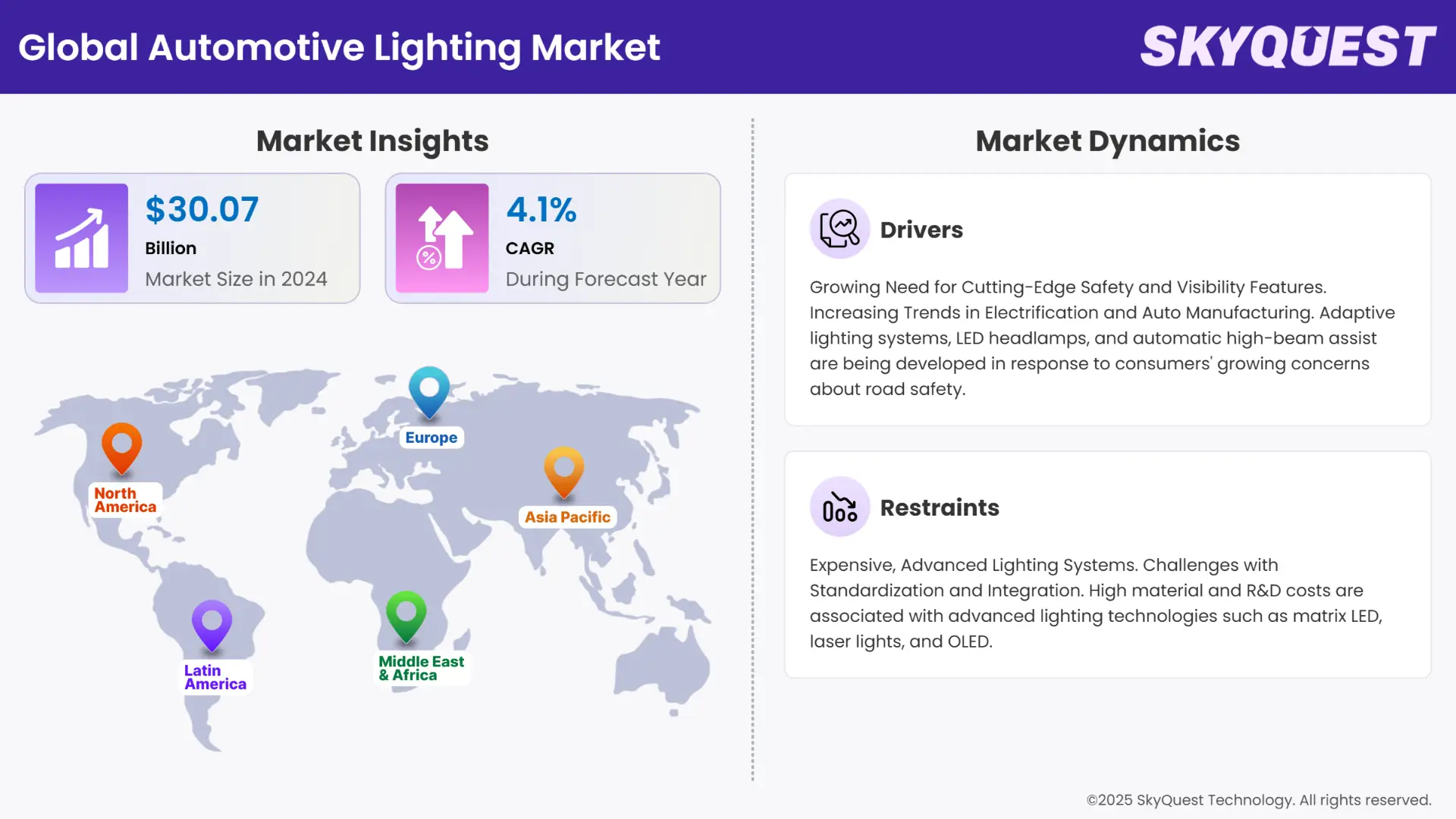
Global Automotive Lighting Market size was valued at USD 30.07 Billion in 2024 and is poised to grow from USD 31.31 Billion in 2025 to USD 43.18 Billion by 2033, growing at a CAGR of 4.1% during the forecast period (2026–2033).

Key Takeaways: Market Trends & Insights

  • Asia-Pacific dominated the Automotive Lighting market with the largest market share in 2025.
  • The Japan Automotive Lighting market is expected to grow significantly over the forecast period.
  • By Product Type, the Exterior segment held the largest Automotive Lighting market share in 2024.
  • The Interior segment held the highest growing market over the forecast period.
  • Asia-Pacific: Largest Market in 2025
  • Europe: Fastest Growing Market
  • 2025 Market Size: USD 31.31 Billion
  • 2026 Projected Market Size: USD 32.59 Billion
  • 2033 Projected Market Size: USD 43.18 Billion
  • CAGR (2026-2033): 4.1%

The increasing number of traffic accidents is one of the primary factors driving global automotive lighting market growth. The overall demand for vehicle lights is directly impacted by the number of vehicles sold. High car sales are accompanied by an increase in light demand. For automakers, lights are an essential part of the manufacturing process.

In addition to raising production volume, automakers are enhancing the features and quality of their vehicles to stay competitive. New car models are increasingly using advanced lighting systems like LEDs, OLEDs, and adaptive lighting technologies to increase safety, energy efficiency, and aesthetic appeal. As these lighting technologies outperform traditional halogen and xenon lights in terms of illumination, lifespan, and energy efficiency, they are a popular choice for new cars.

  • In February 2024, for example, Honda Motor Co. and Infineon Technologies signed a Memorandum of Understanding (MoU) to establish a strategic partnership focused on the semiconductor industry, specifically on advancements in the automotive lighting market. By leveraging Infineon's experience in semiconductor solutions and coordinating their future product and technology roadmaps, this collaboration will enhance Honda's automotive lighting systems.

Why are Automakers Turning to MicroLED Technology for Smart Lighting?

The introduction of MicroLED-based high-definition Matrix LED headlamps, which provide incredibly accurate illumination with over 20,000 individual light pixels per headlamp, is a significant advancement in the automotive lighting industry. These systems provide real-time adaptive lighting that can highlight people, project lane or hazard signals onto the road, and dynamically hide oncoming vehicles to lessen glare. Audi introduced the Q8 e-tron with MicroLED Matrix headlights in 2024, improving visual communication and driver safety. By 2025, BMW and Porsche want all of their high-end vehicles to have this technology. The growing demand for vehicle-to-everything (V2X) integration in intelligent lighting and transportation systems is reflected in this change.
Automotive Lighting Market Insights

To get more insights on this market click here to Request a Free Sample Report

Automotive Lighting Market Segments Analysis

The global automotive lighting market is segmented into vehicle type, technology, product type, sales channel, and region. By vehicle type, the market is classified into passenger vehicles, light commercial vehicles, and heavy commercial vehicles. Depending on technology, it is divided into LED, halogen, and xenon. According to product type, the market is categorized into interior and exterior. On the basis of sales channel, it is bifurcated into OEM and aftermarket. Regionally, it is analyzed across North America, Europe, Asia-Pacific, Latin America, and the Middle East & Africa.

What Role Do Exterior Decoration Lamps Play in Modern Vehicles?

As per the 2024 global automotive lighting market analysis, the exterior segment is subdivided into headlamps, tail lamps, brake lamps, signal lamps, exterior decoration lamps, exterior illumination function lamps, and other types of lamps. The exterior lighting segment currently holds most of the automotive lighting market share due to the increasing use of LED headlamps, which offer superior brightness, energy efficiency, and a longer lifespan than traditional halogen bulbs. As safety and aesthetics become more important to manufacturers and consumers, there is a greater need for advanced lighting solutions like adaptive headlights and daytime running lights. Partnerships and acquisitions have also aided in the development of this market and the advancement of technology.

  • For instance, in October 2024, Remsons Holding Ltd. purchased a 51 percent share in BEE Lighting, allowing the company to enter the automotive lighting market. This acquisition will expand market reach, improve customer satisfaction, and diversify product offerings.

The interior category is expected to have the largest automotive lighting market share during the forecast period. The segment is further divided into backlighting, reading lamps, ambient lamps, and other categories. The growth of the segment can be attributed to the growing use of better interior lighting systems in mid- and high-end cars.

How are LEDs Outperforming Halogen and HID in Automotive Lighting?

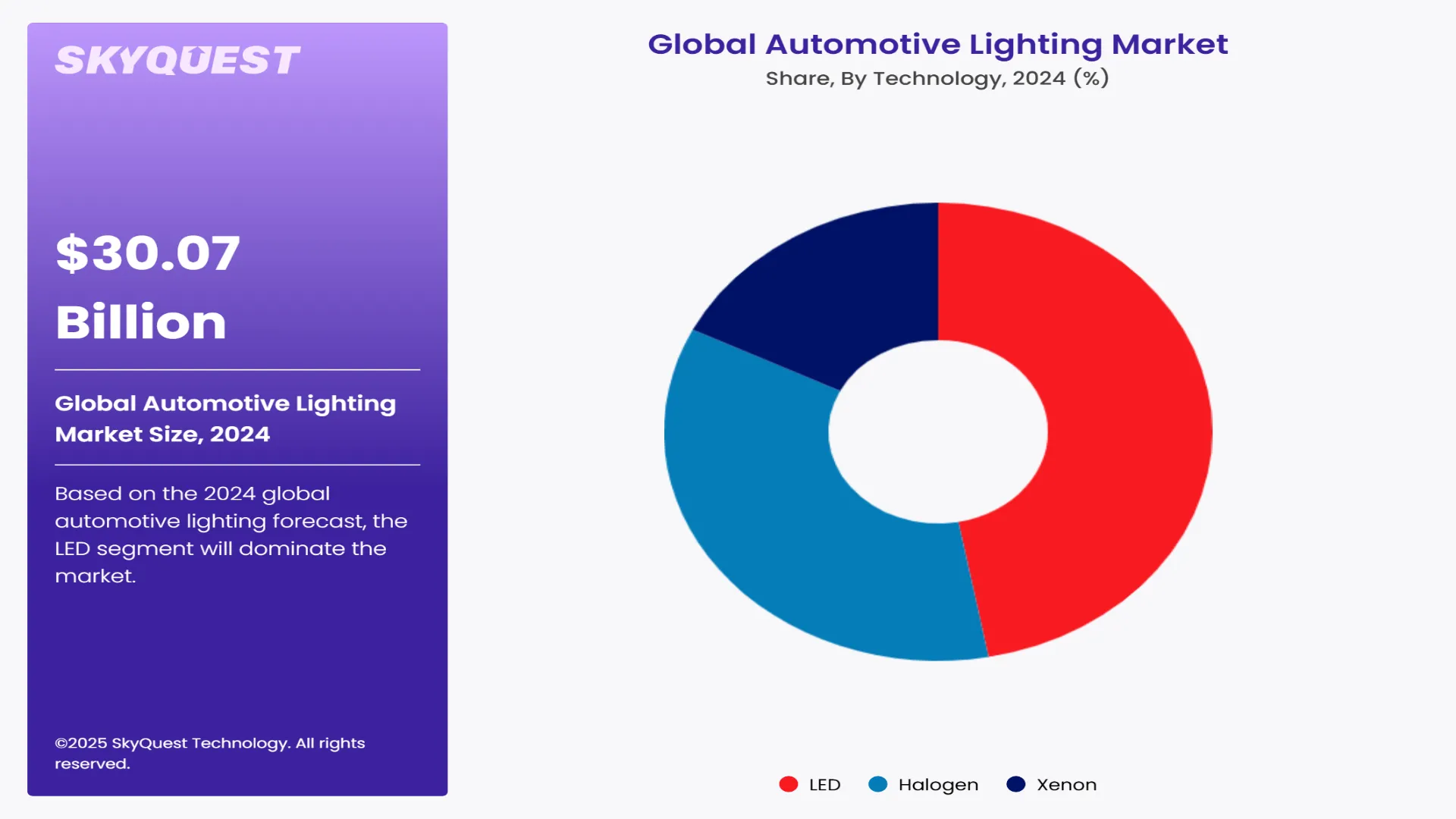
Based on the 2024 global automotive lighting forecast, the LED segment will dominate the market. As LEDs produce more power and use less energy than halogen, the market is anticipated to grow. Leading manufacturers are focusing on developing advanced LED lights, which will eventually replace halogen bulbs.

  • For instance, international automotive supplier Forvia Hella began producing an RGB LED rear combination lamp with full-color light animations in China in September 2024. This innovative product offers a range of new light-based functionalities to satisfy the growing demand for unique branding and customization options.

The halogen segment will continue to hold its second-largest market position throughout the forecast period in the automotive lighting sector. Its growth has been consistent throughout the forecast period. Halogen lights are most commonly found in heavy vehicles due to their unique characteristics and lower heat output than LED lights. Halogen lights also increase visibility, which enhances driver safety and comfort.
Global Automotive Lighting Market By Product Type 2026-2033
Automotive Lighting Market Segment By Technology

To get detailed segments analysis, Request a Free Sample Report

Automotive Lighting Market Regional Insights

How is Asia-Pacific Leading the Shift Toward Smart Automotive Lighting?

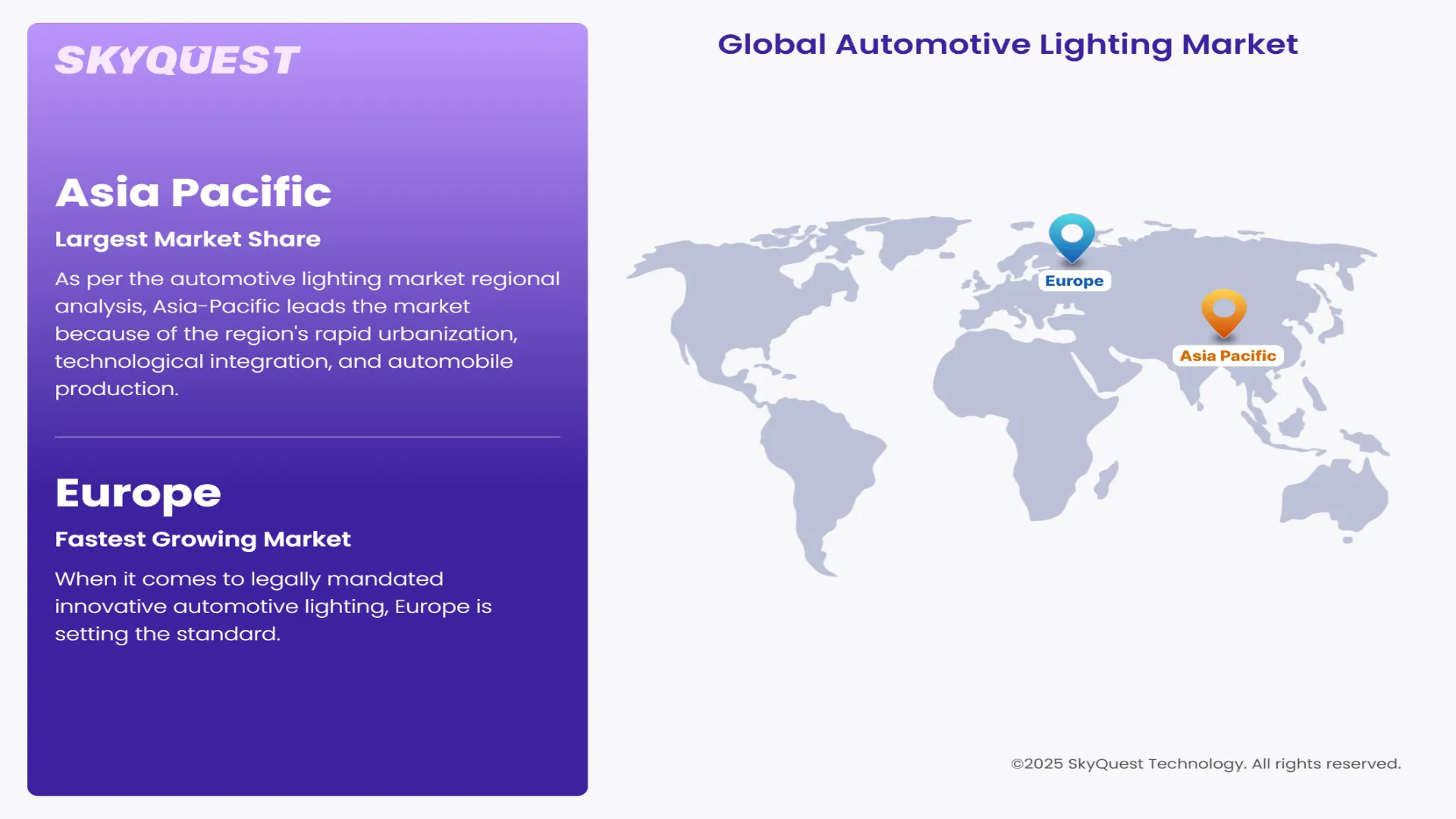
As per the automotive lighting market regional analysis, Asia-Pacific leads the market because of the region's rapid urbanization, technological integration, and automobile production. In 2024, this region accounted for over half of the world's automotive LED production. Chinese, Japanese, and South Korean automakers are equipping EVs with laser-based and adjustable lighting. Government safety regulations will promote the use of MicroLEDs for ADAS (Advanced Driver Assistance Systems) and smart lighting by 2025.

South Korea Automotive Lighting Market

Innovation from companies like Hyundai Mobis, which unveiled a ground-projecting LED lighting system for EVs in 2024 to improve pedestrian safety and interaction, is propelling the South Korean automotive lighting sector. Government programs promoting autonomous driving and smart mobility in 2025 are promoting the use of dynamic, sensor-integrated lighting. High-end Hyundai and Kia vehicles are increasingly using OLED and matrix LED technologies.

Japan Automotive Lighting Market

Japan is still at the forefront of precision lighting development globally. In 2024, Koito Manufacturing and Toyota worked together to equip adaptive LED headlights with camera-based management, allowing precise beam adjustments. The demand for smart lighting is rising because of Japan's emphasis on road safety and autonomous vehicle readiness. Advanced high-beam control and laser lighting in Lexus and Nissan vehicles are anticipated to spur market expansion by 2025.

How Is North America Advancing Automotive Lighting Through Safety and Tech?

The demand from consumers for luxury cars and cutting-edge safety features is propelling the North American automotive lighting market. In 2024, premium SUVs from Ford and General Motors were equipped with Adaptive Matrix LED headlights. Installations were further increased by U.S. regulations that relaxed restrictions on adaptable lighting. As the automotive lighting industry trend toward electrification and smart lighting integration accelerates, communication lighting and AI-based beam control will become more prevalent in the coming years.

U.S. Automotive Lighting Market

The US holds a significant market share in the automotive lighting market due to strict safety regulations, high vehicle manufacturing, and technological advancements. In the US, where consumers prioritize safety, effectiveness, and aesthetics, there is a particular demand for innovative lighting solutions like LED systems and adaptive headlights. Additionally, the use of advanced lighting systems is driven by the nation's expertise in electric and autonomous car technologies. A constant flow of new goods and innovations into the market is also guaranteed by the US's large automotive and lighting technology companies.

  • For example, the renowned lighting solutions provider Lumileds unveiled an upgraded Philips Automotive Lighting in February 2024. It has every Philips car light and accessory available in North America and appears to be brand new.

Canada Automotive Lighting Market

Canada's automotive lighting market is gradually expanding due to its transition to electric vehicles and compliance with US regulations. The first modular LED solutions for electric vehicles were developed in 2024 by Canadian companies such as Lumen Cache. The need for energy-efficient and temperature-adaptive lighting will increase in 2025 due to extreme weather. Another factor driving demand is the addition of smart lighting to Ontario's testbeds for autonomous vehicles.

How are European Regulations Fueling Automotive Lighting Innovation?

When it comes to legally mandated innovative automotive lighting, Europe is setting the standard. Automakers like Audi, BMW, and Mercedes-Benz implemented MicroLED Matrix systems after the EU approved the broader use of adaptive high-beam systems in 2024. By 2025, more pedestrians will use V2X-capable lighting and dynamic projection systems to communicate. Energy-efficient OLED and laser-based lighting is also encouraged by sustainability goals.

UK Automotive Lighting Market

Initiatives for urban safety and the growth of EVs influence the automotive lighting market in the UK. To inform pedestrians of their intentions, Jaguar Land Rover outfitted concept EVs with LED projection systems in 2024. Interest in smart lighting will rise by 2025 as more autonomous shuttle demonstrations in London use interactive lighting. In the UK, Tier 1 suppliers are funding research and development on adaptive lighting for urban transportation.

France Automotive Lighting Market

Innovations from Valeo and Stellantis support the automotive lighting industry in France. AI-controlled adaptive headlights, which could modify beam distribution based on traffic and weather conditions, were first introduced by Valeo in 2024. Improvements in lighting are being driven by the government's support for autonomous technologies and emphasis on road safety. Mid-range EVs will increasingly combine safety and style by 2025 with edge-lit interiors and dynamic rear lights.

Germany Automotive Lighting Market

Automotive lighting technology is centered in Germany, where companies such as OSRAM and Hella are spearheading advancements. Audi introduced cars with 32,000-pixel MicroLED matrix headlights in 2024. Fully integrated lighting systems that enhance navigation, communication, and aesthetics are being pushed for by German automakers. By 2025, 3D OLED tail lamps and laser-based lighting will be extensively utilized, particularly in the EV sector.
Global Automotive Lighting Market By Geography, 2026-2033
Automotive Lighting Market Regional Analysis

To know more about the market opportunities by region and country, click here to
Buy The Complete Report

Automotive Lighting Market Dynamics

Drivers

Growing Need for Cutting-Edge Safety and Visibility Features

  • Adaptive lighting systems, LED headlamps, and automatic high-beam assist are being developed in response to consumers' growing concerns about road safety. To lower the risk of collisions, automakers are installing lighting that improves visibility for drivers in bad weather. Regulations in Europe and Asia that mandate daytime running lights (DRLs) and improved lighting features are expected to enhance the automotive lighting market penetration.

Increasing Trends in Electrification and Auto Manufacturing

  • Energy-efficient lighting systems are becoming more and more in demand as EV production rises worldwide. Due to their modern appearance and low power consumption, automakers favor LED and laser illumination for EVs. The rise in EVs in China, the US, and Europe has led to a significant increase in the use of innovative lighting technologies in both the premium and mid-range markets.

Restraints

Expensive, Advanced Lighting Systems

  • High material and R&D costs are associated with advanced lighting technologies such as matrix LED, laser lights, and OLED. This limits the uptake of low-cost and budget automakers, particularly in areas where consumers are price conscious. In places like Southeast Asia, Africa, and portions of South America, the price barrier still prevents market penetration.

Challenges with Standardization and Integration

  • It can be technically challenging to integrate contemporary lighting with automotive electronics, ADAS, and communication systems. Manufacturers face difficulties due to variations in national regulations regarding automation, color, and lighting intensity. This hinders quicker global acceptance by delaying product rollouts and raising compliance-related expenses.


Request Free Customization of this report to help us to meet your business objectives.

Automotive Lighting Market Competitive Landscape

The primary forces behind the fiercely competitive automotive lighting market are innovation, partnerships, and regional expansion. While Valeo concentrates on laser and ambient lighting advancements, companies such as Hella and Koito are creating intelligent and flexible lighting solutions for OEMs. Joint ventures and strategic acquisitions, like Marelli's lighting partnership in Europe, are assisting businesses in growing their market share and customizing their goods to meet regional safety and fashion standards.

  • In 2016, the US-based business Optisys Automotive was founded. High-precision optical components for cutting-edge automotive lighting are the focus of Optisys Automotive, a spinoff from aerospace optics. The company specializes in laser-based lighting solutions and adaptive headlamp systems for luxury and electric cars. In response to the increasing demand for intelligent and artistically complex car lighting, Optisys uses aerospace-grade technology to provide small, light optics that improve beam precision and energy efficiency.
  • Lightelligence founded in the United States in 2017. Artificial intelligence (AI)-powered car lighting systems that instantly adjust to changing road conditions were first introduced by Lightelligence. Its technology facilitates ADAS features while improving visibility using dynamic beam shaping, environmental monitoring, and object-aware illumination. Lightelligence helps automakers develop safer, smarter lighting systems by fusing optical processing and artificial intelligence (AI). Their products are being used more in luxury and next-generation electric vehicles that emphasize connected, intelligent driving.

Top Player’s Company Profile

  • Koito Manufacturing Co., Ltd.
  • Hella GmbH & Co. KGaA
  • Semilux International Ltd.
  • Valeo S.A.
  • DOMINANT Opto Technologies
  • Hyundai Mobis Co., Ltd.
  • OSRAM Continental GmbH
  • ZKW Group GmbH
  • Robert Bosch GmbH
  • Varroc Engineering Ltd.
  • LG Innotek Co., Ltd.
  • SL Corporation

Recent Developments

  • In April 2024, DOMINANT Opto Technologies, a leading Malaysian manufacturer of automotive LED solutions, announced its collaboration with ams OSRAM (SIX: AMS), a supplier of intelligent sensors and emitters. This partnership aims to incorporate ams OSRAM's Open System Protocol (OSP) into the next generation of intelligent RGB LED for DOMINANT Opto Technologies ambient automotive lighting solutions.
  • In March 2024, Semilux International Ltd., a manufacturer of ADB, LiDAR, and ASIC components and solutions, announced it will commence a research and development program it is running with scholars and researchers from various universities in Taiwan. The aim of the collaboration is to develop an advanced solid-state LiDAR module designed for the automotive industry specifically. This technology will integrate LiDAR into particular automotive lighting systems to improve perception and navigation capabilities of the vehicle and improve functionality and safety features of the automotive lighting systems.
  • In March 2025, France's national road safety agency, Sécurité Routière, recognized Valeo's EvenLED lighting technology with the 2025 Road Safety Innovation Award. With greater than 80% light uniformity, this ultra-homogeneous LED solution provides better visibility and is appropriate for both front and rear signaling applications. It provides improved energy efficiency, less glare, and an easy spot for seamless integration for both light and heavy vehicles.

Automotive Lighting Key Market Trends

Automotive Lighting Market SkyQuest Analysis

SkyQuest’s ABIRAW (Advanced Business Intelligence, Research & Analysis Wing) is our Business Information Services team that Collects, Collates, Correlates, and Analyses the Data collected by means of Primary Exploratory Research backed by robust Secondary Desk research.

As per SkyQuest analysis, the automotive lighting market is transforming due to a mix of consumer demand for efficiency and aesthetics, safety regulations, and technology. New models of vehicles are often presented with LEDs and adaptive lighting systems and are witnessing more prevalence in more costly and electrified vehicles. The prohibitive costs and variability in regulations present challenges in the short term. The competitive basis for the automotive lighting industry is international expansion, collaborations with strategic partners, and innovation. Industry players will increasingly focus on intelligent, sensor-based lighting systems that improve vehicle visibility and intelligence. As automotive technology progresses and informs design for future bicycles, lighting systems are poised to be critically important in relation to user experience and safety, amongst other facets of transportation.

Report Metric Details
Market size value in 2024 USD 30.07 Billion
Market size value in 2033 USD 43.18 Billion
Growth Rate 4.1%
Base year 2024
Forecast period 2026-2033
Forecast Unit (Value) USD Billion
Segments covered
  • Vehicle Type
    • Passenger Vehicles, Light Commercial Vehicles, Heavy Commercial Vehicles
  • Technology
    • LED, Halogen, Xenon
  • Product Type
    • Interior and Exterior
  • Sales Channel
    • OEM and Aftermarket
Regions covered North America (US, Canada), Europe (Germany, France, United Kingdom, Italy, Spain, Rest of Europe), Asia Pacific (China, India, Japan, Rest of Asia-Pacific), Latin America (Brazil, Rest of Latin America), Middle East & Africa (South Africa, GCC Countries, Rest of MEA)
Companies covered
  • Koito Manufacturing Co., Ltd.
  • Hella GmbH & Co. KGaA
  • Semilux International Ltd.
  • Valeo S.A.
  • DOMINANT Opto Technologies
  • Hyundai Mobis Co., Ltd.
  • OSRAM Continental GmbH
  • ZKW Group GmbH
  • Robert Bosch GmbH
  • Varroc Engineering Ltd.
  • LG Innotek Co., Ltd.
  • SL Corporation
Customization scope

Free report customization with purchase. Customization includes:-

  • Segments by type, application, etc
  • Company profile
  • Market dynamics & outlook
  • Region

To get a free trial access to our platform which is a one stop solution for all your data requirements for quicker decision making. This platform allows you to compare markets, competitors who are prominent in the market, and mega trends that are influencing the dynamics in the market. Also, get access to detailed SkyQuest exclusive matrix.

Table Of Content

Executive Summary

Market overview

  • Exhibit: Executive Summary – Chart on Market Overview
  • Exhibit: Executive Summary – Data Table on Market Overview
  • Exhibit: Executive Summary – Chart on Automotive Lighting Market Characteristics
  • Exhibit: Executive Summary – Chart on Market by Geography
  • Exhibit: Executive Summary – Chart on Market Segmentation
  • Exhibit: Executive Summary – Chart on Incremental Growth
  • Exhibit: Executive Summary – Data Table on Incremental Growth
  • Exhibit: Executive Summary – Chart on Vendor Market Positioning

Parent Market Analysis

Market overview

Market size

  • Market Dynamics
    • Exhibit: Impact analysis of DROC, 2021
      • Drivers
      • Opportunities
      • Restraints
      • Challenges
  • SWOT Analysis

KEY MARKET INSIGHTS

  • Technology Analysis
    • (Exhibit: Data Table: Name of technology and details)
  • Pricing Analysis
    • (Exhibit: Data Table: Name of technology and pricing details)
  • Supply Chain Analysis
    • (Exhibit: Detailed Supply Chain Presentation)
  • Value Chain Analysis
    • (Exhibit: Detailed Value Chain Presentation)
  • Ecosystem Of the Market
    • Exhibit: Parent Market Ecosystem Market Analysis
    • Exhibit: Market Characteristics of Parent Market
  • IP Analysis
    • (Exhibit: Data Table: Name of product/technology, patents filed, inventor/company name, acquiring firm)
  • Trade Analysis
    • (Exhibit: Data Table: Import and Export data details)
  • Startup Analysis
    • (Exhibit: Data Table: Emerging startups details)
  • Raw Material Analysis
    • (Exhibit: Data Table: Mapping of key raw materials)
  • Innovation Matrix
    • (Exhibit: Positioning Matrix: Mapping of new and existing technologies)
  • Pipeline product Analysis
    • (Exhibit: Data Table: Name of companies and pipeline products, regional mapping)
  • Macroeconomic Indicators

COVID IMPACT

  • Introduction
  • Impact On Economy—scenario Assessment
    • Exhibit: Data on GDP - Year-over-year growth 2016-2022 (%)
  • Revised Market Size
    • Exhibit: Data Table on Automotive Lighting Market size and forecast 2021-2027 ($ million)
  • Impact Of COVID On Key Segments
    • Exhibit: Data Table on Segment Market size and forecast 2021-2027 ($ million)
  • COVID Strategies By Company
    • Exhibit: Analysis on key strategies adopted by companies

MARKET DYNAMICS & OUTLOOK

  • Market Dynamics
    • Exhibit: Impact analysis of DROC, 2021
      • Drivers
      • Opportunities
      • Restraints
      • Challenges
  • Regulatory Landscape
    • Exhibit: Data Table on regulation from different region
  • SWOT Analysis
  • Porters Analysis
    • Competitive rivalry
      • Exhibit: Competitive rivalry Impact of key factors, 2021
    • Threat of substitute products
      • Exhibit: Threat of Substitute Products Impact of key factors, 2021
    • Bargaining power of buyers
      • Exhibit: buyers bargaining power Impact of key factors, 2021
    • Threat of new entrants
      • Exhibit: Threat of new entrants Impact of key factors, 2021
    • Bargaining power of suppliers
      • Exhibit: Threat of suppliers bargaining power Impact of key factors, 2021
  • Skyquest special insights on future disruptions
    • Political Impact
    • Economic impact
    • Social Impact
    • Technical Impact
    • Environmental Impact
    • Legal Impact

Market Size by Region

  • Chart on Market share by geography 2021-2027 (%)
  • Data Table on Market share by geography 2021-2027(%)
  • North America
    • Chart on Market share by country 2021-2027 (%)
    • Data Table on Market share by country 2021-2027(%)
    • USA
      • Exhibit: Chart on Market share 2021-2027 (%)
      • Exhibit: Market size and forecast 2021-2027 ($ million)
    • Canada
      • Exhibit: Chart on Market share 2021-2027 (%)
      • Exhibit: Market size and forecast 2021-2027 ($ million)
  • Europe
    • Chart on Market share by country 2021-2027 (%)
    • Data Table on Market share by country 2021-2027(%)
    • Germany
      • Exhibit: Chart on Market share 2021-2027 (%)
      • Exhibit: Market size and forecast 2021-2027 ($ million)
    • Spain
      • Exhibit: Chart on Market share 2021-2027 (%)
      • Exhibit: Market size and forecast 2021-2027 ($ million)
    • France
      • Exhibit: Chart on Market share 2021-2027 (%)
      • Exhibit: Market size and forecast 2021-2027 ($ million)
    • UK
      • Exhibit: Chart on Market share 2021-2027 (%)
      • Exhibit: Market size and forecast 2021-2027 ($ million)
    • Rest of Europe
      • Exhibit: Chart on Market share 2021-2027 (%)
      • Exhibit: Market size and forecast 2021-2027 ($ million)
  • Asia Pacific
    • Chart on Market share by country 2021-2027 (%)
    • Data Table on Market share by country 2021-2027(%)
    • China
      • Exhibit: Chart on Market share 2021-2027 (%)
      • Exhibit: Market size and forecast 2021-2027 ($ million)
    • India
      • Exhibit: Chart on Market share 2021-2027 (%)
      • Exhibit: Market size and forecast 2021-2027 ($ million)
    • Japan
      • Exhibit: Chart on Market share 2021-2027 (%)
      • Exhibit: Market size and forecast 2021-2027 ($ million)
    • South Korea
      • Exhibit: Chart on Market share 2021-2027 (%)
      • Exhibit: Market size and forecast 2021-2027 ($ million)
    • Rest of Asia Pacific
      • Exhibit: Chart on Market share 2021-2027 (%)
      • Exhibit: Market size and forecast 2021-2027 ($ million)
  • Latin America
    • Chart on Market share by country 2021-2027 (%)
    • Data Table on Market share by country 2021-2027(%)
    • Brazil
      • Exhibit: Chart on Market share 2021-2027 (%)
      • Exhibit: Market size and forecast 2021-2027 ($ million)
    • Rest of South America
      • Exhibit: Chart on Market share 2021-2027 (%)
      • Exhibit: Market size and forecast 2021-2027 ($ million)
  • Middle East & Africa (MEA)
    • Chart on Market share by country 2021-2027 (%)
    • Data Table on Market share by country 2021-2027(%)
    • GCC Countries
      • Exhibit: Chart on Market share 2021-2027 (%)
      • Exhibit: Market size and forecast 2021-2027 ($ million)
    • South Africa
      • Exhibit: Chart on Market share 2021-2027 (%)
      • Exhibit: Market size and forecast 2021-2027 ($ million)
    • Rest of MEA
      • Exhibit: Chart on Market share 2021-2027 (%)
      • Exhibit: Market size and forecast 2021-2027 ($ million)

KEY COMPANY PROFILES

  • Competitive Landscape
    • Total number of companies covered
      • Exhibit: companies covered in the report, 2021
    • Top companies market positioning
      • Exhibit: company positioning matrix, 2021
    • Top companies market Share
      • Exhibit: Pie chart analysis on company market share, 2021(%)

Methodology

For the Automotive Lighting Market, our research methodology involved a mixture of primary and secondary data sources. Key steps involved in the research process are listed below:

1. Information Procurement: This stage involved the procurement of Market data or related information via primary and secondary sources. The various secondary sources used included various company websites, annual reports, trade databases, and paid databases such as Hoover's, Bloomberg Business, Factiva, and Avention. Our team did 45 primary interactions Globally which included several stakeholders such as manufacturers, customers, key opinion leaders, etc. Overall, information procurement was one of the most extensive stages in our research process.

2. Information Analysis: This step involved triangulation of data through bottom-up and top-down approaches to estimate and validate the total size and future estimate of the Automotive Lighting Market.

3. Report Formulation: The final step entailed the placement of data points in appropriate Market spaces in an attempt to deduce viable conclusions.

4. Validation & Publishing: Validation is the most important step in the process. Validation & re-validation via an intricately designed process helped us finalize data points to be used for final calculations. The final Market estimates and forecasts were then aligned and sent to our panel of industry experts for validation of data. Once the validation was done the report was sent to our Quality Assurance team to ensure adherence to style guides, consistency & design.

Analyst Support

Customization Options

With the given market data, our dedicated team of analysts can offer you the following customization options are available for the Automotive Lighting Market:

Product Analysis: Product matrix, which offers a detailed comparison of the product portfolio of companies.

Regional Analysis: Further analysis of the Automotive Lighting Market for additional countries.

Competitive Analysis: Detailed analysis and profiling of additional Market players & comparative analysis of competitive products.

Go to Market Strategy: Find the high-growth channels to invest your marketing efforts and increase your customer base.

Innovation Mapping: Identify racial solutions and innovation, connected to deep ecosystems of innovators, start-ups, academics, and strategic partners.

Category Intelligence: Customized intelligence that is relevant to their supply Markets will enable them to make smarter sourcing decisions and improve their category management.

Public Company Transcript Analysis: To improve the investment performance by generating new alpha and making better-informed decisions.

Social Media Listening: To analyze the conversations and trends happening not just around your brand, but around your industry as a whole, and use those insights to make better Marketing decisions.

Automotive Lighting Market Report Snapshots

$5,300

REQUEST FOR SAMPLE

Please verify that you're not a robot to proceed!
Want to customize this report? REQUEST FREE CUSTOMIZATION

FAQs

Global Automotive Lighting Market size was valued at USD 30.07 Billion in 2024 and is poised to grow from USD 31.31 Billion in 2025 to USD 43.18 Billion by 2033, growing at a CAGR of 4.1% during the forecast period (2026–2033).

The primary forces behind the fiercely competitive automotive lighting market are innovation, partnerships, and regional expansion. While Valeo concentrates on laser and ambient lighting advancements, companies such as Hella and Koito are creating intelligent and flexible lighting solutions for OEMs. Joint ventures and strategic acquisitions, like Marelli's lighting partnership in Europe, are assisting businesses in growing their market share and customizing their goods to meet regional safety and fashion standards. 'Koito Manufacturing Co., Ltd.', 'Hella GmbH & Co. KGaA', 'Semilux International Ltd.', 'Valeo S.A.', 'DOMINANT Opto Technologies', 'Stanley Electric Co., Ltd.', 'Magneti Marelli S.p.A.', 'Hyundai Mobis Co., Ltd.', 'OSRAM Continental GmbH', 'ZKW Group GmbH', 'Robert Bosch GmbH', 'Varroc Engineering Ltd.', 'LG Innotek Co., Ltd.', 'SL Corporation'

Adaptive lighting systems, LED headlamps, and automatic high-beam assist are being developed in response to consumers' growing concerns about road safety. To lower the risk of collisions, automakers are installing lighting that improves visibility for drivers in bad weather. Regulations in Europe and Asia that mandate daytime running lights (DRLs) and improved lighting features are expected to enhance the automotive lighting market penetration.

Transition to Adaptive and Intelligent Lighting Systems: Automotive lighting is transforming into a smart feature by utilizing technologies that adapt light beam patterns as per approaching traffic, road curvature, and relevant circumstances. In 2024, manufacturers, including major automotive brands, will be spending on adaptive driving beam (ADB) systems and introducing artificial intelligence and other lighting technologies incorporating the use of sensors. This transition yields less glare and offers safer travel journeys, particularly in the luxury or premium segment.

How is Asia-Pacific Leading the Shift Toward Smart Automotive Lighting?
AGC3x.webp
Aisin3x.webp
ASKA P Co. LTD3x.webp
BD3x.webp
BILL & MELIDA3x.webp
BOSCH3x.webp
CHUNGHWA TELECOM3x.webp
DAIKIN3x.webp
DEPARTMENT OF SCIENCE & TECHNOLOGY3x.webp
ETRI3x.webp
Fiti Testing3x.webp
GERRESHEIMER3x.webp
HENKEL3x.webp
HITACHI3x.webp
HOLISTIC MEDICAL CENTRE3x.webp
Institute for information industry3x.webp
JAXA3x.webp
JTI3x.webp
Khidi3x.webp
METHOD.3x.webp
Missul E&S3x.webp
MITSUBISHI3x.webp
MIZUHO3x.webp
NEC3x.webp
Nippon steel3x.webp
NOVARTIS3x.webp
Nttdata3x.webp
OSSTEM3x.webp
PALL3x.webp
Panasonic3x.webp
RECKITT3x.webp
Rohm3x.webp
RR KABEL3x.webp
SAMSUNG ELECTRONICS3x.webp
SEKISUI3x.webp
Sensata3x.webp
SENSEAIR3x.webp
Soft Bank Group3x.webp
SYSMEX3x.webp
TERUMO3x.webp
TOYOTA3x.webp
UNDP3x.webp
Unilever3x.webp
YAMAHA3x.webp
Yokogawa3x.webp

Want to customize this report? This report can be personalized according to your needs. Our analysts and industry experts will work directly with you to understand your requirements and provide you with customized data in a short amount of time. We offer $1000 worth of FREE customization at the time of purchase.

Feedback From Our Clients


