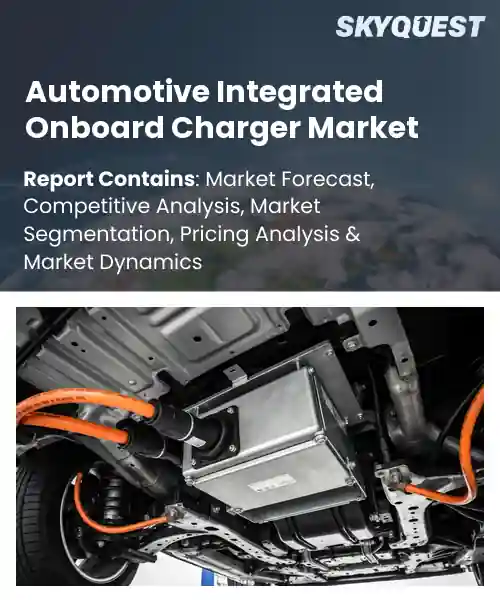
Automotive Integrated Onboard Charger Market
Report ID: SQMIG25A2672
Report ID: SQMIG25A2672
[email protected]
USA +1 351-333-4748
Report ID:
SQMIG25A2672 |
Region:
Global |
Published Date: May, 2026
Pages:
157
|Tables:
142
|Figures:
78


Global Automotive Integrated Onboard Charger Market size was valued at USD 2.85 Billion in 2024 and is poised to grow from USD 3.45 Billion in 2025 to USD 15.85 Billion by 2033, growing at a CAGR of 21.0% during the forecast period (2026-2033).
The main reason for the the automotive integrated onboard charger market growth is the accelerating adoption of electric vehicles, and that in turn pushes demand for smaller, efficient charging systems, that simplify vehicle architecture and lower overall cost. Integrated onboard chargers bring power electronics together with thermal management inside the vehicle, so they can deliver faster charging, smoother energy flow, and better space usage than having separate components. This market matters because charging capability affects range confidence for consumers, fleet uptime for operators, and even grid interaction strategies; manufacturers like Tesla, Volkswagen,and Hyundai went into integrated solutions to satisfy regulatory efficiency targets, showing a noticeable shift from retrofitted chargers toward systems that are built for purpose, and not just adapted.
On top of that tech progression, another factor shaping the automotive integrated onboard charger market outlook is semiconductor innovation, especially with silicon carbide and gallium nitride devices, which lift power density while cutting losses and reducing the cooling requirement. As these devices cut weight and improve efficiency, companies can fit stronger chargers into compact vehicle platforms, making quicker AC charging possible and supporting stronger vehicle-to-grid functions. Fleets benefit because shorter charging times mean higher vehicle utilization and lower operating expenses. Meanwhile automakers can gain economies from modular architectures, so suppliers and OEMs can chase growth in retrofit fleets, commercial vehicles, and charging ecosystems where electronics also become a revenue stream.
AI is helping automotive integrated onboard chargers perform better and last longer through adaptive power control, predictive maintenance, fault detection, and smarter thermal management. Newer AI models look at sensor data and inverter behavior, then they adjust switching profiles and charging curves in real time. That reduces strain on the components and boosts energy conversion efficiency. Machine learning also spots early degradation clues, so problems can be handled before a real failure happens, and software updates keep improving charger behavior after launch. Since demand keeps rising for compact, high efficiency chargers, automakers and suppliers are moving toward AI driven control and diagnostics to meet packaging limits and longevity expectations, while also making the customer charging experience better.
Market snapshot - (2026-2033)
Global Market Size
USD 2.85 Billion
Largest Segment
Less than 11 kW
Fastest Growth
11 kW to 22 kW
Growth Rate
21.0% CAGR
To get more insights on this market click here to Request a Free Sample Report
Global automotive integrated onboard charger market is segmented by power output rating, current architecture, vehicle propulsion type, integration level, vehicle class and region. Based on power output rating, the market is segmented into Less than 11 kW, 11 kW to 22 kW and Above 22 kW. Based on current architecture, the market is segmented into Single-Phase and Three-Phase. Based on vehicle propulsion type, the market is segmented into Battery Electric Vehicles (BEV) and Plug-in Hybrid Electric Vehicles (PHEV). Based on integration level, the market is segmented into Standalone Onboard Chargers and Integrated Powertrain Systems (OBC, DCDC, and PDU combo). Based on vehicle class, the market is segmented into Passenger Cars and Commercial Vehicles. Based on region, the market is segmented into North America, Europe, Asia Pacific, Latin America and Middle East & Africa.
As per the automotive integrated onboard charger market analysis, the Three Phase segment dominates, simply because it lets the system handle more power, and it tends to run more efficiently, which matches heavier vehicle duty cycles, and those more demanding charging profiles. The architectural advantage reduces stress on thermal systems, and it also allows a more compact layout for power across the vehicle electrical domains. So OEMs often prefer architectures that make power electronics scaling easier, because it feels less painful to extend. All of this ends up with stronger integration across the powertrain components, and it also justifies the engineering spend in three phase solutions for high performance use cases.
However, single phase is showing up as the fastest growing area, mainly because it is cost effective, and it stays simpler, which fits passenger vehicle architectures and typical home charging patterns. The lower integration complexity speeds up adoption by vehicle programs that are dealing with tight packaging limits, and in parallel supplier innovation is pushing compact designs forward, so the use cases keep expanding. That opens doors for both broad aftermarket activity and OEM upgrade opportunities too.
According to the automotive integrated onboard charger market forecast, the Integrated Powertrain Systems segment leads, because combining the onboard charger with dcdc converters and power distribution units reduces redundancy in the system, plus it improves thermal performance and spatial efficiency across multiple vehicle platforms. OEMs usually lean toward these consolidated architectures for faster validation, and easier wiring, since it lowers the total vehicle complexity, and it supports drivability in a more direct way. With that level of integration, the design cycles accelerate, and electrification gets an extra boost because coordinated control becomes more practical across charging, battery management, and power distribution.
On the other hand, the standalone onboard chargers category is predicted to have the largest automotive integrated onboard charger market share, largely due to modularity and compatibility with a wider range of vehicle architectures, and faster development timelines. Suppliers can ship plug and play upgrades for new platforms, or they can retrofit existing ones, which gives flexible power options and supports aftermarket expansion. Ongoing innovation in compact designs, along with more capable thermal management, keeps broadening applicability across both passenger and commercial vehicle programs.
To get detailed segments analysis, Request a Free Sample Report
As per the automotive integrated onboard charger market regional forecast, Asia Pacific dominated the market, because of this mix of tech leadership , packed vehicle manufacturing, and a lot of supportive industrial surroundings. In the region, big automakers and tier one suppliers seem to put serious attention on integration, mainly to push system efficiency up and also lower overall vehicle complexity. With solid local supply lines and real know-how in power electronics, companies can move through development faster and then scale up those integrated units. On top of that, government moves that lean hard toward electrification, along with big spending on charging networks, keep OEMs focused on onboard charging innovation. And then you have the cross-company collaboration, like manufacturers, semiconductor suppliers, and research organizations working together, which helps validation and deployment happen sooner. So overall, it’s that manufacturing volume, technical depth, and coordinated infrastructure progress that forms the advantage, and it keeps the region leading in integrated onboard charging tech. Even the way supply chains respond, that part shortens time to market too.
Japan Automotive Integrated Onboard Charger Market
The Automotive Integrated Onboard Charger industry in Japan benefits from serious electronics know-how, strong internal automaker engineering muscle, and close, almost day to day collaboration between suppliers and research groups. Japanese companies tend to stress compact , high efficiency designs that are tuned for both premium models and mass market cars. A well established supplier ecosystem and a continuous “tuning” mindset around technology help products stand out, and they stay consistent on quality. Also, local testing and validation setups let firms verify performance in a rigorous way, which builds trust for original equipment manufacturers and tier suppliers.
South Korea Automotive Integrated Onboard Charger Market
The Automotive Integrated Onboard Charger sector in South Korea is propelled by heavyweight semiconductor and power electronics ability, tight coupling between automakers and component manufacturers, and production systems that can pivot quickly. Suppliers commonly aim for compact packaging , and they lean into smart thermal management so vehicle design limits don’t get hit too hard. Collaboration across large conglomerates and specialist suppliers helps push prototypes into production without dragging too long. There’s also a strong focus on cost reduction and keeping local supply stable , which helps competitiveness especially for vehicle programs that target export.
Europe is seeing fast growth in the automotive integrated onboard charger market, mostly because emissions reduction rules are getting more strict, leading automakers are showing heavy commitments, and investments are stacking up around charging interoperability. OEMs across Europe favor integrated approaches that match modern vehicle architectures, and also meet those premium brand expectations. A collaborative supplier web across electronics, software, and automotive ecosystems supports modular platforms, so integration can stay flexible. Meanwhile, infrastructure upgrades aimed at grid compatibility and city focused charging strategies blend with vehicle level innovations. Cross border partnerships and standardization pushes also limit fragmentation, making adoption faster. Finally, regional research centers and supplier specialization , in a targeted way, keep refining products quicker and improve time to market, supporting competitiveness across multiple segments.
Germany Automotive Integrated Onboard Charger Market
Germany’s Automotive Integrated Onboard Charger Market gains from a strong automotive build base, top supplier networks, and deep systems integration experience inside engineering teams. Local OEM preferences lean toward high density solutions and extremely careful safety validation, which lifts the technical sophistication. There’s also a dense mesh of specialist suppliers and research organizations that back iterative development, including repeated testing cycles. A strong push on quality and lifecycle durability helps ensure solutions hold up under demanding operational needs, especially for export oriented vehicle programs.
United Kingdom Automotive Integrated Onboard Charger Market
The Automotive Integrated Onboard Charger Market in the United Kingdom shows early momentum due to a cluster of innovative suppliers, software centric engineering styles, and active partnerships between automakers and technology firms. Key focus areas include system level integration, smart charging compatibility, and lightweight packaging that fits urban vehicle categories. More prototyping effort and pilot programs is also helping suppliers mature. At the same time, academic and industry cooperation supports skills building and helps accelerate market entry for specialized onboard charging solutions.
France Automotive Integrated Onboard Charger Market
The Automotive Integrated Onboard Charger Market in France benefits from alignment between public bodies and industry, an active startup environment, and purposeful investment into power electronics innovation. Suppliers tend to highlight adaptable architectures and software defined features so they can serve different vehicle needs. Cooperation between research labs and manufacturing partners helps shrink development timelines. And with attention to urban mobility needs, and integration with local charging strategy, France is slowly shaping into a growing hub for advanced onboard charging solutions and related R and D.
North America is strengthening its stance in the automotive integrated onboard charger market , mainly by pushing concentrated innovation in power electronics, and having strong semiconductor production capabilities , and also speeding up collaboration between automakers and technology firms. OEMs keep highlighting modular architectures, and software enabled functionalities , which then get plugged into the vehicle energy management systems. Then investment in domestic supply chains, and a manufacturing flexibility approach, helps them stay responsive when the market shifts , even unexpectedly. Engagement from electric utilities, and pilot programs meant to check vehicle-to-grid compatibility, feed into the way product specifications are formed. Meanwhile, academic and industry partnerships support applied research , and a steadily growing supplier base leans into scalable production. Standardization efforts , along with more expanded validation facilities, create a framework for interoperability, and they make certification move faster. On top of that, consumer and fleet electrification trends nudge OEMs to weave intelligent charging features across different vehicle segments .
United States Automotive Integrated Onboard Charger Market
The Automotive Integrated Onboard Charger Market in the United States is driven by solid semiconductor manufacturing, advanced power electronics research , and the involvement of technology led automotive firms . Suppliers and OEMs team up to scale modular charger platforms and bring smart charging functions into vehicle software ecosystems . Test facilities add the needed rigor for qualification processes. Strategic partnerships with utilities , and continuous pilot deployments, shape grid integration requirements, so readiness improves for a wider range of market uses , including fleet electrification programs.
Canada Automotive Integrated Onboard Charger Market
The Automotive Integrated Onboard Charger Market in Canada leans on a flexible manufacturing base , research collaboration , and a supplier focus on ruggedized efficient charger designs that fit varied operating conditions. Industry players stress alignment with regional grid characteristics , along with integration into fleet management systems. There are also close ties between universities and industry incubators , and that mix helps innovation stick. Supportive national procurement activity from fleet operators, together with coordination among suppliers, boosts capability building and keeps momentum for broader deployment across segments.
To know more about the market opportunities by region and country, click here to
Buy The Complete Report
Rising EV Adoption and Demand
Advances In Power Electronics
High Development and Integration Costs
Fragmented Charging Standards and Regulations
Request Free Customization of this report to help us to meet your business objectives.
The competitive landscape revolves around consolidation, more focused acquisitions, and those supplier OEM tie ups that lock in an integrated OBC supply. Lately, there are a few notable moves, like a strategic investment in a European OBC specialist, a big automotive components agreement with a BYD spin off and a private buyer picking up a bidirectional OBC developer. Meanwhile startups and suppliers are also pushing SiC based OBC technology and commercial high power onboard charger modules, trying to stand out technically, not just in pricing.
Top Player’s Company Profile
Recent Developments in the Automotive Integrated Onboard Charger Market
SkyQuest’s ABIRAW (Advanced Business Intelligence, Research & Analysis Wing) is our Business Information Services team that Collects, Collates, Correlates, and Analyses the Data collected by means of Primary Exploratory Research backed by robust Secondary Desk research.
As per SkyQuest analysis, the global automotive integrated onboard charger market is mainly propelled by the rising adoption of electric vehicles, this pulls demand toward compact, efficient charging solutions. But, growth is somewhat dampened by high development and integration costs, those raise the engineering, validation and certification workload. Asia Pacific leads the market, supported by dense vehicle manufacturing and power electronics ecosystems, while three phase architectures dominate high power applications, because they offer better efficiency and thermal performance. Another major driver is progress in power electronics, especially silicon carbide and gallium nitride semiconductors, which increases power density and lowers losses. That enables faster charging and better integration across different vehicle platforms.
| Report Metric | Details |
|---|---|
| Market size value in 2024 | USD 2.85 Billion |
| Market size value in 2033 | USD 15.85 Billion |
| Growth Rate | 21.0% |
| Base year | 2024 |
| Forecast period | (2026-2033) |
| Forecast Unit (Value) | USD Billion |
| Segments covered |
|
| Regions covered | North America (US, Canada), Europe (Germany, France, United Kingdom, Italy, Spain, Rest of Europe), Asia Pacific (China, India, Japan, Rest of Asia-Pacific), Latin America (Brazil, Rest of Latin America), Middle East & Africa (South Africa, GCC Countries, Rest of MEA) |
| Companies covered |
|
| Customization scope | Free report customization with purchase. Customization includes:-
|
To get a free trial access to our platform which is a one stop solution for all your data requirements for quicker decision making. This platform allows you to compare markets, competitors who are prominent in the market, and mega trends that are influencing the dynamics in the market. Also, get access to detailed SkyQuest exclusive matrix.
Table Of Content
Executive Summary
Market overview
Parent Market Analysis
Market overview
Market size
KEY MARKET INSIGHTS
COVID IMPACT
MARKET DYNAMICS & OUTLOOK
Market Size by Region
KEY COMPANY PROFILES
Methodology
For the Automotive Integrated Onboard Charger Market, our research methodology involved a mixture of primary and secondary data sources. Key steps involved in the research process are listed below:
1. Information Procurement: This stage involved the procurement of Market data or related information via primary and secondary sources. The various secondary sources used included various company websites, annual reports, trade databases, and paid databases such as Hoover's, Bloomberg Business, Factiva, and Avention. Our team did 45 primary interactions Globally which included several stakeholders such as manufacturers, customers, key opinion leaders, etc. Overall, information procurement was one of the most extensive stages in our research process.
2. Information Analysis: This step involved triangulation of data through bottom-up and top-down approaches to estimate and validate the total size and future estimate of the Automotive Integrated Onboard Charger Market.
3. Report Formulation: The final step entailed the placement of data points in appropriate Market spaces in an attempt to deduce viable conclusions.
4. Validation & Publishing: Validation is the most important step in the process. Validation & re-validation via an intricately designed process helped us finalize data points to be used for final calculations. The final Market estimates and forecasts were then aligned and sent to our panel of industry experts for validation of data. Once the validation was done the report was sent to our Quality Assurance team to ensure adherence to style guides, consistency & design.
Analyst Support
Customization Options
With the given market data, our dedicated team of analysts can offer you the following customization options are available for the Automotive Integrated Onboard Charger Market:
Product Analysis: Product matrix, which offers a detailed comparison of the product portfolio of companies.
Regional Analysis: Further analysis of the Automotive Integrated Onboard Charger Market for additional countries.
Competitive Analysis: Detailed analysis and profiling of additional Market players & comparative analysis of competitive products.
Go to Market Strategy: Find the high-growth channels to invest your marketing efforts and increase your customer base.
Innovation Mapping: Identify racial solutions and innovation, connected to deep ecosystems of innovators, start-ups, academics, and strategic partners.
Category Intelligence: Customized intelligence that is relevant to their supply Markets will enable them to make smarter sourcing decisions and improve their category management.
Public Company Transcript Analysis: To improve the investment performance by generating new alpha and making better-informed decisions.
Social Media Listening: To analyze the conversations and trends happening not just around your brand, but around your industry as a whole, and use those insights to make better Marketing decisions.
REQUEST FOR SAMPLE
 REQUEST FREE CUSTOMIZATION
Global Automotive Integrated Onboard Charger Market size was valued at USD 2.85 Billion in 2024 and is poised to grow from USD 3.45 Billion in 2025 to USD 15.85 Billion by 2033, growing at a CAGR of 21.0% during the forecast period (2026-2033).
Competitive landscape centers on consolidation, targeted acquisitions and supplier OEM tie ups that secure integrated OBC supply. Recent moves include a strategic investment in a European OBC specialist, a major automotive components agreement with a BYD spin off, and a private buyer acquiring a bidirectional OBC developer. Startups and suppliers also advance SiC based OBC technology and commercial high power OBC modules to differentiate technologically. 'BorgWarner', 'Hyundai Mobis', 'LG Corporation', 'STMicroelectronics', 'Ficosa', 'Valeo', 'Toyota Industries', 'Bel Fuse', 'Bosch', 'Siemens', 'Schneider Electric', 'ABB', 'Mitsubishi Electric', 'Panasonic Holdings', 'BYD Company', 'Samsung SDI', 'Vitesco Technologies', 'Yazaki Corporation', 'Nichicon', 'Delta Electronics'
Integrated onboard chargers gain prominence as electric vehicle adoption expands, because manufacturers prioritize compact, efficient power electronics to enhance vehicle packaging and reduce system complexity. The consolidation of charging functionality into the vehicle architecture simplifies supply chains and supports seamless user charging experiences, which encourages automaker investment and platform integration. As OEMs seek consistent performance and reduced component counts, the onboard charger becomes a strategic enabler for new EV models and powertrain variants, fostering design standardization and supplier partnerships that drive market demand.
Smart Vehicle Power Integration: Growing electrification and emphasis on efficient energy management are driving demand for smarter onboard chargers tightly integrated with vehicle electrical and thermal systems. Manufacturers favor modular software driven architectures that simplify platform integration and support features such as bidirectional energy flow and vehicle to grid interactions. Close collaboration between OEMs and suppliers is promoting standardized interfaces and design for manufacturability, while focus on packaging, reliability and user experience shapes product roadmaps toward compact, serviceable and future ready charger solutions.
Why does Asia Pacific Dominate the Global Automotive Integrated Onboard Charger Market? |@12


Want to customize this report? This report can be personalized according to your needs. Our analysts and industry experts will work directly with you to understand your requirements and provide you with customized data in a short amount of time. We offer $1000 worth of FREE customization at the time of purchase.
Feedback From Our Clients


 USA (+1) 351-333-4748

