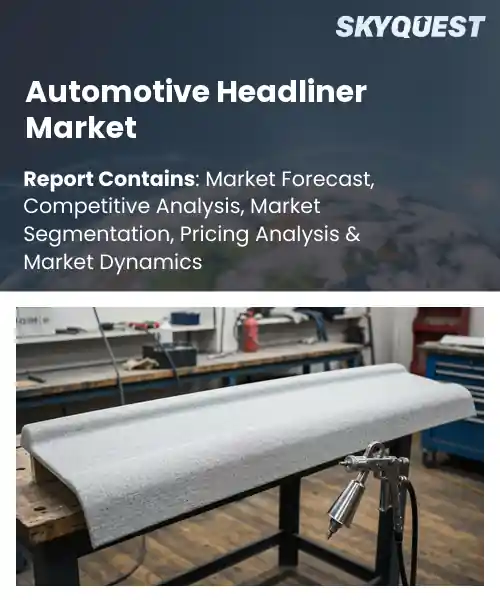
Automotive Headliner Market
Report ID: SQMIG25A2778
Report ID: SQMIG25A2778
[email protected]
USA +1 351-333-4748
Report ID:
SQMIG25A2778 |
Region:
Global |
Published Date: June, 2026
Pages:
157
|Tables:
143
|Figures:
78


Global Automotive Headliner Market size was valued at USD 9.68 Billion in 2024 and is poised to grow from USD 10.09 Billion in 2025 to USD 14.02 Billion by 2033, growing at a CAGR of 4.2% during the forecast period (2026-2033).
The automotive headliner market comprises the manufacturing and distribution of ceiling panels consisting of composites, sound-absorbing foams and decorative fabrics for passenger vehicles. This section is critical because headliners impact cabin acoustics, aesthetics and vehicle weight which directly impact fuel economy and consumer perception. Manufacturers have traditionally used single layer cloth backed board, but the move to multi-layer engineered laminates started in the early 2000s as regulations tightened emission standards. European OEMs used polyester blends to reduce cabin noise, while Asian companies used recycled PET cores to meet sustainability targets. So the market has gone from being a cost center to a differentiator.
The growth of the automotive headliner market is driven mainly by the integration of acoustic technologies. Buyers want a quieter cabin, so OEMs are embedding micro-perforated membranes and nano-cellular foams that absorb a broader range of frequencies rather than heavyweight sound-deadening mats. The substitution reduces the weight of the vehicle and thus the fuel consumption and the CO₂ limits are respected. A German premium brand has introduced a headliner in graphene-enhanced foam that reduces weight by 5 percent and has won a sustainability award. Such developments create a need for polymer suppliers and recyclers of reclaimed fibers, expanding the market across Europe, North America and Asia-Pac and creating new revenue streams for manufacturers of interior components.
How is AI-driven automation reshaping material selection in the automotive headliner market?
AI-powered and revolutionizing the way automotive headliner materials are specified and engineered from design intent to performance data. Machine learning models convert acoustic, thermal and weight requirements into fibre blends, foam cores and bio-based laminates. This helps to shorten trial cycle lengths and allows engineers to explore sustainable options earlier in the development process. Customers demand light, quiet interiors of premium quality and suppliers are responding to shifts in the market by providing digital tools to speed up material selection, while maintaining quality. Which means faster product launches and a more direct route to more sustainable headline options.
The automotive supplier has launched an AI-powered platform that makes it easier to select materials, helping to expand the market and reduce waste by speeding up the development of lightweight headliners.
Market snapshot - (2026-2033)
Global Market Size
USD 9.68 Billion
Largest Segment
Built Type Headliners
Fastest Growth
Solar Glass Panoramic Headliners
Growth Rate
4.2% CAGR
To get more insights on this market click here to Request a Free Sample Report
Global automotive headliner market is segmented by headliner architectural design, construction type, material substrate formulation, vehicle deployment class, sales distribution channel and region. Based on headliner architectural design, the market is segmented into Built Type Headliners, Tilt and Slide Sunroof Headliners and Solar Glass Panoramic Headliners. Based on construction type, the market is segmented into Hard Top Headliners and Soft Top Headliners. Based on material substrate formulation, the market is segmented into Foam-Backed Cloth, Cotton-Napped Cloth, Synthetic Cloth and Perforated Cloth. Based on vehicle deployment class, the market is segmented into Passenger Cars, Light Commercial Vehicles and Heavy Commercial Vehicles. Based on sales distribution channel, the market is segmented into Original Equipment Manufacturer Demand and Aftermarket Customization. Based on region, the market is segmented into North America, Europe, Asia Pacific, Latin America and Middle East & Africa.
The Solar Glass Panoramic Headliners segment is dominating as it combines natural daylight with breathability to create an upscale cabin ambience, matching with premium brand positioning. Adding photovoltaic functionality provides energy efficiency, which is attractive for manufacturers who want to have sustainability credentials. The seamless glass architecture reduces the number of assembly steps and labor intensity and gives a sleek aesthetic. This is the choice that OEMs prefer to differentiate their models and to respond to changing consumer preferences for luxury and eco-friendly.
The fastest growing segment is Tilt and Slide Sunroof Headliners which is growing due to increasing consumer demand for flexible open air experiences without impacting the structural integrity. Innovative actuation mechanisms and lightweight materials allow for integration across vehicle classes without seam, and will be the key for adoption by lifestyle-positioning brands. This momentum drives design cycles and creates opportunities in the marketplace.
The Hard Top Headliners segment is the leading segment in the market owing to its rigid construction that provides better acoustic insulation and impact resistance, meeting strict safety standards and noise reduction targets. This shape is preferred by manufacturers because it is durable, compatible with advanced fastening systems and easy to integrate into vehicle body-in-white processes. Hard‑top solutions are the choice for mass-produced models that want reliability and comfort. OEM confidence is also added by the predictability of performance in different climate conditions.
Conversely, the Soft Top Headliners segment is witnessing the highest growth as automobile manufacturers are seeking lightweight interior solutions to enhance fuel efficiency and electric vehicle range. Developments in polymer composites and high-tenacity fabrics allow soft tops to meet durability expectations while reducing mass. The design flexibility of convertibles and crossovers will be a trend that will open up new revenue streams and market scope.
To get detailed segments analysis, Request a Free Sample Report
The presence of advanced manufacturing facilities, large supplier base, and cultural inclination towards interior comfort is driving the automotive headliner market in Asia Pacific. OEMs are investing big bucks into R&D to blend lightweight composites with premium aesthetics to satiate the consumer craving for functionality and luxury. Collaborations between car manufacturers, material innovators and design studios fast-track product cycles and policy frameworks incentivise sustainable fabrics, recycling practices. Simple integration into production lines Access to leading suppliers with extensive expertise in textiles In a competitive landscape, a wide range of colors, textures and integrated lighting options further differentiate as consumer preferences for personalization continue to drive the market. Furthermore, regional automotive clusters enable a rapid dissemination of knowledge and joint development projects following the changes of the design trends.
The Japanese automotive headliner market is driven by demand for high-quality interior finishes and a complex supply chain linking premium textile mills to leading vehicle manufacturers. The theme of consumer demand for quiet cabins has carried over to Japanese automakers’ efforts to develop new materials that are lighter but also have acoustic performance. We monitor craftsmanship closely so that design details are of the highest standards and we work with local research institutes to accelerate the adoption of sustainable fibers.
South Korea’s Automotive Headliner Market is a blend of advanced design, and the changing supplier ecosystem. Korean manufacturers are focusing on smart textiles that offer temperature regulation and better sound dampening to meet consumer demand for connected cabin experiences. Automakers’ tight relationships with electronics companies are resulting in headliner solutions with ambient lighting and sensor-based adjustments. Sustainability initiatives encourage the use of recycled polymers, making South Korea a hotspot for forward-thinking interior technologies.
Design excellence backed by a strong regulatory push for interior safety and sustainability is driving the European automotive headliner market. Across the continent, manufacturers are snapping up lightweight composite fabrics that meet strict acoustic requirements and reduce vehicle weight. Luxury car manufacturers are teaming up with premium material suppliers to create bespoke finishes for the discerning consumer. The growing awareness of consumers about environmental impact, the use of recyclable and bio-based fibers. Sophisticated digital tools allow for quick prototyping of complex patterns and built-in lighting, further strengthening Europe’s status as a pioneer in luxury interior design. European research consortia also unite universities, automotive clusters and technology companies to develop health-oriented materials to enhance quality of air in the cabin and reduce emissions of volatile organic compounds, thus aligning product development even more with consumer well-being expectations.
Precision engineering and premium materials sourcing are deeply embedded in Germany’s automotive headliner market, a reflection of the country’s high-end vehicle production reputation. Multilayered fabrics with sophisticated sound-absorbing properties are being used by leading German automakers for acoustic excellence and tactile quality. The company is working closely with local textile innovators to accelerate the use of recycled fibers and bio-based composites, ensuring that cabin upgrades meet stringent environmental standards and consumer desire for a refined cabin ambience.
Automotive Headliner Market in United Kingdom to be Driven by Strong Emphasis on Bespoke Design and Smart-interior Technologies British manufacturers rely on a creative sector to come up with unique colour schemes and texture mixes to tempt style-conscious consumers. The inclusion of lightweight electronics, such as ambient lighting controls and sensor linked climate features, enhances the perceived value of headliner solutions. Working with universities through joint ventures is driving research into sustainable fabrics, strengthening the UK’s position as a center for progressive interior design concepts.
In France, the automotive headliner market is a combination of artistic tradition and increased environmental awareness. The French automakers highlight elegant textures and refined visual treatments that reflect the country’s design sensibilities. There is an increasing market demand for eco-friendly fibres. The fibers are environment-friendly and are obtained from natural sources, and government incentives support the manufacturing of sustainable products. Fashion and textile companies are forging innovative partnerships to provide the latest patterns and tactile enhancements, while research partnerships are providing lightweight composites that improve acoustic comfort without sacrificing attractiveness.
North America maintains its position in the automotive headliner market due to its technological leadership, strong consumer demand for high quality interiors and a strong supply chain supported by leading material producers. Car makers are also looking at adding smart features such as ambient lighting and climate controls that respond to the cabin environment, and headliner systems are also looking at these options to deliver on the promise of connected cabin experiences. investments in research of sustainable materials are needed for regional environmental goals and movement towards recyclable polymers and plant based fibers Car makers, fabric innovators and tech firms are teaming up to bring lighter, acoustically optimized textiles to market more quickly. Developed from a culture of innovation and dedication to consumer comfort, this ecosystem is putting North America at the forefront of interior vehicle design evolution.
The United States Automotive Headliner Market is characterized by fast adoption of advanced manufacturing and high appetite for personalization. The big OEMs are teaming up with tech companies to embed interactive lighting, sound masking systems and connectivity modules right into the headliner panels. Sustainability efforts encourage the use of recycled polyester and bio-based textiles, and supplier networks enable rapid scaling of new designs. We’re always thinking about the consumer and their love of comfort and technology, and that helps us in refining the acoustic and aesthetic qualities.
Canada Automotive Headliner Market: Introduction of Eco-friendly Materials and Use of Safety Features Canadian mills are looking at low-emission fabrics from renewable resources that match the country’s sustainability targets. Aerospace and defence suppliers are collaborating to create high-performance acoustic textiles to reduce cabin noise. The market demand for personalized interior solutions which are comfortable, durable and environmentally responsible can be satisfied by advanced manufacturing techniques like 3-D knitting, which provides control over texture and rapid prototyping.
To know more about the market opportunities by region and country, click here to
Buy The Complete Report
Increasing Consumer Preference for Luxury
Advancements In Lightweight Materials
Regulatory Compliance Costs
Supply Chain Disruptions
Request Free Customization of this report to help us to meet your business objectives.
The automotive headliner market is witnessing growing rivalry between OEMs and material suppliers with premium-grade fabrics and lightweight composites emerging as a key differentiator. Companies are partnering faster with textile innovators and investing in in-house R&D to bring in acoustic and smart film technologies. Recent acquisitions of niche fabric companies are intended to broaden product portfolios and strengthen the supply chain.
SkyQuest’s ABIRAW (Advanced Business Intelligence, Research & Analysis Wing) is our Business Information Services team that Collects, Collates, Correlates, and Analyses the Data collected by means of Primary Exploratory Research backed by robust Secondary Desk research.
As per SkyQuest analysis, the market is being propelled primarily by the rising consumer preference for luxury interiors, which pushes OEMs to adopt premium‑grade fabrics and customizable designs, while a second driver is the integration of advanced lightweight materials that improve fuel efficiency and meet stricter emissions targets. A notable restraint comes from escalating regulatory compliance costs that demand extra testing and specialized treatments, slowing the rollout of innovative headliner concepts. Asia Pacific dominates the landscape thanks to its extensive supplier networks and strong demand for comfort‑focused cabins, and within this region the solar‑glass panoramic headliner segment leads, combining natural daylight, premium aesthetics and emerging photovoltaic functions to set the benchmark for future interior solutions.
| Report Metric | Details |
|---|---|
| Market size value in 2024 | USD 9.68 Billion |
| Market size value in 2033 | USD 14.02 Billion |
| Growth Rate | 4.2% |
| Base year | 2024 |
| Forecast period | (2026-2033) |
| Forecast Unit (Value) | USD Billion |
| Segments covered |
|
| Regions covered | North America (US, Canada), Europe (Germany, France, United Kingdom, Italy, Spain, Rest of Europe), Asia Pacific (China, India, Japan, Rest of Asia-Pacific), Latin America (Brazil, Rest of Latin America), Middle East & Africa (South Africa, GCC Countries, Rest of MEA) |
| Companies covered |
|
| Customization scope | Free report customization with purchase. Customization includes:-
|
To get a free trial access to our platform which is a one stop solution for all your data requirements for quicker decision making. This platform allows you to compare markets, competitors who are prominent in the market, and mega trends that are influencing the dynamics in the market. Also, get access to detailed SkyQuest exclusive matrix.
Table Of Content
Executive Summary
Market overview
Parent Market Analysis
Market overview
Market size
KEY MARKET INSIGHTS
COVID IMPACT
MARKET DYNAMICS & OUTLOOK
Market Size by Region
KEY COMPANY PROFILES
Methodology
For the Automotive Headliner Market, our research methodology involved a mixture of primary and secondary data sources. Key steps involved in the research process are listed below:
1. Information Procurement: This stage involved the procurement of Market data or related information via primary and secondary sources. The various secondary sources used included various company websites, annual reports, trade databases, and paid databases such as Hoover's, Bloomberg Business, Factiva, and Avention. Our team did 45 primary interactions Globally which included several stakeholders such as manufacturers, customers, key opinion leaders, etc. Overall, information procurement was one of the most extensive stages in our research process.
2. Information Analysis: This step involved triangulation of data through bottom-up and top-down approaches to estimate and validate the total size and future estimate of the Automotive Headliner Market.
3. Report Formulation: The final step entailed the placement of data points in appropriate Market spaces in an attempt to deduce viable conclusions.
4. Validation & Publishing: Validation is the most important step in the process. Validation & re-validation via an intricately designed process helped us finalize data points to be used for final calculations. The final Market estimates and forecasts were then aligned and sent to our panel of industry experts for validation of data. Once the validation was done the report was sent to our Quality Assurance team to ensure adherence to style guides, consistency & design.
Analyst Support
Customization Options
With the given market data, our dedicated team of analysts can offer you the following customization options are available for the Automotive Headliner Market:
Product Analysis: Product matrix, which offers a detailed comparison of the product portfolio of companies.
Regional Analysis: Further analysis of the Automotive Headliner Market for additional countries.
Competitive Analysis: Detailed analysis and profiling of additional Market players & comparative analysis of competitive products.
Go to Market Strategy: Find the high-growth channels to invest your marketing efforts and increase your customer base.
Innovation Mapping: Identify racial solutions and innovation, connected to deep ecosystems of innovators, start-ups, academics, and strategic partners.
Category Intelligence: Customized intelligence that is relevant to their supply Markets will enable them to make smarter sourcing decisions and improve their category management.
Public Company Transcript Analysis: To improve the investment performance by generating new alpha and making better-informed decisions.
Social Media Listening: To analyze the conversations and trends happening not just around your brand, but around your industry as a whole, and use those insights to make better Marketing decisions.
REQUEST FOR SAMPLE
 REQUEST FREE CUSTOMIZATION
Global Automotive Headliner Market size was valued at USD 9.68 Billion in 2024 and is poised to grow from USD 10.09 Billion in 2025 to USD 14.02 Billion by 2033, growing at a CAGR of 4.2% during the forecast period (2026-2033).
Intensifying competition among OEMs and material suppliers is reshaping the automotive headliner market, with premium‑grade fabrics and lightweight composites becoming key differentiators. Companies are accelerating partnerships with textile innovators and pursuing in‑house R&D to integrate acoustic and smart‑film technologies, while recent acquisitions of niche fabric firms aim to broaden product portfolios and secure supply chain resilience. 'Grupo Antolin', 'Yanfeng Automotive Interiors', 'Motus Integrated Technologies', 'Lear Corporation', 'Adient plc', 'Magna International Inc.', 'Toyota Boshoku Corporation', 'Kasai Kogyo Co. Ltd.', 'IAC Group', 'Howa Textile Industry Co. Ltd.', 'UGN Inc.', 'Sage Automotive Interiors', 'Auria Solutions Ltd.', 'STS Group AG', 'Autotech Nonwovens Pvt. Ltd.', 'Vishesh Technologies', 'CMI Enterprises Inc.', 'American Axle & Manufacturing Holdings Inc.', 'Gentex Corporation', 'Hayashi Telempu Co. Ltd.'
The rising desire for premium cabin aesthetics drives automakers to prioritize high‑quality headliners, as consumers associate sophisticated interior finishes with overall vehicle value. Manufacturers respond by integrating advanced textiles and customizable designs, which enhance perceived luxury and differentiate brands in competitive markets. This focus on interior refinement fuels investment in headliner research and development, encouraging broader product portfolios and accelerating market expansion across multiple vehicle segments while improving comfort and acoustic qualities that appeal to discerning buyers in the evolving automotive landscape.
Advanced Material Integration: Manufacturers are increasingly adopting advanced lightweight composites, bio‑based fabrics, and recycled fibers for headliners to meet sustainability targets while enhancing acoustic comfort and aesthetic appeal. These materials enable thinner profiles, weight reductions, and improved crash‑energy absorption, aligning with broader vehicle efficiency goals. The shift also supports brand narratives around eco‑responsibility, prompting collaborations with innovative textile startups and material science firms, and fostering differentiated interior experiences that resonate with environmentally conscious consumers across global markets and increasing regulatory expectations for automakers.
Why does Asia Pacific Dominate the Global Automotive Headliner Market? |@12


Want to customize this report? This report can be personalized according to your needs. Our analysts and industry experts will work directly with you to understand your requirements and provide you with customized data in a short amount of time. We offer $1000 worth of FREE customization at the time of purchase.
Feedback From Our Clients


 USA (+1) 351-333-4748

