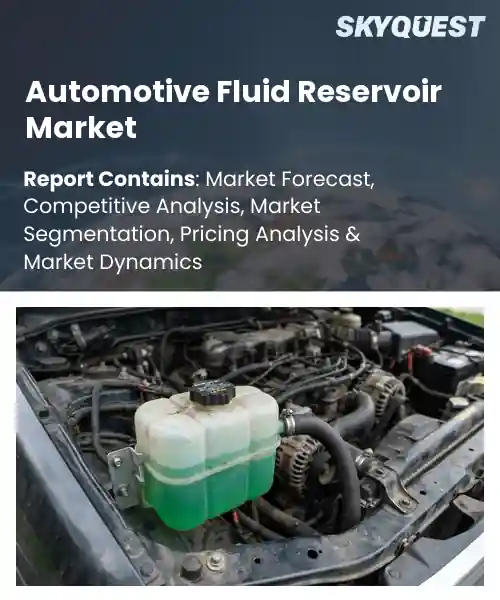
Automotive Fluid Reservoir Market
Report ID: SQMIG25A3015
Report ID: SQMIG25A3015
[email protected]
USA +1 351-333-4748
Report ID:
SQMIG25A3015 |
Region:
Global |
Published Date: November, 2026
Pages:
157
|Tables:
119
|Figures:
77


Global Automotive Fluid Reservoir Market size was valued at USD 3.8 Billion in 2024 and is poised to grow from USD 3.97 Billion in 2025 to USD 5.7 Billion by 2033, growing at a CAGR of 4.6% during the forecast period (2026-2033).
The global automotive fluid reservoir market supplies containers that store brake, coolant, transmission and power‑steering fluids in passenger cars, trucks and electric vehicles. Its importance stems from the need to protect fluid circuits from contamination, temperature extremes and vibration, preserving safety and performance. In twenty years the market expanded as manufacturers shifted from stamped steel to polymer and aluminum alloys to meet fuel‑efficiency rules and weight targets. German OEMs adopted polyethylene reservoirs in 2015 to cut weight by 15 %, while Chinese makers embraced aluminum designs in 2020 to satisfy tighter emissions standards. This evolution mirrors an industry push toward efficiency. The growth driver for automotive fluid reservoir market is the rise of electric and hybrid powertrains, which reshapes fluid architecture and raises demand for reservoirs. Electric drivetrains discard transmission oil but introduce coolant and battery‑thermal fluids, forcing manufacturers to redesign reservoirs for low‑viscosity coolant loops and embed sensors that enable temperature control. Tesla teamed with polymer firms to launch nitrogen‑filled coolant tanks that cut package volume by 20 % and free space for larger battery packs. This evolution creates opportunities for suppliers of composites, monitoring and lightweight molding, while OEMs revise design standards and invest in labs, expanding overall market volume.
How is AI-driven automation influencing design trends in the automotive fluid reservoir market?
AI driven automation is reshaping how engineers approach fluid reservoir design for cars. By feeding large data sets of crash performance, thermal behavior and manufacturing constraints into generative models, designers can explore lightweight geometries that still meet safety standards. The technology shortens iteration cycles and allows rapid testing of novel materials. OEMs are seeing concepts that integrate sensor housings and routing channels directly into the reservoir wall, reducing part count. This shift is encouraging suppliers to adopt digital twins and collaborative platforms, making the development process more transparent and adaptable to changing powertrain architectures.Continental announced an AI driven fluid reservoir redesign in April 2024, the new approach cuts tooling time and enables lighter modules that support electric vehicle cooling needs while preserving durability, accelerating market adoption and improving overall efficiency and reducing assembly complexity.
Market snapshot - (2026-2033)
Global Market Size
USD 3.8 Billion
Largest Segment
Coolant Reservoirs
Fastest Growth
Power Steering Fluid Reservoirs
Growth Rate
4.6% CAGR
To get more insights on this market click here to Request a Free Sample Report
Global automotive fluid reservoir market is segmented by fluid type, material, vehicle type, sales channel and region. Based on fluid type, the market is segmented into Coolant Reservoirs, Brake Fluid Reservoirs, Windshield Washer Fluid Reservoirs, Power Steering Fluid Reservoirs and Other Fluid Reservoirs. Based on material, the market is segmented into Plastic, Metal and Other Materials. Based on vehicle type, the market is segmented into Passenger Cars, Light Commercial Vehicles, Heavy Commercial Vehicles and Off-Highway Vehicles. Based on sales channel, the market is segmented into Original Equipment Manufacturers and Aftermarket. Based on region, the market is segmented into North America, Europe, Asia Pacific, Latin America and Middle East & Africa.
Coolant reservoirs segment dominates because they serve as the primary buffer that stabilizes coolant volume under thermal expansion and contraction, ensuring continuous heat exchange. Their integration with engine cooling systems reduces overheating risk, extends component life, and supports tighter emissions controls. Manufacturers prioritize reliable designs, leading to widespread adoption across passenger and commercial platforms, which reinforces their central position in the automotive fluid reservoir market.
However, windshield washer fluid reservoirs emerge as the most rapidly expanding area, driven by growing consumer expectations for convenience and safety features. Increased automation in cleaning systems and the incorporation of sensor‑controlled dispensing elevate demand, prompting innovative lightweight designs. This momentum stimulates new supplier opportunities and broadens the overall market’s growth trajectory.
Plastic material segment leads because it offers a combination of lightweight properties, corrosion resistance, and cost‑effective molding capabilities that align with volume production goals. Its adaptability enables complex geometries and integrated features, facilitating easier installation and reduced vehicle weight, which manufacturers and service providers value for both new builds and refurbishments. These advantages cement plastic’s prominence in the aftermarket fluid reservoir landscape.
Conversely, metal reservoirs are witnessing the strongest growth due to rising performance requirements in heavy-duty and off‑highway sectors. Enhanced durability, superior heat dissipation, and the ability to withstand harsh operating conditions attract OEMs seeking longer service intervals. Investment in advanced coating technologies further expands metal’s appeal, accelerating its penetration and creating new avenues for market expansion.
To get detailed segments analysis, Request a Free Sample Report
Asia Pacific enjoys a confluence of advanced manufacturing capabilities, deep engineering expertise, and a dense network of original equipment manufacturers that together create a highly competitive environment for fluid reservoir production. The region’s emphasis on innovative design, lightweight materials, and stringent emission standards drives continuous improvement in reservoir performance and durability. Collaborative relationships between tier‑one suppliers and vehicle assemblers enable rapid adoption of emerging technologies such as electric‑drive cooling solutions. Strong investment in research and development, coupled with cost‑effective production scales, reinforces the region’s ability to meet diverse customer requirements while maintaining high quality. Together, these factors position Asia Pacific as the leading hub for automotive fluid reservoir innovation and supply.
Automotive Fluid Reservoir Market in Japan benefits from a longstanding heritage of precision engineering and a robust supply chain that links component makers directly with major vehicle manufacturers. The focus on high‑performance materials and rigorous quality standards supports the development of reservoirs that meet demanding efficiency and durability criteria. Collaborative projects between research institutions and industry foster continual refinement of designs, particularly for emerging powertrain technologies. This environment sustains Japan’s reputation as a cornerstone of global fluid reservoir excellence.
Automotive Fluid Reservoir Market in South Korea is propelled by a dynamic automotive sector that prioritizes technological advancement and rapid product cycles. Investment in advanced manufacturing processes and material science enables the production of reservoirs optimized for both conventional and electrified powertrains. Close integration between component suppliers and vehicle assemblers facilitates swift incorporation of innovative cooling and fluid management solutions. This synergy sustains South Korea’s role as a vital contributor to the region’s overall market leadership.
North America experiences rapid expansion of the fluid reservoir market due to heightened consumer demand for vehicles with improved fuel efficiency and robust thermal management, especially in larger vehicle segments. Strong aftermarket activity, supported by a well‑established repair network, encourages regular replacement and upgrades of fluid handling components. Ongoing innovation in electric and hybrid powertrains creates new requirements for specialized reservoirs that ensure optimal cooling and fluid distribution. Collaborative efforts among suppliers, technology firms, and automakers accelerate the introduction of high‑performance, lightweight solutions that align with stringent regulatory expectations. This combination of consumer preferences, aftermarket vitality, and forward‑looking engineering fuels sustained growth across the continent.
Automotive Fluid Reservoir Market in United States thrives on a sizable original equipment manufacturer base and an extensive aftermarket infrastructure that together drive continuous product evolution. Emphasis on advanced cooling strategies for high‑performance and electrified vehicles encourages adoption of innovative reservoir designs. Partnerships between component developers and research institutions support the integration of cutting‑edge materials aimed at reducing weight while preserving durability. This ecosystem promotes rapid response to evolving vehicle architectures and regulatory demands, reinforcing the United States as a pivotal market for fluid reservoir advancement.
Automotive Fluid Reservoir Market in Canada benefits from a strong focus on sustainable vehicle technologies and a collaborative supply chain that links component producers with local assemblers. Emphasis on environmental performance leads to the development of reservoirs that enhance thermal efficiency and support low‑emission powertrains. Integration of advanced materials and precision manufacturing techniques ensures compliance with rigorous quality expectations. This supportive environment nurtures a market that aligns closely with broader North American trends while addressing specific regional priorities.
Europe strengthens its position through a blend of rigorous regulatory frameworks, deep engineering expertise, and a concentration of premium automotive manufacturers that demand high‑quality fluid management solutions. Commitment to sustainability drives the adoption of lightweight, recyclable materials and designs that optimize fluid flow for emerging electrified platforms. Robust research collaborations across universities and industry foster innovation in thermal management and component integration. Continuous investment in advanced manufacturing capabilities, such as precision casting and additive processes, enhances the ability to meet exacting performance standards. Together, these elements reinforce Europe’s reputation as a leader in sophisticated, environmentally conscious fluid reservoir solutions.
Automotive Fluid Reservoir Market in Germany is characterized by a strong tradition of engineering precision and a dense network of tier‑one suppliers serving premium vehicle makers. The focus on high‑efficiency designs aligns with stringent emission standards, prompting the development of reservoirs that deliver superior cooling performance. Collaboration between research institutes and industry accelerates the incorporation of novel materials and manufacturing techniques, supporting the production of lightweight yet robust components. This environment sustains Germany’s influential role in shaping advanced fluid management solutions across the continent.
Automotive Fluid Reservoir Market in United Kingdom benefits from a vibrant ecosystem of specialist manufacturers and a dynamic research community dedicated to vehicle performance optimization. Emphasis on lightweight construction and efficient thermal regulation drives innovation in reservoir geometry and material selection. Strong ties between component producers and leading automotive brands facilitate rapid prototyping and integration of next‑generation cooling solutions. This synergy helps the United Kingdom maintain a competitive edge in delivering high‑quality fluid handling components for diverse vehicle platforms.
Automotive Fluid Reservoir Market in France is supported by a robust automotive supply chain that prioritizes sustainability and performance. Focus on reducing vehicle weight and enhancing thermal efficiency leads to the adoption of advanced reservoir designs that meet strict environmental criteria. Partnerships between engineering firms and academic research centers foster the development of innovative materials and precise manufacturing processes. This collaborative approach reinforces France’s contribution to Europe’s broader leadership in advanced fluid reservoir technologies.
To know more about the market opportunities by region and country, click here to
Buy The Complete Report
Increasing Demand for Efficient Vehicles
Adoption of Advanced Manufacturing Techniques
Stringent Environmental Disposal Regulations
High Cost of Specialized Materials
Request Free Customization of this report to help us to meet your business objectives.
The Global Automotive Fluid Reservoir market is shaped by intense competition among established suppliers such as Bosch, Continental, Denso and Mahle, who are leveraging M&A of niche fluid‑management firms, forming joint development agreements with OEMs, and introducing lightweight polymer and aluminum reservoir technologies to meet efficiency targets and regulatory pressure.
Top Player’s Company Profile
Recent Developments
SkyQuest’s ABIRAW (Advanced Business Intelligence, Research & Analysis Wing) is our Business Information Services team that Collects, Collates, Correlates, and Analyses the Data collected by means of Primary Exploratory Research backed by robust Secondary Desk research. As per SkyQuest analysis, the global automotive fluid reservoir market is being propelled primarily by the rising demand for more efficient vehicles, which pushes OEMs to seek lightweight, compact reservoirs that improve fuel‑economy and meet stricter emissions standards. A second driver comes from the swift adoption of advanced manufacturing techniques such as additive printing and precision casting, allowing suppliers to create complex, integrated designs faster and at lower cost. However, stringent environmental disposal regulations act as a restraint by requiring costly material redesigns and recycling processes. Asia Pacific dominates the market thanks to its deep manufacturing base and strong OEM ecosystem, while coolant reservoirs remain the leading segment due to their critical role in thermal management.
| Report Metric | Details |
|---|---|
| Market size value in 2024 | USD 3.8 Billion |
| Market size value in 2033 | USD 5.7 Billion |
| Growth Rate | 4.6% |
| Base year | 2024 |
| Forecast period | (2026-2033) |
| Forecast Unit (Value) | USD Billion |
| Segments covered |
|
| Regions covered | North America (US, Canada), Europe (Germany, France, United Kingdom, Italy, Spain, Rest of Europe), Asia Pacific (China, India, Japan, Rest of Asia-Pacific), Latin America (Brazil, Rest of Latin America), Middle East & Africa (South Africa, GCC Countries, Rest of MEA) |
| Companies covered |
|
| Customization scope | Free report customization with purchase. Customization includes:-
|
To get a free trial access to our platform which is a one stop solution for all your data requirements for quicker decision making. This platform allows you to compare markets, competitors who are prominent in the market, and mega trends that are influencing the dynamics in the market. Also, get access to detailed SkyQuest exclusive matrix.
Table Of Content
Executive Summary
Market overview
Parent Market Analysis
Market overview
Market size
KEY MARKET INSIGHTS
COVID IMPACT
MARKET DYNAMICS & OUTLOOK
Market Size by Region
KEY COMPANY PROFILES
Methodology
For the Automotive Fluid Reservoir Market, our research methodology involved a mixture of primary and secondary data sources. Key steps involved in the research process are listed below:
1. Information Procurement: This stage involved the procurement of Market data or related information via primary and secondary sources. The various secondary sources used included various company websites, annual reports, trade databases, and paid databases such as Hoover's, Bloomberg Business, Factiva, and Avention. Our team did 45 primary interactions Globally which included several stakeholders such as manufacturers, customers, key opinion leaders, etc. Overall, information procurement was one of the most extensive stages in our research process.
2. Information Analysis: This step involved triangulation of data through bottom-up and top-down approaches to estimate and validate the total size and future estimate of the Automotive Fluid Reservoir Market.
3. Report Formulation: The final step entailed the placement of data points in appropriate Market spaces in an attempt to deduce viable conclusions.
4. Validation & Publishing: Validation is the most important step in the process. Validation & re-validation via an intricately designed process helped us finalize data points to be used for final calculations. The final Market estimates and forecasts were then aligned and sent to our panel of industry experts for validation of data. Once the validation was done the report was sent to our Quality Assurance team to ensure adherence to style guides, consistency & design.
Analyst Support
Customization Options
With the given market data, our dedicated team of analysts can offer you the following customization options are available for the Automotive Fluid Reservoir Market:
Product Analysis: Product matrix, which offers a detailed comparison of the product portfolio of companies.
Regional Analysis: Further analysis of the Automotive Fluid Reservoir Market for additional countries.
Competitive Analysis: Detailed analysis and profiling of additional Market players & comparative analysis of competitive products.
Go to Market Strategy: Find the high-growth channels to invest your marketing efforts and increase your customer base.
Innovation Mapping: Identify racial solutions and innovation, connected to deep ecosystems of innovators, start-ups, academics, and strategic partners.
Category Intelligence: Customized intelligence that is relevant to their supply Markets will enable them to make smarter sourcing decisions and improve their category management.
Public Company Transcript Analysis: To improve the investment performance by generating new alpha and making better-informed decisions.
Social Media Listening: To analyze the conversations and trends happening not just around your brand, but around your industry as a whole, and use those insights to make better Marketing decisions.
REQUEST FOR SAMPLE
 REQUEST FREE CUSTOMIZATION


Want to customize this report? This report can be personalized according to your needs. Our analysts and industry experts will work directly with you to understand your requirements and provide you with customized data in a short amount of time. We offer $1000 worth of FREE customization at the time of purchase.
Feedback From Our Clients


 USA (+1) 351-333-4748

