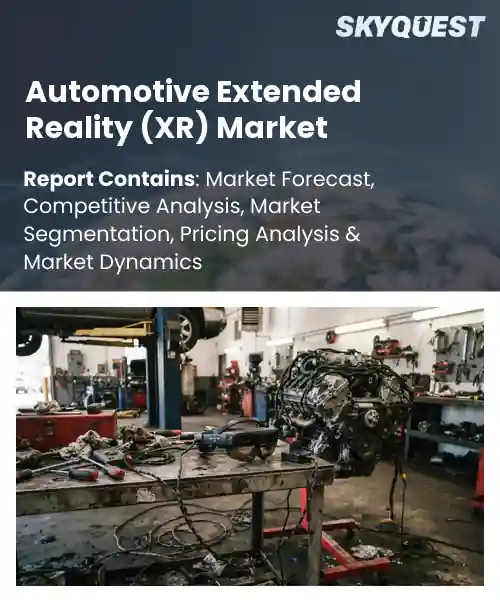
Automotive Extended Reality (XR) Market
Report ID: SQMIG25A2970
Report ID: SQMIG25A2970
[email protected]
USA +1 351-333-4748
Report ID:
SQMIG25A2970 |
Region:
Global |
Published Date: September, 2026
Pages:
157
|Tables:
146
|Figures:
78


Global Automotive Extended Reality (Xr) Market size was valued at USD 1.19 Billion in 2024 and is poised to grow from USD 1.3 Billion in 2025 to USD 2.61 Billion by 2033, growing at a CAGR of 9.1% during the forecast period (2026-2033).
The automotive extended reality (XR) market merges virtual, augmented, and mixed reality technologies with vehicle design, manufacturing, and after‑sales services, creating immersive environments that accelerate product innovation. Its driver is the escalating demand for prototyping and digital twins, which reduce tooling costs while enabling engineers to visualize assemblies instantly. Over the past decade, OEMs such as BMW and Volvo have adopted XR for cabin ergonomics testing, allowing designers to adjust seat ergonomics in a simulated space rather than building multiple mock‑ups. This shift not only shortens development cycles but also strengthens brand differentiation as consumers increasingly expect personalized, rich experiences.Building on the prototyping impetus, the market’s next key factor is the integration of XR into after‑sales support, which creates a cascade of cost savings and customer loyalty. By overlaying diagnostic data onto a technician’s field of view, manufacturers such as Ford enable remote experts to guide repairs in real‑time, cutting vehicle downtime and reducing parts inventory. This capability fuels demand for cloud‑based XR platforms, attracting software firms that specialize in latency‑optimised streaming. As dealerships adopt virtual showrooms, consumers can experience configurable trims without visiting a physical lot, translating immersive interaction into higher conversion rates and revenue streams for OEMs.
How is AI driving adoption of XR solutions in the automotive manufacturing sector?
Artificial intelligence is turning extended reality from a visual novelty into a decision making tool on the factory floor. AI algorithms interpret sensor data to overlay precise assembly instructions while computer vision recognises parts and guides workers in real time. In design studios generative AI creates multiple vehicle concepts that designers can walk through instantly in XR shortening the iteration loop. Training modules now adapt to each trainee’s performance offering personalized feedback that speeds skill acquisition. The automotive sector is embracing these capabilities as it seeks to reduce physical prototyping shorten time to market and improve safety making AI driven XR a core pillar of modern manufacturing.Toyota March 2024, introduced an AI enhanced XR system for virtual prototyping accelerating design cycles and cutting material waste. The platform integrates generative AI that adapts models instantly allowing engineers to test fit and ergonomics without physical parts illustrating how AI drives XR adoption and supports efficiency.
Market snapshot - (2026-2033)
Global Market Size
USD 1.19 Billion
Largest Segment
Augmented Reality
Fastest Growth
Mixed Reality
Growth Rate
9.1% CAGR
To get more insights on this market click here to Request a Free Sample Report
Global automotive extended reality (xr) market is segmented by xr type, component, application, vehicle type, end user and region. Based on xr type, the market is segmented into Augmented Reality, Virtual Reality and Mixed Reality. Based on component, the market is segmented into Hardware, Software and Services. Based on application, the market is segmented into Vehicle Design & Development, Manufacturing & Assembly, Training & Simulation, Sales & Marketing and In-Vehicle Experience. Based on vehicle type, the market is segmented into Passenger Vehicles and Commercial Vehicles. Based on end user, the market is segmented into Automotive OEMs, Automotive Suppliers, Automotive Dealerships and Service & Training Providers. Based on region, the market is segmented into North America, Europe, Asia Pacific, Latin America and Middle East & Africa.
Augmented Reality segment dominates because it seamlessly overlays contextual data onto the driver’s view, enabling real‑time navigation cues, safety alerts, and infotainment without diverting attention. Its integration leverages existing windshield displays and head‑up technologies, providing intuitive interactions that improve safety and user satisfaction. The convergence of automotive manufacturers’ focus on driver assistance and consumer demand for immersive features fuels this leadership and creates a competitive edge for early adopters.
Meanwhile, Virtual Reality segment experiences the strongest growth as manufacturers expand its use for immersive design reviews, virtual prototyping, and customer showroom experiences. The heightened ability to visualize full‑scale vehicle models in a simulated environment reduces physical mock‑up costs and accelerates decision cycles, unlocking revenue streams and fostering adoption across the industry.
Hardware segment dominates because it provides the foundational processing power, sensor arrays, and display technologies required for reliable XR deployment on factory floors. Robust edge compute units, high‑resolution headsets, and ruggedized cameras enable real‑time data capture and low‑latency visualization, meeting stringent automotive quality standards. The push for digitized assembly lines and the need for precise ergonomic support drive manufacturers to prioritize hardware investments as the critical enabler for sustainable production.
On the other hand, Software segment is witnessing rapid expansion as developers deliver modular XR platforms, simulation tools, and collaboration suites. These solutions lower integration complexity, enable scalable updates, and provide analytics that improve process optimization. The growing appetite for flexible, subscription‑driven models accelerates market penetration, unlocking use cases across design, training, and after‑sales support.
To get detailed segments analysis, Request a Free Sample Report
Asia Pacific leads through a confluence of advanced manufacturing heritage, deep integration of electronics expertise, and aggressive investment in immersive technologies. Leading automotive manufacturers collaborate closely with semiconductor and software firms, creating end‑to‑end XR solutions that accelerate design validation, virtual prototyping, and driver training. Regional supply chains support rapid iteration, while government initiatives encourage technology transfer and skill development. Strong consumer adoption of connected vehicles further fuels demand for immersive in‑car experiences, positioning the region as a hub for both hardware innovation and software ecosystem growth.
Japan Automotive Extended Reality (XR) Market
Automotive Extended Reality (XR) Market in Japan benefits from a longstanding culture of precision engineering and a robust electronics sector. Major automakers partner with local technology leaders to embed XR into vehicle design cycles, enabling detailed virtual mock‑ups and immersive safety simulations. Academic institutions contribute cutting‑edge research, while government programs promote workforce upskilling, creating a sustainable pipeline of talent that reinforces Japan’s position at the forefront of XR integration.
South Korea Automotive Extended Reality (XR) Market
Automotive Extended Reality (XR) Market in South Korea thrives on a vibrant startup ecosystem and strong backing from global conglomerates. Collaborative projects focus on real‑time visualization for assembly lines and advanced driver assistance system training. The nation’s expertise in display technology and high‑speed connectivity enhances the fidelity of XR experiences, while public‑private partnerships accelerate adoption across both legacy manufacturers and emerging electric vehicle players.
North America experiences rapid expansion due to a synergistic blend of innovative culture, substantial venture capital, and a mature automotive landscape seeking efficiency and differentiation. Leading manufacturers leverage XR to shorten development cycles, improve ergonomic design, and enhance after‑sales service through remote assistance. Technology giants contribute high‑performance hardware and cloud platforms, while regulatory focus on safety and driver assistance creates a compelling use case for immersive training. The region’s strong dealer networks and consumer appetite for connected experiences further amplify market momentum.
United States Automotive Extended Reality (XR) Market
Automotive Extended Reality (XR) Market in the United States is energized by extensive research institutions and a vibrant ecosystem of technology firms. Leading carmakers integrate XR into every phase of product development, from concept sketches to final assembly validation. The emphasis on immersive driver assistance testing and remote maintenance aligns with broader digital transformation goals, while collaborations with entertainment and gaming sectors enrich the quality of in‑vehicle experiences for end users.
Canada Automotive Extended Reality (XR) Market
Automotive Extended Reality (XR) Market in Canada draws strength from strong academic research hubs and supportive government innovation programs. Automotive firms adopt XR for virtual prototyping and climate‑specific scenario testing, leveraging the country’s expertise in simulation and digital twin technologies. Partnerships between OEMs and local technology providers focus on enhancing safety training and supply‑chain visualization, positioning Canada as a niche leader in XR applications tailored to cold‑weather performance and sustainability goals.
Europe advances its position by combining a heritage of engineering excellence with coordinated policy frameworks that encourage cross‑border collaboration. Established automakers integrate XR to streamline complex platform development and meet stringent regulatory standards for safety and emissions. The region’s dense network of specialized suppliers, research consortia, and creative design studios fosters innovative XR content that enhances both vehicle aesthetics and driver interaction. By aligning standards and promoting shared data ecosystems, Europe creates a unified market environment that accelerates adoption across multiple countries.
Germany Automotive Extended Reality (XR) Market
Automotive Extended Reality (XR) Market in Germany reflects the nation’s reputation for precision engineering and high‑quality production. OEMs employ XR to conduct detailed virtual assembly checks, reduce tooling costs, and improve ergonomics for production staff. Collaborative initiatives with local software developers focus on high‑resolution simulations for autonomous driving scenarios, reinforcing Germany’s leadership in safety‑critical XR applications.
United Kingdom Automotive Extended Reality (XR) Market
Automotive Extended Reality (XR) Market in the United Kingdom benefits from a strong creative sector and a cluster of specialist XR studios. Manufacturers partner with design firms to create immersive brand experiences and refine vehicle interiors through virtual walkthroughs. Academic research centers contribute advanced visualization techniques, while government incentives support pilot projects that integrate XR into vehicle testing and driver education programs.
France Automotive Extended Reality (XR) Market
Automotive Extended Reality (XR) Market in France merges a tradition of luxury automotive design with cutting‑edge digital artistry. Premium brands leverage XR for high‑fidelity virtual showrooms and bespoke customization tools that engage discerning customers. Collaborative efforts between automakers and local technology innovators focus on enhancing driver assistance training and immersive safety demonstrations, strengthening France’s role in the European XR landscape.
To know more about the market opportunities by region and country, click here to
Buy The Complete Report
XR is Transforming Vehicle Design
Manufacturers are Leveraging Immersive Simulations
High Cost is Hindering Adoption
Limited Content Development is Slowing Growth
Request Free Customization of this report to help us to meet your business objectives.
The automotive XR market is shaped by intense competition as OEMs and tech firms race to embed immersive visualization, training and infotainment solutions. Recent M&A activity includes NVIDIA’s acquisition of a German AR startup to strengthen its automotive cockpit platform, while Volkswagen partnered with Microsoft to launch a mixed‑reality design hub. Companies also push tech innovation through AI‑driven holographic displays and cloud‑based XR services, accelerating adoption across the value chain.
Top Player’s Company Profile
Recent Developments
SkyQuest’s ABIRAW (Advanced Business Intelligence, Research & Analysis Wing) is our Business Information Services team that Collects, Collates, Correlates, and Analyses the Data collected by means of Primary Exploratory Research backed by robust Secondary Desk research. As per SkyQuest analysis, the global automotive XR market is being propelled primarily by the ability of extended reality to accelerate vehicle design through immersive prototyping, which shortens development cycles and cuts tooling costs. A second strong driver is the infusion of artificial‑intelligence that turns XR into a real‑time decision tool on the factory floor, enhancing assembly instructions and personalized training. The market’s growth is tempered by the high cost of hardware and software bundles, which limits adoption especially among smaller suppliers. Asia Pacific leads the market thanks to its advanced manufacturing base and strong electronics ecosystem, while augmented‑reality solutions dominate overall, reflecting their pivotal role in in‑vehicle experiences.
| Report Metric | Details |
|---|---|
| Market size value in 2024 | USD 1.19 Billion |
| Market size value in 2033 | USD 2.61 Billion |
| Growth Rate | 9.1% |
| Base year | 2024 |
| Forecast period | (2026-2033) |
| Forecast Unit (Value) | USD Billion |
| Segments covered |
|
| Regions covered | North America (US, Canada), Europe (Germany, France, United Kingdom, Italy, Spain, Rest of Europe), Asia Pacific (China, India, Japan, Rest of Asia-Pacific), Latin America (Brazil, Rest of Latin America), Middle East & Africa (South Africa, GCC Countries, Rest of MEA) |
| Companies covered |
|
| Customization scope | Free report customization with purchase. Customization includes:-
|
To get a free trial access to our platform which is a one stop solution for all your data requirements for quicker decision making. This platform allows you to compare markets, competitors who are prominent in the market, and mega trends that are influencing the dynamics in the market. Also, get access to detailed SkyQuest exclusive matrix.
Table Of Content
Executive Summary
Market overview
Parent Market Analysis
Market overview
Market size
KEY MARKET INSIGHTS
COVID IMPACT
MARKET DYNAMICS & OUTLOOK
Market Size by Region
KEY COMPANY PROFILES
Methodology
For the Automotive Extended Reality (XR) Market, our research methodology involved a mixture of primary and secondary data sources. Key steps involved in the research process are listed below:
1. Information Procurement: This stage involved the procurement of Market data or related information via primary and secondary sources. The various secondary sources used included various company websites, annual reports, trade databases, and paid databases such as Hoover's, Bloomberg Business, Factiva, and Avention. Our team did 45 primary interactions Globally which included several stakeholders such as manufacturers, customers, key opinion leaders, etc. Overall, information procurement was one of the most extensive stages in our research process.
2. Information Analysis: This step involved triangulation of data through bottom-up and top-down approaches to estimate and validate the total size and future estimate of the Automotive Extended Reality (XR) Market.
3. Report Formulation: The final step entailed the placement of data points in appropriate Market spaces in an attempt to deduce viable conclusions.
4. Validation & Publishing: Validation is the most important step in the process. Validation & re-validation via an intricately designed process helped us finalize data points to be used for final calculations. The final Market estimates and forecasts were then aligned and sent to our panel of industry experts for validation of data. Once the validation was done the report was sent to our Quality Assurance team to ensure adherence to style guides, consistency & design.
Analyst Support
Customization Options
With the given market data, our dedicated team of analysts can offer you the following customization options are available for the Automotive Extended Reality (XR) Market:
Product Analysis: Product matrix, which offers a detailed comparison of the product portfolio of companies.
Regional Analysis: Further analysis of the Automotive Extended Reality (XR) Market for additional countries.
Competitive Analysis: Detailed analysis and profiling of additional Market players & comparative analysis of competitive products.
Go to Market Strategy: Find the high-growth channels to invest your marketing efforts and increase your customer base.
Innovation Mapping: Identify racial solutions and innovation, connected to deep ecosystems of innovators, start-ups, academics, and strategic partners.
Category Intelligence: Customized intelligence that is relevant to their supply Markets will enable them to make smarter sourcing decisions and improve their category management.
Public Company Transcript Analysis: To improve the investment performance by generating new alpha and making better-informed decisions.
Social Media Listening: To analyze the conversations and trends happening not just around your brand, but around your industry as a whole, and use those insights to make better Marketing decisions.
REQUEST FOR SAMPLE
 REQUEST FREE CUSTOMIZATION


Want to customize this report? This report can be personalized according to your needs. Our analysts and industry experts will work directly with you to understand your requirements and provide you with customized data in a short amount of time. We offer $1000 worth of FREE customization at the time of purchase.
Feedback From Our Clients


 USA (+1) 351-333-4748

