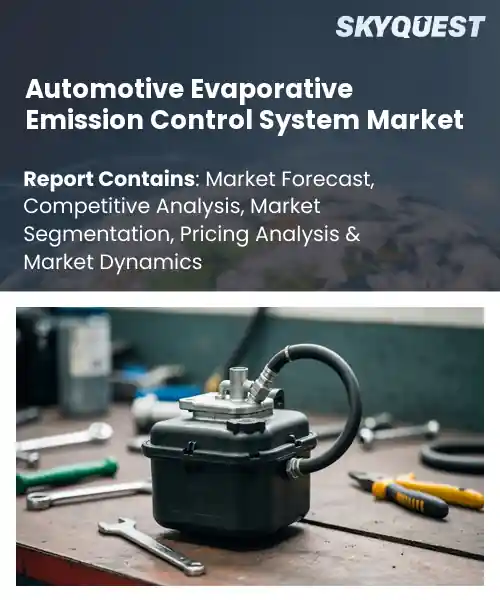
Automotive Evaporative Emission Control System Market
Report ID: SQMIG25A2627
Report ID: SQMIG25A2627
[email protected]
USA +1 351-333-4748
Report ID:
SQMIG25A2627 |
Region:
Global |
Published Date: February, 2026
Pages:
157
|Tables:
120
|Figures:
77


Global Automotive Evaporative Emission Control System Market size was valued at USD 4.0 Billion in 2024 and is poised to grow from USD 4.2 Billion in 2025 to USD 5.88 Billion by 2033, growing at a CAGR of 4.3% during the forecast period (2026-2033).
The global automotive evaporative emission control systems market growth is experiencing major changes because of stricter environmental regulations and increased public knowledge about vehicle air pollution. Governments around the world have started to enforce more rigorous air quality regulations. Manufacturers require new pollution control methods that they need to develop. The changes made to products enable companies to fulfill environmental standards while they meet consumer demand for more sustainable vehicle options. The industry is currently investing in research and development to create better evaporative emission control systems, which will function with greater efficiency.
Moreover, new technological developments have created a major impact on how automotive evaporative emission control systems operate in the market. The performance of these systems has been improved through the application of advanced materials and intelligent technologies, which create more reliable and efficient operations. The global automotive evaporative emission control systems market outlook is changing because car manufacturers want to find new methods to integrate evaporative emission control systems into their hybrid and electric vehicle designs. The market will experience a prosperous future, which will bring forth new sustainable innovations because the current market changes reflect this potential.
How is IoT Improving Monitoring and Compliance in the Automotive Evaporative Emission Control System Market?
Automotive evaporative emission control systems see better monitoring and compliance through Internet of Things technology, which connects onboard sensors with vehicle telematics and cloud analytics to create continuous monitoring of vapor containment performance. Manufacturers and fleets need real-time leak detection with remote health reporting and onboard diagnostics integration to confirm system integrity between scheduled inspections. The current market requires regulators to obtain permanent proof of fuel vapor control, which prompts suppliers to introduce intelligent sensors and edge data processing to their canister and valve and pressure sensor systems. Fleet telematics systems show evaporative faults to dispatch immediate maintenance teams, while cloud dashboards collect entire vehicle data for internal compliance checks.
Market snapshot - (2026-2033)
Global Market Size
USD 4.3 Billion
Largest Segment
Gasoline
Fastest Growth
Hybrid
Growth Rate
4.9% CAGR
To get more insights on this market click here to Request a Free Sample Report
The global automotive evaporative emission control system market is segmented by fuel type, component type, vehicle type, sales channel, and region. By fuel type, the market is categorized into gasoline, diesel, alternative fuel, and hybrid vehicles. By component type, it is segmented into charcoal canisters, fuel tank pressure sensors, purge valves, and vent valves. By vehicle type, the market includes passenger vehicles, commercial vehicles, motorcycles, and heavy-duty vehicles. By sales channel, it is divided into OEM, aftermarket, and online retail. Regionally, the market is segmented into North America, Europe, Asia Pacific, Latin America, and the Middle East & Africa.
As per the global automotive evaporative emission control system market analysis, the gasoline segment dominated the market because EVAP systems only function to control emissions from gasoline engine fuel vapor. Major automakers such as Toyota Motor Corporation and Volkswagen AG continue to manufacture gasoline-powered vehicles throughout the world, especially across the Asia-Pacific and North America. The gasoline-powered vehicle production, together with the existing regulations, has resulted in a stable market share for this segment because those two factors have created ongoing production.
However, the hybrid vehicles segment will experience rapid growth because governments are working to decrease pollution, and customers are beginning to adopt electrified powertrains instead of traditional engines. Demand for EVAP systems remains active because hybrid vehicles use gasoline as their fuel source. The addition of new hybrid models to global OEM portfolios will create faster growth for the hybrid segment.
According to the global automotive evaporative emission control system market forecast, the OEM segment dominated the market, resulting from mandatory evaporative emission control system installation requirements that car manufacturers needed to follow because of strict pollution control regulations. Top suppliers work with automotive manufacturers like Ford and Hyundai to establish production processes that allow EVAP part installation according to their specific requirements. OEMs generate substantial profits because they maintain production operations while meeting regulatory requirements.
Whereas the aftermarket industry is anticipated to have the largest automotive evaporative emission control system market share because vehicle ages increase and drivers need replacement parts, such which include charcoal canisters and purge valves. The automotive market is experiencing growth because stricter inspection procedures and emissions standard compliance inspections force car owners to replace their damaged EVAP parts with new ones.
To get detailed segments analysis, Request a Free Sample Report
As per the automotive evaporative emission control system market regional forecast, the manufacturing capacity of Asia Pacific, together with its supplier networks and regional engineering skills, establishes a base which drives quick uptake and development of evaporative control technologies. The major manufacturing sites of the area create complete supply networks which permit fast material development together with canister design improvements and system packaging changes needed to accommodate various vehicle designs and fuel types. The combination of maker and supplier partnerships together with local research centers produces cost-effective technical solutions which meet specific customer requirements. The market needs aftersales services because of early regulatory requirements which create demand while export activities together with global technology partner relations enable ongoing transfer of knowledge. The region produces both innovative products and high-volume manufacturing, which creates two essential components needed for the worldwide market.
The Japanese automotive evaporative emission control system sector depends on three key elements which include the close partnerships between auto manufacturers and their parts suppliers and the strict fuel evaporation control regulations and the high-level technical skills of the industry. The local production companies develop small and precise products which meet the requirements of domestic automotive designs. Vehicle telematics system integration together with long-lasting supplier agreements enables organizations to develop their products through a process of continuous improvement. The testing facilities work together with the three-tier supplier system to enable various levels of emission control technology development and testing which helps organizations reach their operational goals.
The automotive evaporative emission control system industry in South Korea expands through three main drivers which include strong domestic electric vehicle programs and tight partnerships between car makers and specialized parts providers and the development of compact modular products which can fit multiple automotive platforms. The engineering centers of the company focus on developing new materials through rapid prototyping methods which allow them to create products with greater durability and better resistance to chemical penetration. The company establishes strategic partnerships with top-tier suppliers to speed up technology transfer while its testing centers and logistics systems provide on-time delivery of services to clients.
The European automotive evaporative emission control system market penetration is driven quickly because of three factors which include standardized regulatory requirements and high concentration of advanced component manufacturers and supply chain collaboration which speeds up the market introduction of improved evaporation control technologies. The product development process achieves market distinction through three main elements which include development of lightweight materials and integration of alternative powertrain systems and execution of extensive testing through all stages of product development. Germany serves as a strong engineering nucleus, while other markets contribute dynamic innovation and growth pathways. The aftermarket, together with the retrofit market, creates new business opportunities which encourage suppliers to expand their product range. Cross border research initiatives and standardized testing approaches further reduce technical barriers and facilitate faster diffusion of best practices across the region.
The automotive evaporative emission control system market in Germany is fueled by three factors which include the presence of luxury automotive manufacturers and the extensive technical knowledge of engineers and the advanced supply network which focuses on producing high-quality durable products. The testing facilities together with research institutes work with manufacturers to create better system frameworks and material selection methods. The market demands that products work with complete vehicle systems while companies must follow strict regulations to achieve quality standards which enable basic operational improvements across their entire supply chain.
The automotive evaporative emission control system market is growing in the United Kingdom because of three factors which include government financial support and strong aftermarket market activity and manufacturing investments from both local and foreign companies. The company uses flexible production methods together with rapid development capabilities to implement new evaporative control solutions immediately. The joint research efforts between academic institutions and business organizations drive innovation in materials and systems while the wide range of vehicles and flexible delivery from suppliers enable quick service across both passenger and commercial vehicle markets.
The automotive evaporative emission control system market in France is developing through industrial programs which create new business opportunities together with local engineering talent development and partnerships between auto manufacturers and their innovative product development partners. The development of tailored evaporative control systems for different vehicle types is enabled using lightweight materials which work efficiently with hybrid powertrain systems. Research clusters establish testing facilities which enable prototype validation while new aftermarket channels support early capabilities to develop into full-scale products which can compete in both the European market and the broader European market.
North America enhances its market presence through joint regulatory efforts, substantial material and system-level technical advances, and its strong supplier network which enables widespread delivery of products across different vehicle types. OEMs and leading suppliers need to demonstrate their products through complete verification testing, which includes all environmental operating scenarios and all types of fuel. Research organizations and testing facilities work together to speed up product development while helping enterprises expand their operational capabilities. The combination of aftermarket channels, retrofit activity, and flexible manufacturing enables responsive supply to changing market needs. The existing capabilities enable North America to concentrate on three aspects which include building durable products, combining different systems, and fulfilling all regulatory requirements. This approach improves North America's position in the international network of evaporative emission control systems.
The automotive evaporative emission control system market in the United States operates under three main factors which are existing regulations and strong OEM demand and advanced research laboratories which develop new materials and system components. The company requires its suppliers to develop solutions which can achieve maximum durability and scalability to establish operations in multiple market segments. The leading tier companies work together with academic institutions to create faster validation processes. The wide distribution of aftermarket channels and logistics networks enables vehicle fleets to access retrofitting opportunities across their entire fleet.
The Canadian automotive evaporative emission control system market depends on two factors which include its supply chain links for North American businesses and its ability to adapt to different fuel types and weather patterns. Domestic suppliers work together with manufacturers to create compact and durable evaporative solutions which match local vehicle specifications. The testing process uses various conditions and testing facilities to guarantee product reliability. The combination of aftermarket demand together with logistical capabilities enables greater adoption across the entire passenger and commercial vehicle markets.
To know more about the market opportunities by region and country, click here to
Buy The Complete Report
Tightening Global Emission Regulations
Regulatory authorities worldwide have increasingly emphasized limits on hydrocarbon and evaporative losses from vehicles. Manufacturers now need to implement advanced systems which handle evaporative emissions for complete compliance to regulatory standards which help them to prevent monetary penalties. The regulatory requirements drive OEMs to develop and implement advanced systems which handle canister operations and purge control and leak detection across all new vehicle designs. This process pushes suppliers to invest in greater production capability while creating a market need for retrofitting systems in areas which introduce more stringent regulations. The manufacturers choose standardized testing procedures and certification methods to deliver consistent product performance which will help their products gain acceptance in the market.
Advances in Fuel System Technology
The performance of evaporative emission control systems has improved through ongoing upgrades to materials and sorbent technology and control components. The operational capabilities of modern systems attract vehicle manufacturers because they deliver improved execution and prolonged product life and better space efficiency for packaging. The new technologies which include higher-capacity carbon canisters and more precise purge valves and advanced leak detection sensors have become easier to use inside vehicle electronics and powertrains. This development decreases the obstacles which OEMs face when they want to use new technologies. The new technological improvements enable suppliers to broaden their product lines while they help automakers to design vehicles which comply with emission standards.
Rising Electrification of Vehicle Fleets
The rising adoption of battery electric vehicles decreases the potential market size for evaporative emission control systems. This happens because manufacturers need to transfer their engineering personnel and procurement staff toward work on electrification and battery development. The rising demand for electric vehicle products creates an impact on traditional evaporation control technology sales because OEMs dedicate their resources to developing electric vehicle models. The traditional evaporation control technology market will experience decreased demand because OEMs shift their focus to selling electric vehicles and their corresponding components. The supplier base reacts to the structural transition by conducting strategic assessments while handling inventory management.
The development of advanced evaporative control systems needs complex parts which require precise calibration and must interact closely with vehicle suspension control systems. This system needs to establish handling and manufacturing procedures for production by OEMs and suppliers. The business needs to assess vehicle needs for cost-sensitive areas and product segments. The higher costs which come with initial purchases and system integration will deter customers from buying the product. The smaller suppliers face difficulty with developing necessary research and validation products while car manufacturers will select affordable options. The situation creates obstacles for advanced solution deployment across the business landscape. This situation has two negative effects. It decreases supplier profits. It makes new companies less likely to enter.
Request Free Customization of this report to help us to meet your business objectives.
The automotive evaporative emission control system market currently exists in a state of intense competition. The testing requirements have become more rigorous because environmental regulations have become stricter, and sustainability efforts have gained priority. The market's three largest companies include Delphi Technologies, Denso Corporation, and Tenneco Inc. (US). The company uses its new ideas and strategic partnerships to create complete market transformation. The company Delphi Technologiesoperates as an early developer of advanced systems for controlling environmental pollution. The company uses research and development to enhance product performance. Denso Corporation secures its market edge through its strategy of producing goods in local markets while expanding to new territories to fulfill its global customer needs.
Competitive landscape of this market is marked by consolidation, regulatory-driven product differentiation, and supplier-led technology moves: tier-one consolidation such as Faurecia’s acquisition of HELLA reshaped supplier scale and capabilities, while suppliers are launching electronically controlled vapor management (Eaton’s eVaptive) and aftermarket coverage expansions (Standard Motor Products) to respond to stricter evaporative and ORVR standards. Search summary: recent public sources show market activity concentrated in established suppliers, OEM patents and aftermarket expansions; no verified startups founded in 2019 or later with a clear, public EVAP product footprint were found in the searched materials.
Regulatory Harmonization Driving Innovation: The need for manufacturers and suppliers to establish stronger evaporative emission controls throughout their product range arises from global policy alignment with increased tailpipe regulations. The standardization of requirements establishes platform solutions which decrease the need for design replication, enable various components to be reused, and drive development of new materials and sealing solutions. The stability of regulatory frameworks allows companies to establish testing facilities and build supplier relationships which drive cost-efficient engineering solutions that enable fast compliance while increasing system protection and operational efficiency across international markets.
Connected Diagnostics and Monitoring: The combination of onboard diagnostics and vehicle telematics systems with cloud-based analytics platforms has completely changed the way drivers maintain evaporative emission systems because it enables them to conduct proper maintenance through proactive methods rather than following outdated repair techniques. The system establishes continuous monitoring capabilities which allow technicians to detect leaks and system faults while providing data for precise maintenance activities and performing remote system updates to extend hardware lifespan. The enhanced data streams which improve OEM collaboration with aftermarket service providers help warranty management while creating feedback systems which enhance design processes and regulatory compliance for fleets across various worldwide markets.
SkyQuest’s ABIRAW (Advanced Business Intelligence, Research & Analysis Wing) is our Business Information Services team that Collects, Collates, Correlates, and Analyses the Data collected by means of Primary Exploratory Research backed by robust Secondary Desk research.
As per SkyQuest analysis, the global automotive evaporative emission control systems market experiences its primary growth through stricter international emission standards and further development through fuel system technology advancements which produce intelligent canisters and valves and sensors. The rising electrification of vehicle fleets creates a major obstacle because it decreases demand for basic EVAP parts while forcing manufacturers to search for new market opportunities. The Asia Pacific region holds the largest market share because its manufacturing capabilities work together with its supplier network while charcoal canisters dominate the market because their adsorption capabilities have been confirmed through practical use by numerous OEMs. Regulatory bodies will continue to drive demand from compliance-driven OEMs and fleet operators through their progressive establishment of standard regulations and automotive diagnostics systems.
| Report Metric | Details |
|---|---|
| Market size value in 2024 | USD 4.3 Billion |
| Market size value in 2033 | USD 6.61 Billion |
| Growth Rate | 4.9% |
| Base year | 2024 |
| Forecast period | (2026-2033) |
| Forecast Unit (Value) | USD Billion |
| Segments covered |
|
| Regions covered | North America (US, Canada), Europe (Germany, France, United Kingdom, Italy, Spain, Rest of Europe), Asia Pacific (China, India, Japan, Rest of Asia-Pacific), Latin America (Brazil, Rest of Latin America), Middle East & Africa (South Africa, GCC Countries, Rest of MEA) |
| Companies covered |
|
| Customization scope | Free report customization with purchase. Customization includes:-
|
To get a free trial access to our platform which is a one stop solution for all your data requirements for quicker decision making. This platform allows you to compare markets, competitors who are prominent in the market, and mega trends that are influencing the dynamics in the market. Also, get access to detailed SkyQuest exclusive matrix.
Table Of Content
Executive Summary
Market overview
Parent Market Analysis
Market overview
Market size
KEY MARKET INSIGHTS
COVID IMPACT
MARKET DYNAMICS & OUTLOOK
Market Size by Region
KEY COMPANY PROFILES
Methodology
For the Automotive Evaporative Emission Control System Market, our research methodology involved a mixture of primary and secondary data sources. Key steps involved in the research process are listed below:
1. Information Procurement: This stage involved the procurement of Market data or related information via primary and secondary sources. The various secondary sources used included various company websites, annual reports, trade databases, and paid databases such as Hoover's, Bloomberg Business, Factiva, and Avention. Our team did 45 primary interactions Globally which included several stakeholders such as manufacturers, customers, key opinion leaders, etc. Overall, information procurement was one of the most extensive stages in our research process.
2. Information Analysis: This step involved triangulation of data through bottom-up and top-down approaches to estimate and validate the total size and future estimate of the Automotive Evaporative Emission Control System Market.
3. Report Formulation: The final step entailed the placement of data points in appropriate Market spaces in an attempt to deduce viable conclusions.
4. Validation & Publishing: Validation is the most important step in the process. Validation & re-validation via an intricately designed process helped us finalize data points to be used for final calculations. The final Market estimates and forecasts were then aligned and sent to our panel of industry experts for validation of data. Once the validation was done the report was sent to our Quality Assurance team to ensure adherence to style guides, consistency & design.
Analyst Support
Customization Options
With the given market data, our dedicated team of analysts can offer you the following customization options are available for the Automotive Evaporative Emission Control System Market:
Product Analysis: Product matrix, which offers a detailed comparison of the product portfolio of companies.
Regional Analysis: Further analysis of the Automotive Evaporative Emission Control System Market for additional countries.
Competitive Analysis: Detailed analysis and profiling of additional Market players & comparative analysis of competitive products.
Go to Market Strategy: Find the high-growth channels to invest your marketing efforts and increase your customer base.
Innovation Mapping: Identify racial solutions and innovation, connected to deep ecosystems of innovators, start-ups, academics, and strategic partners.
Category Intelligence: Customized intelligence that is relevant to their supply Markets will enable them to make smarter sourcing decisions and improve their category management.
Public Company Transcript Analysis: To improve the investment performance by generating new alpha and making better-informed decisions.
Social Media Listening: To analyze the conversations and trends happening not just around your brand, but around your industry as a whole, and use those insights to make better Marketing decisions.
REQUEST FOR SAMPLE
 REQUEST FREE CUSTOMIZATION
Global Automotive Evaporative Emission Control System Market size was valued at USD 4.3 Billion in 2024 and is poised to grow from USD 4.51 Billion in 2025 to USD 6.61 Billion by 2033, growing at a CAGR of 4.9% during the forecast period (2026-2033).
Competitive landscape is marked by consolidation, regulatory-driven product differentiation, and supplier-led technology moves: tier-one consolidation such as Faurecia’s acquisition of HELLA reshaped supplier scale and capabilities, while suppliers are launching electronically controlled vapor management (Eaton’s eVaptive) and aftermarket coverage expansions (Standard Motor Products) to respond to stricter evaporative and ORVR standards. Search summary: recent public sources show market activity concentrated in established suppliers, OEM patents and aftermarket expansions; no verified startups founded in 2019 or later with a clear, public EVAP product footprint were found in the searched materials. 'Delphi Technologies', 'Denso Corporation', 'Continental AG', 'Magna International Inc.', 'Tenneco Inc.', 'Aisin Seiki Co., Ltd.', 'Faurecia', 'BorgWarner Inc.', 'Valeo SA', 'Panasonic Corporation', 'Bosch (Robert Bosch GmbH)', 'Hyundai Mobis', 'ZF Friedrichshafen AG', 'Johnson Controls International plc', 'Mahle GmbH', 'Pirelli & C. S.p.A.', 'Cummins Inc.', 'Honeywell International Inc.', 'NTN Corporation', 'Hitachi Automotive Systems, Ltd.'
Regulatory authorities worldwide have increasingly emphasized limits on hydrocarbon and evaporative losses from vehicles, compelling manufacturers to incorporate more effective evaporative emission control systems to achieve compliance and avoid penalties. This regulatory pressure motivates OEMs to prioritize development and integration of advanced canister, purge control, and leak detection technologies across new vehicle platforms, accelerating supplier investment and expanded production capacity while stimulating demand for retrofit solutions in regions phasing in stricter standards. Manufacturers also pursue standardized testing and certification processes to ensure consistent performance and market acceptance.
As per the automotive evaporative emission control system market regional forecast, the manufacturing capacity of Asia Pacific, together with its supplier networks and regional engineering skills, establishes a base which drives quick uptake and development of evaporative control technologies.


Want to customize this report? This report can be personalized according to your needs. Our analysts and industry experts will work directly with you to understand your requirements and provide you with customized data in a short amount of time. We offer $1000 worth of FREE customization at the time of purchase.
Feedback From Our Clients


 USA (+1) 351-333-4748

