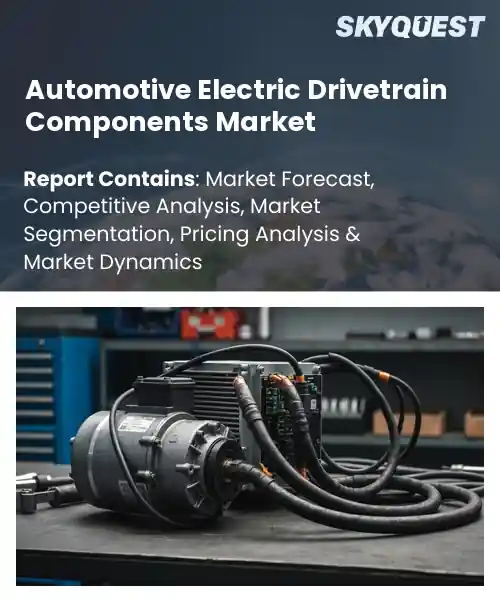
Automotive Electric Drivetrain Components Market
Report ID: SQMIG25A2692
Report ID: SQMIG25A2692
[email protected]
USA +1 351-333-4748
Report ID:
SQMIG25A2692 |
Region:
Global |
Published Date: June, 2026
Pages:
157
|Tables:
205
|Figures:
80


Global Automotive Electric Drivetrain Components Market size was valued at USD 47.5 Billion in 2024 and is poised to grow from USD 53.95 Billion in 2025 to USD 149.42 Billion by 2033, growing at a CAGR of 13.58% during the forecast period (2026-2033).
The rise in vehicle electrification, due to both strict emissions standards and demand from consumers for a lower cost of ownership, is leading to an increase in the sales and the availability of the automotive electric drivetrain components marketplace. This marketplace encompasses the components of an electric powertrain—the electric motor, inverter and power electronics, e-axles, modified transmission systems, and thermal management systems—which functionally replace the existing internal combustion engine-based architecture. The electric drivetrain components are the key driver for the electric vehicle market, as they determine how efficient and effective vehicles are, their ranges, and how much they will ultimately cost, and therefore affect adoption rates. This market has evolved over the last 10 years from a combined market of hybrid electric vehicles (HEV) parts to a total mass-market battery electric vehicle (BEV) parts market as demonstrated by the initial mass-market production of examples like the Nissan Leaf and Tesla's integrated drive units, which have significantly lowered technology barriers for entry.
As volumes of BEVs continue to increase, the primary drivers of the marketplace will be the system-level costs of components, as the decreasing costs of batteries and ongoing improvements in power electronics technology result in ripple effects through the value chain of components. The reduction in battery pricing will lead to increased model lines of BEVs, thus providing additional opportunities for suppliers to scale their manufacturing and to pursue larger volumes of high-efficiency motors, inverters, and integrated e-axles. Consequently, suppliers are seeking to continue to broaden their production capacity through the development of modular platforms in order to lower their production costs. Fleet electrification offers concrete use cases because delivery van and bus procurement creates steady predictable volume that justifies manufacturing upgrades, while adoption of silicon carbide semiconductors improves inverter efficiency, extending range and enabling smaller motors, opening new product and service revenue streams.
How is AI Improving Efficiency In The Automotive Electric Drivetrain Components Market?
Artificial Intelligence (AI) is being utilized in improving the efficiency of electric drive train components through the acceleration of design and tighter integration between the three main components - motor, inverter and thermal. AI is being used to simulate component sizing, ML is being used to calibrate control software and condition monitoring is being done to ensure reliability of components. Today’s market is requiring reduced-weight and higher performance integrated modules and shorter development cycles. Suppliers are using AI for reducing the number of prototypes, predicting thermal problems earlier in the development process, and automating the inspections process to improve yield.
Examples vary from AI tools used for simplifying the calibration of driveline systems to factory analytics which are used for reducing bottlenecks and allowing a faster time to market. On February 2, 2026, BorgWarner announced the receipt of an award for $800,000 for an Integrated Drive Module and Dual Inverter from a major North American OEM. The use of AI will help Achieve Predictive Thermal Management, faster virtual validation and adaptive control calibration, which will reduce the time for development and increase the efficiency of a component once used in service.
Market snapshot - (2026-2033)
Global Market Size
USD 47.5 Billion
Largest Segment
Battery Packs
Fastest Growth
Power Electronics
Growth Rate
13.58% CAGR
To get more insights on this market click here to Request a Free Sample Report
Global automotive electric drivetrain components market is segmented by by component type, by vehicle type, by propulsion type, by drive type, by voltage architecture, by sales channel, by application and region. Based on by component type, the market is segmented into Electric Motors, Power Electronics, Transmission Systems, Battery Packs, Thermal Management Systems, E-axles, Differential Systems and Others. Based on by vehicle type, the market is segmented into Passenger Vehicles, Commercial Vehicles and Two & Three-wheelers. Based on by propulsion type, the market is segmented into Battery Electric Vehicles, Hybrid Electric Vehicles, Plug-in Hybrid Electric Vehicles and Fuel Cell Electric Vehicles. Based on by drive type, the market is segmented into Front-wheel Drive, Rear-wheel Drive and All-wheel Drive. Based on by voltage architecture, the market is segmented into Below 400V, 400V to 800V and Above 800V. Based on by sales channel, the market is segmented into OEM and Aftermarket. Based on by application, the market is segmented into Passenger Transportation, Logistics & Freight Transportation, Public Transportation, Off-highway Applications and Others. Based on region, the market is segmented into North America, Europe, Asia Pacific, Latin America and Middle East & Africa.
As per automotive electric drivetrain components market analysis, Battery Packs segment dominates because battery energy capacity, packaging, and system-level integration determine vehicle range, weight distribution, and charging dynamics, making packs central to drivetrain performance. OEMs prioritize advanced cell chemistry selection, module design, and pack thermal integration to meet consumer expectations and regulatory efficiency targets, which drives supplier consolidation and investment. As a result, control over pack architecture cascades into component interoperability and cost optimization across the drivetrain ecosystem.
As per automotive electric drivetrain components market forecast, Power Electronics is emerging as the most rapidly expanding area owing to breakthroughs in inverter design, semiconductor adoption, and integrated powertrain controls that boost efficiency and support higher voltage architectures. Increasing demand for compact, efficient converters and smart power modules is accelerating integration with motors and battery systems, unlocking new performance tiers and aftermarket opportunities.
E-axles segment dominates because integrated assemblies consolidate electric motor, transmission, and power electronics into compact modules that simplify vehicle architecture and accelerate electrification adoption. Their packaging efficiency reduces assembly complexity and weight, enabling OEMs to scale multiple vehicle platforms with fewer part variants and streamlined testing paths. This integration drives supplier specialization, vertical partnerships, and faster time to market, reinforcing e-axles' central role in modern drivetrain strategies.
As per automotive electric drivetrain components market outlook, Electric Motors are witnessing the strongest growth momentum driven by innovations in motor topologies, materials, and integrated control algorithms that raise power density and lower costs. Broader adoption across vehicle classes, focus on scalable manufacturing, and software enabled performance tuning are expanding applications and creating supplier opportunities across aftermarket and OEM channels.
To get detailed segments analysis, Request a Free Sample Report
Asia Pacific commands the global automotive electric drivetrain components market due to a convergence of manufacturing scale, deep supplier networks, and concentrated technological expertise. Established automotive hubs and vertically integrated supply chains enable efficient production of electric motors, inverters, and power electronics. Strategic investments in research and development, close collaboration between original equipment manufacturers and component suppliers, and strong local demand create an innovation cycle that accelerates component refinement and cost optimization. Robust upstream battery and semiconductor ecosystems and specialized testing and validation infrastructure strengthen the region's end-to-end capability. Government industrial policy that encourages localization, skills development programs, and public private partnerships supports rapid scaling. Combined with advanced manufacturing practices and export orientation, these factors reinforce Asia Pacific leadership across the electric drivetrain value chain.
The automotive electric drivetrain components sector in Japan is fortunate to have access to many established original equipment manufacturers (OEMs) with vast experience in designing motors and power electronics. The concentration of these businesses in industrial clusters provides an efficient production environment and encourages the standardisation of components. In addition, OEMs and their suppliers partner closely to facilitate the rapid development of new products and to continually modify current designs. In Japan, a focus on high-quality, reliable products and incremental innovation ensures continued ability to export productions globally. In addition, collaboration with universities and research centres, as well as precision manufacturing processes and advanced engineering, maintain Japan's competitiveness as a key centre for high-performance drivetrain components.
In South Korea, the automotive electric drivetrain components industry benefits from knowledgeable engineers in electronics and a supply chain that supports an innovative process for developing new components through rapid prototyping. The power semiconductor and motor control system supplier ecosystem enables a global-scaled approach to all aspects of the automotive electric drivetrain components supply chain. Additionally, close collaboration between technical companies and OEMs results in quick finding solutions to optimise complete systems. With all classified as modular architectures, automation in manufacturing processes, and export-friendly trade regulations, South Korea is positioned as an important destination for developing advanced electric drivetrain component solutions.
Europe is experiencing rapid expansion in the automotive electric drivetrain components market driven by a combination of regulatory encouragement, strong engineering capabilities, and active collaboration between OEMs and specialized suppliers. A mature automotive ecosystem, centered on high technology manufacturing and component expertise, enables efficient development of motors, power electronics, and thermal management systems. Investment in charging infrastructure, emphasis on interoperability standards, and targeted incentives for local production stimulate demand for advanced drivetrain components. Public and private research initiatives and cross border partnerships accelerate technology transfer and scale up production of sophisticated modules. Regional strengths in precision engineering, certification facilities, and supplier diversification support resilient supply chains and position Europe as a major growth arena for high quality drivetrain component solutions.
Automotive Electric Drivetrain Components Market Germany leverages deep engineering expertise, concentrated manufacturing clusters, and strong OEM supplier integration. Capabilities in motor design, power electronics, and thermal management support development of reliable drivetrain modules. Focus on rigorous testing, certification, and automation enhances product quality and manufacturability. Cross sector collaboration with research centers and industrial partners accelerates prototyping and scaling. Attributes position Germany as a central hub for quality drivetrain component solutions.
Automotive Electric Drivetrain Components Market United Kingdom is emerging as a hub for drivetrain design and software integration, supported by flexible manufacturing. Collaborative ecosystems of industry and research centers enable rapid prototyping of motor controllers and power management modules. Supportive policy frameworks and investment foster supplier diversification and supplier incubation. Emphasis on modular components and integration services positions United Kingdom as an agile contributor to drivetrain supply chains and markets.
Automotive Electric Drivetrain Components Market France shows strong momentum driven by supportive industrial strategy and collaboration between OEMs and component suppliers. Growing capabilities in motor manufacturing, power electronics packaging, thermal integration, and innovation underpin competitive module development. Regional clusters foster supplier specialization and network resilience. Emphasis on domestic production, certification facilities, and export orientation accelerates industrial maturation, broadly positioning France as an increasingly prominent source of advanced drivetrain component solutions.
North America is strengthening its position in the automotive electric drivetrain components market through coordinated efforts across industry, government, and academia to build resilient domestic supply chains and advance core technologies. Strategic investments by original equipment manufacturers and component suppliers focus on localization of key components, development of high performance electric motors, and integration of power electronics with vehicle software. A dynamic startup ecosystem and increasing collaboration with research institutions drive innovation in materials, thermal management, and motor control algorithms. Policy incentives and procurement priorities encourage reshoring of critical manufacturing capabilities while established production infrastructure and skilled labor pools support scale up. Cross border trade and supplier networks with Canada further enhance regional capability, enabling North America to play a more prominent role in global drivetrain value chains.
Automotive Electric Drivetrain Components Market United States draws on advanced research, innovation ecosystems, and established manufacturing capacity. OEMs and specialized suppliers focus on motor design, power electronics integration, and control software to deliver system level solutions. Tooling and prototyping capabilities accelerate industrialization, while public private initiatives support localization of critical component production. These combined strengths promote maturation of competitive drivetrain components that serve domestic markets, export opportunities, and supplier networks.
Automotive Electric Drivetrain Components Market Canada leverages materials expertise, engineering talent to support drivetrain component development. Partnerships among universities, technology firms, and manufacturers enable applied research in motor materials, thermal solutions, and power electronics packaging. Government cluster initiatives encourage domestic production and cross border collaboration with United States manufacturers. Emphasis on sustainable supply chains, workforce training, and test facilities positions Canada as a strategic participant in North American drivetrain ecosystems.
To know more about the market opportunities by region and country, click here to
Buy The Complete Report
Favorable Government Incentives
Advancements In Power Electronics
High Component Manufacturing Costs
Supply Chain Raw Material Volatility
Request Free Customization of this report to help us to meet your business objectives.
Competitive landscape is driven by supplier consolidation, joint ventures and venture investment as OEMs and Tier 1s race to secure integrated e-axles and compact high density motors. Real tactics include strategic acquisitions such as Mercedes-Benz acquiring axial flux specialist YASA, supplier JVs like Aisin and Denso forming BluE Nexus, and visible startup funding and supplier partnerships that accelerate novel motor and power electronics commercialization.
SkyQuest’s ABIRAW (Advanced Business Intelligence, Research & Analysis Wing) is our Business Information Services team that Collects, Collates, Correlates, and Analyses the Data collected by means of Primary Exploratory Research backed by robust Secondary Desk research.
As per SkyQuest analysis, the global automotive electric drivetrain components market is driven primarily by the shift to vehicle electrification spurred by stricter emissions regulations and consumer demand for lower operating costs, while a second key driver is rapid advancements in power electronics that improve efficiency and enable higher voltage architectures. Growth is concentrated in Asia Pacific where manufacturing scale and integrated supply chains dominate. Battery packs remain the leading component segment because pack energy, packaging and integration dictate range and system performance. Nevertheless high component manufacturing costs present a meaningful restraint, increasing pricing pressure and slowing adoption in cost-sensitive segments despite strong technological momentum.
| Report Metric | Details |
|---|---|
| Market size value in 2024 | USD 47.5 Billion |
| Market size value in 2033 | USD 149.42 Billion |
| Growth Rate | 13.58% |
| Base year | 2024 |
| Forecast period | (2026-2033) |
| Forecast Unit (Value) | USD Billion |
| Segments covered |
|
| Regions covered | North America (US, Canada), Europe (Germany, France, United Kingdom, Italy, Spain, Rest of Europe), Asia Pacific (China, India, Japan, Rest of Asia-Pacific), Latin America (Brazil, Rest of Latin America), Middle East & Africa (South Africa, GCC Countries, Rest of MEA) |
| Companies covered |
|
| Customization scope | Free report customization with purchase. Customization includes:-
|
To get a free trial access to our platform which is a one stop solution for all your data requirements for quicker decision making. This platform allows you to compare markets, competitors who are prominent in the market, and mega trends that are influencing the dynamics in the market. Also, get access to detailed SkyQuest exclusive matrix.
Table Of Content
Executive Summary
Market overview
Parent Market Analysis
Market overview
Market size
KEY MARKET INSIGHTS
COVID IMPACT
MARKET DYNAMICS & OUTLOOK
Market Size by Region
KEY COMPANY PROFILES
Methodology
For the Automotive Electric Drivetrain Components Market, our research methodology involved a mixture of primary and secondary data sources. Key steps involved in the research process are listed below:
1. Information Procurement: This stage involved the procurement of Market data or related information via primary and secondary sources. The various secondary sources used included various company websites, annual reports, trade databases, and paid databases such as Hoover's, Bloomberg Business, Factiva, and Avention. Our team did 45 primary interactions Globally which included several stakeholders such as manufacturers, customers, key opinion leaders, etc. Overall, information procurement was one of the most extensive stages in our research process.
2. Information Analysis: This step involved triangulation of data through bottom-up and top-down approaches to estimate and validate the total size and future estimate of the Automotive Electric Drivetrain Components Market.
3. Report Formulation: The final step entailed the placement of data points in appropriate Market spaces in an attempt to deduce viable conclusions.
4. Validation & Publishing: Validation is the most important step in the process. Validation & re-validation via an intricately designed process helped us finalize data points to be used for final calculations. The final Market estimates and forecasts were then aligned and sent to our panel of industry experts for validation of data. Once the validation was done the report was sent to our Quality Assurance team to ensure adherence to style guides, consistency & design.
Analyst Support
Customization Options
With the given market data, our dedicated team of analysts can offer you the following customization options are available for the Automotive Electric Drivetrain Components Market:
Product Analysis: Product matrix, which offers a detailed comparison of the product portfolio of companies.
Regional Analysis: Further analysis of the Automotive Electric Drivetrain Components Market for additional countries.
Competitive Analysis: Detailed analysis and profiling of additional Market players & comparative analysis of competitive products.
Go to Market Strategy: Find the high-growth channels to invest your marketing efforts and increase your customer base.
Innovation Mapping: Identify racial solutions and innovation, connected to deep ecosystems of innovators, start-ups, academics, and strategic partners.
Category Intelligence: Customized intelligence that is relevant to their supply Markets will enable them to make smarter sourcing decisions and improve their category management.
Public Company Transcript Analysis: To improve the investment performance by generating new alpha and making better-informed decisions.
Social Media Listening: To analyze the conversations and trends happening not just around your brand, but around your industry as a whole, and use those insights to make better Marketing decisions.
REQUEST FOR SAMPLE
 REQUEST FREE CUSTOMIZATION
Global Automotive Electric Drivetrain Components Market size was valued at USD 47.5 Billion in 2024 and is poised to grow from USD 53.95 Billion in 2025 to USD 149.42 Billion by 2033, growing at a CAGR of 13.58% during the forecast period (2026-2033).
Competitive landscape is driven by supplier consolidation, joint ventures and venture investment as OEMs and Tier 1s race to secure integrated e-axles and compact high density motors. Real tactics include strategic acquisitions such as Mercedes-Benz acquiring axial flux specialist YASA, supplier JVs like Aisin and Denso forming BluE Nexus, and visible startup funding and supplier partnerships that accelerate novel motor and power electronics commercialization. 'Robert Bosch', 'ZF Friedrichshafen', 'Continental', 'Denso', 'Magna International', 'BorgWarner', 'Valeo', 'Schaeffler', 'Hitachi Astemo', 'Nidec', 'Mitsubishi Electric', 'AISIN', 'Dana', 'Vitesco Technologies', 'Hyundai Mobis', 'GKN Automotive', 'Siemens', 'Marelli', 'Toshiba', 'BYD'
Favorable fiscal and regulatory incentives reduce the effective cost of electric drivetrains and make automakers more willing to commit to electric powertrain programs. Subsidies, tax breaks, and non-monetary support encourage original equipment manufacturers to accelerate research, localize production, and scale component procurement, which in turn creates stable demand for motors, inverters, and transmissions. Policy certainty enables longer term investment plans, supports supplier ecosystem development, and lowers perceived risk for new entrants, thereby expanding production capacity and fostering broader industry adoption across multiple markets.
Modular Scalable Platforms: Industry adoption of modular scalable platform architectures is accelerating component standardization and enabling flexible integration across vehicle segments. Suppliers and OEMs prioritize plug and play modules that support rapid configuration, simplify validation, and permit incremental upgrades through the vehicle lifecycle. This trend fosters collaborative ecosystems around common interfaces, enhances localization of production, and reduces engineering complexity. It also supports serviceability and aftermarket innovation, allowing manufacturers to differentiate through software and package variants while maintaining supply consistency and rapid product introductions.
Why does Asia Pacific Dominate the Global Automotive Electric Drivetrain Components Market? |@12


Want to customize this report? This report can be personalized according to your needs. Our analysts and industry experts will work directly with you to understand your requirements and provide you with customized data in a short amount of time. We offer $1000 worth of FREE customization at the time of purchase.
Feedback From Our Clients


 USA (+1) 351-333-4748

