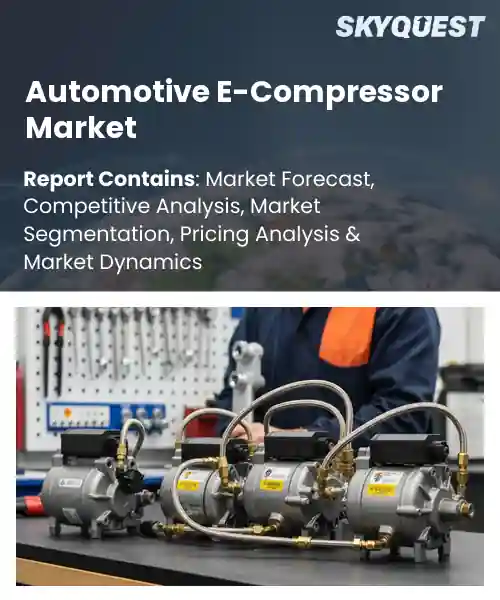
Automotive E-Compressor Market
Report ID: SQMIG25A2625
Report ID: SQMIG25A2625
[email protected]
USA +1 351-333-4748
Report ID:
SQMIG25A2625 |
Region:
Global |
Published Date: February, 2026
Pages:
189
|Tables:
116
|Figures:
69


Global Automotive E-Compressor Market size was valued at USD 6.3 Billion in 2024 and is poised to grow from USD 7.09 Billion in 2025 to USD 18.18 Billion by 2033, growing at a CAGR of 12.5% during the forecast period (2026-2033).
The increasing complexity of electric vehicles (EVs) and hybrid vehicles is driving higher global automotive e-compressor market growth due to the increased focus on thermal management system components. Optimizing performance while operation requires effective heat regulation of the battery, electric motor, cabin, and power electronics.
Thus, efficient heat management of an electric vehicle can achieve optimum driving range, enhanced performance, and increased battery life. That leads to more sophisticated thermal systems, like the e-compressor, being included in the car for temperature control in the various parts of the car.
How Does IoT Enable Predictive Maintenance in Automotive E-Compressors?
The Internet of Things (IoT) gives way to the improved development of data-centric and networked thermal management systems, especially in electric vehicles. Thus, it impacts the global automotive e-compressor market outlook. With the help of Internet-based sensors, these e-compressors monitor temperature, pressure, vibration, and power consumption to provide maximum efficiency for cooling performance and energy management. Predictive maintenance will assist fleet operators and OEM manufacturers in detecting strains or defects before an eventual failure occurs. Connected HVAC and battery thermal management platforms operate on the same principle, controlling e-compressor function based on driving states, weather conditions, and battery load and thereby allowing better range, reliability, and comfort for the passengers.
Market snapshot - 2026-2033
Global Market Size
USD 4.0 Billion
Largest Segment
Hybrid
Fastest Growth
Electric
Growth Rate
11.1% CAGR
To get more insights on this market click here to Request a Free Sample Report
Global Automotive E-Compressor Market is segmented by Type of E-Compressor, Cooling Technology, End-Use, Sales Channel and region. Based on Type of E-Compressor, the market is segmented into Scroll Compressors, Rotary Compressors and Piston Compressors. Based on Cooling Technology, the market is segmented into Air Cooling and Liquid Cooling. Based on End-Use, the market is segmented into Passenger Vehicles, Commercial Vehicles and Electric Vehicles. Based on Sales Channel, the market is segmented into OEMs and Aftermarket. Based on region, the market is segmented into North America, Europe, Asia Pacific, Latin America and Middle East & Africa.
As per the 2025 automotive e-compressor market analysis, as hybrid electric vehicles enjoyed widespread adoption in Asia, North America, and Europe, they also largely impacted the hybrid segment. These types of hybrids are equipped with electric compressors, thus keeping the cabin cool even when quiet gasoline engines run. E-compressors are fitted in all hybrid models of Toyota and Honda. Hence, efficiency and comfort are ensured while 100% on battery power.
However, the surge in global adoption of electric vehicles is predicted to boost the rapid growth of the electric segment. EVs, in fact, entirely rely on e-compressors for battery temperature control and cabin cooling. The market growth for more advanced, high-efficiency electric compressors increases steadily as companies such as Tesla, BYD, and Hyundai continue expanding their EV lineups.
As per the 2025 automotive e-compressor market forecast, the scroll segment dominated the market due to its unparalleled energy efficiency, compactness, low vibration, and silent operation. Because of these features, scroll compressors are ideal for the HVAC systems installed in electric and hybrid cars. They are found in a large number of electric passenger cars, contributing to improved driving range, reduced energy consumption, and increased comfort of the cabin climate.
Nonetheless, it is expected that the rotary category would dominate the automotive e-compressor market share, especially with respect to electric and hybrid vehicles, where cost is the most significant driving factor. The simpler design, the benefits of lower costs for production, and the ever-increasing efficiency levels thereof make them a very attractive solution for mass-market EVs and emerging markets. Car manufacturers are keen to arrive at a compromise between cost, performance, and manufacturing scalability.
To get detailed segments analysis, Request a Free Sample Report
As per the automotive e-compressor market regional forecast, Asia-Pacific dominated the market. This is most commonly due to the large production of electric and hybrid cars as well as strong government regulations in the electrification of transport and local manufacturing of components. The growth is mainly driven by China and Japan while then, however, the regional suppliers gain from strategic technology collaborations and manufacturing reducing costs. The more common battery electric vehicles become and the stricter emission regulations in Asia, it continues with increasing usage of electric compressors to regulate HVAC and battery thermal management.
China is indeed the largest national automotive e-compressor sector due to its strong dominance in e-vehicle manufacturing. Mass-market and premium EV cars are now entering e-compressor technology, courtesy of Original Equipment Manufacturers, such as BYD, SAIC, and Geely. Because of these new government subsidies for New Energy Vehicles (NEVs), high EV adoption rates in metropolitan areas, and domestic supply chains for compressors and power electronics, China's market leadership will be maintained and accelerated in volume growth.
The advanced hybrid and electric car technology pioneered by Toyota, Honda, and Nissan is what spurs the growth of the automotive e-compressor industry in Japan. Major players like Denso and Mitsubishi Electric contribute significantly to the continuous development of scroll and rotary e-compressors with very high efficiency. The continuous demand for hybrid vehicles together with a growing export market for electrified vehicles will guarantee Japan's position as a technological leader and an innovation center.
Strong CO2 pollution standards and aggressive electrification targets make Europe a considerable automotive e-compressor market. This is mainly due to the increasing importance of electric compressors, improving energy economy, and passenger comfort in EVs and hybrids. Demand would remain for both passenger and commercial vehicles due to the growing EV infrastructure and regulatory requirements as well as the ever-increasing adoption of battery heat management technologies.
Sales of electric vehicles are rising at the same time that favorable government policies are increasing to promote zero-emission transport. This is enhancing the UK automotive e-compressor market penetration. E-compressors are now being included by the Original Equipment Manufacturers (OEMs) and their suppliers to improve the effectiveness of HVACs built domestically. Increasing consumer demand for electric vehicles and investment in domestic EV manufacture, particularly temperature control and battery thermal management systems, are expected to sustain increased demand for electric compressors.
The automotive e-compressor market in France is increasing tremendously, owing principally to strong government subsidies aimed at advancing low-emission automobiles and greater acceptance of electric vehicle technology. Electric compressors are thereby used in cars produced by companies like Renault and Stellantis in the aim of optimizing vehicle efficiency and driving range. It is expected that the country's decarbonization targets along with the development of hybrid and electric vehicle fleets will contribute to a steady rise in demand for highly innovative e-compressor technologies.
Germany has a huge automotive e-compressor market backed by a very strong premium car industry, and a robust base in automotive engineering. To provide very high-performance e-compressors for accurate temperature control, companies like Mercedes-Benz, BMW, and Volkswagen utilize them. The projected rise in EV output during that period, along with tighter emission regulations and emphasis on passenger comfort and economy, is expected to further grow the market.
The North American automotive e-compressor market is currently growing mainly owing to the increased use of electric and hybrid vehicles and their enabling regulatory frameworks. To meet emission and efficiency standards, Original Equipment Manufacturers (OEMs) are emphasizing effective thermal systems. It is also expected that the use of electric compressors in passenger cars and light business fleets will expand with the increasing EV production capacity, battery investments, and government support.
The U.S. market has been booming for the adoption of electric vehicles because of extensive investment in manufacturing EVs and legislative incentives. They are using e-compressors for their HVAC and battery cooling needs in companies including Tesla, Ford, and General Motors. Demand for high-efficiency automotive e-compressors will most certainly increase, as EV sales rise, and the domestic supply chain becomes increasingly specialized.
The growth of electric vehicles, clean energy regulations favoring such growth, and integration into the North American automotive supply chain are all contributing to the automotive e-compressor market in Canada. They are often turning to electric compressors for their improved thermal efficiency performance in EVs, particularly in cold areas. The continuous investment in assembly plants for building batteries and reducing emissions will result in moderate but sure growth in the market.
To know more about the market opportunities by region and country, click here to
Buy The Complete Report
Swift EV Adoption and Electrification
Enhanced Thermal Management Requirements
High Costs and Complex Manufacturing
Supply Chain and Technology Challenges
Request Free Customization of this report to help us to meet your business objectives.
The key international competitors fight for dominance in the automobile e-compressor market through innovation, strategic partnerships, and increased manufacturing capacity to cater to the rising demand. Industry giants such as Denso Corporation, Hanon Systems, MAHLE GmbH, Valeo, and Sanden Company intervene with advanced design and mass production facilities to dominate the market. Competition is thus driving investments in small, intelligent, and power-efficient e-compressor technologies. These advancements are required in the context of fulfilling increasingly stringent performance, efficiency, and integration requirements of OEMs and responding to the overall trend of electrification.
SkyQuest’s ABIRAW (Advanced Business Intelligence, Research & Analysis Wing) is our Business Information Services team that Collects, Collates, Correlates, and Analyses the Data collected by means of Primary Exploratory Research backed by robust Secondary Desk research.
As per SkyQuest analysis, the global automotive e-compressor market is expected to witness substantial development. The development is driven by rapid penetration of hybrid and electric vehicles and the growing need for sophisticated thermal management systems. These products are for extending the driving range and enhancing automotive efficiency. Product development is being envisaged through the lens of technological advancements in heat pump integration, smart compressors, and Internet of Things cable connections. But it has massive challenges from the cost perspective and the omnipresent semiconductor availability problems. Major automotive players for innovations to meet the booming OEM demands, ramping production capacities, including Denso, Hanon Systems, MAHLE, Valeo, and Sanden. The growing surge of global electrification in vehicles will tend to lift the importance of automotive e-compressor markets much further in delivering the broader agenda of electrification, energy efficiency, and clean mobility in the automotive space.
| Report Metric | Details |
|---|---|
| Market size value in 2024 | USD 6.3 Billion |
| Market size value in 2033 | USD 18.18 Billion |
| Growth Rate | 12.5% |
| Base year | 2024 |
| Forecast period | 2026-2033 |
| Forecast Unit (Value) | USD Billion |
| Segments covered |
|
| Regions covered | North America (US, Canada), Europe (Germany, France, United Kingdom, Italy, Spain, Rest of Europe), Asia Pacific (China, India, Japan, Rest of Asia-Pacific), Latin America (Brazil, Rest of Latin America), Middle East & Africa (South Africa, GCC Countries, Rest of MEA) |
| Companies covered |
|
| Customization scope | Free report customization with purchase. Customization includes:-
|
To get a free trial access to our platform which is a one stop solution for all your data requirements for quicker decision making. This platform allows you to compare markets, competitors who are prominent in the market, and mega trends that are influencing the dynamics in the market. Also, get access to detailed SkyQuest exclusive matrix.
Table Of Content
Executive Summary
Market overview
Parent Market Analysis
Market overview
Market size
KEY MARKET INSIGHTS
COVID IMPACT
MARKET DYNAMICS & OUTLOOK
Market Size by Region
KEY COMPANY PROFILES
Methodology
For the Automotive E-Compressor Market, our research methodology involved a mixture of primary and secondary data sources. Key steps involved in the research process are listed below:
1. Information Procurement: This stage involved the procurement of Market data or related information via primary and secondary sources. The various secondary sources used included various company websites, annual reports, trade databases, and paid databases such as Hoover's, Bloomberg Business, Factiva, and Avention. Our team did 45 primary interactions Globally which included several stakeholders such as manufacturers, customers, key opinion leaders, etc. Overall, information procurement was one of the most extensive stages in our research process.
2. Information Analysis: This step involved triangulation of data through bottom-up and top-down approaches to estimate and validate the total size and future estimate of the Automotive E-Compressor Market.
3. Report Formulation: The final step entailed the placement of data points in appropriate Market spaces in an attempt to deduce viable conclusions.
4. Validation & Publishing: Validation is the most important step in the process. Validation & re-validation via an intricately designed process helped us finalize data points to be used for final calculations. The final Market estimates and forecasts were then aligned and sent to our panel of industry experts for validation of data. Once the validation was done the report was sent to our Quality Assurance team to ensure adherence to style guides, consistency & design.
Analyst Support
Customization Options
With the given market data, our dedicated team of analysts can offer you the following customization options are available for the Automotive E-Compressor Market:
Product Analysis: Product matrix, which offers a detailed comparison of the product portfolio of companies.
Regional Analysis: Further analysis of the Automotive E-Compressor Market for additional countries.
Competitive Analysis: Detailed analysis and profiling of additional Market players & comparative analysis of competitive products.
Go to Market Strategy: Find the high-growth channels to invest your marketing efforts and increase your customer base.
Innovation Mapping: Identify racial solutions and innovation, connected to deep ecosystems of innovators, start-ups, academics, and strategic partners.
Category Intelligence: Customized intelligence that is relevant to their supply Markets will enable them to make smarter sourcing decisions and improve their category management.
Public Company Transcript Analysis: To improve the investment performance by generating new alpha and making better-informed decisions.
Social Media Listening: To analyze the conversations and trends happening not just around your brand, but around your industry as a whole, and use those insights to make better Marketing decisions.
REQUEST FOR SAMPLE
 REQUEST FREE CUSTOMIZATION
Global Automotive E-compressor Market size was valued at USD 4.0 Billion in 2025 and is poised to grow from USD 4.44 Billion in 2026 to USD 9.28 Billion by 2033, growing at a CAGR of 11.1% during the forecast period (2026-2033).
The key international competitors fight for dominance in the automobile e-compressor market through innovation, strategic partnerships, and increased manufacturing capacity to cater to the rising demand. Industry giants such as Denso Corporation, Hanon Systems, MAHLE GmbH, Valeo, and Sanden Company intervene with advanced design and mass production facilities to dominate the market. Competition is thus driving investments in small, intelligent, and power-efficient e-compressor technologies. These advancements are required in the context of fulfilling increasingly stringent performance, efficiency, and integration requirements of OEMs and responding to the overall trend of electrification. 'Denso Corporation', 'Hanon Systems', 'MAHLE GmbH', 'Valeo SA', 'Sanden Corporation', 'Toyota Industries Corporation', 'BorgWarner Inc.', 'Mitsubishi Heavy Industries', 'Panasonic Corporation', 'LG Electronics', 'Garrett Motion', 'Cummins (e-compressor for fuel cells)'
Electric and hybrid vehicle transition constitutes the prime driver for the e-compressor market. With the internal combustion engine being absent, traditional belt-driven compressors do not see any use; therefore, climate and temperature systems for electric and plug-in hybrid electric vehicles must be electrically driven. As such, the demand for efficient e-compressors, which are key to climate control and battery heat management, is increasing rapidly for various vehicle categories as sales for EVs surge.
Heat Pump Systems-Integration: In the realm of automotive e-compressor markets, melding the e-compressors into state-of-art heat pump systems in electric cars is a sweeping transformation. It facilitates combining heating and cooling functions into a single unit, therethrough enhancing energy utilization in terms of vehicle range, especially in cold climatic zones. The extensive deployment is expected to take place, encouraging the automakers to embrace the heat pump system for temperature control, comfort of passengers, and energy saving.
How Is EV Manufacturing Driving E-Compressor Demand in Asia-Pacific?


Want to customize this report? This report can be personalized according to your needs. Our analysts and industry experts will work directly with you to understand your requirements and provide you with customized data in a short amount of time. We offer $1000 worth of FREE customization at the time of purchase.
Feedback From Our Clients


 USA (+1) 351-333-4748

