Automotive E-axle Market
Report ID: SQMIG25A2708
Report ID: SQMIG25A2708
[email protected]
USA +1 351-333-4748
Report ID:
SQMIG25A2708 |
Region:
Global |
Published Date: June, 2026
Pages:
157
|Tables:
141
|Figures:
73


Global Automotive E-Axle Market size was valued at USD 8.52 Billion in 2024 and is poised to grow from USD 10.18 Billion in 2025 to USD 42.85 Billion by 2033, growing at a CAGR of 19.52% during the forecast period (2026-2033).
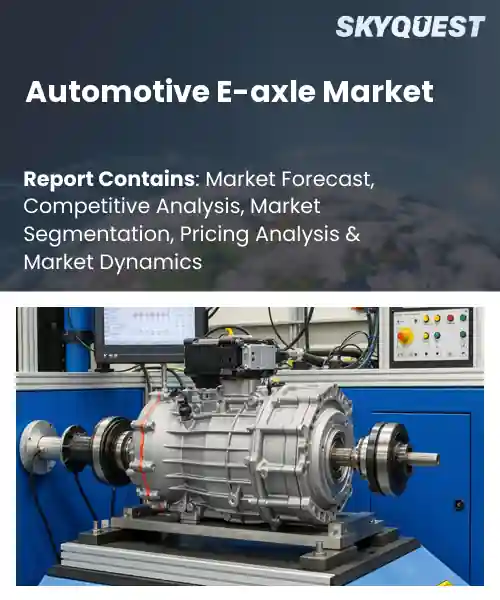
The automotive e axle market centers on integrated electric drive units that combine an electric motor, power electronics, and transmission into a single assembly for electric vehicles and hybrid platforms. Its primary driver is the accelerating shift to electrification mandated by emissions regulation and consumer demand for cleaner mobility, which has compelled automakers to adopt compact modular drives. Over the past decade suppliers such as GKN and BorgWarner evolved from component vendors into system integrators while Tesla and Volkswagen deployed dedicated electric architectures using e axle modules, demonstrating cost and efficiency gains that validate scale economies and justify further investment.
Building on that momentum a key growth factor is the rapid decline in battery cost and concurrent advances in power electronics, which increase EV affordability, driving demand for integrated e axle systems. As batteries become cheaper manufacturers pursue lighter and more efficient packaging, causing e axle adoption to rise in passenger cars and light commercial vehicles where improved packaging yields longer range and higher payload. This creates opportunities for suppliers to offer modular scalable platforms and software tuned for torque vectoring, enabling use cases from urban delivery fleets that reduce operating cost to performance models that demonstrate measurable efficiency gains.
How is AI improving performance and reliability in the automotive e-axle market?
AI is improving performance and reliability in the automotive e axle market by enhancing control strategies, testing and lifecycle management. Key aspects are adaptive torque and thermal management, simulation based calibration, and predictive maintenance driven by high fidelity sensor data. Suppliers today embed on board AI to smooth torque delivery, reduce energy losses and detect early faults before they cause failure. The market is shifting from hardware focused design to software led optimization which shortens development cycles and makes modular e axle platforms easier to scale. Real world examples show AI aided calibration and fleet analytics moving from pilots into series use.
ZF January 2026, ZF showcased an AI powered cubiX Tuner at CES that automates calibration and uses data driven models to improve e axle performance and reliability. This supports market growth by reducing engineering time, enabling faster ramp to volume production and improving in field uptime through smarter diagnostics and continuous optimization.
Market snapshot - (2026-2033)
Global Market Size
USD 8.52 Billion
Largest Segment
Electric Motor
Fastest Growth
Power Electronics (Inverter)
Growth Rate
19.52% CAGR
To get more insights on this market click here to Request a Free Sample Report
Global automotive e-axle market is segmented by component, integration, vehicle type, drive, sales and region. Based on component, the market is segmented into Electric Motor, Power Electronics (Inverter) and Gearbox. Based on integration, the market is segmented into 2-in-1 (Motor + Inverter) and 3-in-1 (Motor + Inverter + Gearbox). Based on vehicle type, the market is segmented into Battery Electric Vehicles (BEV) and Plug-in Hybrid Electric Vehicles (PHEV). Based on drive, the market is segmented into Front-Wheel Drive, Rear-Wheel Drive and All-Wheel Drive. Based on sales, the market is segmented into OEM and Aftermarket. Based on region, the market is segmented into North America, Europe, Asia Pacific, Latin America and Middle East & Africa.
Electric Motor segment dominates because it provides the core traction capability that defines vehicle acceleration, efficiency and packaging decisions within e-axle architectures. Proven motor topologies offer high power density and established manufacturability, which reduce technical risk for OEMs and support integration with gear trains and control electronics. This maturity drives supplier focus and design standardization that simplify platform-level adoption across electrified vehicle programs.
However, Power Electronics (Inverter) is emerging as the fastest growing area because advances in semiconductor materials and inverter architectures markedly improve conversion efficiency while reducing size and weight. Rapid development of control software and higher thermal resilience expands applicability across vehicle platforms, enabling range and performance gains and opening opportunities for new suppliers and retrofitting solutions.
3-in-1 (Motor + Inverter + Gearbox) segment dominates because it consolidates key drivetrain functions into a compact module that reduces mass, minimizes interconnections and streamlines thermal management. This integrated approach simplifies assembly, lowers total system cost and enables tighter system-level optimization, which appeals to OEMs seeking packaging efficiency and faster time to market, prompting increased investments in integrated module engineering and manufacturing capabilities.
Conversely, 2-in-1 (Motor + Inverter) is gaining the strongest growth momentum as manufacturers seek integration benefits with lower complexity and faster development cycles. Its balance of compactness and modularity makes it easier to validate across multiple power ratings and vehicle platforms, accelerating mainstream EV and hybrid rollouts while broadening supplier participation and aftermarket support.
To get detailed segments analysis, Request a Free Sample Report
Asia Pacific command of the global automotive e-axle market stems from intertwined strengths across manufacturing scale, integrated supply chains and concentrated demand for electrified mobility. Established automotive clusters support rapid component localization and iterative engineering, while OEMs and tier suppliers align product roadmaps with regional accessory and drivetrain needs. Policy and infrastructure emphasis on vehicle electrification reinforces platform investments and pilot programs. Collaborative ecosystems among component manufacturers, research institutions and assembly operations accelerate design maturation and cost optimization. The region benefits from deep expertise in power electronics and motor production, enabling diverse application of e-axle architectures across passenger and commercial vehicle segments and fostering a competitive manufacturing cost base that sustains long term leadership. Close collaboration between system integrators and component innovators promotes modular designs and scalable assembly approaches that lower barriers to adoption.
Automotive E-axle Market in Japan is shaped by advanced engineering traditions and collaboration between OEMs and suppliers. A strong focus on refinement of electric powertrain integration and motor control delivers high reliability and efficiency in application. Suppliers emphasize precise manufacturing tolerances and quality management, while research institutions contribute to incremental innovation in materials and thermal management. The market prioritizes modular solutions that support diverse vehicle architectures and high build standards.
Automotive E-axle Market in South Korea reflects strong synergy between electrification and advanced electronics manufacturing. Suppliers focus on compact motor design and integrated power electronics to meet packaging and thermal constraints. Cooperation with software developers improves control strategies and system calibration for varied driving conditions. Automotive manufacturers favor vertically integrated supply chains that enable pilot deployments and localized refinement, supporting resilience and competitive positioning across regional and export oriented programs.
Rapid expansion of the automotive e-axle market in Europe is driven by coordinated regulatory emphasis on emissions reduction, broad OEM commitments to electrified portfolios and a strong engineering talent base that prioritizes vehicle level integration. Dense supplier networks facilitate cross border collaboration on modular architectures and component standardization, while testing and validation capabilities support complex system validation for diverse vehicle classes. Investments in electrified platform programs and partnerships between OEMs and specialized manufacturers accelerate scale up of production readiness. Market momentum is further underpinned by demand for high performance and differentiated driving experiences, prompting suppliers to innovate in torque delivery, thermal solutions and weight optimization to meet premium and mainstream segment requirements. Strategic public and private investments in pilot production lines and supplier reshoring reinforce industrial capacity and shorten development cycles across the value chain.
Automotive E-axle Market Germany features deep OEM and supplier integration around powertrain development and system validation. Established automotive clusters provide testing infrastructure and specialist engineering services that enable iteration of e-axle concepts. Suppliers emphasize industrial capability for component machining and motor winding processes, while aftermarket networks support deployment and maintenance. The market favors scalable production methods and close alignment with vehicle platform strategies to meet premium and volume oriented requirements.
Automotive E-axle Market in United Kingdom combines strong software and controls expertise with agile manufacturing practices, supporting rapid prototyping and system optimization. A vibrant cluster of suppliers advances integration of control algorithms and functional safety frameworks. Collaboration with research centers accelerates materials and thermal innovations, while flexible assembly models enable targeted pilot runs. Market dynamics favor differentiated drivetrain solutions that enhance driving feel and energy efficiency for diverse vehicle segments.
Automotive E-axle Market in France is emerging through focused collaborations between OEM design centers and specialized suppliers that emphasize lightweighting and thermal efficiency. Research institutions contribute to advanced materials and power electronics development, enhancing system level integration. Pilot manufacturing initiatives and supplier networks support adaptation of designs for varied vehicle formats. Market players pursue differentiated packaging solutions and noise vibration refinement to align with domestic preferences and broader export potential.
North America is strengthening its position in the automotive e-axle market through strategic alignment between OEM electrification programs, supplier investment in local production capability and a concentrated focus on system integration for varied vehicle architectures. Strong capabilities in software for vehicle controls and power management complement manufacturing investments in motors and power electronics. Collaborative initiatives among industry, research centers and government programs support supply chain resilience and skills development. Emphasis on modular architectures and flexible manufacturing allows rapid adaptation to platform changes, while growing supplier networks enable localized sourcing and improved serviceability for regional vehicle fleets and export oriented platforms. Testing and validation facilities for durability and safety are expanding, enabling accelerated qualification of e-axle variants for both passenger and commercial applications. OEM and supplier partnerships are increasingly focused on aftersales readiness and networked diagnostics to support lifecycle management.
Automotive E-axle Market in United States is supported by large OEM electrification programs and expertise in vehicle controls and semiconductor integration. Suppliers prioritize scalable manufacturing of motors and power electronics and advanced software development for torque control and thermal management. Robust testing facilities and collaboration between tier suppliers and OEM engineering teams enable accelerated validation. Market focus includes aftersales diagnostics and fleet solutions that support commercial electrification and service networks.
Automotive E-axle Market in Canada is characterized by close cooperation between automotive engineering centers and research institutions, fostering innovation in power electronics and thermal systems. Suppliers leverage flexible manufacturing models to serve domestic assembly and cross border supply chains. Emphasis on reliability and cold weather performance shapes design priorities, while partnerships between OEMs and local suppliers support pilot production and testing. The market values adaptability for commercial and passenger applications.
To know more about the market opportunities by region and country, click here to
Buy The Complete Report
Rising Electric Vehicle Adoption
Favorable Government Policies
High Component Costs And Complexity
Supply Chain And Material Constraints
Request Free Customization of this report to help us to meet your business objectives.
Competitive landscape in the global automotive e-axle market is defined by tier suppliers and new entrants pursuing vertical integration, JV formation, and targeted partnerships to secure OEM programs; examples include Marelli's 2021 e-axle JV with Punch winning OEM contracts, Allison partnering with Xos on heavy duty e-axles, and motor makers integrating inverter and gearbox into single e-axle modules to shorten development cycles.
SkyQuest’s ABIRAW (Advanced Business Intelligence, Research & Analysis Wing) is our Business Information Services team that Collects, Collates, Correlates, and Analyses the Data collected by means of Primary Exploratory Research backed by robust Secondary Desk research.
As per SkyQuest analysis, the global automotive e-axle market is poised for rapid expansion as automakers adopt integrated drivetrain solutions. One key driver is rising electric vehicle adoption, and a second driver is declining battery costs combined with advances in power electronics that improve affordability and performance. One restraint is high component costs and engineering complexity that slow standardization and wider uptake. The dominating region is Asia Pacific, benefiting from scale manufacturing, supply chain depth and strong demand, while the dominating segment is 3-in-1 (Motor + Inverter + Gearbox) modules that offer compact packaging, cost and assembly advantages appealing to OEMs.
| Report Metric | Details |
|---|---|
| Market size value in 2024 | USD 8.52 Billion |
| Market size value in 2033 | USD 42.85 Billion |
| Growth Rate | 19.52% |
| Base year | 2024 |
| Forecast period | (2026-2033) |
| Forecast Unit (Value) | USD Billion |
| Segments covered |
|
| Regions covered | North America (US, Canada), Europe (Germany, France, United Kingdom, Italy, Spain, Rest of Europe), Asia Pacific (China, India, Japan, Rest of Asia-Pacific), Latin America (Brazil, Rest of Latin America), Middle East & Africa (South Africa, GCC Countries, Rest of MEA) |
| Companies covered |
|
| Customization scope | Free report customization with purchase. Customization includes:-
|
To get a free trial access to our platform which is a one stop solution for all your data requirements for quicker decision making. This platform allows you to compare markets, competitors who are prominent in the market, and mega trends that are influencing the dynamics in the market. Also, get access to detailed SkyQuest exclusive matrix.
Table Of Content
Executive Summary
Market overview
Parent Market Analysis
Market overview
Market size
KEY MARKET INSIGHTS
COVID IMPACT
MARKET DYNAMICS & OUTLOOK
Market Size by Region
KEY COMPANY PROFILES
Methodology
For the Automotive E-axle Market, our research methodology involved a mixture of primary and secondary data sources. Key steps involved in the research process are listed below:
1. Information Procurement: This stage involved the procurement of Market data or related information via primary and secondary sources. The various secondary sources used included various company websites, annual reports, trade databases, and paid databases such as Hoover's, Bloomberg Business, Factiva, and Avention. Our team did 45 primary interactions Globally which included several stakeholders such as manufacturers, customers, key opinion leaders, etc. Overall, information procurement was one of the most extensive stages in our research process.
2. Information Analysis: This step involved triangulation of data through bottom-up and top-down approaches to estimate and validate the total size and future estimate of the Automotive E-axle Market.
3. Report Formulation: The final step entailed the placement of data points in appropriate Market spaces in an attempt to deduce viable conclusions.
4. Validation & Publishing: Validation is the most important step in the process. Validation & re-validation via an intricately designed process helped us finalize data points to be used for final calculations. The final Market estimates and forecasts were then aligned and sent to our panel of industry experts for validation of data. Once the validation was done the report was sent to our Quality Assurance team to ensure adherence to style guides, consistency & design.
Analyst Support
Customization Options
With the given market data, our dedicated team of analysts can offer you the following customization options are available for the Automotive E-axle Market:
Product Analysis: Product matrix, which offers a detailed comparison of the product portfolio of companies.
Regional Analysis: Further analysis of the Automotive E-axle Market for additional countries.
Competitive Analysis: Detailed analysis and profiling of additional Market players & comparative analysis of competitive products.
Go to Market Strategy: Find the high-growth channels to invest your marketing efforts and increase your customer base.
Innovation Mapping: Identify racial solutions and innovation, connected to deep ecosystems of innovators, start-ups, academics, and strategic partners.
Category Intelligence: Customized intelligence that is relevant to their supply Markets will enable them to make smarter sourcing decisions and improve their category management.
Public Company Transcript Analysis: To improve the investment performance by generating new alpha and making better-informed decisions.
Social Media Listening: To analyze the conversations and trends happening not just around your brand, but around your industry as a whole, and use those insights to make better Marketing decisions.
REQUEST FOR SAMPLE
 REQUEST FREE CUSTOMIZATION
Global Automotive E-Axle Market size was valued at USD 8.52 Billion in 2024 and is poised to grow from USD 10.18 Billion in 2025 to USD 42.85 Billion by 2033, growing at a CAGR of 19.52% during the forecast period (2026-2033).
Competitive landscape in the global automotive e-axle market is defined by tier suppliers and new entrants pursuing vertical integration, JV formation, and targeted partnerships to secure OEM programs; examples include Marelli's 2021 e-axle JV with Punch winning OEM contracts, Allison partnering with Xos on heavy duty e-axles, and motor makers integrating inverter and gearbox into single e-axle modules to shorten development cycles. 'BorgWarner Inc.', 'Dana Incorporated', 'GKN Automotive (Melrose)', 'ZF Friedrichshafen', 'Robert Bosch GmbH', 'Continental AG', 'Schaeffler AG', 'Magna International', 'Nidec Corporation', 'Valeo SA', 'Marelli Holdings', 'Vitesco Technologies', 'Allison Transmission', 'Nexteer Automotive', 'AVL List GmbH'
Accelerated consumer preference for electric mobility expands demand for integrated drivetrain solutions, and the shift toward electrified vehicles increases OEM interest in compact, efficient e-axles that simplify vehicle architecture. Manufacturers prioritize systems that combine motor, inverter, and gearbox to save packaging space and improve assembly processes, which makes e-axles attractive as a standardized solution. This alignment between vehicle electrification goals and supplier capabilities encourages investment in development and production capacity, thereby supporting broader market expansion through stronger adoption by automakers.
Integration With Vehicle Software: Automakers and suppliers are converging e-axle hardware with vehicle software stacks to enable seamless powertrain control, predictive diagnostics and remote performance updates. This integration emphasizes software-defined vehicle strategies, fostering closer collaboration between electrical engineering and software teams. It accelerates feature customization, continuous improvement and differentiated customer experiences, while shifting value capture toward firms that can deliver robust integration, security and lifecycle support. Strategic partnerships and platform-based approaches are becoming central to scaling sophisticated software and hardware ecosystems across vehicle portfolios.
Why does Asia Pacific Dominate the Global Automotive E-axle Market? |@12


Want to customize this report? This report can be personalized according to your needs. Our analysts and industry experts will work directly with you to understand your requirements and provide you with customized data in a short amount of time. We offer $1000 worth of FREE customization at the time of purchase.
Feedback From Our Clients


 USA (+1) 351-333-4748

