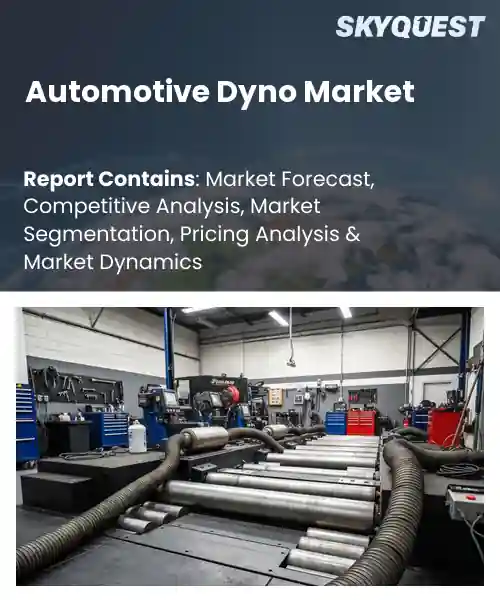
Automotive Dyno Market
Report ID: SQMIG45J2567
Report ID: SQMIG45J2567
[email protected]
USA +1 351-333-4748
Report ID:
SQMIG45J2567 |
Region:
Global |
Published Date: June, 2026
Pages:
157
|Tables:
115
|Figures:
77


Global Automotive Dyno Market size was valued at USD 865.1 Million in 2024 and is poised to grow from USD 904.2 Million in 2025 to USD 1287.84 Million by 2033, growing at a CAGR of 4.52% during the forecast period (2026-2033).
Some testing equipment used in the automotive industry is called dynamometers or dynos . These dynos measure engine power , vehicle performance and emissions in a controlled environment . The main force behind this market has been the tightening of global emissions regulations, which challenge manufacturers and tuning shops to certify powertrains against ever stricter standards. From the heavy hydraulic rigs of the 1970s, the market has historically moved toward compact electric dynos that capture torque and speed data. North American performance shops are using S&S Power electronic dyno platforms as an example of how precision testing has become a must for compliance and brand reputation.
The shift to electric vehicles is altering the automotive dyno market as conventional dynos cannot replicate the braking or instantaneous torque curves of electric powertrains. Now, manufacturers want to see proof of battery efficiency and motor performance. Suppliers have responded with hybrid dyno systems that combine load banks and torque simulators to test everything from acceleration to energy recuperation. The change has opened up opportunities for companies like Dyno Dynamics, who recently launched a platform that integrates analytics and cloud reporting for EV service centres. This opens market reach into tuning shops and attracts OEMs, research labs and fleet operators seeking solutions to compliance and performance optimisation.
How is AI enhancing predictive analytics in the automotive dyno market?
AI is transforming the predictive analytics of the automotive dyno world and making test data into actionable insights. Durability and power output is predicted by historical performance curves, engine load patterns, environmental factors and machine learning models. This shortens the development cycles and reduces the physical runs. Real-time anomaly detection provides an early warning for engineers to identify deviations before they turn into expensive failures. A digital twin platform can be used to validate new powertrain designs against regulatory expectations in a virtual environment. Such capabilities are helping to deliver efficiencies and sustain higher performance in this expanding market.
Recently, we launched AI-powered analytics platforms that have boosted the efficiency of our dyno scheduling and reduced the idle time at our testing sites. This enables manufacturers to fuel market growth and operational agility with shorter turn-around times and lower energy consumption, automatically aligning engine configurations to the optimal test protocol.
Market snapshot - (2026-2033)
Global Market Size
USD 865.1 Million
Largest Segment
Engine Dynamometers
Fastest Growth
Chassis Dynamometers
Growth Rate
4.52% CAGR
To get more insights on this market click here to Request a Free Sample Report
Global automotive dyno market is segmented by dynamometer type, testing mode, vehicle configuration, end use sector and region. Based on dynamometer type, the market is segmented into Engine Dynamometers, Chassis Dynamometers and Transmission Dynamometers. Based on testing mode, the market is segmented into In-House Testing and Outsourced Testing. Based on vehicle configuration, the market is segmented into Passenger Vehicles and Commercial Vehicles. Based on end use sector, the market is segmented into Automotive OEMs, Aftermarket Service Providers and Motorsport Teams. Based on region, the market is segmented into North America, Europe, Asia Pacific, Latin America and Middle East & Africa.
The engine dynamometers segment holds the highest share, as it measures the power output directly at the source and provides accurate data for tuning combustion efficiency and emissions controls. That precision is what manufacturers rely on to meet ever tighter regulatory standards and to benchmark performance across model lines. Isolation of engine behaviour from drivetrain effects simplifies validation, reduces development time and builds confidence in simulation models, supporting its central market role.
However, the fastest growing segment is chassis dynamometers due to increasing demand for vehicle level performance testing on electric and hybrid platforms. The ability to simulate road load and include drivetrain interactions supports the industry movement toward full-vehicle validation, driving investment in flexible test cells and expanding the market.
This is why the in-house testing part is leading the charge: car makers can add dyno testing straight into their development pipelines, allowing confidential testing and faster iteration cycles. The test environment can be controlled by the companies so that data collection can be aligned with design milestones so that they are not dependent on outside schedules and can have rapid feedback cycles. This independence helps protect intellectual property and allows for custom calibrations that directly support brand-specific performance targets, further solidifying its position of market leadership.
The outsourced testing segment meanwhile is experiencing the fastest growth momentum as manufacturers are looking for specialized expertise and cost-effective scalability for emerging powertrain technologies. The most advanced dyno facilities combined with experienced analysts are driving faster validation of electric, hybrid and fuel-cell systems, unlocking new service models and growing the overall market footprint.
To get detailed segments analysis, Request a Free Sample Report
North America has a large base of engineering talent, a very integrated supply chain and a strong culture of performance testing and as such is the leader in the automotive dyno market. The region has a robust network of original equipment manufacturers and an expanding aftermarket industry specializing in precision measurement and validation. Leading universities and specialized testing laboratories form powerful research and development ecosystems that constantly develop new technologies for dynamometers. Furthermore, proactive regulatory regimes foster stringent emissions and efficiency testing, which in turn, drives demand for sophisticated dyno solutions. The synergy of these factors creates a robust market landscape for legacy internal combustion platforms and new electrified powertrains, underpinning North America’s leadership position.
For example, the Automotive Dyno Market in the United States is driven by the presence of a high density of OEM testing centers as well as independent laboratories that serve a wide variety of vehicle types. The market is also driven by continuous investments in high-performance dyno systems, allowing accurate power and emissions verification for traditional and electric powertrains. The US is a hotbed for innovation and application in the dyno space with collaborative ventures between manufacturers, research institutions and technology providers driving rapid adoption of advanced diagnostics and data analytics experience.
The regulatory environment in Canada is favorable for the operations of the Automotive Dyno Market and the country’s emphasis on sustainability testing is high. Canadian companies run state-of-the-art dyno facilities to certify emissions compliance and support the development of cold-climate powertrain solutions. Canada’s proximity to major North American manufacturers will enable knowledge transfer and the integration of next-generation testing protocols, creating a strategic node in the broader regional dyno ecosystem.
Europe’s automotive dyno market is accelerating, driven by greater regulatory pressure, a strategic shift toward electrified mobility and a history of engineering excellence. To ensure that stringent emission requirements are met across a range of powertrain options, manufacturers need advanced dyno testing. Strong government incentives are also driving investment in advanced testing infrastructure to support the roll-out of hybrid and full electric vehicles. The high density of automotive clusters, particularly in Germany, the UK and France, is helping to encourage collaboration between OEMs, research institutes and specialist service providers, accelerating technology transfer and market adoption. It is this mix of policy, innovation and networks of collaboration that fuels Europe’s fast-growing market.
Germany’s Automotive Dyno Market is a testament to the country’s engineering prowess with manufacturers integrating advanced dyno solutions to develop high-performance, low-emission powertrains. German test benches are famous for their precision measurements be it for optimisation of the internal combustion or validation of the electric drivetrain. The leading position of Germany in performance testing and regulatory conformity is based on the close links between car manufacturers, specialist suppliers and research institutions and the continuous development of dyno methods.
The UK automotive dyno market growth is driven by a fast-moving ecosystem that embraces digitalization and sustainable mobility. The sector has a rich motorsport heritage that gives it sophisticated dyno testing capabilities, which are being used more and more in mainstream vehicle development. Collaborative programs between universities, technology firms and automotive manufacturers are fast-tracking use of advanced data analytics and testing in real-time, making the UK a fast-growing market for dyno services.
The French market for Dyno is evolving with the aim of lowering emissions and developing electric vehicles. France is increasing the capacity of testing facilities to accommodate hybrid and battery-electric powertrains, in line with national priorities for cleaner mobility. Leading car makers, start-ups and research bodies are working together to boost innovation in dyno technology and France’s burgeoning role in the European automotive testing sector.
With a strong adoption of electrification, higher vehicle production, and strategic investments in testing infrastructure, Asia Pacific is cementing its grip on the automotive dyno market. Manufacturers in the region are deploying Dyno solutions to ensure performance reliability and compliance to evolving emissions standards in different market segments. State-of-the-art test facilities are being developed with the assistance of government programs, and close collaboration between automakers, parts suppliers and technology developers is driving the growth of advanced dyno techniques. Asia Pacific can develop its capabilities in both conventional and electric powertrain validation within this collaborative context to further build the company’s growing presence in the global arena.
Japan’s automotive dynamometer market with its extensive tradition of precise engineering and progressive approach to electric and hybrid technologies. Japanese testing labs have high-precision measuring systems and strict quality standards to verify performance and durability on a wide variety of vehicle platforms. The real-time data analysis and collaboration with top technology firms improve the efficiency of the dyno testing and raise Japan’s profile in all-round powertrain development.
Rapid developments in the production of electric vehicles and a high focus on high‑efficiency powertrain testing are driving South Korea’s Automotive Dyno Market. Korean manufacturers utilize state of the art dyno equipment to shorten development cycles and conform to stringent domestic and export standards. This environment is a hub of global auto manufacturers, specialized dyno suppliers and research bodies, fueling continuous evolution in testing techniques and highlighting South Korea’s growing importance in the regional dyno scene.
To know more about the market opportunities by region and country, click here to
Buy The Complete Report
Increasing Adoption of Electric Vehicles
Integration of Advanced Data Analytics
High Initial Capital Expenditure
Stringent Regulatory Compliance Requirements
Request Free Customization of this report to help us to meet your business objectives.
The global automotive dynamometer market is witnessing increased competition among the players as manufacturers are trying to differentiate themselves in terms of innovative digital-twin integration and flexible test-bench solutions owing to rising demand for accurate validation of vehicle performance. Companies are also making strategic acquisitions and alliances to diversify technology portfolios and speed up entry into emerging high-performance testing segments.
SkyQuest’s ABIRAW (Advanced Business Intelligence, Research & Analysis Wing) is our Business Information Services team that Collects, Collates, Correlates, and Analyses the Data collected by means of Primary Exploratory Research backed by robust Secondary Desk research.
As per SkyQuest analysis, the global automotive dyno market is being propelled primarily by the rapid adoption of electric vehicles, which is prompting manufacturers to invest in dyno systems capable of testing battery‑driven powertrains, while a second important catalyst is the growing integration of advanced data analytics and AI that turn raw test data into predictive insights, shortening development cycles. The market faces a notable restraint in the high initial capital outlay required for high‑precision equipment, which can slow adoption among smaller players. North America remains the dominant region, benefiting from a mature supply chain and strong R&D ecosystems, and the engine‑dynamometer segment continues to lead in revenue share due to its critical role in engine‑level performance and emissions validation.
| Report Metric | Details |
|---|---|
| Market size value in 2024 | USD 865.1 Million |
| Market size value in 2033 | USD 1287.84 Million |
| Growth Rate | 4.52% |
| Base year | 2024 |
| Forecast period | (2026-2033) |
| Forecast Unit (Value) | USD Million |
| Segments covered |
|
| Regions covered | North America (US, Canada), Europe (Germany, France, United Kingdom, Italy, Spain, Rest of Europe), Asia Pacific (China, India, Japan, Rest of Asia-Pacific), Latin America (Brazil, Rest of Latin America), Middle East & Africa (South Africa, GCC Countries, Rest of MEA) |
| Companies covered |
|
| Customization scope | Free report customization with purchase. Customization includes:-
|
To get a free trial access to our platform which is a one stop solution for all your data requirements for quicker decision making. This platform allows you to compare markets, competitors who are prominent in the market, and mega trends that are influencing the dynamics in the market. Also, get access to detailed SkyQuest exclusive matrix.
Table Of Content
Executive Summary
Market overview
Parent Market Analysis
Market overview
Market size
KEY MARKET INSIGHTS
COVID IMPACT
MARKET DYNAMICS & OUTLOOK
Market Size by Region
KEY COMPANY PROFILES
Methodology
For the Automotive Dyno Market, our research methodology involved a mixture of primary and secondary data sources. Key steps involved in the research process are listed below:
1. Information Procurement: This stage involved the procurement of Market data or related information via primary and secondary sources. The various secondary sources used included various company websites, annual reports, trade databases, and paid databases such as Hoover's, Bloomberg Business, Factiva, and Avention. Our team did 45 primary interactions Globally which included several stakeholders such as manufacturers, customers, key opinion leaders, etc. Overall, information procurement was one of the most extensive stages in our research process.
2. Information Analysis: This step involved triangulation of data through bottom-up and top-down approaches to estimate and validate the total size and future estimate of the Automotive Dyno Market.
3. Report Formulation: The final step entailed the placement of data points in appropriate Market spaces in an attempt to deduce viable conclusions.
4. Validation & Publishing: Validation is the most important step in the process. Validation & re-validation via an intricately designed process helped us finalize data points to be used for final calculations. The final Market estimates and forecasts were then aligned and sent to our panel of industry experts for validation of data. Once the validation was done the report was sent to our Quality Assurance team to ensure adherence to style guides, consistency & design.
Analyst Support
Customization Options
With the given market data, our dedicated team of analysts can offer you the following customization options are available for the Automotive Dyno Market:
Product Analysis: Product matrix, which offers a detailed comparison of the product portfolio of companies.
Regional Analysis: Further analysis of the Automotive Dyno Market for additional countries.
Competitive Analysis: Detailed analysis and profiling of additional Market players & comparative analysis of competitive products.
Go to Market Strategy: Find the high-growth channels to invest your marketing efforts and increase your customer base.
Innovation Mapping: Identify racial solutions and innovation, connected to deep ecosystems of innovators, start-ups, academics, and strategic partners.
Category Intelligence: Customized intelligence that is relevant to their supply Markets will enable them to make smarter sourcing decisions and improve their category management.
Public Company Transcript Analysis: To improve the investment performance by generating new alpha and making better-informed decisions.
Social Media Listening: To analyze the conversations and trends happening not just around your brand, but around your industry as a whole, and use those insights to make better Marketing decisions.
REQUEST FOR SAMPLE
 REQUEST FREE CUSTOMIZATION
Global Automotive Dyno Market size was valued at USD 865.1 Million in 2024 and is poised to grow from USD 904.2 Million in 2025 to USD 1287.84 Million by 2033, growing at a CAGR of 4.52% during the forecast period (2026-2033).
Intense competition in the global automotive dyno market is prompting firms to differentiate through advanced digital‑twin integration and the development of flexible test‑bench solutions, addressing rising demand for precise vehicle performance validation. Companies are also pursuing strategic acquisitions and partnerships to broaden technology portfolios and accelerate entry into emerging high‑performance testing segments. 'AVL List GmbH', 'HORIBA Ltd.', 'Mustang Dynamometer', 'Froude Inc.', 'Meidensha Corporation', 'Dynomerk Controls', 'SuperFlow Dynamometers & Flowbenches', 'Maha Maschinenbau Haldenwang GmbH & Co. KG', 'SAJ Test Plant Private Limited', 'Rototest International AB', 'Taylor Dynamometer', 'Kahn & Company Inc.', 'Land & Sea Inc.', 'Link Engineering Company', 'Schenck RoTec GmbH', 'Unico LLC', 'Burke Porter Group', 'Sierra Instruments', 'Sakor Technologies Inc.', 'Power Test Inc.'
The shift toward electric propulsion is prompting manufacturers to install dyno systems capable of measuring torque and power under battery‑driven conditions, thereby expanding equipment demand. As regulators tighten emissions standards, testing facilities require precise performance validation for electric powertrains, encouraging investment in advanced dynamometers. This growth is further supported by consumer preference for sustainable mobility, which drives automakers to accelerate development cycles and rely on dynamic testing solutions to ensure efficiency and reliability across new vehicle platforms in the global market.
Ev Testing Acceleration: Manufacturers are rapidly integrating advanced dynamometer capabilities into electric vehicle powertrain validation, driven by the need to simulate high‑torque instant acceleration and regenerative braking scenarios. This shift is prompting dyno providers to develop platforms capable of precise torque control, battery thermal management, and software‑driven load profiles that mirror real‑world driving cycles. As OEMs seek to shorten development timelines while ensuring reliability, the demand for specialized EV‑focused testing solutions is reshaping supplier offerings and fostering closer collaborations across the supply chain.
Why does North America Dominate the Global Automotive Dyno Market? |@12


Want to customize this report? This report can be personalized according to your needs. Our analysts and industry experts will work directly with you to understand your requirements and provide you with customized data in a short amount of time. We offer $1000 worth of FREE customization at the time of purchase.
Feedback From Our Clients


 USA (+1) 351-333-4748

