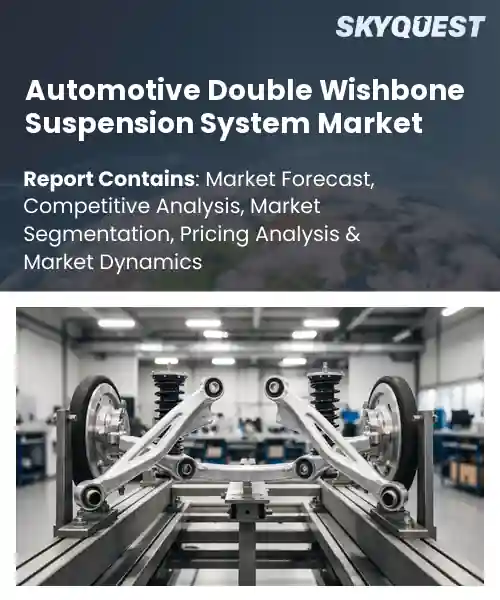
Automotive Double Wishbone Suspension System Market
Report ID: SQMIG25A2791
Report ID: SQMIG25A2791
[email protected]
USA +1 351-333-4748
Report ID:
SQMIG25A2791 |
Region:
Global |
Published Date: July, 2026
Pages:
157
|Tables:
142
|Figures:
78


Global Automotive Double Wishbone Suspension System Market size was valued at USD 8.52 Billion in 2024 and is poised to grow from USD 9.06 Billion in 2025 to USD 14.85 Billion by 2033, growing at a CAGR of 6.32% during the forecast period (2026-2033).
Demand for improved vehicle handling, safety concerns, popularity of premium and electric vehicles, development of lighter suspension parts, and the adoption of advanced chassis technology are expected to drive the sales of automotive double wishbone suspension system.
Increasing acceptance of lightweight materials such as aluminum alloys, upgrading to semi-active & electronic controlled suspension technology, and prioritizing stability & control are boosting market growth. Progress in suspension topology, chassis modularization, and sensified suspension to provide affordable & tough products is important for market expansion. Increasing R&D spending for high-end, high-performance cars, luxury SUV's and future mobility solutions will open new market opportunities worldwide. Rising demand for superior ride comfort and precise vehicle dynamics, coupled with increasing adoption of advanced suspension systems in premium passenger vehicles and electric vehicles, is expected to primarily drive automotive double wishbone suspension system market growth.
On the contrary, high manufacturing and installation costs, complex suspension design, higher maintenance requirements, and growing adoption of cost-effective suspension alternatives are anticipated to slow down automotive double wishbone suspension system market penetration across the study period and beyond.
How is AI Improving Design and Performance of Automotive Double Wishbone Suspension Systems?
AI is revolutionizing automotive double wishbone suspension system market by enhancing suspension design, enhancing vehicle handling, and real-time chassis control. Machine learning algorithms enable engineers to improve suspension geometry, consider each component's weight and strength, and analyze fast simulations and predictive modeling to reduce system time to gain insight into suspension. AI algorithms use vehicle sensor information to automatically optimize system damping and suspension levels for specific road conditions and driving style, enhancing ride comfort, handling, and driving dynamics and stability.
Market snapshot - (2026-2033)
Global Market Size
USD 8.52 Billion
Largest Segment
Lower Control Arms
Fastest Growth
Coilover Kits
Growth Rate
6.32% CAGR
To get more insights on this market click here to Request a Free Sample Report
Global automotive double wishbone suspension system market is segmented by component, vehicle type, sales channel, material, distribution channel, and region. Based on component, the market is segmented into upper control arms, lower control arms, ball joints, and coilover kits. Based on vehicle type, the market is segmented into passenger cars, sports cars, and SUVs & trucks. Based on sales channel, the market is segmented into OEM and aftermarket. Based on material, the market is segmented into Steel and Aluminum Alloy. Based on distribution channel, the market is segmented into direct to OEMs and aftermarket distributors. Based on region, the market is segmented into North America, Europe, Asia Pacific, Latin America, and Middle East & Africa.
The upper control arms segment is projected to spearhead the global automotive double wishbone suspension system market revenue generation across the study period. It establishes the overall geometry and load path that is essential to wheel alignment, steering handling and suspension kinematics in double wishbone configurations. Through its effect on camber control and lateral loads handling, it minimizes tire wear and enhances handling, encouraging OEMs to seek strong upper arm geometry. Established production processes and component reliability reinforce this preference in a wide range of car segments and assembly lines.
However, coilover kits are emerging as the most rapidly expanding segment as per this automotive double wishbone suspension system industry analysis, driven by the consumer's appetite for ride and performance tuning and motorsport inspired customization. Increased aftermarket acceptance and simplicity of retrofit will motivate vendors toimproven damping and adjustability, procuring fresh income sources and providing specified performance enhancement for various vehicle categories.
The aluminum alloy segment is predicted to account for the highest global automotive double wishbone suspension system market share going forward. Aluminum's lightweight characteristics and corrosion resistance help to meet efficiency and handling targets in double wishbone designs. Formability lends itself to intricate arm shapes that help reduce unsprung mass and improve responsiveness and gives OEMs confidence to adopt for performance and EV use. Material benefits allow it to be a collaborative partner with suppliers on casting and forging processes, leading to aluminum Preference where weight savings and durability requirements dominate design decisions.
However, steel is witnessing the strongest growth momentum as new higher strength grades and cheaper manufacturing processes are allowing for heavy duty applications for broader vehicles on the market. Built manufacturing and distribution chains, and the affordability of the materials, are supporting OEM investing and suppliers going to high volume production opening wider markets in the mainstream vehicle slices.
To get detailed segments analysis, Request a Free Sample Report
Concentrated automotive manufacturing expertise, robust supplier networks, and longstanding engineering traditions that favor sophisticated suspension architectures cement the dominance of this region. Automotive OEMs have also demonstrated strong commitment to improving the driving experience through development of a wide range of different dynamic, performance and luxury products; thus, creating an ongoing requirement for double wishbone suspension systems. Regional suppliers utilize cost and lead time advantages afforded by local supply chains, and leading suppliers in the region are investing in flexible manufacturing and engineering facilities. Working in partnership with other manufacturers and component manufacturers has accelerated the design validation process and integration of various double wishbone suspension components across multiple vehicle categories. Regulatory conformity issues related to safety and ride quality complement consumer interest in improved vehicle control/handling of specific vehicles and further reinforce Asia Pacific's dominant position and development of a sustainable double wishbone suspension technology ecosystem. In addition, high levels of skilled engineering resources and targeted research funding provide the means for manufacturers to rapidly adapt to shifting vehicle architectures that may occur because of new technologies introduced by automotive manufacturers.
Automotive double wishbone suspension system market in Japan is shaped by advanced engineering culture, strong OEM integration, and emphasis on precision handling. Local suppliers are experienced in high-quality manufacturing and collaborate closely with automakers on suspension tuning. Consumer demand for refined ride dynamics in premium and performance models encourages continual innovation. Proximity to research institutions and a tradition of vehicle testing under varied conditions supports iterative improvements and validation.
Automotive double wishbone suspension system demand in South Korea benefits from strong integration between OEMs and suppliers focused on performance engineering. Focusing on driving dynamics in the domestic models encourages the use of more sophisticated suspension layouts. Supplier investment in lighter-weight materials and packaging enhancement boosts the vehicle design aims. Collaborative testing programs as well as the tight coupling of design and manufacturing processes enable fast prototyping and tuning. Performance segments even bring more technical know-how and component improvement.
Stringent performance expectations from discerning consumers, strong engineering heritage, and concentrated clusters of high technology suppliers are helping create new opportunities in the region. Automakers in Europe are strongly focused on providing high ride quality and dynamic handling in their vehicle offerings, whether they are considered premium or sport models, and therefore do incorporate double wishbone architectures into their vehicle specifications. In addition to these performance characteristics, investments made by automakers in lightweight materials, advanced manufacturing processes and tailored calibration services, will allow double wishbone architectures to see an expanded use. Collaboration between OEMs and their suppliers, as well as independent research centers, have facilitated the sharing of innovation across national borders, while the increasing focus on safety and an appropriate testing methodology, has ensured that engineering excellence is maintained. The presence of strong aftermarket communities and motorsport activities allows the testing of performance-based solutions, as well as expediting the transfer of new technologies into road vehicles.
Automotive double wishbone suspension system demand in Germany is anchored by OEM engineering strength and deep supplier networks focused on vehicle dynamics. Automakers collaborate with manufacturers on precision calibration and validation protocols. Emphasis on premium models and performance variants sustains demand for sophisticated suspension architectures. Application of advanced materials and manufacturing excellence enables high quality output. A culture of rigorous testing and iterative improvement underpins technical leadership in suspension development.
Automotive double wishbone suspension system sales in the United Kingdom are driven by dynamic engineering firms, a thriving motorsport sector, and supplier capability that supports product development. Sales growth in high end and niche vehicles reinforces demand for the specification of a double wishbone system. Outsourcing by vehicle integrators in the development of the suspension system also increases the effectiveness of suspension calibration. Investment in lightweight solutions and in calibration benefits vehicle differentiation. An active aftermarket and a strong testing culture promote innovation in mainstream vehicles.
Automotive double wishbone suspension system market in France is emerging through growing engineering expertise, OEM initiatives, and emphasis on ride comfort and balanced handling. Supplier innovation is strengthening suspension calibration and fabrication of lightweight parts. Working with research and test centers allows for optimization based on specific vehicle types. Greater demand for custom suspension for specialty and luxury vehicles is supported by a tradition of skilled craftsmanship and innovation.
Concentrated innovation efforts, advanced manufacturing capabilities, and collaboration among automakers, suppliers, and specialized engineering centers create new demand for automotive double wishbone suspension systems in the region. OEMs are developing performance/competition-oriented, upscale, and niche vehicles, which drives demand from these OEMs to integrate double wishbones due to the advantages of packaging and handling. The suppliers are investing in adaptable manufacturing processes and advanced materials expertise to satisfy the requirements for the variety of platforms being manufactured for customers. Several of the suppliers are investing in testing facilities and motorsports programs to provide real-world validation of new technologies or processes that will speed up the introduction of new products to market. Joint research efforts with universities and technology companies to develop technologies to advance sensor integration and adaptive damping tuning. Vendor consolidation and strategic relationships with other vendors allows for scale and a common platform between vendors to facilitate large scale integration across multiple OEM models.
Automotive double wishbone suspension system demand in the United States benefits from research capabilities, strong OEM engineering, and an active aftermarket that supports performance validation. Sophisticated testing facilities, standing start/roll mode control, and extensive motorsport alliances are exploited by manufacturers to improve suspension geometry and calibration. Material knowledge and economies of scale, provided by the supplier base, facilitate platform blending. Partnering with hi-tech specialists promotes sensor integration and adaptive damping. Market opportunities lead to rapid prototyping and high-performance absorption.
Automotive double wishbone suspension system market in Canada is supported by a strong supplier base, engineering capabilities, and collaboration with OEM programs. Focus on lightweighting and packaging efficiency directed suppliers toward a package of tight suspension configurations. Test facilities and alliances with academic institutions provided validation capability across different operating environments. Cross border supply chain integration is intended for compatibility with larger vehicle programs. Niche manufacturers and aftermarket specialists sponsors continued technical progression.
To know more about the market opportunities by region and country, click here to
Buy The Complete Report
Shift Toward Premium Driving Dynamics
Demand For Improved Vehicle Safety
Higher Manufacturing And Component Cost
Complex Packaging Requirements For Vehicles
Request Free Customization of this report to help us to meet your business objectives.
Competition in the double wishbone suspension market centers on suppliers and vehicle startups racing to deliver ride refinement through active and modular solutions. Strategic moves include ClearMotion's acquisition of Bose's active-suspension assets and ClearMotion collaborations with NIO and Porsche on CM1 technology. REE's corner-module partnerships with tier suppliers integrate double wishbone kinematics to accelerate OEM adoption. These tactics such as M&A, supplier alliances, and in-corner innovation shape differentiation.
SkyQuest’s ABIRAW (Advanced Business Intelligence, Research & Analysis Wing) is our Business Information Services team that Collects, Collates, Correlates, and Analyses the Data collected by means of Primary Exploratory Research backed by robust Secondary Desk research.
As per SkyQuest analysis, high emphasis on occupant safety, rising adoption of premium and electric vehicles, and advancements in lightweight suspension components are anticipated to drive the demand for automotive double wishbone suspension systems going forward. However, high manufacturing and installation costs and growing adoption of cost-effective suspension alternatives are slated to slow down the adoption of automotive double wishbone suspension systems in the future. Asia Pacifc is expected to spearhead the demand for automotive double wishbone suspension systems owing to strong automotive manufacturing capabilities, high demand for premium vehicles, increasing adoption of electric vehicles, and the presence of leading OEMs and suspension system suppliers. AI-powered chassis control and integration of semi-active suspension technologies are anticipated to be key trends driving the automotive double wishbone suspension system sector in the future.
| Report Metric | Details |
|---|---|
| Market size value in 2024 | USD 8.52 Billion |
| Market size value in 2033 | USD 14.85 Billion |
| Growth Rate | 6.32% |
| Base year | 2024 |
| Forecast period | (2026-2033) |
| Forecast Unit (Value) | USD Billion |
| Segments covered |
|
| Regions covered | North America (US, Canada), Europe (Germany, France, United Kingdom, Italy, Spain, Rest of Europe), Asia Pacific (China, India, Japan, Rest of Asia-Pacific), Latin America (Brazil, Rest of Latin America), Middle East & Africa (South Africa, GCC Countries, Rest of MEA) |
| Companies covered |
|
| Customization scope | Free report customization with purchase. Customization includes:-
|
To get a free trial access to our platform which is a one stop solution for all your data requirements for quicker decision making. This platform allows you to compare markets, competitors who are prominent in the market, and mega trends that are influencing the dynamics in the market. Also, get access to detailed SkyQuest exclusive matrix.
Table Of Content
Executive Summary
Market overview
Parent Market Analysis
Market overview
Market size
KEY MARKET INSIGHTS
COVID IMPACT
MARKET DYNAMICS & OUTLOOK
Market Size by Region
KEY COMPANY PROFILES
Methodology
For the Automotive Double Wishbone Suspension System Market, our research methodology involved a mixture of primary and secondary data sources. Key steps involved in the research process are listed below:
1. Information Procurement: This stage involved the procurement of Market data or related information via primary and secondary sources. The various secondary sources used included various company websites, annual reports, trade databases, and paid databases such as Hoover's, Bloomberg Business, Factiva, and Avention. Our team did 45 primary interactions Globally which included several stakeholders such as manufacturers, customers, key opinion leaders, etc. Overall, information procurement was one of the most extensive stages in our research process.
2. Information Analysis: This step involved triangulation of data through bottom-up and top-down approaches to estimate and validate the total size and future estimate of the Automotive Double Wishbone Suspension System Market.
3. Report Formulation: The final step entailed the placement of data points in appropriate Market spaces in an attempt to deduce viable conclusions.
4. Validation & Publishing: Validation is the most important step in the process. Validation & re-validation via an intricately designed process helped us finalize data points to be used for final calculations. The final Market estimates and forecasts were then aligned and sent to our panel of industry experts for validation of data. Once the validation was done the report was sent to our Quality Assurance team to ensure adherence to style guides, consistency & design.
Analyst Support
Customization Options
With the given market data, our dedicated team of analysts can offer you the following customization options are available for the Automotive Double Wishbone Suspension System Market:
Product Analysis: Product matrix, which offers a detailed comparison of the product portfolio of companies.
Regional Analysis: Further analysis of the Automotive Double Wishbone Suspension System Market for additional countries.
Competitive Analysis: Detailed analysis and profiling of additional Market players & comparative analysis of competitive products.
Go to Market Strategy: Find the high-growth channels to invest your marketing efforts and increase your customer base.
Innovation Mapping: Identify racial solutions and innovation, connected to deep ecosystems of innovators, start-ups, academics, and strategic partners.
Category Intelligence: Customized intelligence that is relevant to their supply Markets will enable them to make smarter sourcing decisions and improve their category management.
Public Company Transcript Analysis: To improve the investment performance by generating new alpha and making better-informed decisions.
Social Media Listening: To analyze the conversations and trends happening not just around your brand, but around your industry as a whole, and use those insights to make better Marketing decisions.
REQUEST FOR SAMPLE
 REQUEST FREE CUSTOMIZATION
Global Automotive Double Wishbone Suspension System Market size was valued at USD 8.52 Billion in 2024 and is poised to grow from USD 9.06 Billion in 2025 to USD 14.85 Billion by 2033, growing at a CAGR of 6.32% during the forecast period (2026-2033).
Competition in the double wishbone suspension market centers on suppliers and vehicle startups racing to deliver ride refinement through active and modular solutions. Strategic moves include ClearMotion's acquisition of Bose's active-suspension assets and ClearMotion collaborations with NIO and Porsche on CM1 technology. REE's corner-module partnerships with tier suppliers integrate double wishbone kinematics to accelerate OEM adoption. These tactics such as M&A, supplier alliances, and in-corner innovation shape differentiation. 'Tenneco Inc. (Monroe)', 'ZF Friedrichshafen', 'Mando Corporation (HL Mando)', 'JTEKT Corporation', 'KYB Corporation', 'Magneti Marelli (KKR)', 'Multimatic Inc.', 'Hendrickson International', 'NHK Spring', 'Chassix Holdings', 'Shiloh Industries', 'Metalform', 'Tower International', 'Martinrea International', 'Yorozu Corporation', 'Futaba Corporation', 'Cosma International (Magna)', 'Metalsa SA', 'Rassini', 'Bharat Forge Limited'
Vehicle manufacturers increasingly prioritize ride comfort and handling to meet consumer expectations for refined driving experiences, driving adoption of double wishbone suspension systems in markets where differentiation is critical. The geometry and tuning flexibility of double wishbone layouts enable engineers to manage camber and roll characteristics without compromising passenger comfort, supporting product positioning for higher-value models. This emphasis on perceived quality encourages investment in these systems across a range of vehicle segments, reinforcing availability and standardization in platforms where premium dynamics are a selling point.
Advanced Vehicle Dynamics: Suppliers and OEMs are prioritizing double wishbone architectures to enhance lateral stability and steering precision across premium and performance vehicle segments. The design flexibility supports tuned suspension kinematics for improved tire contact and predictable responses during cornering. Increased emphasis on differentiated ride experiences is driving closer engineering collaboration between chassis, tires and control system teams. As consumers expect refined handling without compromising comfort, manufacturers view optimized double wishbone integration as a competitive differentiator that influences platform choices and supplier partnerships.
Why does Asia Pacific Dominate the Global Automotive Double Wishbone Suspension System Market? |@12


Want to customize this report? This report can be personalized according to your needs. Our analysts and industry experts will work directly with you to understand your requirements and provide you with customized data in a short amount of time. We offer $1000 worth of FREE customization at the time of purchase.
Feedback From Our Clients


 USA (+1) 351-333-4748

