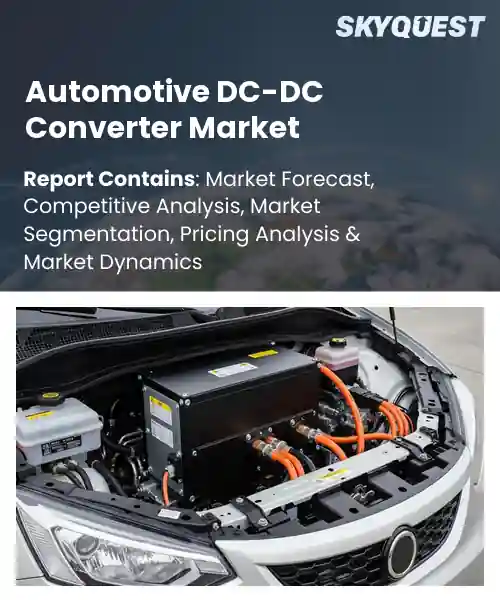
Automotive DC-DC Converter Market
Report ID: SQMIG20D2601
Report ID: SQMIG20D2601
[email protected]
USA +1 351-333-4748
Report ID:
SQMIG20D2601 |
Region:
Global |
Published Date: May, 2026
Pages:
157
|Tables:
228
|Figures:
81


Global Automotive Dc-Dc Converter Market size was valued at USD 5.9 Billion in 2024 and is poised to grow from USD 6.66 Billion in 2025 to USD 17.58 Billion by 2033, growing at a CAGR of 12.9% during the forecast period (2026-2033).
Automotive DC-DC converters are power electronic systems used to step voltage between vehicle energy sources and loads, primarily driven by vehicle electrification. As internal combustion architectures transitioned to hybrid and battery electric systems, a growing need emerged for reliable, efficient DC-DC conversion to power accessories, control units and 12-volt networks from high-voltage traction batteries. This market is important because converters have a direct impact on vehicle efficiency, range and component integration. Regulators pushing fuel economy and emissions have accelerated adoption. In recent decades, the market moved from 12V alternator systems to multi-voltage architectures as seen in the Toyota Prius and modern EVs worldwide.
Higher voltage architectures and the related progress in semiconductors are driving the Global Automotive DC-DC Converter Market. This is based on the electrification momentum mentioned above, which is increasing the need for converters with higher power density and efficiency. As manufacturers are increasingly incorporating 48-volt mild hybrids or high-voltage traction systems into their designs, there is a need for compact converters that generate less heat, thus driving the use of wide-bandgap devices like SiC and GaN. This leads to smaller, lighter modules which improve EV range and create space for safety systems, opening up opportunities for tier-one suppliers to develop integrated, bidirectional units for V2G and ADAS power management.
How is AI improving efficiency in the automotive DC-DC converter market?
AI increases the link between control software and power hardware, thus enhancing efficiency in the automotive DC to DC converter market. Key aspects include adaptive control that adapts switching behavior to real time load profiles, predictive analytics that flag emerging faults before they cause failures and physics aware digital twins that guide thermal and electromagnetic tradeoffs. The increasing electrification and software defined vehicle functions lead to more complex and more critical converters in today’s market. AI reduces design cycle time, improves vehicle efficiency across real duty cycles, and enables remote diagnostics and continuous field optimization through edge and cloud workflows.
Scalvy March 2026 announced a modular battery integrated architecture that combines inverter, onboard charger and DC to DC converter functions and provides for system level AI driven optimization. The integration enables AI to orchestrate energy routing and thermal management in real-time, improving the efficiency of the converter and accelerating the adoption of compact electrified architectures.
Market snapshot - (2026-2033)
Global Market Size
USD 5.9 Billion
Largest Segment
Passenger Vehicles
Fastest Growth
Electric Vehicles (BEV)
Growth Rate
12.9% CAGR
To get more insights on this market click here to Request a Free Sample Report
Global automotive dc-dc converter market is segmented by vehicle type, converter type, input voltage, output power, propulsion type, application, sales channel, cooling type and region. Based on vehicle type, the market is segmented into Passenger Vehicles, Commercial Vehicles, Electric Vehicles (BEV) and Hybrid Electric Vehicles (HEV/PHEV). Based on converter type, the market is segmented into Isolated DC-DC Converter and Non-Isolated DC-DC Converter. Based on input voltage, the market is segmented into 12V–24V, 24V–48V and Above 48V. Based on output power, the market is segmented into Low Power (Below 1 kW), Medium Power (1–5 kW) and High Power (Above 5 kW). Based on propulsion type, the market is segmented into Internal Combustion Engine Vehicles, Battery Electric Vehicles, Hybrid Electric Vehicles and Fuel Cell Electric Vehicles. Based on application, the market is segmented into Powertrain Systems, Battery Management Systems, Infotainment & Telematics, Lighting Systems, Advanced Driver Assistance Systems (ADAS), Body Electronics and Others. Based on sales channel, the market is segmented into OEM and Aftermarket. Based on cooling type, the market is segmented into Air-Cooled and Liquid-Cooled. Based on region, the market is segmented into North America, Europe, Asia Pacific, Latin America and Middle East & Africa.
Among the various segments, isolated DC-DC Converter is the dominant segment due to its galvanic isolation that protects vehicle electronics from high-voltage domains and allows safe interfaces between battery systems and low-voltage loads. OEMs prefer modular designs for electromagnetic compatibility and functional safety, which can reduce system level risk and ease certification. With the increasing complexity and safety-criticalness of vehicle electrical architectures, isolation-driven converter designs are selected to protect the sensitive modules and ensure the reliability under the various operating conditions.
However, the Non-Isolated DC-DC Converter is seeing the strongest growth momentum as automakers are implementing more cost-effective, compact power conversion for mid-voltage architectures. Improvements in wide-bandgap devices and integration approaches are improving efficiency and thermal performance, making non-isolated configurations attractive for auxiliary loads and light-weight electrified systems, opening up addressable applications and aftermarket opportunities.
The Powertrain Systems segment is the dominant segment. DC-DC converters are key components to provide stable low voltage power from high voltage propulsion batteries to critical drivetrain controllers and auxiliary actuators. Reliable conversion will enable torque management, thermal management and power distribution strategies, which is why robust converter architectures are the focus of OEMs. The need for continuous operation and safety at varying load and environmental conditions results in investment in high-reliability designs and deep integration with vehicle control networks.
But the fastest growing segment is Battery Management Systems as higher energy density packs and tighter safety and longevity requirements demand smarter, more integrated conversion and monitoring solutions. Better charging strategies and longer battery life are enabled by innovations in bidirectional converters and cell-level balancing, creating new integration opportunities and demand from electrification-focused OEMs and suppliers.
To get detailed segments analysis, Request a Free Sample Report
Asia Pacific’s dominance in the automotive DC-DC converter market can be attributed to a mix of concentrated manufacturing capability, deep semiconductor and electronic component ecosystems, and close proximity to leading vehicle makers who prioritize power electronics integration. Production clusters at scale enable rapid iteration between design and manufacturing while local suppliers have developed specialized know-how in high-efficiency conversion technologies and thermal management. OEMs, tier suppliers and semiconductor companies are forming strategic collaborations to accelerate the adoption of advanced topologies. Policy environments that are supportive of electrification and infrastructure deployment also help to build on market momentum, while existing supply chain resilience is shortening lead times. The region also enjoys a competitive advantage in both component innovation and cost control, due to a skilled engineering workforce and strong research and development investment in power electronics.
Automotive DC-DC Converter Market in Japan is characterized by precision engineering, strict quality standards, and tight cooperation between automakers and specialized suppliers. Local companies emphasize reliability and compact designs optimized for hybrid and electric drivetrains, supported by strong expertise in semiconductor integration and thermal solutions. Continuous refinement of manufacturing processes and stringent testing protocols ensure market leadership in segments that value long-term durability and system-level optimization and performance.
South Korea Automotive DC-DC Converter Market is driven by close collaboration between semiconductor companies and vehicle manufacturers, leading to adoption of efficient power modules and compact packaging. Capabilities across passenger and commercial vehicle segments, with emphasis on miniaturization and thermal management. Manufacturing agility and export-oriented production networks facilitate technology transfer and collaborative product development, enhancing competitive positioning and integration into broader regional and global electronics supply chains.
The European automotive DC-DC converter market will see rapid growth driven by the convergence of strict vehicle emission and efficiency requirements, aggressive electrification strategies by the major automakers, and a mature supplier network focused on high-performance power electronics. European companies are concerned with compliance, functional safety and interoperability, which is pushing the demand for converters that can easily integrate with complex electrical architectures within a vehicle. Strong engineering ecosystems in key markets foster collaboration across sectors between auto companies and high-tech specialists, and policy frameworks and infrastructure initiatives are creating an environment conducive to electrified mobility. Investment in scalable modular converter designs and advanced thermal and electromagnetic management accelerates adoption. Together, these dynamics make Europe a quick adopter of sophisticated DC-DC solutions that address demanding quality and safety expectations.
Automotive manufacturing strength, strong R&D capability and dense network of tier suppliers specializing in power electronics supports the Automotive DC-DC Converter Market in Germany. OEM engineering cultures emphasize tight integration of converter design with vehicle architectures, focusing on reliability, thermal efficiency and meeting stringent safety standards. “We see collaborations between traditional makers and innovative component companies, which lead to advanced solutions suited to the premium vehicle segments and production needs.
United Kingdom Automotive DC-DC Converter Market is characterized by an increasing amalgamation of established automotive know-how and emerging high-tech companies focusing on modular converter designs. Partnerships with vehicle manufacturers, innovative companies and research institutions help to tailor solutions to electrified platforms. Focus on rapid prototyping, software-enabled control strategies, and diversification of supply chain supports a dynamic profile of the market balancing innovation with regulatory compliance and pragmatic manufacturing approaches and scale commercial deployment efforts.
The automotive DC-DC Converter market in France is driven by innovation resulting from a combination of automotive groups, technology startups and joint research efforts for efficient power conversion and system integration. National focus on electrified mobility and public-private cooperation accelerate development of compact, scalable converter solutions. Demand growth across different vehicle segments and specialized mobility applications will be unlocked by vehicle-level optimization, cooling innovations, and flexible control architectures.
North America strengthens its role in the automotive DC-DC converter industry with a multi-layered strategy that combines leadership in the design of advanced semiconductors, increasing development of electrified vehicles and strategic manufacturing initiatives. Technology companies and carmakers are working with research institutions to improve converter topologies, control algorithms and integration with battery management systems. Regional solution providers often specialize in software-defined power management and vehicle-level energy optimization. Localization of key component manufacturing and diversification of supplier networks increase supply chain resilience, while venture-backed start-ups accelerate commercialisation of new materials and packaging techniques. Cross-border collaboration with material producers and system integrators further strengthens a competitive landscape that favors performance, scalability and fast adaption to evolving vehicle architectures. Robust standards development, rigorous validation practices, and aftermarket service networks enable adoption and long-term reliability expectations across vehicle segments.
United States Automotive DC-DC Converter Market is marked by dominance in semiconductor and systems design, with technology companies and automakers pushing high-performance converter architectures and software-enabled energy management. Differentiation is derived from the focus on integration with battery systems, advanced packaging and control algorithms for a wide range of applications. Initiatives to localize manufacturing and strengthen supplier ecosystems support faster commercialization cycles and strong testing and validation practices are at the core of reliability expectations in vehicle development programs.
The Automotive DC-DC Converter Market in Canada is influenced by connections among materials expertise, power electronics research and vehicle manufacturers seeking electrification. Suppliers stress ruggedized designs for different operating environments and work with research centers to improve thermal management and packaging. Working with battery producers and system integrators leads to converter solutions for commercial applications. At the same time, the focus on quality, validation and sustainable sourcing improves supplier reputation in regional markets and scale capability.
To know more about the market opportunities by region and country, click here to
Buy The Complete Report
Rising Adoption Of Electric Vehicles
Increasing Need For Energy Efficiency
Complexity Of High-Voltage Integration
Supply Chain Component Constraints
Request Free Customization of this report to help us to meet your business objectives.
Competitive landscape is tightening as OEM electrification accelerates demand for compact, higher efficiency DC to DC converters, driving consolidation through targeted acquisitions and capability builds. Notable moves include Turntide’s 2021 acquisitions to assemble power electronics expertise. Vendors also pursue partnerships and SiC and GaN innovation programs to differentiate by efficiency and thermal density, for example Marelli’s collaboration work on next generation power conversion and recent prototype R and D efforts.
SkyQuest’s ABIRAW (Advanced Business Intelligence, Research & Analysis Wing) is our Business Information Services team that Collects, Collates, Correlates, and Analyses the Data collected by means of Primary Exploratory Research backed by robust Secondary Desk research. As per SkyQuest analysis, rising adoption of electric vehicles is a key driver for the global automotive DC-DC converter market, supported by a second driver in the form of increasing demand for energy efficiency and higher-voltage architectures that push semiconductor innovation. A notable restraint is the complexity of high-voltage integration, which extends validation cycles and raises engineering costs. The market is dominated by the Asia Pacific region thanks to concentrated manufacturing, semiconductor ecosystems and proximity to OEMs, while isolated DC-DC converters lead the product landscape because they provide galvanic isolation and support functional safety across mixed-voltage vehicle architectures. Modular designs and AI-enabled controls are accelerating supplier differentiation.
| Report Metric | Details |
|---|---|
| Market size value in 2024 | USD 5.9 Billion |
| Market size value in 2033 | USD 17.58 Billion |
| Growth Rate | 12.9% |
| Base year | 2024 |
| Forecast period | (2026-2033) |
| Forecast Unit (Value) | USD Billion |
| Segments covered |
|
| Regions covered | North America (US, Canada), Europe (Germany, France, United Kingdom, Italy, Spain, Rest of Europe), Asia Pacific (China, India, Japan, Rest of Asia-Pacific), Latin America (Brazil, Rest of Latin America), Middle East & Africa (South Africa, GCC Countries, Rest of MEA) |
| Companies covered |
|
| Customization scope | Free report customization with purchase. Customization includes:-
|
To get a free trial access to our platform which is a one stop solution for all your data requirements for quicker decision making. This platform allows you to compare markets, competitors who are prominent in the market, and mega trends that are influencing the dynamics in the market. Also, get access to detailed SkyQuest exclusive matrix.
Table Of Content
Executive Summary
Market overview
Parent Market Analysis
Market overview
Market size
KEY MARKET INSIGHTS
COVID IMPACT
MARKET DYNAMICS & OUTLOOK
Market Size by Region
KEY COMPANY PROFILES
Methodology
For the Automotive DC-DC Converter Market, our research methodology involved a mixture of primary and secondary data sources. Key steps involved in the research process are listed below:
1. Information Procurement: This stage involved the procurement of Market data or related information via primary and secondary sources. The various secondary sources used included various company websites, annual reports, trade databases, and paid databases such as Hoover's, Bloomberg Business, Factiva, and Avention. Our team did 45 primary interactions Globally which included several stakeholders such as manufacturers, customers, key opinion leaders, etc. Overall, information procurement was one of the most extensive stages in our research process.
2. Information Analysis: This step involved triangulation of data through bottom-up and top-down approaches to estimate and validate the total size and future estimate of the Automotive DC-DC Converter Market.
3. Report Formulation: The final step entailed the placement of data points in appropriate Market spaces in an attempt to deduce viable conclusions.
4. Validation & Publishing: Validation is the most important step in the process. Validation & re-validation via an intricately designed process helped us finalize data points to be used for final calculations. The final Market estimates and forecasts were then aligned and sent to our panel of industry experts for validation of data. Once the validation was done the report was sent to our Quality Assurance team to ensure adherence to style guides, consistency & design.
Analyst Support
Customization Options
With the given market data, our dedicated team of analysts can offer you the following customization options are available for the Automotive DC-DC Converter Market:
Product Analysis: Product matrix, which offers a detailed comparison of the product portfolio of companies.
Regional Analysis: Further analysis of the Automotive DC-DC Converter Market for additional countries.
Competitive Analysis: Detailed analysis and profiling of additional Market players & comparative analysis of competitive products.
Go to Market Strategy: Find the high-growth channels to invest your marketing efforts and increase your customer base.
Innovation Mapping: Identify racial solutions and innovation, connected to deep ecosystems of innovators, start-ups, academics, and strategic partners.
Category Intelligence: Customized intelligence that is relevant to their supply Markets will enable them to make smarter sourcing decisions and improve their category management.
Public Company Transcript Analysis: To improve the investment performance by generating new alpha and making better-informed decisions.
Social Media Listening: To analyze the conversations and trends happening not just around your brand, but around your industry as a whole, and use those insights to make better Marketing decisions.
REQUEST FOR SAMPLE
 REQUEST FREE CUSTOMIZATION
Global Automotive Dc-Dc Converter Market size was valued at USD 5.9 Billion in 2024 and is poised to grow from USD 6.66 Billion in 2025 to USD 17.58 Billion by 2033, growing at a CAGR of 12.9% during the forecast period (2026-2033).
Competitive landscape is tightening as OEM electrification accelerates demand for compact, higher efficiency DC to DC converters, driving consolidation through targeted acquisitions and capability builds. Notable moves include Turntide’s 2021 acquisitions to assemble power electronics expertise. Vendors also pursue partnerships and SiC and GaN innovation programs to differentiate by efficiency and thermal density, for example Marelli’s collaboration work on next generation power conversion and recent prototype R and D efforts. 'Robert Bosch GmbH', 'Continental AG', 'Denso Corporation', 'Valeo SA', 'Mitsubishi Electric Corporation', 'Vicor Corporation', 'TDK Corporation', 'Murata Manufacturing Co., Ltd.', 'Infineon Technologies AG', 'Delta Electronics, Inc.', 'Vitesco Technologies Group AG', 'Lear Corporation', 'Eaton Corporation plc', 'STMicroelectronics N.V.', 'Texas Instruments Incorporated', 'Toyota Industries Corporation', 'HELLA GmbH & Co. KGaA', 'RECOM Power GmbH', 'Advanced Energy Industries, Inc.', 'Bel Fuse Inc.'
Rising adoption of electric vehicles increases demand for advanced DC-DC converters because these components enable efficient voltage management between high-voltage batteries and low-voltage vehicle systems. As manufacturers prioritize weight reduction, energy efficiency, and integration of multiple electronic subsystems, more compact and reliable converters are required to support power distribution, safety features, and infotainment. This need drives suppliers to expand product portfolios and invest in application-specific designs, which in turn stimulates market expansion by aligning component development with evolving vehicle architectures and OEM requirements.
Electrification Integration Strategies: Automakers are prioritizing seamless integration of DC DC converters across heterogeneous electric and hybrid vehicle platforms to enhance overall system efficiency, thermal management, and packaging. Cross functional design processes are aligning power electronics with battery management, propulsion and infotainment systems to reduce redundancy and improve scalability. Suppliers are deepening collaboration with OEMs to deliver tailored solutions that support varying voltage domains and extended service life expectations, enabling differentiated vehicle architectures while simplifying manufacturing and aftermarket servicing pathways and regulatory readiness.
Why does Asia Pacific Dominate the Global Automotive DC-DC Converter Market? |@12


Want to customize this report? This report can be personalized according to your needs. Our analysts and industry experts will work directly with you to understand your requirements and provide you with customized data in a short amount of time. We offer $1000 worth of FREE customization at the time of purchase.
Feedback From Our Clients


 USA (+1) 351-333-4748

