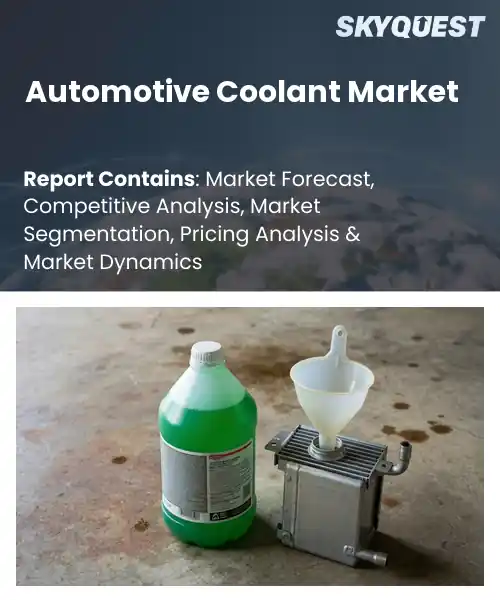
Automotive Coolant Market
Report ID: SQMIG15E3845
Report ID: SQMIG15E3845
[email protected]
USA +1 351-333-4748
Report ID:
SQMIG15E3845 |
Region:
Global |
Published Date: June, 2026
Pages:
157
|Tables:
170
|Figures:
79


Global Automotive Coolant Market size was valued at USD 8.29 Billion in 2024 and is poised to grow from USD 8.65 Billion in 2025 to USD 12.11 Billion by 2033, growing at a CAGR of 4.3% during the forecast period (2026-2033).
Automotive coolant market worldwide includes fluids used to control engine temperature, prevent corrosion and extend the life of components in passenger cars, light trucks and commercial vehicles. Its significance is that it maintains performance, fuel economy and emissions compliance especially as engines become more thermally efficient. The market evolved in the 1950’s with the introduction of aluminum blocks in place of cast iron and the need for specialized antifreeze formulations. Over the past 30 years, tighter environmental regulations and the move to long-life, low-phosphate coolants have driven innovation. For example, Toyota and other OEMs have switched to organic acid technology (OAT) coolants, an example of how regulatory pressure and material change can expand a market.
One of the most important factors driving the growth of global automotive coolant market is the adoption of electric and hybrid powertrains as these platforms require accurate thermal management to protect batteries and power electronics. This has led to high performance formulations, glycol-based and silicate free with improved heat transfer, in compliance with safety standards. So, suppliers like BASF and Valvoline have signed deals with EV makers like Rivian, opening up a new revenue stream outside of traditional ICE vehicles. This diversification drives R&D investment, expands distribution channels and creates opportunities for aftermarket retrofits, enhancing long-term market resilience.
How is IoT-enabled monitoring influencing efficiency in the automotive coolant market?
IoT enabled sensors for coolant loop monitoring, connectivity, analytics. It monitors temperature, pressure, fluid level in real-time and sends alerts to vehicle control units or fleet managers. This visibility helps operators optimize coolant flow, plan maintenance before leaks occur and reduce waste. The automotive coolant market is expanding as manufacturers are fitting these sensors to new cars and retrofitting them to older fleets. The early adopters say the technology is helping them become more efficient by improved engine performance and less downtime. This is in line with the overall digitization of vehicle subsystems and supports the market to grow steadily. It also enables predictive algorithms to forecast a coolant’s degradation before it affects performance.
In April 2024, a major automotive supplier launched an IoT-based coolant monitoring platform that employs vehicle telematics to monitor coolant condition in real time and automatically schedule coolant changes. The rollout has been shown to be a quicker way of finding problems and wasting less coolant thereby helping to improve market efficiency. And customers say their engines run smoother and their maintenance costs are lower.
Market snapshot - (2026-2033)
Global Market Size
USD 8.29 Billion
Largest Segment
Ethylene Glycol Coolants
Fastest Growth
Glycerin-Based Coolants
Growth Rate
4.3% CAGR
To get more insights on this market click here to Request a Free Sample Report
Global automotive coolant market is segmented by chemical formulation base, inhibitor technology type, product state, vehicle propulsion engine, vehicle type segment, commercial sales channel and region. Based on chemical formulation base, the market is segmented into Ethylene Glycol Coolants, Propylene Glycol Coolants and Glycerin-Based Coolants. Based on inhibitor technology type, the market is segmented into Inorganic Additive Technology, Organic Acid Technology, Hybrid Organic Acid Technology and Nitrited Organic Acid Technology. Based on product state, the market is segmented into Concentrated Coolants and Ready-to-Use Prediluted Coolants. Based on vehicle propulsion engine, the market is segmented into Internal Combustion Engine Vehicles, Hybrid Vehicles and Battery Electric Vehicles. Based on vehicle type segment, the market is segmented into Passenger Cars, Light Commercial Vehicles and Heavy Trucks Buses. Based on commercial sales channel, the market is segmented into Original Equipment Manufacturer Factory Fill and Aftermarket Service Stations Retail. Based on region, the market is segmented into North America, Europe, Asia Pacific, Latin America and Middle East & Africa.
Ethylene glycol coolants currently enjoy the largest share of the market, thanks to their proven thermal performance, compatibility with a wide range of engine designs, and cost-effectiveness that appeals to manufacturers and service providers alike. Its high boiling point and reliable freeze protection make it an ideal product for extreme climates, and why it is the default choice for OEM specifications. This innate credibility and established supply chain and broad technical expertise ensures that it remains ahead of the curve in the automotive coolant market.
In addition, glycerin based coolants segment is expected to be the fastest growing segment in the automotive coolant market. Increasing consumer demand for sustainable and low toxicity formulations is driving this trend and manufacturers are looking into bio derived production routes that are compliant with environmental regulations. This green momentum is opening new doors and encouraging more comprehensive integration across new vehicle platforms.
The category of organic acid technology is the leading segment, providing better corrosion protection and compatibility with modern engine alloys and emission control systems. Its balanced design reduces the formation of deposits and increases the service intervals, solving critical durability problems for both manufacturers and owners. Proven reliability and broad OEM support further establish the inhibitor solution of choice for a wide range of vehicle classes.
On the other hand, the hybrid organic acid technology segment is growing at the highest rate in automotive coolant market. It combines the benefits of traditional organic acids with some inorganic additives to provide better protection in heavy thermal swings. The increasing uptake in high performance and heavy duty applications is acting as a catalyst for future market diversification which is driving growth.
To get detailed segments analysis, Request a Free Sample Report
Asia Pacific, with its deep manufacturing base, strict environmental regulations and focus on advanced vehicle technologies, has become the engine of the automotive coolant sector. Demand for high-performance, low-toxicity coolants that meet emissions standards is being driven by leading OEMs focusing production in Japan and South Korea. A strong R&D capability is driving the development of environmentally friendly formulations, and an increasing number of hybrid and electric vehicles are imposing new requirements for coolants. Major suppliers of raw materials and a well established distribution network further reduce supply chain friction and allow for rapid product roll-out. Consumers in the region are more aware of best maintenance practices, which encourages regular coolant replacement and use of aftermarket services. These converging forces strengthen the region’s hold on volume and innovation in the world market.
The Japan Automotive Coolant Market is driven by the existence of the leading automotive manufacturers across the globe focusing on the precision engineering and stringent quality standards. OEMs looking to develop high-efficiency powertrains and compact engines are being offered coolant solutions by local suppliers. Joint research projects with universities are speeding up the use of biodegradable and low-temperature formulations. A well-established distributor network guarantees a steady supply of product to service centers and repair shops throughout the country for the domestic market.
South Korea Automotive Coolant Market is driven by focus on electronic vehicle adoption and advanced thermal management systems: There is a need for coolants as heat fluxes increase and also due to environmental regulations, and domestic automakers are looking for solutions. Suppliers are developing low volatility formulations for both conventional and electric drivetrains. Government incentives for technologies encourage R&D investment which leads to advanced coolant products that can be easily distributed through a dealer network.
North America’s automotive coolant market is experiencing rapid growth driven by consumer expectations, regulatory pressures and a move towards electrified powertrains. Demand for high-performance, corrosion-resistant coolants is growing as U.S. and Canadian automakers adopt advanced thermal management systems to improve fuel economy and extend vehicle life. The challenge for the manufacturers is to formulate coolants that are low in toxicity, biodegradable and meet aggressive emissions and safety standards. This also demands frequent cycles of coolant replacement because of the strong aftermarket culture. The region’s large pool of OEMs, tier-one suppliers and aftermarket distributors means innovative coolant chemistries are readily available. Moreover, raising awareness about climate friendly maintenance methods among fleet operators and private owners further stimulates the market activity and North America is a major growth driver across the globe.
The Automotive Coolant Market in United States is driven by numerous global OEMs and a strong aftermarket industry focusing on improved coolant chemistries in the gasoline and the electric vehicle segments. Federal environmental laws are so strict that manufacturers must produce low-volatile, non-hazardous formulations. Consumers are aware of preventive maintenance, so there are many coolant flushes. A strong distribution network provides wide access to premium coolant products in retail and service channels.
Canada’s automotive coolant market to focus on sustainability to meet provincial emissions standards Manufacturers are developing coolants with improved freeze-point protection and corrosion inhibition to meet the demands of climate. Canadian OEMs and parts distributors collaborate to develop low-toxicity products in line with national environmental policies. The active service network and government incentives for electric vehicle purchase are also leading to a steady increase in use of coolant.
Europe is still making its mark in the automotive coolant industry with the combination of stringent environmental regulations, innovative engineering skills and developed automotive ecosystem. Across the continent manufacturers are required to use coolant formulations that are low-impact and recyclable, and that meet tough safety and emissions directives, driving ongoing innovation in fluid chemistry. In the region, the need for high-performance coolants with better heat-transfer properties and long service intervals is being driven by fuel efficiency and vehicle durability. Collaboration research programs with automotive clusters, academic institutions and chemical producers enable the fast development of next generation bio-based coolant solutions. The market is further bolstered by a well-established aftermarket network and growing consumer consciousness about the significance of preventive maintenance, positioning Europe as a frontrunner in terms of product quality and sustainable practices in the global coolant market.
Germany’s automotive coolant market is driven by its engineering heritage and EU directives that require vehicles to run on low emissions. In Germany, OEMs are seeking the correct coolant formulations that will satisfy tough standards under extreme weather conditions. Local chemical companies are teaming up with manufacturers to develop bio-based solutions that meet durability and environmental standards. A comprehensive dealer and service network will ensure a rapid market penetration of these premium coolant products in the passenger car and commercial vehicle markets.
UK Automotive Coolant Market growth is being driven by domestic emission norms, and the adoption of electric vehicles. British manufacturers are looking for coolant formulations with low toxicity and high thermal efficiency to meet safety regulations. Chemical companies are partnering with local research institutes to speed the development of recyclable coolants based on biomass. A network of service garages and aftermarket distributors will back this conscious solution for fleet and passenger vehicles.
The French automotive coolant market is supported by the rich history of automotive engineering along with the EU environmental policies. French manufacturers require biodegradable coolant solutions with good heat transfer to meet regulatory requirements. Domestic chemical companies and research labs are partnering to spur innovation in low impact and high efficiency coolant chemistries. The service chain and consumer education are the driving forces behind the maintenance of coolants and it also ensures the demand of advanced eco-friendly products in both, passenger and commercial vehicle segments.
To know more about the market opportunities by region and country, click here to
Buy The Complete Report
Increasing Vehicle Production Volumes
Stringent Emission Regulation Compliance
High Cost Of Advanced Coolants
Limited Availability Of Raw Materials
Request Free Customization of this report to help us to meet your business objectives.
The world market for automotive coolants is a competitive one and is largely dominated by the major oil and chemical companies. Take, for example, Royal Dutch Shell, one of the biggest providers of automotive coolants in the US. Demand for super-efficient cooling solutions is growing and emissions regulation is tightening, so incumbents are under intense pressure. They are aiming for OEM contracts leveraging their existing distribution channels and their know-how in advanced formulation.
SkyQuest’s ABIRAW (Advanced Business Intelligence, Research & Analysis Wing) is our Business Information Services team that Collects, Collates, Correlates, and Analyses the Data collected by means of Primary Exploratory Research backed by robust Secondary Desk research.
As per SkyQuest analysis, the global automotive coolant market is being propelled primarily by rising vehicle production volumes that push manufacturers to adopt high‑performance cooling solutions, while the rapid growth of electric and hybrid powertrains acts as a second driver by demanding specialized, high‑efficiency formulations. The market’s largest share is held in Asia Pacific, where a strong manufacturing base and stringent environmental rules fuel demand, and ethylene glycol‑based coolants remain the dominant segment thanks to their proven thermal performance and cost‑effectiveness. However, the high cost of advanced coolant chemistries constrains broader adoption, especially among price‑sensitive OEMs, creating a balancing force in the market’s growth trajectory.
| Report Metric | Details |
|---|---|
| Market size value in 2024 | USD 8.29 Billion |
| Market size value in 2033 | USD 12.11 Billion |
| Growth Rate | 4.3% |
| Base year | 2024 |
| Forecast period | (2026-2033) |
| Forecast Unit (Value) | USD Billion |
| Segments covered |
|
| Regions covered | North America (US, Canada), Europe (Germany, France, United Kingdom, Italy, Spain, Rest of Europe), Asia Pacific (China, India, Japan, Rest of Asia-Pacific), Latin America (Brazil, Rest of Latin America), Middle East & Africa (South Africa, GCC Countries, Rest of MEA) |
| Companies covered |
|
| Customization scope | Free report customization with purchase. Customization includes:-
|
To get a free trial access to our platform which is a one stop solution for all your data requirements for quicker decision making. This platform allows you to compare markets, competitors who are prominent in the market, and mega trends that are influencing the dynamics in the market. Also, get access to detailed SkyQuest exclusive matrix.
Table Of Content
Executive Summary
Market overview
Parent Market Analysis
Market overview
Market size
KEY MARKET INSIGHTS
COVID IMPACT
MARKET DYNAMICS & OUTLOOK
Market Size by Region
KEY COMPANY PROFILES
Methodology
For the Automotive Coolant Market, our research methodology involved a mixture of primary and secondary data sources. Key steps involved in the research process are listed below:
1. Information Procurement: This stage involved the procurement of Market data or related information via primary and secondary sources. The various secondary sources used included various company websites, annual reports, trade databases, and paid databases such as Hoover's, Bloomberg Business, Factiva, and Avention. Our team did 45 primary interactions Globally which included several stakeholders such as manufacturers, customers, key opinion leaders, etc. Overall, information procurement was one of the most extensive stages in our research process.
2. Information Analysis: This step involved triangulation of data through bottom-up and top-down approaches to estimate and validate the total size and future estimate of the Automotive Coolant Market.
3. Report Formulation: The final step entailed the placement of data points in appropriate Market spaces in an attempt to deduce viable conclusions.
4. Validation & Publishing: Validation is the most important step in the process. Validation & re-validation via an intricately designed process helped us finalize data points to be used for final calculations. The final Market estimates and forecasts were then aligned and sent to our panel of industry experts for validation of data. Once the validation was done the report was sent to our Quality Assurance team to ensure adherence to style guides, consistency & design.
Analyst Support
Customization Options
With the given market data, our dedicated team of analysts can offer you the following customization options are available for the Automotive Coolant Market:
Product Analysis: Product matrix, which offers a detailed comparison of the product portfolio of companies.
Regional Analysis: Further analysis of the Automotive Coolant Market for additional countries.
Competitive Analysis: Detailed analysis and profiling of additional Market players & comparative analysis of competitive products.
Go to Market Strategy: Find the high-growth channels to invest your marketing efforts and increase your customer base.
Innovation Mapping: Identify racial solutions and innovation, connected to deep ecosystems of innovators, start-ups, academics, and strategic partners.
Category Intelligence: Customized intelligence that is relevant to their supply Markets will enable them to make smarter sourcing decisions and improve their category management.
Public Company Transcript Analysis: To improve the investment performance by generating new alpha and making better-informed decisions.
Social Media Listening: To analyze the conversations and trends happening not just around your brand, but around your industry as a whole, and use those insights to make better Marketing decisions.
REQUEST FOR SAMPLE
 REQUEST FREE CUSTOMIZATION
Global Automotive Coolant Market size was valued at USD 8.29 Billion in 2024 and is poised to grow from USD 8.65 Billion in 2025 to USD 12.11 Billion by 2033, growing at a CAGR of 4.3% during the forecast period (2026-2033).
The competitive landscape of the global automotive coolant market is shaped by strong participation from major oil and chemical firms, with Royal Dutch Shell identified as a key vendor in the United States, underscoring its dominant position. Growing demand for high‑efficiency cooling solutions and stringent emissions regulations drive intense rivalry, prompting incumbents to leverage extensive distribution networks and advanced formulation capabilities to secure OEM contracts. 'BASF SE', 'Chevron Corporation', 'Valvoline Global', 'Exxon Mobil Corporation', 'Shell plc', 'TotalEnergies SE', 'BP p.l.c.', 'Prestone Products Corporation', 'Old World Industries LLC', 'CCI Corporation', 'Arteco NV', 'Kukdo Chemical Co. Ltd.', 'Motul S.A.', 'FUCHS SE', 'Petronas Lubricants International', 'Idemitsu Kosan Co. Ltd.', 'Sinopec Lubricant Company', 'Lukoil Oil Company', 'Paraflu', 'Recochem Inc.'
broad expansion of automotive manufacturing across emerging markets drives demand for efficient thermal management solutions, prompting manufacturers to integrate high-performance coolants to enhance engine reliability and extend service life, thereby supporting overall market growth through increased adoption and product development initiatives. The rising purchasing power of consumers in these regions encourages automakers to introduce new vehicle models equipped with advanced cooling technologies, which not only improve performance under diverse climatic conditions but also reduce maintenance costs, fostering greater confidence among end‑users and reinforcing the positive trajectory of the coolant sector.
Electrification Drives Coolant Innovation: With the rapid rise of electric vehicles, manufacturers are re‑engineering coolant formulations to address high‑voltage battery thermal management, extended range goals, and tighter packaging constraints. New glycol‑based and water‑free fluids provide superior dielectric properties and lower freezing points, enabling efficient heat extraction from battery packs and power electronics. This shift is prompting OEMs to collaborate with specialty chemical suppliers, accelerating the adoption of next‑generation, low‑toxicity coolants that meet stringent safety standards while supporting overall vehicle efficiency in today's market globally.
Why does Asia Pacific Dominate the Global Automotive Coolant Market? |@12


Want to customize this report? This report can be personalized according to your needs. Our analysts and industry experts will work directly with you to understand your requirements and provide you with customized data in a short amount of time. We offer $1000 worth of FREE customization at the time of purchase.
Feedback From Our Clients


 USA (+1) 351-333-4748

