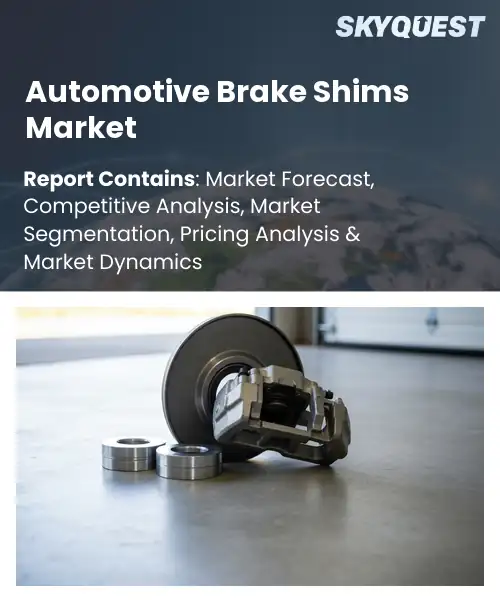
Automotive Brake Shims Market
Report ID: SQMIG20X2031
Report ID: SQMIG20X2031
[email protected]
USA +1 351-333-4748
Report ID:
SQMIG20X2031 |
Region:
Global |
Published Date: June, 2026
Pages:
157
|Tables:
141
|Figures:
78


Global Automotive Brake Shims Market size was valued at USD 6.9 Billion in 2024 and is poised to grow from USD 8.03 Billion in 2025 to USD 27.05 Billion by 2033, growing at a CAGR of 16.39% during the forecast period (2026-2033).
Automotive brake shims, those thin bits put between brake pads and caliper pistons, are like the quiet guards that soak up noise and keep vibration from getting too loud, and they’ve become integral to modern braking systems. They matter because they affect occupant comfort, the way braking performs, and how long the pads last. What pushed the market forward is the growing focus on noise, vibration and harshness control as cars got quieter and more polished, especially with electric and hybrid vehicles in the mix, since engine noise is reduced and there’s less “masking” for what the brakes might be doing.
Then, as adoption spread, the main factor accelerating the automotive brake shims market growth is the stronger need for real noise reduction in those quieter vehicle platforms. That pressure makes OEMs and tier suppliers demand higher performance shims, and it also pushes material innovation. Because of that, manufacturers are shifting away from simple steel plates toward layered composites and viscoelastic coatings, which can lead to measurable drops in brake squeal, and also improves perceived quality. This transition opens doors for specialty suppliers to win contracts, for aftermarket players to sell retrofit options for EV conversions, and for lightweight designs that cut unsprung mass, something that can support range improvements.
Brake shims work as a last line of defense against noise and vibration by isolating the pad from the caliper and damping high frequency energy. Now AI-driven tools are helping engineers move away from pure trial and error, and toward predictive design. Machine learning models can take vibration sensor readings and lab test outcomes to forecast squeal modes, then suggest material layer setups and pad attachment strategies. Plus simulation supported by AI speeds up the selection of damping foams and shim geometries, while inline inspection systems catch assembly variations that can trigger noise. These improvements are particularly relevant right now, because quieter electric vehicles raise customer expectations, and that pushes the market toward more “smarter” shim solutions.
Market snapshot - (2026-2033)
Global Market Size
USD 6.9 Billion
Largest Segment
Organic Brake Shims
Fastest Growth
Composite Brake Shims
Growth Rate
16.39% CAGR
To get more insights on this market click here to Request a Free Sample Report
The global automotive brake shims market is segmented by type of brake shims, vehicle type, distribution channel, material properties, application and region. Based on type of brake shims, the market is segmented into Organic Brake Shims, Metallic Brake Shims and Composite Brake Shims. Based on vehicle type, the market is segmented into Passenger Vehicles, Commercial Vehicles and Electric Vehicles. Based on distribution channel, the market is segmented into Online Sales and Offline Sales. Based on material properties, the market is segmented into Heat Resistance and Noise Reduction. Based on application, the market is segmented into OEM Applications and Aftermarket Applications. Based on region, the market is segmented into North America, Europe, Asia Pacific, Latin America and Middle East & Africa.
As per the automotive brake shims market analysis, the Organic Brake Shims segment leads, because organic constructions have this natural compliance and damping that lessen brake noise ,and vibration, which ends up matching OEM expectations for cabin comfort. Also their lower cost and the fact they are easier to form and mold means lots of adoption across passenger vehicle lines, plus compatibility with common pad materials makes the integration feel straightforward. In practice those things make manufacturers lean toward organic shims for volume use, keeping demand steady through supply chain efficiency and dependable performance during normal, everyday service.
On the other hand, metallic brake shims are picking up the fastest growth pace, because makers want stronger heat tolerance for heavier-duty and performance braking setups. Better bonding methods and surface coatings cut down thermal wear and tear, so expansion into commercial fleets and performance-focused vehicles becomes more realistic. This technical shift opens more chances for both aftermarket and OEM sales, and it tends to boost demand for higher spec shims too.
According to the automotive brake shims market forecast, the Passenger Vehicles segment is still the top player, largely because the installed base is big and production stays steady, so passenger demand becomes the main driver for brake shims. OEMs tend to favor cost-effective, NVH-reducing solutions that work well for comfort ,and also fit the mass market. That pushes standardization of shim materials and manufacturing processes, and it helps suppliers plan better. Plus there are broad aftermarket replacement cycles and fairly stable fleet sizes, which keeps procurement predictable, so suppliers can fine tune supply chains and product portfolios around passenger vehicle needs.
Still, electric vehicles are showing up as the most rapidly expanding part, mainly due to heavier vehicle mass, higher torque profiles, and the way noise stands out more in quieter cabins. Those pressures are speeding up development, with more advanced materials and thermal solutions, and that’s why OEMs and suppliers start offering specialized shims. As a result, new OEM and aftermarket opportunities are being created ,and the whole design direction shifts accordingly.
To get detailed segments analysis, Request a Free Sample Report
As per the automotive brake shims market regional forecast, Asia Pacific leads the market because of a mix of deep manufacturing habitats, very close spacing with major vehicle OEMs, and supplier networks that help firms ramp up fast, keep costs steady, and stay competitive. In the region, capabilities such as precision stamping, materials engineering , and surface treatments allow companies to offer a broad catalog of brake shim products that fit different vehicle types. Plus an established aftermarket, along with tightly connected supply chains, cuts lead times and makes it easier for quick product tweaks. More automation in the production process and joint, back-and-forth R&D with OEMs also pushes adoption of lighter and quieter shim variants. Add a strong engineering workforce and matured tooling supply, so prototyping and customization happen more quickly, while close relationships with raw material providers help stabilize input supply and keep export performance strong.
Japan Automotive Brake Shims Market
The Automotive Brake Shims sector in Japan benefits from a concentrated base of advanced automotive manufacturers, and from high precision tooling plus serious know how in materials, plus surface engineering. Tight coordination with vehicle OEMs leads to application specific solutions, especially around noise , vibration, and weight reduction. A well developed aftermarket with a very strict quality mindset helps deliver steady supply to both domestic assembly and export buyers. Continued investment in manufacturing automation, plus prototyping efforts, keeps the region competitive, particularly across key segments.
South Korea Automotive Brake Shims Market
The Automotive Brake Shims industry in South Korea is supported by strong component manufacturing clusters, solid metalworking skills, and a clear preference for lightweight design as well as acoustic output. Suppliers keep close connections with domestic vehicle makers and also with international OEMs, so they can deliver customized shim solutions. There’s a strong focus on process efficiency, surface treatment capabilities, and fast prototyping, which makes it easier to react when designs change. Also, linking into electric vehicle supply routes and aftermarket ecosystems increases regional production flexibility and makes global access smoother.
Europe is seeing a swift push in the automotive brake shims market, pushed by a mix of strict vehicle performance expectations, acoustic standards, and lots of premium manufacturer density. Supplier innovation is also active, especially around lightweighting and NVH improvement. The regional push toward advanced materials and precise engineering makes it possible to build tailored shims for a wide range of drivetrain platforms, including electrified setups that need different acoustic control. When manufacturers invest in local production and sync more closely with OEM development timelines, lead times drop, and customization increases. Aftermarket demand keeps growing, and there’s collaborative R&D between suppliers and technical centers, which means coating and surface treatment iterations come sooner. Finally, supplier consolidation and partnership strategies with tiered component players improve scale and distribution, which reinforces the market’s momentum.
Germany Automotive Brake Shims Market
The Automotive Brake Shims Market in Germany rests on a dense network of premium vehicle manufacturers, specialized suppliers, and active materials research. Engineering strength, together with close OEM cooperation, supports application specific solutions that emphasize acoustic refinement , durability, and long term reliability. Well established supplier ecosystems and precision tooling help maintain consistent production, plus support technical validation. The use of new coatings, along with lightweight substrate options, keeps Germany positioned as a key innovation, and supply hub for Europe wide brake shim demand.
United Kingdom Automotive Brake Shims Market
In the United Kingdom, the Automotive Brake Shims Market shows growing specialization around lightweight materials, acoustic engineering, and niche style component production. Collaboration between technical centers, suppliers, and vehicle manufacturers helps develop tailored shim solutions for performance oriented segments. Flexible production methods, plus strong aftermarket networks, supports the move from pilot concepts into commercialization of advanced coatings and bonding approaches. New clusters and partnerships, quietly forming, strengthen agility and create routes for adoption in both domestic markets and export channels.
France Automotive Brake Shims Market
The Automotive Brake Shims Market penetration in France is expanding in a more dynamic way, fueled by a strong focus on materials innovation, acoustic engineering, and tighter integration with electric platform strategies. A lively network of suppliers and technical centers helps accelerate development of advanced coatings and lightweight substrate builds. Close collaboration with automakers enables prototyping and application specific customization. At the same time, growing aftermarket participation, plus industrial initiatives, supports scaling manufacturing capabilities, and broadens access to regional clients and export driven channels.
North America seems to be firming up its standing in the automotive brake shims market, mainly by putting more money into advanced manufacturing, materials science, and a close-quarters collaboration between suppliers and vehicle makers. A lot of the attention goes to lighter substrates, better coating technologies, and acoustic tweaking, because vehicle layouts keep shifting, especially with electrified platforms that change how the braking system behaves in the first place. Then there is also the strategic reshoring, plus supplier diversification, which helps the supply chain stay steadier, and keeps production closer to where assembly actually happens, so development cycles can move faster. Meanwhile, a fairly mature aftermarket plus a handful of focused technical centers help teams repeat prototype designs and refine surface treatments with less delay. Working with research institutions pushes material improvement and lifecycle testing further along, and when service networks expand, aftermarket response gets quicker, making adoption of new shim architectures feel more natural.
United States Automotive Brake Shims Market
In the United States, the Automotive Brake Shims Market is influenced by dense OEM clusters, tier supplier networks and a strong base of technical know-how in materials and coatings. Suppliers typically use advanced stamping, coating, and bonding processes to satisfy tough acoustic and long-life durability targets. Dedicated R&D hubs, plus steady partnership with universities and colleges, speed up validation of lightweight substrates, and those surface treatments that are meant to reduce noise and wear. On top of that, aftermarket routes along with investments in automation back up production that’s both scalable and consistent, while still matching how vehicle architectures are evolving.
Canada Automotive Brake Shims Market
In Canada, the Automotive Brake Shims Market leans into precise metalworking, deep surface treatment know how, and ties to vehicle assembly operations. Suppliers concentrate on corrosion-resistant coating systems, stamping methods and bonding approaches that fit local climatic conditions. Collaboration with technical institutes, and cross border OEM programs, supports materials testing and qualification work without too many detours. With manufacturing footprints that can flex, and aftermarket service channels already in place, suppliers can better handle domestic assembly needs and still pursue export opportunities with dependable delivery and practical support.
To know more about the market opportunities by region and country, click here to
Buy The Complete Report
Rising Demand For Vehicle Safety
Growth In Electric Vehicle Adoption
Rising Material And Production Costs
Limited Standardization Across Markets
Request Free Customization of this report to help us to meet your business objectives.
In the global market for automotive brake shims, the competitive “push pull” comes from OEM NVH requirements and newer material know how, so companies start making bids, buying up rivals, adding capacity in quiet phases, and then leaning into supplier and OEM relationships. There are concrete launches like Wolverine Advanced Materials bringing out QUIETPATH shim materials, Meneta working on SmartStack shim technology, Trelleborg stretching its production line footprint, plus broader consolidation through acquisitions such as First Brands Group, where the intent feels clear.
Top Player’s Company Profile
Recent Developments in the Automotive Brake Shims Market
SkyQuest’s ABIRAW (Advanced Business Intelligence, Research & Analysis Wing) is our Business Information Services team that Collects, Collates, Correlates, and Analyses the Data collected by means of Primary Exploratory Research backed by robust Secondary Desk research.
As per SkyQuest analysis, the global automotive brake shims market is being driven by rising emphasis on nv h management, and there’s also a second driver: the quick uptake of electric vehicles, which ups the need for advanced, thermally stable shims. Still, rising material and production costs act like a noticeable restraint, and that can slow down the adoption of premium solutions. Asia Pacific is staying in front, mainly because of deep manufacturing ecosystems and close ties to OEMs. In terms of product type, organic brake shims are dominating , partly due to inherent damping, cost advantages and how widely they’re used in passenger vehicles. Overall, suppliers that can juggle material innovation with cost control and solid OEM collaboration are in the best position to capture the growth.
| Report Metric | Details |
|---|---|
| Market size value in 2024 | USD 6.9 Billion |
| Market size value in 2033 | USD 27.05 Billion |
| Growth Rate | 16.39% |
| Base year | 2024 |
| Forecast period | (2026-2033) |
| Forecast Unit (Value) | USD Billion |
| Segments covered |
|
| Regions covered | North America (US, Canada), Europe (Germany, France, United Kingdom, Italy, Spain, Rest of Europe), Asia Pacific (China, India, Japan, Rest of Asia-Pacific), Latin America (Brazil, Rest of Latin America), Middle East & Africa (South Africa, GCC Countries, Rest of MEA) |
| Companies covered |
|
| Customization scope | Free report customization with purchase. Customization includes:-
|
To get a free trial access to our platform which is a one stop solution for all your data requirements for quicker decision making. This platform allows you to compare markets, competitors who are prominent in the market, and mega trends that are influencing the dynamics in the market. Also, get access to detailed SkyQuest exclusive matrix.
Table Of Content
Executive Summary
Market overview
Parent Market Analysis
Market overview
Market size
KEY MARKET INSIGHTS
COVID IMPACT
MARKET DYNAMICS & OUTLOOK
Market Size by Region
KEY COMPANY PROFILES
Methodology
For the Automotive Brake Shims Market, our research methodology involved a mixture of primary and secondary data sources. Key steps involved in the research process are listed below:
1. Information Procurement: This stage involved the procurement of Market data or related information via primary and secondary sources. The various secondary sources used included various company websites, annual reports, trade databases, and paid databases such as Hoover's, Bloomberg Business, Factiva, and Avention. Our team did 45 primary interactions Globally which included several stakeholders such as manufacturers, customers, key opinion leaders, etc. Overall, information procurement was one of the most extensive stages in our research process.
2. Information Analysis: This step involved triangulation of data through bottom-up and top-down approaches to estimate and validate the total size and future estimate of the Automotive Brake Shims Market.
3. Report Formulation: The final step entailed the placement of data points in appropriate Market spaces in an attempt to deduce viable conclusions.
4. Validation & Publishing: Validation is the most important step in the process. Validation & re-validation via an intricately designed process helped us finalize data points to be used for final calculations. The final Market estimates and forecasts were then aligned and sent to our panel of industry experts for validation of data. Once the validation was done the report was sent to our Quality Assurance team to ensure adherence to style guides, consistency & design.
Analyst Support
Customization Options
With the given market data, our dedicated team of analysts can offer you the following customization options are available for the Automotive Brake Shims Market:
Product Analysis: Product matrix, which offers a detailed comparison of the product portfolio of companies.
Regional Analysis: Further analysis of the Automotive Brake Shims Market for additional countries.
Competitive Analysis: Detailed analysis and profiling of additional Market players & comparative analysis of competitive products.
Go to Market Strategy: Find the high-growth channels to invest your marketing efforts and increase your customer base.
Innovation Mapping: Identify racial solutions and innovation, connected to deep ecosystems of innovators, start-ups, academics, and strategic partners.
Category Intelligence: Customized intelligence that is relevant to their supply Markets will enable them to make smarter sourcing decisions and improve their category management.
Public Company Transcript Analysis: To improve the investment performance by generating new alpha and making better-informed decisions.
Social Media Listening: To analyze the conversations and trends happening not just around your brand, but around your industry as a whole, and use those insights to make better Marketing decisions.
REQUEST FOR SAMPLE
 REQUEST FREE CUSTOMIZATION
Global Automotive Brake Shims Market size was valued at USD 6.9 Billion in 2024 and is poised to grow from USD 8.03 Billion in 2025 to USD 27.05 Billion by 2033, growing at a CAGR of 16.39% during the forecast period (2026-2033).
Competitive dynamics in the global automotive brake shims market are driven by OEM NVH specifications and material innovation, prompting acquisitions, capacity expansions, and supplier and OEM partnerships. Concrete moves include Wolverine Advanced Materials launching QUIETPATH shim materials, Meneta developing SmartStack shim technology, Trelleborg expanding production lines, and industry consolidation via acquisitions such as First Brands Group. 'Federal-Mogul', 'Rassini', 'Tenneco', 'Randon', 'Brembo', 'Akebono Brake Corporation', 'WABCO', 'TRW Automotive', 'Raybestos', 'Dayco', 'ACDelco', 'Centric Parts', 'Carquest', 'Nisshinbo Brake', 'Honeywell (Bendix)', 'HuaHua Industrial', 'Midas', 'EBC Brakes', 'Dura International', 'Wagner Brake'
Brake shims reduce noise, vibration, and harshness in braking systems, improving perceived vehicle safety and comfort. As consumers and manufacturers prioritize quieter, smoother braking performance, demand for higher quality shims grows because they ensure consistent pad alignment and reduce wear on brake components. Suppliers respond by enhancing materials and coatings to meet OEM specifications, and aftermarket channels expand offerings to satisfy repair and upgrade needs. This focus on safety and refinement directly supports market expansion through broader adoption across vehicle segments and replacement cycles.
Nvh Optimization Focus: Manufacturers and suppliers are prioritizing brake shim designs that reduce noise, vibration and harshness across segments. Emphasis on tailored geometry, enhanced adhesive bonding and multilayer constructions is driving collaboration between OEMs and material specialists to meet evolving cabin comfort standards. This focus encourages investments in prototyping and acoustic testing as differentiators, while enabling positioning for quiet braking systems. Suppliers that can offer validated solutions integrating coatings and dampers gain strategic advantage as consumer expectations and regulatory scrutiny around quality intensify.
Why does Asia Pacific Dominate the Global Automotive Brake Shims Market? |@12


Want to customize this report? This report can be personalized according to your needs. Our analysts and industry experts will work directly with you to understand your requirements and provide you with customized data in a short amount of time. We offer $1000 worth of FREE customization at the time of purchase.
Feedback From Our Clients


 USA (+1) 351-333-4748

