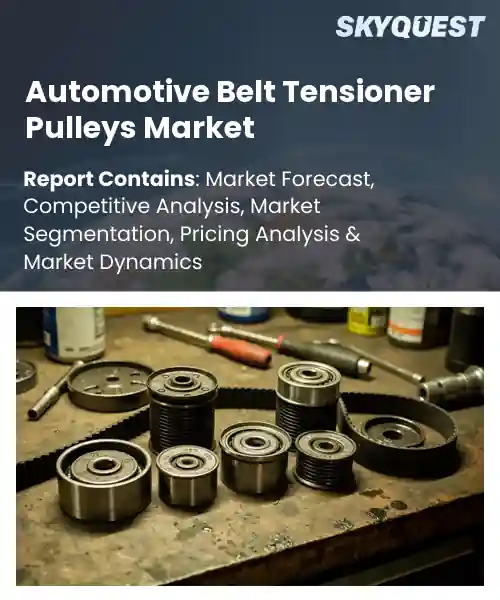
Automotive Belt Tensioner Pulleys Market
Report ID: SQMIG25A2815
Report ID: SQMIG25A2815
[email protected]
USA +1 351-333-4748
Report ID:
SQMIG25A2815 |
Region:
Global |
Published Date: July, 2026
Pages:
157
|Tables:
145
|Figures:
78


Global Automotive Belt Tensioner Pulleys Market size was valued at USD 355.90 Million in 2024 and is poised to grow from USD 372.63 Million in 2025 to USD 538.08 Million by 2033, growing at a CAGR of 4.7% during the forecast period (2026-2033).
The global automotive belt tensioner pulleys market trends includes manufacturers of components that maintain the correct belt tension for engine accessories such as alternators, water pumps and air-conditioning compressors. It’s important because of the direct impact on engine efficiency, fuel consumption and emissions compliance, a critical link in vehicle reliability. The market has grown over the last 20 years as electronic engine control systems have required tighter tolerance and longer service intervals. For example, the shift to serpentine-belt systems from V-belt designs in the early 2000s necessitated the use of actively controlled tensioners by automakers, leading to an increase in demand for high-precision pulleys across the globe.
One of the major automotive belt tensioner pulleys market growth drivers is the adoption of electrified powertrains, which require belt management to synchronize auxiliary systems in hybrid and mild-hybrid architectures. With manufacturers switching to electric motors instead of old-style compressors, they need to redesign tensioners to cope with higher rotational speeds and less lubrication. That opens the door for lightweight, alloy-based pulleys with embedded sensors. This technical transition creates opportunities for suppliers that can incorporate IoT connectivity, allowing fleet operators to track belt wear and conduct predictive maintenance. Thus manufacturers embedding such smart tensioners will be able to enjoy lower warranty costs and benefits of service networks in terms of data-driven scheduling, expediting market adoption across emerging economies across the world.
How is AI-driven Automation Influencing the Automotive Belt Tensioner Pulleys Market?
Intelligent control and data-rich manufacturing processes are powering AI-driven automation to transform the automotive belt tensioner pulleys market share. Machine learning algorithms predict wear patterns, enabling designers to fine-tune pulley geometry before tooling. Robotic assembly with the use of vision systems on production lines is used for accurate positioning and torque to minimize scrap. Each unit connects to cloud analytics through real-time monitoring, giving fleet operators alerts to initiate predictive maintenance and lengthen service intervals. These capabilities reduce total cost of ownership and increase the attractiveness of pulleys for hybrid and electric vehicles, speeding adoption among OEMs and aftermarket suppliers.
Schaeffler April 2025, launched an electronically controlled tensioner for hybrid electric vehicles with adaptive damping that uses artificial intelligence algorithms to adjust the tension in real time. The smart system increases efficiency and reliability, which in turn drives market growth by incorporating advanced automation into global supply chains and vehicle platforms.
Market snapshot - (2026-2033)
Global Market Size
USD 355.9 Million
Largest Segment
Automatic Belt Tensioner Pulleys
Fastest Growth
Hydraulic Belt Tensioner Pulleys
Growth Rate
4.7% CAGR
To get more insights on this market click here to Request a Free Sample Report
Global automotive belt tensioner pulleys market is segmented by product design, material type, vehicle type, propulsion type, sales channel and region. Based on product design, the market is segmented into automatic belt tensioner pulleys, manual belt tensioner pulleys and hydraulic belt tensioner pulleys. Based on material type, the market is segmented into steel pulleys, aluminum pulleys, plastic pulleys and polymeric pulleys. Based on vehicle type, the market is segmented into passenger cars, light commercial vehicles, heavy commercial vehicles and two-wheelers. Based on propulsion type, the market is segmented into internal combustion engine vehicles, hybrid vehicles and electric vehicles. Based on sales channel, the market is segmented into original equipment manufacturer and aftermarket. Based on region, the market is segmented into North America, Europe, Asia Pacific, Latin America and Middle East & Africa.
The automatic belt tensioner pulleys segment dominates the market due to its self-adjusting mechanism, which eliminates the need for manual intervention and ensures consistent belt tension under different operating conditions. Consistent with the OEM's focus on durability and low lifecycle cost, this reliability reduces wear on belts and downstream components. Its integrated tensioning intelligence streamlines assembly lines, speeding up vehicle production while delivering on tough performance requirements strengthening its market leadership and accommodating evolving powertrain architectures throughout.
However, manual belt tensioner pulleys segment is seeing highest growth momentum as manufacturers look for cost effective solutions for entry level models and aftermarket refurbishments. Easier to design, easier to retrofit, this will then appeal to repair shops and low cost vehicle platforms, which will increase the market and provide new opportunities for suppliers of components in the wider supply chain.”
The aluminum pulleys segment is the largest, thanks to its light weight that directly reduces the weight of the vehicle, a key lever to improve fuel efficiency and electric range. This alloy offers high corrosion resistance and good machinability allowing designers to create complex shapes without sacrificing strength. This alignment of strict emission targets and performance goals positions aluminum as the material of choice for OEMs and aftermarket players across multiple vehicle platforms through the product lifecycle.
The polymeric pulleys segment is emerging as the key high growth segment with automotive engineers seeking vibration damping solutions and further weight savings for next generation vehicles. Advanced polymers provide inherent noise reduction and corrosion immunity as well as the ability to be injection molded into complex geometries at low cost, allowing for rapid design cycles and meeting consumer expectations for quiet, durable powertrain components.
To get detailed segments analysis, Request a Free Sample Report
The Asia Pacific region dominates the global automotive belt tensioner pulleys market, due to its strong engineering capabilities, well-established manufacturing bases, and emphasis on lightweight and fuel-efficient vehicle technologies. Japan and South Korea tier-one suppliers are constantly innovating materials and machining processes to deliver high-performance solutions that meet demanding OEM specifications. Close integration between original equipment manufacturers and component manufacturers speeds up product development cycles and enables rapid adoption of advanced designs. Large domestic car assemblers generate constant demand for locally produced parts and manufacturing catering to exports benefits from cheaper supply chains. This reputation for quality and reliability in the region is enhanced by a strong commitment to R&D and a culture of continuous improvement that has cemented its dominant position in the market.
Automotive belt tensioner pulleys market outlook in Japan benefits from a tightly integrated supplier network that aligns closely with major vehicle manufacturers. Advanced machining capabilities and a legacy of precision engineering enable Japanese firms to produce components that meet exacting durability standards. Ongoing collaboration between automotive OEMs and component makers fosters rapid incorporation of new design concepts, reinforcing Japan’s reputation as a hub for high‑quality belt tensioner solutions.
Automotive belt tensioner pulleys market forecast in South Korea is propelled by a strong emphasis on advanced material science and innovative manufacturing techniques. Korean suppliers leverage sophisticated coating processes and precision stamping to create pulleys that support higher torque capacities while reducing weight. Strategic partnerships with global automotive brands encourage the transfer of technology and the adoption of stringent quality benchmarks. This synergy between research institutions and industry accelerates product refinement, positioning South Korea as a key contributor to the region’s market leadership.
The North America automotive belt tensioner pulleys market is projected to witness rapid growth, owing to a combination of factors such as the increasing demand for high efficiency power train systems and a growing focus on enhancing vehicle reliability. In the US and Canada, OEMs are concentrating on components that facilitate lower emissions and improved fuel economy, thus driving the uptake of sophisticated pulley designs. There’s a wide range of specialty manufacturers offering customized solutions for all vehicle platforms, from light trucks to luxury sedans. Collaborative engineering programs between automakers and tier-one suppliers accelerate the adoption of innovative materials and manufacturing techniques. Supportive trade policies and focus on domestic sourcing further bolster the market’s momentum, making North America a key growth engine.
Automotive belt tensioner pulleys market regional outlook in the United States is characterized by a robust ecosystem of original equipment manufacturers and specialist component firms that emphasize performance and durability. Investment in advanced casting and machining technologies enables producers to meet exacting standards for a wide range of vehicle classes. Close collaboration between design engineers and suppliers accelerates the rollout of next‑generation pulley configurations that enhance engine efficiency. The domestic focus on supply chain resilience also encourages the adoption of locally sourced components, strengthening the overall market trajectory.
Automotive belt tensioner pulleys market regional forecast in Canada benefits from a collaborative environment that links automotive manufacturers with high‑precision component makers. Emphasis on engineering excellence and stringent quality controls drives the production of pulleys suited for both conventional and emerging powertrain architectures. Partnerships with research institutions support the development of lightweight, corrosion‑resistant solutions that align with Canada’s focus on sustainable mobility. This combination of technical expertise and strategic alignment bolsters Canada’s role in the broader North American market expansion.
Europe is bolstering its stance in the automotive belt tensioner pulleys market through a mix of rigorous engineering standards, a lengthy legacy of automotive manufacturing, and a forward-looking stance towards greener mobility solutions. Across the UK and France and in Germany, key automotive hubs are innovating by blending precision metallurgy with leading-edge design methodologies. Cooperative structures between OEMs and tier-one suppliers facilitate fast deployment of lightweight, high-strength pulleys that comply with stringent emissions and efficiency targets. Strict regulatory environments push constant improvements in component durability and performance, while investment in digital manufacturing improves production agility. This joint effort among major European economies highlights the region’s reputation for quality and technological leadership.
Automotive belt tensioner pulleys market analysis in Germany is anchored by a tradition of precision engineering and a network of manufacturers that specialize in high‑performance components. Integration of advanced finite element analysis and automated production lines enables German firms to deliver pulleys with superior torque handling and reduced mass. Close collaboration with vehicle makers facilitates early inclusion of innovative materials that support fuel‑efficiency goals. The emphasis on stringent testing and compliance ensures that German‑made pulleys meet the exacting reliability expectations of both domestic and global automotive brands.
Automotive belt tensioner pulleys market penetration in the United Kingdom benefits from a strong focus on research and development within its automotive supply chain. Universities and industry research centers collaborate with component manufacturers to explore novel alloy compositions and coating technologies. This innovation pipeline yields pulleys that combine durability with weight savings, aligning with the UK’s strategic emphasis on reducing vehicle emissions. Close partnerships with major car producers enable swift integration of these advancements into production schedules, reinforcing the United Kingdom’s reputation for engineering excellence.
Automotive belt tensioner pulleys industry in France is driven by a commitment to high‑quality manufacturing and a growing emphasis on sustainable vehicle platforms. French component suppliers adopt sophisticated surface treatment processes that enhance wear resistance while minimizing mass. Collaborative projects with automotive OEMs focus on tailoring pulley designs to meet evolving powertrain architectures, including hybrid and electric configurations. This synergy between design innovation and production expertise fortifies France’s contribution to Europe’s advancing position in the global market.
To know more about the market opportunities by region and country, click here to
Buy The Complete Report
Rising Adoption Of Lightweight Materials
Integration Of Electronic Control Systems
Escalating Raw Material Costs
Stringent Environmental Regulations
Request Free Customization of this report to help us to meet your business objectives.
The competitive landscape of the automotive belt tensioner pulley market is characterized by strong competition among established automotive component manufacturers, with innovation focused on lightweight materials, improved bearing durability, noise and vibration reduction, and solutions supporting hybrid and electric vehicle platforms. Leading companies are strengthening their market positions through strategic acquisitions, expansion of aftermarket product portfolios, and investments in advanced manufacturing and electrified powertrain technologies. Increasing demand for high-efficiency front-end accessory drive (FEAD) systems and longer component life continues to drive product development and global OEM partnerships.
Top Player’s Company Profile
Recent Developments in the Automotive Belt Tensioner Pulleys Market
SkyQuest’s ABIRAW (Advanced Business Intelligence, Research & Analysis Wing) is our Business Information Services team that Collects, Collates, Correlates, and Analyses the Data collected by means of Primary Exploratory Research backed by robust Secondary Desk research. As per SkyQuest analysis the global automotive belt tensioner pulleys market is being propelled primarily by the rising adoption of lightweight materials, which help manufacturers meet fuel‑efficiency and emission targets, while a second strong catalyst is the integration of electronic control systems that enable real‑time tension adjustment and predictive maintenance. The automatic belt tensioner pulley segment leads the market because its self‑adjusting design cuts wear and simplifies assembly, and Asia‑Pacific dominates supply and demand thanks to its mature engineering base and extensive OEM networks. However, escalating raw‑material costs pose a restraint, pressuring margins and potentially slowing the rollout of advanced pulley designs.
| Report Metric | Details |
|---|---|
| Market size value in 2024 | USD 355.9 Million |
| Market size value in 2033 | USD 538.08 Million |
| Growth Rate | 4.7% |
| Base year | 2024 |
| Forecast period | (2026-2033) |
| Forecast Unit (Value) | USD Million |
| Segments covered |
|
| Regions covered | North America (US, Canada), Europe (Germany, France, United Kingdom, Italy, Spain, Rest of Europe), Asia Pacific (China, India, Japan, Rest of Asia-Pacific), Latin America (Brazil, Rest of Latin America), Middle East & Africa (South Africa, GCC Countries, Rest of MEA) |
| Companies covered |
|
| Customization scope | Free report customization with purchase. Customization includes:-
|
To get a free trial access to our platform which is a one stop solution for all your data requirements for quicker decision making. This platform allows you to compare markets, competitors who are prominent in the market, and mega trends that are influencing the dynamics in the market. Also, get access to detailed SkyQuest exclusive matrix.
Table Of Content
Executive Summary
Market overview
Parent Market Analysis
Market overview
Market size
KEY MARKET INSIGHTS
COVID IMPACT
MARKET DYNAMICS & OUTLOOK
Market Size by Region
KEY COMPANY PROFILES
Methodology
For the Automotive Belt Tensioner Pulleys Market, our research methodology involved a mixture of primary and secondary data sources. Key steps involved in the research process are listed below:
1. Information Procurement: This stage involved the procurement of Market data or related information via primary and secondary sources. The various secondary sources used included various company websites, annual reports, trade databases, and paid databases such as Hoover's, Bloomberg Business, Factiva, and Avention. Our team did 45 primary interactions Globally which included several stakeholders such as manufacturers, customers, key opinion leaders, etc. Overall, information procurement was one of the most extensive stages in our research process.
2. Information Analysis: This step involved triangulation of data through bottom-up and top-down approaches to estimate and validate the total size and future estimate of the Automotive Belt Tensioner Pulleys Market.
3. Report Formulation: The final step entailed the placement of data points in appropriate Market spaces in an attempt to deduce viable conclusions.
4. Validation & Publishing: Validation is the most important step in the process. Validation & re-validation via an intricately designed process helped us finalize data points to be used for final calculations. The final Market estimates and forecasts were then aligned and sent to our panel of industry experts for validation of data. Once the validation was done the report was sent to our Quality Assurance team to ensure adherence to style guides, consistency & design.
Analyst Support
Customization Options
With the given market data, our dedicated team of analysts can offer you the following customization options are available for the Automotive Belt Tensioner Pulleys Market:
Product Analysis: Product matrix, which offers a detailed comparison of the product portfolio of companies.
Regional Analysis: Further analysis of the Automotive Belt Tensioner Pulleys Market for additional countries.
Competitive Analysis: Detailed analysis and profiling of additional Market players & comparative analysis of competitive products.
Go to Market Strategy: Find the high-growth channels to invest your marketing efforts and increase your customer base.
Innovation Mapping: Identify racial solutions and innovation, connected to deep ecosystems of innovators, start-ups, academics, and strategic partners.
Category Intelligence: Customized intelligence that is relevant to their supply Markets will enable them to make smarter sourcing decisions and improve their category management.
Public Company Transcript Analysis: To improve the investment performance by generating new alpha and making better-informed decisions.
Social Media Listening: To analyze the conversations and trends happening not just around your brand, but around your industry as a whole, and use those insights to make better Marketing decisions.
REQUEST FOR SAMPLE
 REQUEST FREE CUSTOMIZATION
Global Automotive Belt Tensioner Pulleys Market size was valued at USD 355.9 Million in 2024 and is poised to grow from USD 372.63 Million in 2025 to USD 538.08 Million by 2033, growing at a CAGR of 4.7% during the forecast period (2026-2033).
The competitive landscape is shaped by intense rivalry among tier‑1 suppliers and emerging specialists, driving accelerated innovation in lightweight materials and integrated sensor technology. Recent M&A activity, such as a major supplier acquiring a niche pulley‑design firm, and strategic partnerships linking OEMs with digital‑control startups, are sharpening product differentiation and expanding after‑market service networks. These moves reflect the market’s push to meet higher efficiency standards and electrification‑related belt‑system demands. 'Gates Industrial Corporation plc', 'Schaeffler AG', 'SKF', 'Dayco IP Holdings LLC', 'Continental AG', 'Nippon Thompson Co. Ltd.', 'NSK Ltd.', 'NTN Corporation', 'GMB Corporation', 'Koyo Seiko Co. Ltd.', 'Litens Automotive Group', 'MBL Asahi India Corporation', 'Cloyes Gear and Products Inc.', 'ACDelco', 'FEBI Bilstein', 'Dorman Products Inc.', 'Flennor GmbH', 'Ina Bearing Company', 'Torrington Company', 'Hutchinson SA'
The automotive industry seeks to improve fuel efficiency and reduce emissions, prompting manufacturers to replace traditional steel components with lighter alloys and composites. Lightweight belt tensioner pulleys contribute to overall weight reduction while maintaining durability, allowing vehicle designs to meet stricter regulatory standards. As OEMs prioritize these performance goals, demand for advanced pulley solutions escalates, encouraging suppliers to innovate and expand production capacities. This shift creates a favorable environment for market growth, driven by continuous interest in sustainable vehicle engineering.
Advanced Material Adoption: The shift toward lightweight, high‑strength alloys and composite materials is reshaping belt tensioner pulley design. Manufacturers are investing in R&D to replace traditional steel with aluminum‑based or carbon‑reinforced components, delivering weight reductions that improve overall vehicle efficiency and fuel consumption. These material innovations also enhance corrosion resistance and durability, aligning with automakers’ goals for longer service intervals and reduced maintenance costs, while supporting broader industry moves toward sustainability and performance optimization through strategic collaboration with material suppliers and advanced testing protocols.
Why does Asia Pacific Dominate the Global Automotive Belt Tensioner Pulleys Market? |@12


Want to customize this report? This report can be personalized according to your needs. Our analysts and industry experts will work directly with you to understand your requirements and provide you with customized data in a short amount of time. We offer $1000 worth of FREE customization at the time of purchase.
Feedback From Our Clients


 USA (+1) 351-333-4748

