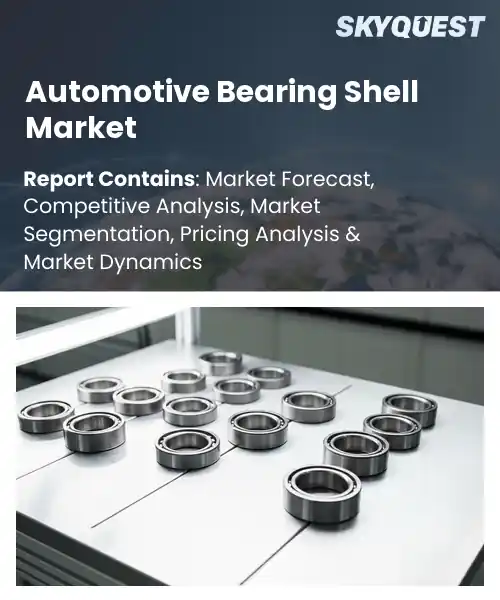
Automotive Bearing Shell Market
Report ID: SQMIG20C2181
Report ID: SQMIG20C2181
[email protected]
USA +1 351-333-4748
Report ID:
SQMIG20C2181 |
Region:
Global |
Published Date: February, 2026
Pages:
157
|Tables:
139
|Figures:
78


Global Automotive Bearing Shell Market size was valued at USD 1.7 Billion in 2024 and is poised to grow from USD 2.03 Billion in 2025 to USD 8.26 Billion by 2033, growing at a CAGR of 19.2% during the forecast period (2026-2033).
The automotive bearing shell market has been primarily driven by the need for better engine performance and life due to stricter emissions regulations and longer expected vehicle lives. Bearing shells are thin, layered components that support crankshafts and connecting rods. Their characteristics directly affect the friction, wear, and thermal management of a power train.
A large factor augmenting the need for automotive bearing shells is the diversification of powertrains. Suppliers are being forced to innovate as the new trends of smaller turbo engines and hybrids need to perform at high speeds for longer periods. More suppliers are investing in new metals and increasing their manufacturing capacity because of the precision required for tri-metal bearings and special coatings. The overall increase in the number of vehicles in use today and the increasing average age of vehicles creates an aftermarket opportunity. Where a fleet has reliable bearing shells, they can lower their overall warranty costs by using them to extend the life of their engines. This interplay of cause-and-effect drives a large increase in demand for customized metal alloys, quality assurance processes, and partnerships with original equipment manufacturers (OEMs) that ultimately lower total cost to the fleet.
In the automotive bearing shell market, AI is helping improve quality control by creating repeatable inspection workflows with machine vision, anomaly detection, and process analytics. Key examples include using automated surface imaging to detect small defects; continuously monitoring the process for drift; and (iii) providing data-driven feedback to narrow manufacturing tolerances. Currently, many suppliers are adopting edge cameras and cloud analytics to increase throughput and reduce scrap. Additionally, due to market demand for longer lasting, quieter bearings and tighter assembly tolerances, there is an increased interest in AI technologies.
Market snapshot - (2026-2033)
Global Market Size
USD 1.7 Billion
Largest Segment
Engine Bearing Shells
Fastest Growth
Engine Bearing Shells
Growth Rate
19.2% CAGR
To get more insights on this market click here to Request a Free Sample Report
Global automotive bearing shell market is segmented into product type, material type, vehicle type, end-use industry, sales channel and region. Based on product type, the market is segmented into engine bearing shells and transmission bearing shells. based on material type, the market is segmented into metal bearings and non-metal bearings. Based on vehicle type, the market is segmented into passenger vehicles and commercial vehicles. Based on end-use industry, the market is segmented into automotive manufacturing and aerospace manufacturing. Based on sales channel, the market is segmented into direct sales and online sales. Based on region, the market is segmented into North America, Europe, Asia Pacific, Latin America and Middle East & Africa.
As per the automotive bearing shell market outlook, engine bearing shells segment dominates because they are critical to internal combustion engine reliability and performance, commanding deep integration with engine design and OEM validation processes. Manufacturers require extreme precision to meet OEM´s specifications, as well as use approved materials, and ensure compatibility with advanced lubricating oils which leads to consistent demand for both OEM and aftermarket product applications. The longevity of the supply chain connections, high levels of engineering requirements, and the emphasis placed on the requested long-term durability of the engine will continue to make investments into manufacturing and product quality control desired, thereby maintaining ongoing market leadership position.
As per the automotive bearing shell market forecast, transmission bearing shells are rapidly increasing as automatic and hybrid drivetrains are creating demand for increased capacity and higher wear characteristics. Advances in low-friction coated bearing products combined with the use of lighter weight alloys create opportunities for improving overall efficiency and shifting performance thereby, creating new OEM and aftermarket opportunities to further expedite automotive bearing shell market growth and product diversification.
As per the automotive bearing shell market analysis, metal bearings segment dominates because metallic alloys provide the strength, fatigue resilience and thermal stability required by conventional automotive powertrains, making them the default choice for OEMs and heavy duty applications. Metal bearings continue to be the primary material option used in automotive powertrains due to a significant amount of technical backup from rigorous material science, long supplier qualification cycles, and economical high-volume production.
The non-metal bearings segment is rapidly growing due to the advent and increasing adoption of polymer composites and ceramics in vehicle design for weight savings and reduced friction. Given their weight savings, NVH performance, and ease of manufacture, OEMs will continue to gravitate toward materials that foster a focus on efficiency, leading to further development of new material technologies, and consequently leading to new aftermarket applications, which in turn will create expanded opportunities across the marketplace as these products are utilized.
To get detailed segments analysis, Request a Free Sample Report
Asia Pacific dominates due to a convergence of integrated manufacturing ecosystems, established automotive original equipment manufacturers, and a dense network of specialized component suppliers that support scale and innovation. Regional strength comes from deep supplier tiers, strong linkage between raw material processors and component fabricators, and cost competitive production that facilitates both domestic vehicle assembly and export oriented supply. Strategic focus on material science, process automation, and adoption of advanced finishing techniques increases product consistency and lifecycle performance. Governmental industrial support and proximity to key markets enable rapid product qualification cycles. Combined with robust aftermarket networks and continuous engineering collaboration, the region sustains leadership in both conventional and evolving powertrain applications, reinforcing its central role in global value chains effectively.
Automotive Bearing Shell Market in Japan is characterized by advanced engineering capability, close collaboration between OEMs and component manufacturers, and strong emphasis on material innovation and precision manufacturing. Suppliers benefit from robust quality systems, integration with powertrain and electric vehicle development, and a focus on long term reliability. Domestic demand complemented by export oriented supply chains sustains specialized production clusters and continuous incremental improvements in production efficiency and alloy development.
Automotive Bearing Shell Market in South Korea is driven by strong integration with vehicle manufacturers, rapid adoption of advanced manufacturing technologies, and a focus on lightweighting and performance. Local suppliers are increasingly aligned with electrified powertrain programs, leveraging efficient production systems and skilled talent. Collaborative research between industry and institutes supports material development and testing capabilities, enabling flexible supply networks that respond to both domestic assembly requirements and export opportunities.
Rapid expansion in Europe is propelled by proximity to premium vehicle manufacturers, strong research and development ecosystems, and regulatory emphasis on efficiency and emissions that stimulates component innovation. Germany serves as a central engineering hub with deep supplier networks and advanced metallurgical capabilities, while the United Kingdom shows agility in adopting novel materials and lightweighting for next generation powertrains. France contributes through coordinated industrial policy and growing emphasis on electrified mobility. Cross border collaboration, emphasis on quality certification, and supplier specialization underpin faster product refinement and market responsiveness. Investment in precision machining, heat treatment, and surface engineering, together with a mature aftermarket and supplier consolidation, strengthens regional competitiveness and accelerates new technology adoption across vehicle segments and supports export potential.
Automotive Bearing Shell Market in Germany benefits from engineering expertise, integrated supplier networks, and close OEM collaboration. Strong emphasis on metallurgical development, stringent testing standards, and precision machining supports production of high reliability components. Local clusters enable specialization in alloys and advanced finishing techniques, while linkage with powertrain programs accelerates product qualification. Continuous investment in process control and automation solidifies Germany position as a source of bearing shell technologies globally.
Automotive Bearing Shell Market in United Kingdom features rapid adoption of novel materials, a strong engineering sector, and agile supplier models that enable fast prototyping and validation. Focus on lightweighting and electrified powertrain integration increases demand for specialized bearing solutions. Collaboration between research institutions and manufacturers accelerates material qualification and surface engineering. Flexible footprints and export orientation allow suppliers to scale capabilities and capture opportunities across premium, niche vehicle segments.
Automotive Bearing Shell Market in France is evolving through collaboration with research centers and manufacturing upgrades. Emphasis on electrified mobility and standardization creates demand for refined bearing solutions and advanced surface treatments. Local suppliers modernize production and expand testing to meet performance expectations. Integration with regional supply chains and investment in material innovation position France as an emerging source of differentiated bearing shell offerings addressing OEM and aftermarket quality requirements.
North America is strengthening its position through a combination of advanced manufacturing adoption, closer alignment between OEMs and domestic suppliers, and strategic investments in material development and surface engineering. Emphasis on reshoring critical component production has encouraged capacity upgrades, automation, and tighter quality control practices. The region benefits from extensive aftermarket demand and integrated logistics that support rapid part availability and serviceability. Collaborative programs between industry and research institutions accelerate validation of new alloys, coatings, and finishing processes suited for electrified and high performance applications. Supplier consolidation and targeted investment in precision machining and heat treatment capabilities enable faster product qualification cycles. Together, these dynamics enhance supply chain resilience and allow North America to compete effectively across both mainstream and specialized vehicle segments.
Automotive Bearing Shell Market in United States is supported by broad OEM base, extensive aftermarket channels, and significant focus on advanced manufacturing technologies. Suppliers concentrate on precision machining, heat treatment, and coating processes to meet stringent durability and performance requirements. Close collaboration with vehicle manufacturers accelerates integration for electrified and performance applications. Investment in testing infrastructure, automation, and supply chain resilience enables scale up and responsiveness to domestic demand effectively.
Automotive Bearing Shell Market in Canada features specialized suppliers, strong metallurgical research, and integration with regional vehicle assembly operations. Focus on production flexibility, quality assurance, and advanced finishing supports OEM and aftermarket requirements. Suppliers collaborate with technical institutes to validate alloy and coating solutions. Modernization of manufacturing assets and emphasis on process control enhance ability to supply differentiated bearing shells for varied powertrain applications while leveraging proximity to logistics corridors.
To know more about the market opportunities by region and country, click here to
Buy The Complete Report
Rising Electric Vehicle Adoption
With the increase in the traction of and/or transition to electric vehicles within global fleets, it is anticipated that there will also be an increase in the demand for specific bearing shells to meet the unique load, speed and thermal requirements of electric drivetrains. These unique requirements lead to manufacturers developing bearings that are optimized for quiet operation, very high RPM's and greater thermal dissipation; thereby allowing for both product diversification and supplier specialization. This change in the marketplace provides all suppliers the opportunity to invest in new materials and production processes, increases the opportunity for component suppliers, and aids in collaboration between OEM's and bearing producers to meet the changing performance and durability expectations of their customers.
Automotive Electrification of Powertrain
With respect to the electrification of the powertrain; the required characteristics for the bearing shell are being redefined due to the change in torque delivery, rotational profiles, and operational conditions; therefore, there is an ever-increasing demand for parts capable of supporting continuous high-speed operational capabilities, with unique lubrication types. Suppliers that are willing to innovate in coatings, alloys, and geometries will find greater opportunity because OEMs are placing a premium on/greater emphasis on durability and noise reduction for electric and hybrid applications. The transition to electric/hybrid platforms is encouraging greater joint efforts between design and material science; creating longer-term commitments to suppliers; and increasing the overall importance placed upon testing and validation; thus, ensuring that those manufacturers that proactively adapt their products to an ever-changing powertrain architecture and performance priorities will experience continued growth.
Volatile Raw Material Availability
Variability in the availability and reliability of raw materials creates procurement uncertainty, ultimately hindering expansion because of limiting the ability to plan production and have adequate capacity to operate. Manufacturers may experience a lack of availability or consistent quality (intermittent shortages, long lead-times on key alloys or coating materials) as well as variance in raw material quality, creating problems with process control and increasing the risk that their parts may reject. This instability makes new manufacturing line investments difficult and slows product development cycles by forcing companies to prioritize supply security ahead of market expansion; this constrains the speed at which the markets can grow.
High Compliance Costs Associated with Environmental Standards
The regulatory requirements associated with pollution and environmentally friendly practices result in increased operating costs and create challenges for a supplier to expand their capacity quickly and effectively, especially for smaller suppliers that lack the financial resources to meet such compliance standards. As noted above, compliance requires companies to invest in cleaner methods of production; perform additional testing; and/or change to the way they source and/or use materials, which spans out the time it takes to introduce new products and lowers margins. Together, these additional costs, employee administrative costs, and employee resource costs involved in complying with regulations will slow the introduction of new products and discourage companies from pursuing aggressive growth plans, thus reducing the momentum of the market as companies try to balance their regulatory obligations with competitive pressures.
Request Free Customization of this report to help us to meet your business objectives.
The global automotive bearing shell market has become increasingly competitive due to the active consolidation between competitors, collaborations between suppliers and OEMs developing electric drivetrains, and accelerated commercialization of coated and sensor technologies where competition has moved toward providing integrated maintenance and qualification services; in the past few months very tangible activities have included strategic acquisitions to enhance engineered bearing portfolios and supplier partnerships to embed sensors and condition-based lubrication.
𝗟𝗶𝗴𝗵𝘁𝘄𝗲𝗶𝗴𝗵𝘁 𝗠𝗮𝘁𝗲𝗿𝗶𝗮𝗹𝘀 𝗔𝗱𝗼𝗽𝘁𝗶𝗼𝗻: There is a shift in the market toward lighter, higher performing materials that will reduce the total weight of the vehicle but maintain its ability to withstand wear and tear. To that end, bearing shell manufacturers are developing a variety of different materials, including aluminum alloys, engineered composites, and advanced high-strength steels. As this automotive bearing shell market trend grows, the compatibility of materials with lubricants and coatings, efficiency of mass production processes, and the ability to optimize design for thinner sections will be priorities without sacrificing the fatigue life of the bearing shells.
𝗜𝗻𝘁𝗲𝗴𝗿𝗮𝘁𝗲𝗱 𝗣𝗿𝗲𝗱𝗶𝗰𝘁𝗶𝘃𝗲 𝗠𝗮𝗶𝗻𝘁𝗲𝗻𝗮𝗻𝗰𝗲: The Industry's bearing shells and housings are being designed to facilitate condition monitoring and predictive maintenance through the incorporation of sensors and increased accessibility for diagnostics as well as their compatibility with digital diagnostic systems. This trend encourages the development of surfaces and interfaces that allow for reliable signal acquisition and ease of non-invasive evaluation; and at this same time aftermarket and OEM service offerings are moving toward performance agreements and lifecycle management. The growing relationship between component manufacturers and telematics providers is resulting in solutions that shift the value from unplanned service and uptime optimization to asset performance transparency.
SkyQuest’s ABIRAW (Advanced Business Intelligence, Research & Analysis Wing) is our Business Information Services team that Collects, Collates, Correlates, and Analyses the Data collected by means of Primary Exploratory Research backed by robust Secondary Desk research.
As per SkyQuest analysis, the relentless push for more efficient and longer-lasting engines drives demand for automotive bearing shells. Stricter emissions standards, longer vehicle lifespans, and greater adoption of advanced alloys and coatings continue to support the growth of bearing shells. Other drivers of growth include powertrain electrification and increased adoption of electric vehicles (EVs), both of which require high-speed, low-friction bearings that meet new torque and thermal requirements. However, continued volatility in raw material availability continues to hinder the ability to procure materials and create production challenges. In terms of geographic markets, the Asia Pacific region currently has the largest automotive bearing shell market share due to its integrated manufacturing ecosystems and supplier tiers. In addition, engine bearing shells dominate the automotive bearing shell market due to close ties to reliability and deep integration with OEMs.
| Report Metric | Details |
|---|---|
| Market size value in 2024 | USD 1.7 Billion |
| Market size value in 2033 | USD 8.26 Billion |
| Growth Rate | 19.2% |
| Base year | 2024 |
| Forecast period | (2026-2033) |
| Forecast Unit (Value) | USD Billion |
| Segments covered |
|
| Regions covered | North America (US, Canada), Europe (Germany, France, United Kingdom, Italy, Spain, Rest of Europe), Asia Pacific (China, India, Japan, Rest of Asia-Pacific), Latin America (Brazil, Rest of Latin America), Middle East & Africa (South Africa, GCC Countries, Rest of MEA) |
| Companies covered |
|
| Customization scope | Free report customization with purchase. Customization includes:-
|
To get a free trial access to our platform which is a one stop solution for all your data requirements for quicker decision making. This platform allows you to compare markets, competitors who are prominent in the market, and mega trends that are influencing the dynamics in the market. Also, get access to detailed SkyQuest exclusive matrix.
Table Of Content
Executive Summary
Market overview
Parent Market Analysis
Market overview
Market size
KEY MARKET INSIGHTS
COVID IMPACT
MARKET DYNAMICS & OUTLOOK
Market Size by Region
KEY COMPANY PROFILES
Methodology
For the Automotive Bearing Shell Market, our research methodology involved a mixture of primary and secondary data sources. Key steps involved in the research process are listed below:
1. Information Procurement: This stage involved the procurement of Market data or related information via primary and secondary sources. The various secondary sources used included various company websites, annual reports, trade databases, and paid databases such as Hoover's, Bloomberg Business, Factiva, and Avention. Our team did 45 primary interactions Globally which included several stakeholders such as manufacturers, customers, key opinion leaders, etc. Overall, information procurement was one of the most extensive stages in our research process.
2. Information Analysis: This step involved triangulation of data through bottom-up and top-down approaches to estimate and validate the total size and future estimate of the Automotive Bearing Shell Market.
3. Report Formulation: The final step entailed the placement of data points in appropriate Market spaces in an attempt to deduce viable conclusions.
4. Validation & Publishing: Validation is the most important step in the process. Validation & re-validation via an intricately designed process helped us finalize data points to be used for final calculations. The final Market estimates and forecasts were then aligned and sent to our panel of industry experts for validation of data. Once the validation was done the report was sent to our Quality Assurance team to ensure adherence to style guides, consistency & design.
Analyst Support
Customization Options
With the given market data, our dedicated team of analysts can offer you the following customization options are available for the Automotive Bearing Shell Market:
Product Analysis: Product matrix, which offers a detailed comparison of the product portfolio of companies.
Regional Analysis: Further analysis of the Automotive Bearing Shell Market for additional countries.
Competitive Analysis: Detailed analysis and profiling of additional Market players & comparative analysis of competitive products.
Go to Market Strategy: Find the high-growth channels to invest your marketing efforts and increase your customer base.
Innovation Mapping: Identify racial solutions and innovation, connected to deep ecosystems of innovators, start-ups, academics, and strategic partners.
Category Intelligence: Customized intelligence that is relevant to their supply Markets will enable them to make smarter sourcing decisions and improve their category management.
Public Company Transcript Analysis: To improve the investment performance by generating new alpha and making better-informed decisions.
Social Media Listening: To analyze the conversations and trends happening not just around your brand, but around your industry as a whole, and use those insights to make better Marketing decisions.
REQUEST FOR SAMPLE
 REQUEST FREE CUSTOMIZATION
Global Automotive Bearing Shell Market size was valued at USD 1.7 Billion in 2024 and is poised to grow from USD 2.03 Billion in 2025 to USD 8.26 Billion by 2033, growing at a CAGR of 19.2% during the forecast period (2026-2033).
Competitive landscape in the global automotive bearing shell market is marked by active consolidation, supplier OEM collaborations for electric drivetrains, and faster commercialization of sensorized and coating technologies that shift competition toward integrated maintenance and qualification services; recent concrete moves include strategic acquisitions to broaden engineered bearings portfolios and supplier partnerships to embed sensors and condition‑based lubrication. 'SKF', 'NSK', 'Timken', 'NTN Corporation', 'Schaeffler Group', 'JTEKT Corporation', 'Rexnord Corporation', 'ZF Friedrichshafen AG', 'Koyo Seiko', 'Fersa Bearings', 'NMB Minebea', 'Barden Corporation', 'C&U Group', 'BSA Bearings', 'S bearings', 'EASE Bearing Co.', 'Samick Precision', 'DGBB', 'Dura Automotive Systems', 'AHR International'
As electric vehicles become a larger share of vehicle fleets, demand for specialized bearing shells increases because electric drivetrains impose distinct load, speed, and thermal characteristics that require precise, tailored bearing solutions. Manufacturers respond by developing bearings optimized for quieter operation, higher rotational speeds, and improved heat dissipation, which supports product diversification and supplier specialization. This shift encourages investment in new materials and production processes, expands opportunities for component suppliers, and stimulates collaboration between OEMs and bearing producers to meet evolving performance and reliability expectations.
𝗟𝗶𝗴𝗵𝘁𝘄𝗲𝗶𝗴𝗵𝘁 𝗠𝗮𝘁𝗲𝗿𝗶𝗮𝗹𝘀 𝗔𝗱𝗼𝗽𝘁𝗶𝗼𝗻: The market is shifting toward lighter, higher performance materials that reduce overall vehicle mass while maintaining durability, prompting bearing shell makers to explore aluminum alloys, engineered composites, and advanced high strength steels. This trend emphasizes material compatibility with lubricants and coatings, manufacturability at scale, and design optimization for thinner sections without compromising fatigue life. Suppliers are working more closely with OEM engineers to co develop tailored metallurgy and process controls, enabling improved fuel efficiency and lifecycle sustainability through material substitution and end of life recyclability strategies.
Why does Asia Pacific Dominate the Global Automotive Bearing Shell Market?


Want to customize this report? This report can be personalized according to your needs. Our analysts and industry experts will work directly with you to understand your requirements and provide you with customized data in a short amount of time. We offer $1000 worth of FREE customization at the time of purchase.
Feedback From Our Clients


 USA (+1) 351-333-4748

