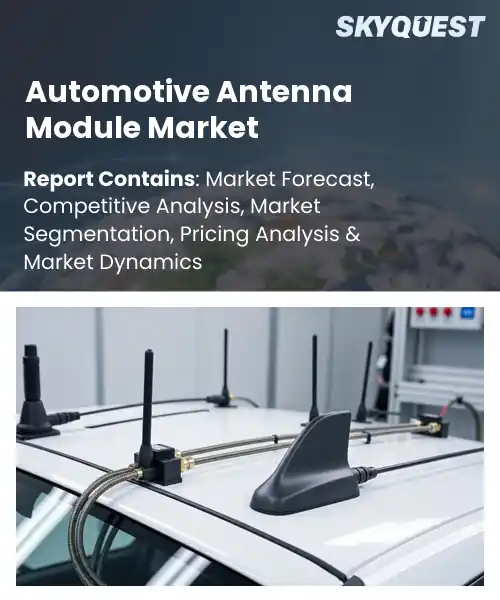
Automotive Antenna Module Market
Report ID: SQMIG25A2767
Report ID: SQMIG25A2767
[email protected]
USA +1 351-333-4748
Report ID:
SQMIG25A2767 |
Region:
Global |
Published Date: June, 2026
Pages:
157
|Tables:
144
|Figures:
78


Global Automotive Antenna Module Market size was valued at USD 3.6 Billion in 2024 and is poised to grow from USD 3.86 Billion in 2025 to USD 6.73 Billion by 2033, growing at a CAGR of 7.2% during the forecast period (2026-2033).
The global automotive antenna module market comprises compact, multi‑frequency transceivers that enable vehicle‑to‑vehicle communication, satellite navigation, and infotainment connectivity. Its importance stems from the rising demand for safety‑critical systems such as adaptive cruise control and V2X messaging, which rely on reliable signal reception across diverse frequency bands. Historically, antenna modules were discrete, single‑band components, but the proliferation of connected‑car functions since the early 2010s forced manufacturers to integrate several antennas into a single package to save space and reduce weight. For example, Tesla’s Model 3 combines GPS, LTE, and Bluetooth within a module, illustrating how integration has become a critical imperative.
Regulatory pressure for emissions reductions and autonomous capability fuels the surge in antenna‑module demand, because advanced driver‑assistance systems require uninterrupted high‑frequency data streams. As 5G rollout expands, manufacturers embed millimeter‑wave arrays into modules, enabling real‑time map updates among neighboring vehicles. This shift opens significant opportunities for Tier‑1 suppliers to offer software‑defined antenna platforms re‑programmable after deployment, extending longer life cycles and reducing recall costs. A practical illustration is Ford’s integration of a reconfigurable V2X module in its 2025 Mustang Mach‑E, which allows continuous over‑the‑air upgrades to support future traffic protocols, creating new significant revenue for both global automaker and supplier.
How is AI influencing the automotive antenna module market?
AI is reshaping the automotive antenna module market by enabling smarter signal management, dynamic beam steering, and predictive design optimization. Machine learning algorithms analyze vehicle data to adjust antenna patterns in real time, improving connectivity for infotainment, driver assistance and emerging autonomous functions. AI driven simulation tools reduce prototype cycles, allowing manufacturers to integrate multi band and 5G capabilities within a single compact module. This intelligence also supports predictive maintenance, alerting service systems to potential degradation before failure. As vehicles become more software centric, AI enhanced antenna modules provide the flexibility needed to accommodate evolving communication standards while keeping weight and cost low.
In June 2024 a leading automotive supplier launched a 5G compatible antenna module that uses AI based beamforming to boost signal reliability and simplify hardware integration, reducing the number of separate antennas and supporting over the air updates, illustrating how AI technology drives market growth and efficiency.
Market snapshot - (2026-2033)
Global Market Size
USD 3.6 Billion
Largest Segment
Shark Fin Antennas
Fastest Growth
Smart Antennas
Growth Rate
7.2% CAGR
To get more insights on this market click here to Request a Free Sample Report
Global automotive antenna module market is segmented by antenna type, frequency band, application, vehicle type, sales channel and region. Based on antenna type, the market is segmented into Shark Fin Antennas, Rod Antennas, Screen Antennas and Smart Antennas. Based on frequency band, the market is segmented into High Frequency, Very High Frequency and Ultra High Frequency. Based on application, the market is segmented into Satellite Radio Navigation, Cellular Communication, Wi-Fi Connection and Vehicle-to-Everything Communication. Based on vehicle type, the market is segmented into Passenger Cars and Commercial Vehicles. Based on sales channel, the market is segmented into Original Equipment Manufacturer and Aftermarket. Based on region, the market is segmented into North America, Europe, Asia Pacific, Latin America and Middle East & Africa.
Shark Fin Antennas segment dominates because their sleek integration aligns with modern vehicle design, delivering reliable multi band performance while preserving aerodynamics. Automotive manufacturers favor them for easy roof line mounting, which simplifies assembly and meets regulatory signal requirements. The low profile also reduces wind noise and drag, improving fuel efficiency, and standardized production lowers cost and accelerates time to market, driving widespread adoption across new vehicle platforms.
Meanwhile, Smart Antennas segment is witnessing the strongest growth momentum because adaptive beamforming and integrated connectivity enable advanced driver assistance and V2X functions. Continuous firmware upgrades enhance performance without hardware changes, attracting OEMs seeking future‑proof solutions. This innovation fuels rapid market expansion and creates new revenue streams for component suppliers.
Ultra High Frequency segment dominates because it supports safety and navigation services that require high data rates and low latency, such as advanced telematics and collision avoidance systems. OEMs prioritize this band to meet performance standards and regulatory mandates, ensuring robust signal penetration and reliable connectivity across diverse driving environments, which consolidates its central role in module design. Additionally the broad bandwidth enables simultaneous support for multiple services, simplifying antenna architecture and reducing vehicle weight.
On the other hand, Very High Frequency segment is emerging as the key high growth area because the rollout of 5G connectivity and broadband infotainment escalates demand for higher frequency capabilities. Automakers leverage VHF modules to deliver faster data streaming and richer media experiences, accelerating market expansion and opening new partnership opportunities.
To get detailed segments analysis, Request a Free Sample Report
Asia Pacific leads the global automotive antenna module market due to a confluence of advanced manufacturing capabilities, strong supplier ecosystems, and rapid electrification of vehicle fleets. The region benefits from deep engineering expertise and extensive R&D investment, fostering innovative multi‑function antenna designs that integrate connectivity, navigation and safety features. Moreover, high consumer adoption of premium and connected vehicles drives demand for sophisticated antenna solutions, while supportive policy frameworks encourage seamless integration of telematics. Close collaboration between automakers, tier‑one suppliers and semiconductor firms accelerates time‑to‑market, reinforcing the region’s competitive edge and sustaining its dominant position.
Automotive Antenna Module Market in Japan thrives on a legacy of precision engineering and a robust supplier network that delivers high‑performance components for both domestic and export models. Close partnerships between leading vehicle manufacturers and specialized antenna designers foster rapid iteration of standards‑compliant solutions. The emphasis on cutting‑edge connectivity and autonomous driving functions fuels continuous refinement of antenna integration, reinforcing Japan’s reputation as a hub of technological excellence.
Automotive Antenna Module Market in South Korea is propelled by a dynamic electronics sector that supplies cutting‑edge semiconductor and RF components essential for modern antenna systems. Strong governmental support for smart mobility initiatives encourages automakers to embed advanced connectivity features, creating a fertile environment for innovative antenna designs. Collaborative ecosystems linking tier‑one suppliers with vehicle manufacturers accelerate development cycles, positioning South Korea as a pivotal source of antenna modules for global OEMs.
Europe experiences rapid expansion of the automotive antenna module market driven by stringent regulatory frameworks, strong emphasis on vehicle safety, and a deep commitment to sustainability. Leading automakers integrate sophisticated antenna solutions to meet rigorous connectivity and autonomous driving standards, while the presence of world‑class research institutions fuels continuous innovation. Collaborative clusters in key industrial nations enable swift translation of emerging 5G and V2X technologies into production. Moreover, consumer demand for premium infotainment and seamless global navigation fuels the need for multi‑band, high‑performance antenna modules, reinforcing Europe’s position as a hub of advanced automotive communication technologies.
Automotive Antenna Module Market in Germany benefits from a strong engineering heritage and a dense network of tier‑one suppliers that specialize in high‑precision RF solutions. Close alignment with leading vehicle manufacturers ensures that antenna designs are optimized for both performance and regulatory compliance. Robust collaboration between automotive and telecommunications sectors accelerates the adoption of next‑generation connectivity standards, cementing Germany’s role as a dominant force in the European antenna ecosystem.
Automotive Antenna Module Market in United Kingdom is characterized by growth fueled by a vibrant start‑up ecosystem and strong investment in connected‑car research. The country’s emphasis on digital infrastructure and open‑source telematics platforms encourages antenna architectures that support emerging V2X services. Close ties between automotive manufacturers and academic institutions foster agility in design, enabling swift response to evolving market demands and reinforcing the United Kingdom’s reputation as a hub for antenna technology.
Automotive Antenna Module Market in France is emerging as a notable contributor, driven by strong government incentives for green mobility and a thriving automotive design community. Collaborative clusters linking antenna specialists with luxury vehicle manufacturers foster bespoke solutions that prioritize aesthetics and performance. The focus on integrating advanced telematics into premium models encourages development of compact, multi‑band antenna modules, positioning France as an innovative player within the broader European landscape.
North America strengthens its position in the automotive antenna module market through a combination of technological leadership, extensive automotive manufacturing capacity, and a proactive approach to emerging connectivity standards. The region’s deep integration of semiconductor expertise with vehicle design accelerates the rollout of high‑frequency antenna solutions essential for autonomous driving and 5G services. Collaborative partnerships among major OEMs, tier‑one suppliers, and innovative start‑ups foster rapid prototyping and scale‑up of next‑generation antenna architectures. Additionally, a supportive regulatory environment encourages the deployment of advanced telematics, reinforcing North America’s role as a key driver of global antenna module advancement.
Automotive Antenna Module Market in United States benefits from a vast ecosystem of electronics innovators and leading automotive manufacturers that prioritize cutting‑edge connectivity. Strong emphasis on research collaborations and substantial venture investment accelerates development of high‑performance, multi‑band antenna designs tailored for autonomous and electric vehicles. Integration of advanced signal processing capabilities within antenna modules enhances vehicle safety and infotainment experiences, cementing the United States as a pivotal hub for next‑generation automotive communication technologies.
Automotive Antenna Module Market in Canada is characterized by a strong focus on sustainable vehicle technologies and cross‑border collaboration with United States partners. Robust research institutions and government programs nurture innovation in low‑power, wide‑band antenna designs suited for electric and hybrid powertrains. The emphasis on safety‑critical communications and V2X applications drives adoption of resilient antenna solutions, positioning Canada as a reliable contributor to the North American automotive antenna ecosystem.
To know more about the market opportunities by region and country, click here to
Buy The Complete Report
Growing Vehicle Connectivity
Adoption Of Advanced Sensors
Regulatory Compliance Challenges
High Component Cost Pressures
Request Free Customization of this report to help us to meet your business objectives.
The global automotive antenna module market is intensely competitive, with leading firms accelerating 5G‑compatible antenna development and multi‑function designs to capture rising vehicle connectivity demand. Recent partnerships aim to integrate advanced connectivity technologies, while strategic acquisitions target niche 5G antenna suppliers, exemplifying how players leverage M&A and collaborative innovation to strengthen market positioning.
SkyQuest’s ABIRAW (Advanced Business Intelligence, Research & Analysis Wing) is our Business Information Services team that Collects, Collates, Correlates, and Analyses the Data collected by means of Primary Exploratory Research backed by robust Secondary Desk research. As per SkyQuest analysis the global automotive antenna module market is being propelled primarily by growing vehicle connectivity as manufacturers seek compact multi‑band modules to support infotainment, navigation and telematics, while a secondary boost comes from the expanding adoption of advanced sensors that demand high‑frequency antenna solutions for driver‑assist and autonomous functions. Regulatory compliance challenges act as a restraint, adding testing and certification costs that can slow new product introductions. Asia Pacific dominates the market thanks to its strong manufacturing base and rapid electrification, and within the segment hierarchy shark‑fin antennas lead due to their low‑profile design, aerodynamic benefits and cost‑effective production.
| Report Metric | Details |
|---|---|
| Market size value in 2024 | USD 3.6 Billion |
| Market size value in 2033 | USD 6.73 Billion |
| Growth Rate | 7.2% |
| Base year | 2024 |
| Forecast period | (2026-2033) |
| Forecast Unit (Value) | USD Billion |
| Segments covered |
|
| Regions covered | North America (US, Canada), Europe (Germany, France, United Kingdom, Italy, Spain, Rest of Europe), Asia Pacific (China, India, Japan, Rest of Asia-Pacific), Latin America (Brazil, Rest of Latin America), Middle East & Africa (South Africa, GCC Countries, Rest of MEA) |
| Companies covered |
|
| Customization scope | Free report customization with purchase. Customization includes:-
|
To get a free trial access to our platform which is a one stop solution for all your data requirements for quicker decision making. This platform allows you to compare markets, competitors who are prominent in the market, and mega trends that are influencing the dynamics in the market. Also, get access to detailed SkyQuest exclusive matrix.
Table Of Content
Executive Summary
Market overview
Parent Market Analysis
Market overview
Market size
KEY MARKET INSIGHTS
COVID IMPACT
MARKET DYNAMICS & OUTLOOK
Market Size by Region
KEY COMPANY PROFILES
Methodology
For the Automotive Antenna Module Market, our research methodology involved a mixture of primary and secondary data sources. Key steps involved in the research process are listed below:
1. Information Procurement: This stage involved the procurement of Market data or related information via primary and secondary sources. The various secondary sources used included various company websites, annual reports, trade databases, and paid databases such as Hoover's, Bloomberg Business, Factiva, and Avention. Our team did 45 primary interactions Globally which included several stakeholders such as manufacturers, customers, key opinion leaders, etc. Overall, information procurement was one of the most extensive stages in our research process.
2. Information Analysis: This step involved triangulation of data through bottom-up and top-down approaches to estimate and validate the total size and future estimate of the Automotive Antenna Module Market.
3. Report Formulation: The final step entailed the placement of data points in appropriate Market spaces in an attempt to deduce viable conclusions.
4. Validation & Publishing: Validation is the most important step in the process. Validation & re-validation via an intricately designed process helped us finalize data points to be used for final calculations. The final Market estimates and forecasts were then aligned and sent to our panel of industry experts for validation of data. Once the validation was done the report was sent to our Quality Assurance team to ensure adherence to style guides, consistency & design.
Analyst Support
Customization Options
With the given market data, our dedicated team of analysts can offer you the following customization options are available for the Automotive Antenna Module Market:
Product Analysis: Product matrix, which offers a detailed comparison of the product portfolio of companies.
Regional Analysis: Further analysis of the Automotive Antenna Module Market for additional countries.
Competitive Analysis: Detailed analysis and profiling of additional Market players & comparative analysis of competitive products.
Go to Market Strategy: Find the high-growth channels to invest your marketing efforts and increase your customer base.
Innovation Mapping: Identify racial solutions and innovation, connected to deep ecosystems of innovators, start-ups, academics, and strategic partners.
Category Intelligence: Customized intelligence that is relevant to their supply Markets will enable them to make smarter sourcing decisions and improve their category management.
Public Company Transcript Analysis: To improve the investment performance by generating new alpha and making better-informed decisions.
Social Media Listening: To analyze the conversations and trends happening not just around your brand, but around your industry as a whole, and use those insights to make better Marketing decisions.
REQUEST FOR SAMPLE
 REQUEST FREE CUSTOMIZATION
Global Automotive Antenna Module Market size was valued at USD 3.6 Billion in 2024 and is poised to grow from USD 3.86 Billion in 2025 to USD 6.73 Billion by 2033, growing at a CAGR of 7.2% during the forecast period (2026-2033).
The global automotive antenna module market is intensely competitive, with leading firms accelerating 5G‑compatible antenna development and multi‑function designs to capture rising vehicle connectivity demand. Recent partnerships aim to integrate advanced connectivity technologies, while strategic acquisitions target niche 5G antenna suppliers, exemplifying how players leverage M&A and collaborative innovation to strengthen market positioning. 'TE Connectivity', 'Continental AG', 'Denso Corporation', 'Yokowo Co. Ltd.', 'Laird Connectivity', 'Ficosa International SA', 'Furuno Electric Co. Ltd.', 'Harada Industry Co. Ltd.', 'Kathrein SE', 'Kymeta Corporation', 'Intellian Technologies Inc.', 'Amphenol Corporation', 'Molex LLC', 'Taoglas', 'PCTEL Inc.', 'Panorama Antennas Ltd.', 'Ace Technologies Corporation', 'Calearo Antenne SpA', 'Schaffner Holding AG', 'Smarteq Wireless AB'
Automakers are integrating multiple communication systems, which increases demand for compact, high‑performance antenna modules that can support diverse frequency bands. This integration enables seamless infotainment, navigation, and telematics services, encouraging manufacturers to source advanced modules to meet consumer expectations. Consequently, suppliers that provide reliable, multi‑band solutions experience heightened interest, driving market expansion as more vehicles require sophisticated connectivity infrastructure across global automotive segments.
5G Connectivity Integration: The rollout of 5G networks is prompting car manufacturers to embed advanced antenna modules that support higher‑frequency bands and low‑latency communication. This shift enables seamless streaming of high‑definition media, real‑time navigation updates, and enhanced driver‑assistance functionalities. Suppliers are redesigning modules for smaller footprints while maintaining performance, and automotive designers are allocating space for multi‑band systems. As telecom operators expand coverage, vehicle connectivity becomes a differentiator, accelerating adoption of connected services and fostering new revenue models for manufacturers and service providers.
Why does Asia Pacific Dominate the Global Automotive Antenna Module Market? |@12


Want to customize this report? This report can be personalized according to your needs. Our analysts and industry experts will work directly with you to understand your requirements and provide you with customized data in a short amount of time. We offer $1000 worth of FREE customization at the time of purchase.
Feedback From Our Clients


 USA (+1) 351-333-4748

