
Automotive Aluminum Market
Report ID: SQMIG15I2015
Report ID: SQMIG15I2015
[email protected]
USA +1 351-333-4748
Report ID:
SQMIG15I2015 |
Region:
Global |
Published Date: July, 2025
Pages:
197
|Tables:
91
|Figures:
71


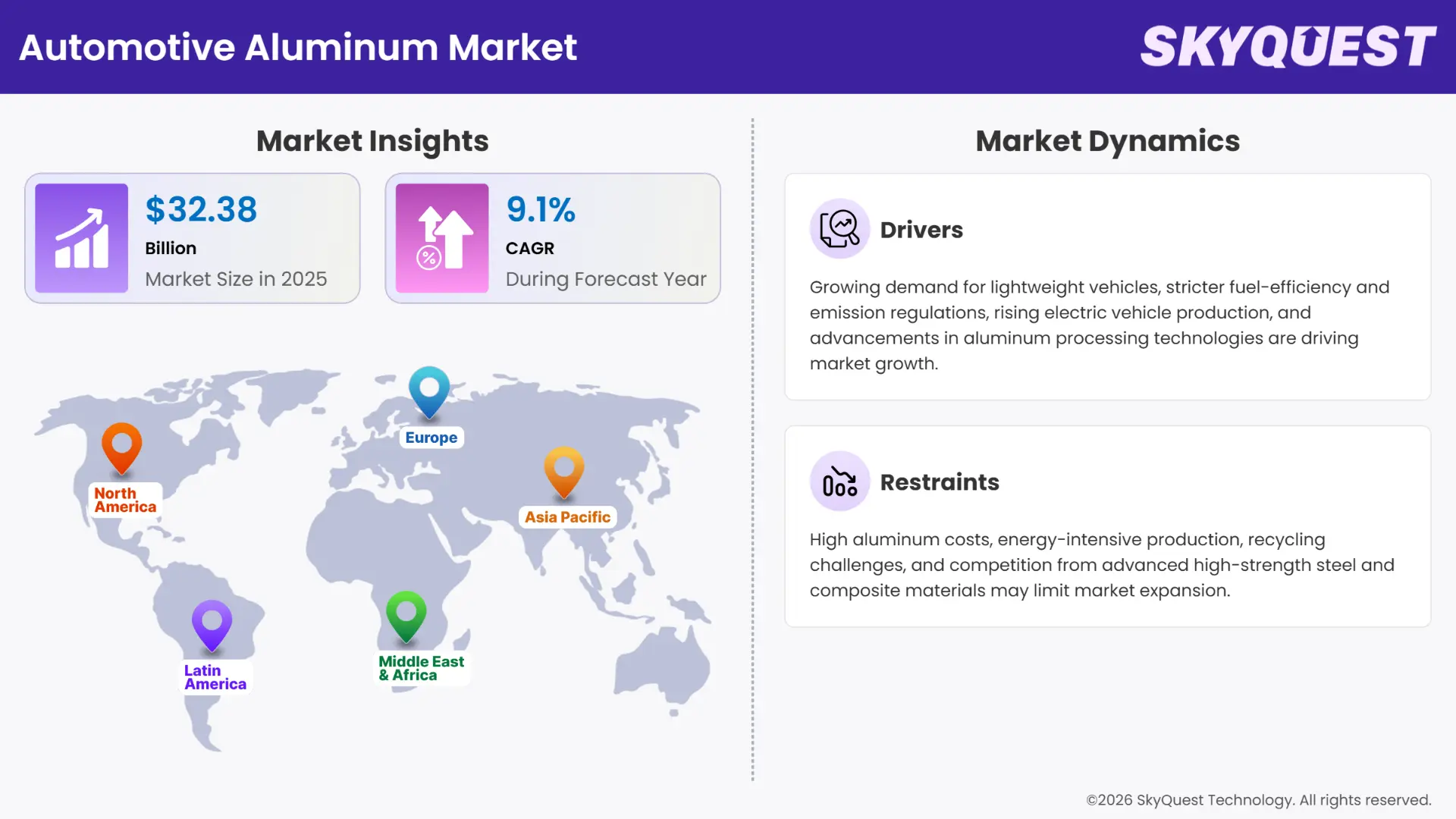
Global Automotive Aluminum Market size was valued at USD 29.68 Billion in 2024 and is poised to grow from USD 32.38 Billion in 2025 to USD 64.99 Billion by 2033, growing at a CAGR of 9.1% during the forecast period (2026–2033).
Key Takeaways: Market Trends & Insights
A primary driver of the global automotive aluminum market is the growing demand for fuel-efficient vehicles, which is largely driven by stricter environmental regulations and increasing fuel prices. As automakers face pressure to meet higher fuel efficiency standards and reduce CO2 emissions, they turn to lightweight materials like aluminum. Aluminum’s lightweight properties help reduce the overall weight of vehicles, which improves fuel efficiency and lowers emissions. This trend has led to its increasing use in critical automotive components such as body panels, engines, and frames. As the push for greener and more fuel-efficient vehicles intensifies, the demand for aluminum in automotive manufacturing grows significantly.
Another key factor driving the market is the rising popularity of electric vehicles (EVs). As EV production surges globally, there is a growing emphasis on reducing vehicle weight to maximize battery efficiency and driving range. Aluminum plays a crucial role here, as its lightweight nature allows for better energy storage and longer battery life. Moreover, aluminum’s resistance to corrosion and high durability makes it an ideal material for EVs, especially for body structures and components exposed to varying weather conditions. As the EV market expands, the demand for aluminum is expected to continue growing, making it integral to the future of the automotive industry.
How do AI Algorithms Improve Aluminum's Performance in Automotive Applications?
AI is indirectly impacting the global automotive aluminum market through advancements in vehicle design, production processes, and materials optimization. AI-driven simulations and design tools enable automakers to create lighter, more efficient vehicle structures by precisely selecting and using aluminum in critical components. Machine learning algorithms also optimize manufacturing processes, enhancing aluminum’s performance in automotive applications by improving its strength-to-weight ratio and reducing waste. A notable development is AI-driven predictive maintenance in aluminum production facilities, ensuring higher efficiency and reducing downtime. This increases aluminum availability for the automotive sector, aligning with the growing demand for lightweight, fuel-efficient vehicles.
In 2024, General Motors (GM) began implementing AI-driven automation in aluminum alloy production, optimizing material selection and production efficiency. AI algorithms now analyze the performance of different aluminum alloys under various conditions, allowing for tailored solutions in vehicle manufacturing. This development has led to reduced material waste, cost savings, and enhanced vehicle performance, driving further demand for aluminum in lightweight automotive applications.
How do Advanced Aluminum Alloys Developed by Startups Contribute to Improved Vehicle Safety?
The global automotive aluminum market's startup landscape is evolving with companies focused on innovation in lightweight materials, AI integration, and sustainable manufacturing processes. These startups aim to disrupt traditional automotive production by creating advanced aluminum alloys, reducing environmental impact, and enhancing manufacturing efficiency. Their solutions cater to automakers seeking to improve fuel efficiency, safety, and sustainability, while simultaneously driving cost reductions and performance enhancements in vehicle design.
To get more insights on this market click here to Request a Free Sample Report
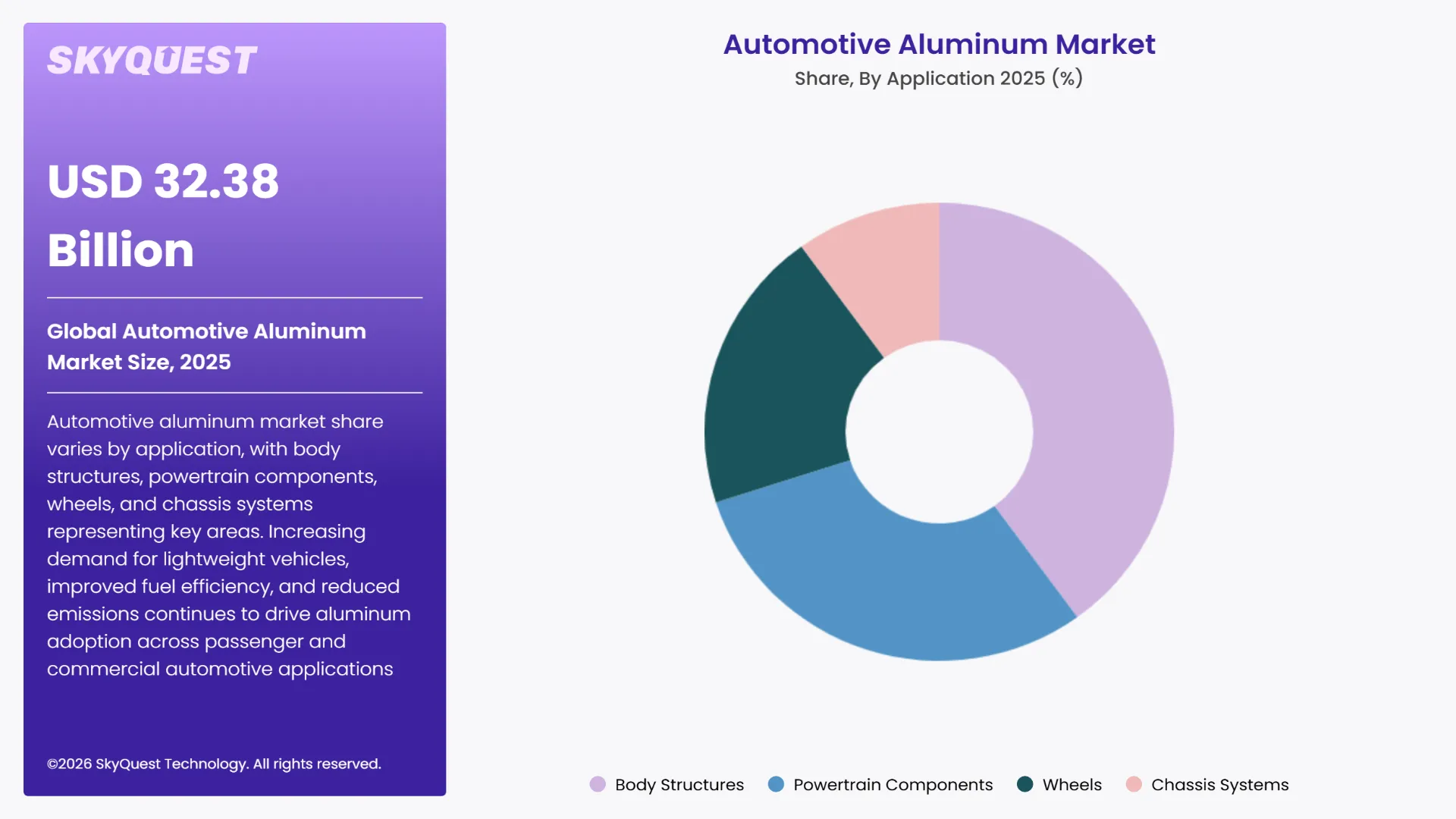
Global Automotive Aluminum Market is segmented by Application, Product Form, Vehicle Type and region. Based on Application, the market is segmented into Powertrain, Chassis & Suspension and Car Body. Based on Product Form, the market is segmented into Cast Aluminum, Rolled Aluminum and Extruded Aluminum. Based on Vehicle Type, the market is segmented into Passenger Car, LCV and HCV. Based on region, the market is segmented into North America, Europe, Asia Pacific, Latin America and Middle East & Africa.
Powertrain applications in the global automotive aluminum market are seeing significant innovation, with aluminum increasingly used in engine blocks, transmission housings, and other components. Its lightweight properties enhance fuel efficiency and reduce emissions, making it crucial for meeting environmental regulations. Powertrain applications dominate due to aluminum's ability to improve vehicle performance while reducing weight, thus addressing the industry's need for fuel-efficient, high-performance vehicles, especially in the growing electric and hybrid vehicle segments.
The body structure application is poised to be the fastest-growing segment in the global automotive aluminum market due to the increasing demand for lightweight, fuel-efficient vehicles. Aluminum’s strength-to-weight ratio improves vehicle performance, safety, and fuel efficiency, making it essential for reducing weight and meeting stringent environmental regulations in the automotive industry.
Cast aluminum is experiencing innovation in the global automotive market, particularly for engine blocks, transmission components, and structural parts. Advanced casting techniques, like die-casting and sand casting, enhance material strength and precision. Cast aluminum dominates the market due to its ability to produce complex, lightweight, and durable components at a lower cost, meeting the demand for fuel-efficient and high-performance vehicles. Its versatility and cost-effectiveness make it ideal for mass production in automotive manufacturing.
Extruded aluminum is expected to be the fastest-growing product form in the global automotive aluminum market due to its flexibility in creating lightweight, high-strength components for vehicle frames, chassis, and structural applications. Its cost-effectiveness, customization potential, and ability to enhance vehicle safety and performance drive its increasing adoption in automotive manufacturing.
To get detailed segments analysis, Request a Free Sample Report
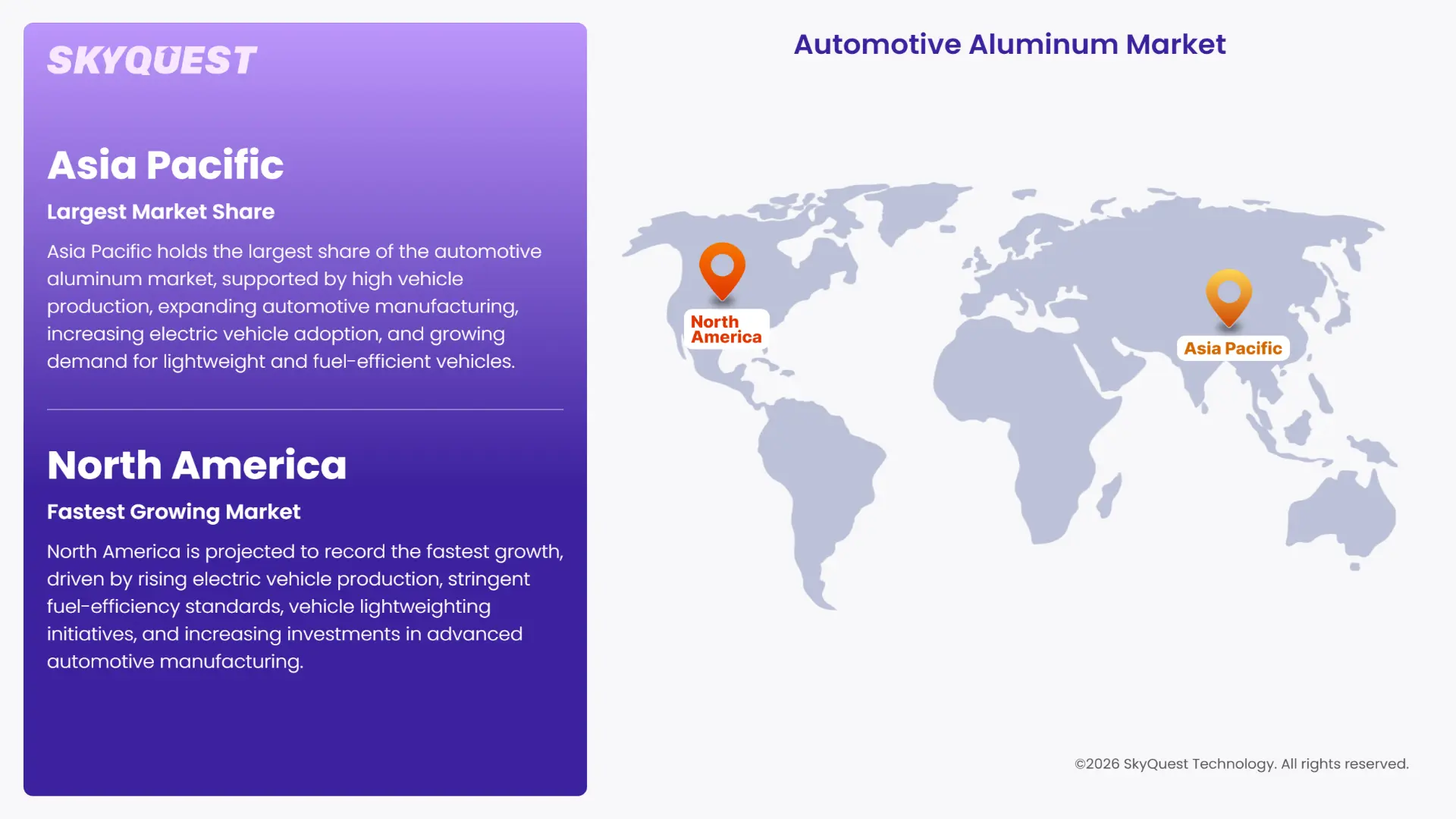
As per the global automotive aluminum market outlook, Asia-Pacific is dominating the industry, which is driven by robust automotive production in countries like China, Japan, and India. The region’s growing demand for fuel-efficient vehicles, coupled with stringent environmental regulations, accelerates aluminum adoption. Additionally, increasing electric vehicle (EV) production in Asia-Pacific boosts the demand for lightweight materials like aluminum, making it a dominant market for automotive innovation and manufacturing expansion.
Japan is a significant contributor to the global automotive aluminum market, driven by its automotive giants like Toyota, Honda, and Nissan. The country focuses on lightweighting vehicles to improve fuel efficiency and reduce emissions. Japan's advanced manufacturing techniques, such as precision casting and aluminum alloy development, play a crucial role in supporting the automotive sector's shift toward more sustainable and energy-efficient vehicles, particularly electric vehicles (EVs).
Indonesia is emerging as a growing player in the global automotive aluminum market, primarily driven by increasing local vehicle production. The country’s automotive industry is adopting aluminum for lightweighting, which enhances fuel efficiency and meets stricter environmental standards. Indonesia’s strategic location in Southeast Asia also positions it as a key supplier of aluminum materials, supporting regional automotive manufacturers’ shift toward lightweight and energy-efficient vehicles, including electric and hybrid models.
Europe is a major player in the global automotive aluminum market, driven by the region's commitment to sustainability and innovation. Strict environmental regulations, such as CO2 emission reduction targets, encourage the use of lightweight materials like aluminum in vehicle manufacturing. The rise of electric vehicle (EV) production further boosts aluminum demand, as it helps improve energy efficiency. Key automotive hubs in Germany, France, and Italy are pivotal to this growing trend.
Germany is a leader in the global automotive aluminum market, driven by its advanced automotive industry and emphasis on engineering excellence. The country’s automotive manufacturers, like Volkswagen, BMW, and Mercedes-Benz, heavily invest in aluminum for lightweight vehicle components. Germany's commitment to sustainability and electric vehicle production further increases the demand for aluminum, which helps improve fuel efficiency and reduce emissions, reinforcing its dominance in the automotive aluminum market.
France contributes significantly to the global automotive aluminum market through its strong automotive manufacturing sector, with key players like Renault and Peugeot. The country focuses on lightweighting strategies to enhance fuel efficiency and meet stringent environmental regulations. France also emphasizes electric vehicle (EV) production, where aluminum's role in reducing weight and increasing range has become crucial. This growing shift toward EVs bolsters the demand for aluminum in automotive applications.
North America is a key region in the global automotive aluminum market, driven by strong automotive manufacturing hubs in the United States, Canada, and Mexico. The region's focus on fuel efficiency, stringent environmental regulations, and the growing shift toward electric vehicles (EVs) accelerates the demand for lightweight materials like aluminum. Additionally, North America's automotive innovation, including advanced alloy development and production technologies, further supports the growing adoption of aluminum in vehicle manufacturing.
The United States plays a pivotal role in North America’s automotive aluminum market, driven by its advanced automotive manufacturing sector. The country’s push for fuel-efficient vehicles and stringent environmental regulations has led automakers to increase the use of aluminum in car bodies, powertrains, and structural components. The U.S. also fosters innovation in aluminum alloys, boosting demand for lightweight, high-performance materials in both traditional and electric vehicles.
Canada contributes significantly to North America’s automotive aluminum market, primarily through its strong manufacturing and supply chain networks. The country is a key producer of primary aluminum, supporting the demand for lightweight materials in the automotive industry. Canada’s automotive sector emphasizes sustainability, with aluminum’s role in reducing vehicle weight and improving fuel efficiency gaining momentum, especially as electric vehicle production grows.
To know more about the market opportunities by region and country, click here to
Buy The Complete Report
Global Environmental Regulations
Rising Demand for Electric Vehicles
Limited Recycling Infrastructure
Supply Chain Disruptions
Request Free Customization of this report to help us to meet your business objectives.
The competitive landscape of the global automotive aluminum market is driven by key players focusing on innovation, cost reduction, and sustainability. Major companies include Alcoa Corporation, Novelis Inc., Constellium, and Hydro Aluminium. These firms invest in advanced aluminum alloys, automation, and recycling technologies. For instance, Novelis focuses on expanding its recycling capabilities, while Alcoa aims to enhance production efficiency through sustainable practices and strategic partnerships with automakers for lightweight vehicle solutions.
Increasing Demand for Lightweight Materials
Growth in Electric Vehicle Production
SkyQuest’s ABIRAW (Advanced Business Intelligence, Research & Analysis Wing) is our Business Information Services team that Collects, Collates, Correlates, and Analyses the Data collected by means of Primary Exploratory Research backed by robust Secondary Desk research.
As per SkyQuest analysis, the global automotive aluminum industry is experiencing significant growth driven by the increasing demand for fuel-efficient vehicles, environmental regulations, and the rise of electric vehicle (EV) production. Aluminum’s lightweight properties make it crucial in enhancing vehicle performance, reducing emissions, and improving fuel efficiency, which aligns with the automotive industry’s sustainability goals.
The growing adoption of aluminum in both traditional and electric vehicles, supported by innovations in aluminum alloys and advanced manufacturing techniques, further bolsters the market. However, challenges such as limited recycling infrastructure and supply chain disruptions must be addressed to fully leverage aluminum's potential in the automotive sector. As a result, the market is poised for continued growth in the coming years.
| Report Metric | Details |
|---|---|
| Market size value in 2024 | USD 29.68 Billion |
| Market size value in 2033 | USD 64.99 Billion |
| Growth Rate | 9.1% |
| Base year | 2024 |
| Forecast period | 2026–2033 |
| Forecast Unit (Value) | USD Billion |
| Segments covered |
|
| Regions covered | North America (US, Canada), Europe (Germany, France, United Kingdom, Italy, Spain, Rest of Europe), Asia Pacific (China, India, Japan, Rest of Asia-Pacific), Latin America (Brazil, Rest of Latin America), Middle East & Africa (South Africa, GCC Countries, Rest of MEA) |
| Companies covered |
|
| Customization scope | Free report customization with purchase. Customization includes:-
|
To get a free trial access to our platform which is a one stop solution for all your data requirements for quicker decision making. This platform allows you to compare markets, competitors who are prominent in the market, and mega trends that are influencing the dynamics in the market. Also, get access to detailed SkyQuest exclusive matrix.
Table Of Content
Executive Summary
Market overview
Parent Market Analysis
Market overview
Market size
KEY MARKET INSIGHTS
COVID IMPACT
MARKET DYNAMICS & OUTLOOK
Market Size by Region
KEY COMPANY PROFILES
Methodology
For the Automotive Aluminum Market, our research methodology involved a mixture of primary and secondary data sources. Key steps involved in the research process are listed below:
1. Information Procurement: This stage involved the procurement of Market data or related information via primary and secondary sources. The various secondary sources used included various company websites, annual reports, trade databases, and paid databases such as Hoover's, Bloomberg Business, Factiva, and Avention. Our team did 45 primary interactions Globally which included several stakeholders such as manufacturers, customers, key opinion leaders, etc. Overall, information procurement was one of the most extensive stages in our research process.
2. Information Analysis: This step involved triangulation of data through bottom-up and top-down approaches to estimate and validate the total size and future estimate of the Automotive Aluminum Market.
3. Report Formulation: The final step entailed the placement of data points in appropriate Market spaces in an attempt to deduce viable conclusions.
4. Validation & Publishing: Validation is the most important step in the process. Validation & re-validation via an intricately designed process helped us finalize data points to be used for final calculations. The final Market estimates and forecasts were then aligned and sent to our panel of industry experts for validation of data. Once the validation was done the report was sent to our Quality Assurance team to ensure adherence to style guides, consistency & design.
Analyst Support
Customization Options
With the given market data, our dedicated team of analysts can offer you the following customization options are available for the Automotive Aluminum Market:
Product Analysis: Product matrix, which offers a detailed comparison of the product portfolio of companies.
Regional Analysis: Further analysis of the Automotive Aluminum Market for additional countries.
Competitive Analysis: Detailed analysis and profiling of additional Market players & comparative analysis of competitive products.
Go to Market Strategy: Find the high-growth channels to invest your marketing efforts and increase your customer base.
Innovation Mapping: Identify racial solutions and innovation, connected to deep ecosystems of innovators, start-ups, academics, and strategic partners.
Category Intelligence: Customized intelligence that is relevant to their supply Markets will enable them to make smarter sourcing decisions and improve their category management.
Public Company Transcript Analysis: To improve the investment performance by generating new alpha and making better-informed decisions.
Social Media Listening: To analyze the conversations and trends happening not just around your brand, but around your industry as a whole, and use those insights to make better Marketing decisions.
REQUEST FOR SAMPLE
 REQUEST FREE CUSTOMIZATION
Global Automotive Aluminum Market size was valued at USD 29.68 Billion in 2024 and is poised to grow from USD 32.38 Billion in 2025 to USD 64.99 Billion by 2033, growing at a CAGR of 9.1% during the forecast period (2026–2033).
Key vendors in the Automotive Aluminum Market include Novelis Inc., Constellium SE, Norsk Hydro ASA, Alcoa Corporation, Rio Tinto, Kobe Steel Ltd., UACJ Corporation, Arconic Corporation, Hindalco Industries Limited, China Zhongwang Holdings Limited, Norsk Hydro, and Aluminum Corporation of China (Chalco). These companies focus on lightweight automotive aluminum sheets, extrusions, castings, recycled aluminum, and low-carbon aluminum solutions.
The key driver of the automotive aluminum market is the push for vehicle lightweighting. Automakers adopt aluminum to reduce weight, boost fuel efficiency, meet strict emission regulations, and extend battery range in electric vehicles (EVs).
The key market trend is the accelerated integration of aluminum in Electric Vehicles (EVs) to extend driving range and offset heavy battery weight. Automakers are increasingly utilizing aluminum extrusions for battery enclosures, structural components, and mega-casting applications.
Asia-Pacific accounts for the largest share in the automotive aluminum market. This regional dominance is driven by massive vehicle production volumes, robust manufacturing infrastructure in China, Japan, and India, and the rapid expansion of electric vehicle (EV) manufacturing.


Want to customize this report? This report can be personalized according to your needs. Our analysts and industry experts will work directly with you to understand your requirements and provide you with customized data in a short amount of time. We offer $1000 worth of FREE customization at the time of purchase.
Feedback From Our Clients


 USA (+1) 351-333-4748

