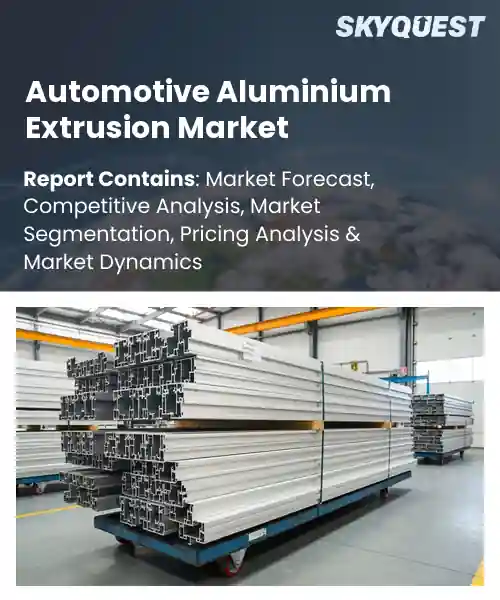
Automotive Aluminium Extrusion Market
Report ID: SQMIG25A2697
Report ID: SQMIG25A2697
[email protected]
USA +1 351-333-4748
Report ID:
SQMIG25A2697 |
Region:
Global |
Published Date: June, 2026
Pages:
157
|Tables:
144
|Figures:
78


Global Automotive Aluminium Extrusion Market size was valued at USD 10.23 Billion in 2024 and is poised to grow from USD 10.99 Billion in 2025 to USD 19.45 Billion by 2033, growing at a CAGR of 7.4% during the forecast period (2026-2033).
The primary driver of the automotive aluminium extrusion market is vehicle lightweighting prompted by stringent emissions and fuel efficiency regulations, which has pushed OEMs to substitute heavier steels with aluminium in structural components. The market comprises firms producing extruded aluminium profiles for frames, crash management systems, heat exchangers and battery enclosures, and this market is significant because reduced mass improves fuel economy, lowers CO2 output and extends electric vehicle range while enabling integrated designs. Historically the sector evolved from simple trim and window channels into complex extrusions used in examples such as Audi’s aluminium spaceframe, Ford’s F-150 panels and Tesla’s battery casings.
The principal growth factor in the global automotive aluminium extrusion market is accelerating electric vehicle adoption combined with stricter emissions standards, which increases demand for complex, high-strength extrusions used in battery enclosures, crash rails and thermal management systems. As OEMs prioritize range and safety, suppliers invest in advanced alloys, tighter tolerances and integrated joining methods so extruded parts can perform structural and heat dissipation roles, causing production scale-up and tooling innovation. This chain reaction creates opportunities for recycled aluminium streams, localized extrusion capacity in Asia, aftermarket upgrades, which reinforce cost competitiveness and broader application and exports.
How is automation improving manufacturing efficiency in the automotive aluminium extrusion market?
In the automotive aluminium extrusion industry, automation is increasing manufacturing efficiency through the use of robotics, advanced process controls and inline quality inspection. Some of the main benefits to this include automated material handling, precise temperature control, quick die changes and digital twin-driven optimisation. The current environment has resulted in a shift from manual to integrated production cells that reduce variability and lead time.
This evolution is being driven by market forces related to increased demand for lightweight and complex profiles, as well as a requirement for consistent quality. Robotic profile handling and autonomous logistics are helping to reduce waste and improve repeatability, allowing suppliers to provide higher value components to automotive manufacturers.
In March 2026, Alcomet AD completed its first extrusion of new Presezzi press with advanced process control and quench systems, showing how automation reduces cycle times and waste and creates more complex vehicle sections that support market growth through higher value, more efficient production techniques.
Market snapshot - (2026-2033)
Global Market Size
USD 10.23 Billion
Largest Segment
Mill Finished Extrusions
Fastest Growth
Powder Coated Extrusions
Growth Rate
7.4% CAGR
To get more insights on this market click here to Request a Free Sample Report
Global automotive aluminium extrusion market is segmented by product configuration type, material alloy class, application component, vehicle segment type, distribution channel and region. Based on product configuration type, the market is segmented into Mill Finished Extrusions, Anodized Extrusions and Powder Coated Extrusions. Based on material alloy class, the market is segmented into 6000 Series Alloys, 7000 Series Alloys and 5000 Series & Others. Based on application component, the market is segmented into Structural Crash Management Systems, Powertrain & EV Battery Enclosures, Body-in-White Structures and Chassis & Suspension Frameworks. Based on vehicle segment type, the market is segmented into Passenger Cars, Light Commercial Vehicles and Medium & Heavy Commercial Vehicles. Based on distribution channel, the market is segmented into Direct and Indirect. Based on region, the market is segmented into North America, Europe, Asia Pacific, Latin America and Middle East & Africa.
Anodized extrusions segment dominates with large automotive aluminium extrusion market share because anodizing forms a stable, corrosion-resistant oxide layer that significantly extends component life and reduces maintenance needs, making it the preferred finish for exposed structural and body elements. The surface hardening effect improves wear and fatigue resistance, enabling designers to pursue thinner, lighter profiles without sacrificing longevity, while OEM quality and finish standards drive wide adoption across production programs.
As per automotive aluminium extrusion market outlook, powder coated extrusions are emerging as the fastest growing area because demand for durable color finishes and surface protection on visible components is rising. Advances in low-temperature curing and eco-friendly powders allow coating of complex profiles and heat-sensitive alloys, unlocking new design freedom and aftermarket customization that spur supplier investment.
As per automotive aluminium extrusion market forecast, powertrain & EV battery enclosures segment leads because vehicle electrification and stringent safety expectations require enclosures that combine thermal management, structural stiffness and crash performance, roles for which aluminium extrusions are uniquely suited. Extrusions enable integrated cooling channels and complex cross-sections that meet packaging and safety constraints, prompting OEMs to specify extruded solutions for efficient assembly and lightweighting, thereby reinforcing demand across vehicle architectures.
As per automotive aluminium extrusion market analysis, body-in-white structures are witnessing the strongest growth momentum as manufacturers pursue lightweighting that integrates extrusion profiles into primary vehicle structures. Advances in joining and multi-material design allow aluminium extrusions to replace heavier parts, creating opportunities for novel cross-sections and supplier collaboration that accelerate adoption and expand value chain participation.
To get detailed segments analysis, Request a Free Sample Report
As per automotive aluminium extrusion market regional forecast, Asia Pacific market share is expected to lead the pack owing to high concentration of car manufacturers, large supplier ecosystem and manufacturing ecosystems conducive to scale and responsiveness. The tight collaboration between OEMs and extrusion specialists enables fast uptake of lightweighting programs and complex profile designs for electric and traditional vehicle architectures. Skilled engineering skills, superior tooling capabilities, and localized value chains that minimize lead times all support regional competitiveness. Policy frameworks and industrial strategies in major markets drive material innovation and capacity development, while proximity to component producers and established logistical corridors allow for efficient flow of extruded components into assembly operations. Demand intensity, technical knowledge and supply chain integration are all combining to maintain Asia Pacific supremacy in the industry.
As per automotive aluminium extrusion market regional outlook, Japan has close relationships between vehicle makers and precision extruders, with an emphasis on high-tolerance profiles and material refinement. Local vendors stress quality systems, surface treatment capabilities and interaction with electronics and battery component manufacturers, enabling sophisticated structural and thermal management elements. The market is biased towards local engineering standards, worldwide OEM requirements, export networks, specialty, high-value extrusion solutions.
As per automotive aluminium extrusion industry analysis, South Korea leverages close alignment with vehicle manufacturers and tier suppliers, focusing on alloy development and automated production processes. Domestic extruders emphasize high-strength profiles and precision fabrication for structural, crash, and thermal applications driven by electrified architectures. Emphasis on collaborative engineering, rapid prototyping, and supply chain responsiveness supports tailored extrusion designs that serve both mass-market platforms and premium vehicle niches, reinforcing local competitiveness.
Europe’s growth is spurred by a mix of legislative focus on emissions and safety, great OEM engineering and an industry-wide focus on sustainability and circular material use. Manufacturers and suppliers are investing in innovative alloy systems, joining technologies and design for recyclability, driving demand for sophisticated extruded profiles. Regional concentrations of expertise in precision metallurgy, surface finishing and tooling facilitate speedy product development cycles. The commercialization of lightweight solutions for electrified powertrains and innovative chassis systems is accelerated by cross-border supplier networks and collaborative innovation platforms.
Germany market is characterized by a large concentration of OEMs and engineering competence with focus on high-performance profiles for structural and safety-critical components. Suppliers focus on precision dies, complicated multi-material assemblies and close cooperation with vehicle engineers to achieve high application standards. It enables the production of premium extrusion products meeting stringent European technical requirements.
United Kingdom is characterized by rapid adoption of lightweighting approaches and agility in prototyping and product development. Local extrusion firms collaborate with innovative vehicle manufacturers and technology startups to deliver customized profiles for electrified platforms and performance applications. Emphasis on flexible manufacturing, specialist alloy work, and engineering partnerships enables quick validation cycles and responsiveness to evolving design requirements, positioning the market as a dynamic growth area within the regional landscape.
France is emerging through strengthening supplier clusters and a growing focus on sustainable materials and circular processes. Domestic manufacturers are enhancing extrusion capabilities for structural and thermal management components while deepening relationships with vehicle integrators. Policy and industry initiatives supporting low-emission mobility and material efficiency encourage investment in advanced profile solutions, enabling French suppliers to expand into higher-value extrusion segments and collaborate on cross-border programs.
North America is strengthening its position through strategic investments into capacity, technology upgrades and supply chain resilience. The greater focus on bringing key parts back home and on limiting vulnerability to logistics has increased the demand in locally made extrusions and value-add fabrication services. OEMs and tier suppliers are collaborating to develop custom extruded profiles as the basis for high-strength alloys, joining technologies and integrated module assembly. Sustainability demands are driving the utilization of recycled content and closed-loop material procedures, connecting extrusion processes with circular economy goals. In addition, North America is meeting the needs of different vehicle programs with shorter development schedules due to the improvement of workforce skills and investment in automation and equipment.
United States is driven by significant OEM-driven demand for high-volume and application-specific profiles backed by investment in modern extrusion presses, tooling and downstream fabrication. Suppliers are focused on scalable production, alloy optimization and integrated assembly solutions, for electrified powertrains and legacy vehicle platforms. Focus on local sourcing, supplier qualification criteria and cross functional design and manufacturing team collaboration improves the ability to meet program schedules and application complexity.
Canada is supported by the closeness to large assembly facilities and access to upstream material and fabrication knowledge that supports both heavy and passenger vehicle applications. Local extruders are focusing on structural profiles, thermal management components and material-efficient designs, with sustainable sourcing and cross-border supply agreements. By working with regional engineering centres and concentrating on specific production segments, Canadian suppliers can get involved in bigger North American car programs.
To know more about the market opportunities by region and country, click here to
Buy The Complete Report
Automaker Lightweighting Initiatives
Regulatory Emissions and Efficiency Standards
Raw Material Price Volatility
Limited Recycling Infrastructure and Costs
Request Free Customization of this report to help us to meet your business objectives.
Competition in the global automotive aluminium extrusion industry is intensifying as automotive OEMs and tier one suppliers pursue lightweighting and supply security. Consolidation through strategic acquisitions and capacity rollouts and targeted partnerships with tooling and joining technology firms are common.
SkyQuest’s ABIRAW (Advanced Business Intelligence, Research & Analysis Wing) is our Business Information Services team that Collects, Collates, Correlates, and Analyses the Data collected by means of Primary Exploratory Research backed by robust Secondary Desk research.
As per SkyQuest analysis, the global automotive aluminium extrusion market growth is propelled primarily by vehicle lightweighting driven by stricter emissions and fuel efficiency standards, and it benefits further from accelerating electric vehicle adoption that raises demand for complex, high-strength extrusions for battery enclosures and crash management systems. Growth is tempered by raw material price volatility that pressures supplier margins and investment decisions. Asia Pacific remains the dominant region due to its dense vehicle manufacturing base and integrated supply chains, while anodized extrusions lead product configurations because their corrosion resistance and surface durability make them preferred for exposed structural components. Suppliers will need cost and circularity strategies to sustain momentum.
| Report Metric | Details |
|---|---|
| Market size value in 2024 | USD 10.23 Billion |
| Market size value in 2033 | USD 19.45 Billion |
| Growth Rate | 7.4% |
| Base year | 2024 |
| Forecast period | (2026-2033) |
| Forecast Unit (Value) | USD Billion |
| Segments covered |
|
| Regions covered | North America (US, Canada), Europe (Germany, France, United Kingdom, Italy, Spain, Rest of Europe), Asia Pacific (China, India, Japan, Rest of Asia-Pacific), Latin America (Brazil, Rest of Latin America), Middle East & Africa (South Africa, GCC Countries, Rest of MEA) |
| Companies covered |
|
| Customization scope | Free report customization with purchase. Customization includes:-
|
To get a free trial access to our platform which is a one stop solution for all your data requirements for quicker decision making. This platform allows you to compare markets, competitors who are prominent in the market, and mega trends that are influencing the dynamics in the market. Also, get access to detailed SkyQuest exclusive matrix.
Table Of Content
Executive Summary
Market overview
Parent Market Analysis
Market overview
Market size
KEY MARKET INSIGHTS
COVID IMPACT
MARKET DYNAMICS & OUTLOOK
Market Size by Region
KEY COMPANY PROFILES
Methodology
For the Automotive Aluminium Extrusion Market, our research methodology involved a mixture of primary and secondary data sources. Key steps involved in the research process are listed below:
1. Information Procurement: This stage involved the procurement of Market data or related information via primary and secondary sources. The various secondary sources used included various company websites, annual reports, trade databases, and paid databases such as Hoover's, Bloomberg Business, Factiva, and Avention. Our team did 45 primary interactions Globally which included several stakeholders such as manufacturers, customers, key opinion leaders, etc. Overall, information procurement was one of the most extensive stages in our research process.
2. Information Analysis: This step involved triangulation of data through bottom-up and top-down approaches to estimate and validate the total size and future estimate of the Automotive Aluminium Extrusion Market.
3. Report Formulation: The final step entailed the placement of data points in appropriate Market spaces in an attempt to deduce viable conclusions.
4. Validation & Publishing: Validation is the most important step in the process. Validation & re-validation via an intricately designed process helped us finalize data points to be used for final calculations. The final Market estimates and forecasts were then aligned and sent to our panel of industry experts for validation of data. Once the validation was done the report was sent to our Quality Assurance team to ensure adherence to style guides, consistency & design.
Analyst Support
Customization Options
With the given market data, our dedicated team of analysts can offer you the following customization options are available for the Automotive Aluminium Extrusion Market:
Product Analysis: Product matrix, which offers a detailed comparison of the product portfolio of companies.
Regional Analysis: Further analysis of the Automotive Aluminium Extrusion Market for additional countries.
Competitive Analysis: Detailed analysis and profiling of additional Market players & comparative analysis of competitive products.
Go to Market Strategy: Find the high-growth channels to invest your marketing efforts and increase your customer base.
Innovation Mapping: Identify racial solutions and innovation, connected to deep ecosystems of innovators, start-ups, academics, and strategic partners.
Category Intelligence: Customized intelligence that is relevant to their supply Markets will enable them to make smarter sourcing decisions and improve their category management.
Public Company Transcript Analysis: To improve the investment performance by generating new alpha and making better-informed decisions.
Social Media Listening: To analyze the conversations and trends happening not just around your brand, but around your industry as a whole, and use those insights to make better Marketing decisions.
REQUEST FOR SAMPLE
 REQUEST FREE CUSTOMIZATION
Global Automotive Aluminium Extrusion Market size was valued at USD 10.23 Billion in 2024 and is poised to grow from USD 10.99 Billion in 2025 to USD 19.45 Billion by 2033, growing at a CAGR of 7.4% during the forecast period (2026-2033).
Competition in the global automotive aluminium extrusion market is intensifying as automotive OEMs and tier one suppliers pursue lightweighting and supply security. Consolidation through strategic acquisitions and capacity rollouts and targeted partnerships with tooling and joining technology firms are common. Examples include Novelis completing the Aleris acquisition and Hydro integrating Sapa, while rivals invest in process and joining innovations to secure EV platform contracts. 'Norsk Hydro', 'Constellium SE', 'UACJ Corporation', 'Kobe Steel', 'Novelists Inc', 'Alcoa Corporation', 'Rio Tinto', 'BHP Group', 'Aluminum Corporation of China', 'Zijin Mining Group', 'China Hongqiao Group', 'Rusal', 'Hindalco Industries', 'Showa Denko', 'Furukawa Electric', 'Sumitomo Electric Industries', 'Mitsubishi Materials Corporation', 'Teijin Limited', 'Toray Industries', 'Asahi Kasei'
The automotive industry's sustained focus on reducing vehicle weight encourages greater adoption of aluminium extrusion for structural and body components, as manufacturers seek materials that improve fuel efficiency and electric range without compromising strength. Aluminium extrusions enable complex profiles and integrated functions that simplify assembly and reduce part counts, aligning with engineering goals to streamline manufacturing. This preference by OEMs for lightweight, formable materials drives product specification decisions across supply chains and promotes investment in extrusion capacity and related tooling expertise.
Lightweighting For Efficiency: Automakers increasingly prioritize lightweighting to improve vehicle efficiency and performance, driving demand for advanced aluminium extrusion solutions that reduce structural mass without compromising safety or rigidity. This trend encourages development of complex profiles, integrated structural components, and design collaborations between extruders and OEMs to optimize load paths and assembly simplicity. Enhanced focus on lifecycle impacts and consumer expectations for responsive handling further consolidates aluminium extrusions as preferred materials, fostering product innovation and closer engineering partnerships across supply chains and markets.
Why does Asia Pacific Dominate the Global Automotive Aluminium Extrusion Market? |@12


Want to customize this report? This report can be personalized according to your needs. Our analysts and industry experts will work directly with you to understand your requirements and provide you with customized data in a short amount of time. We offer $1000 worth of FREE customization at the time of purchase.
Feedback From Our Clients


 USA (+1) 351-333-4748

