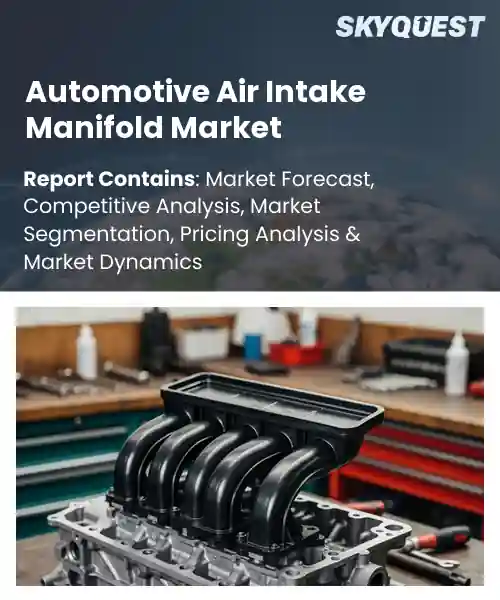
Automotive Air Intake Manifold Market
Report ID: SQMIG25A2698
Report ID: SQMIG25A2698
[email protected]
USA +1 351-333-4748
Report ID:
SQMIG25A2698 |
Region:
Global |
Published Date: June, 2026
Pages:
157
|Tables:
115
|Figures:
77


Global Automotive Air Intake Manifold Market size was valued at USD 52.89 Billion in 2024 and is poised to grow from USD 55.64 Billion in 2025 to USD 83.47 Billion by 2033, growing at a CAGR of 5.2% during the forecast period (2026-2033).
The primary driver of the automobile air intake manifold market is the demand for engine efficiency and emissions reduction transforming the air intake manifold from a simple plenum/runner interface into a focal point for engineering innovation. An intake manifold controls the amount of air that reaches the cylinders and therefore has a direct effect on combustion stability and fuel efficiency and emissions; as regulatory demands increased and consumers began to demand greener vehicles, manufacturers started using lightweight polymer and variable geometry intake manifolds instead of cast iron manifolds.
The shift of the last 20 years has resulted in the formation of new suppliers, closer OEM partnerships, and increased retrofits as automotive manufacturers increasingly use turbocharged downsized engines in conjunction with direct-injection powertrains, exemplifying how manifold integration has evolved. A major factor in the continued expansion of the global automotive air intake manifold market growth is the increasing electrification of vehicle systems, along with the increased use of forced induction, resulting in the need for adaptable intake systems that provide thermal management. Engineered for transient response and cylinder deactivation, manufacturers are investing in modular sensor-equipped intake man
How is AI Improving Efficiency in the Automotive Air Intake Manifold Market?
The automotive air intake manifold market trends will see better air control systems because of AI technology. The first set of advancements will come from quickly defining new designs and reducing the latency of communicating between manufacturing and engineering. The advances to design iterations created by generative design methods will provide new alternatives to be used on the runner and plenum geometries. In addition, the AI-assisted CFD (Computational Fluid Dynamics) process will decrease the time required to run simulations, and the use of digital twins (virtual models representing physical systems) to validate designs will reduce the number of physical prototypes required before a design goes into production.
Finally, during the May 2026 ACT Expo, Bosch demonstrated a new AI-based powertrain and compute solution that improves the speed of validation for simulation and production. By shortening the time frames associated with the design of air intake/manifold systems and associated manufacturing processes, Bosch's development of this AI platform demonstrates its ability to improve overall manufacturing quality.
Market snapshot - (2026-2033)
Global Market Size
USD 52.89 Billion
Largest Segment
Plastic/Composite
Fastest Growth
Plastic/Composite
Growth Rate
5.2% CAGR
To get more insights on this market click here to Request a Free Sample Report
Global automotive air intake manifold market is segmented by material, manifold type, vehicle type, sales channel and region. Based on material, the market is segmented into plastic/composite, aluminum and others. Based on manifold type, the market is segmented into integrated manifold and standard manifold. Based on vehicle type, the market is segmented into passenger cars, light commercial vehicles and heavy commercial vehicles. Based on sales channel, the market is segmented into OEM and aftermarket. Based on region, the market is segmented into North America, Europe, Asia Pacific, Latin America and Middle East & Africa.
The physical characteristics of plastic/composite materials, they have the capability to create very intricate molded shapes that help provide effective airflow and provide a significant reduction in manufacturing time and costs. With their ability to provide designers with maximum design capabilities, they allow for the integration of sensor mounting and acoustic tuning features, which help improve the overall size of the engine as well as the overall efficiency of the engine. As the high volume production capabilities of plastic/composite help to ensure consistent production quality and enable the rapid development of new design iterations, OEM suppliers are motivated to switch to plastic/composite materials due to the long-term supply chain stability created by plastic/composite materials, thereby enhancing their current dominance within the automotive air intake manifold market.
The second material that will continue to see growth is aluminum due to its high thermal stability, mechanical strength and ability to be used in applications requiring either high performance or heavy duty engines. Interest is growing for new and durable aluminum manifold designs and surface treatments due to an increased desire to design for durability and compatibility with forced induction systems; thus, creating new opportunities for use in performance and commercial vehicle powertrains.
The integrated manifold segment has a strong market position since it combines multiple engine intake functions and reduces engine packaging complexity by providing a single assembly instead of multiple individual components resulting in fewer potential leak points. The integration of the intake functions also allows for precise tuning of air flow through the manifold, which, when combined with improving thermal management methods, supports effective emissions control strategies and complements turbocharger integration. As there is less complexity to assemble the Integrated Manifold will often result in shorter engineering development timelines and support collaboration with supplier OEMs when developing integrated designs for new engine architectures and meeting performance and regulatory driven requirements.
At the same time, the standard manifold is experiencing significant growth due to continued spikes in aftermarket demand and retrofit opportunities associated with older powertrains. The Standard Manifold is constructed with simplicity in mind and is compatible with a wide variety of vehicle configurations, enabling suppliers to be able to customize and economically replace products, which allows them to continue servicing diverse sets of powertrain configurations. In addition, the continued demand for Standard Manifolds creates new channels for performance upgrades, thus increasing the market opportunity for suppliers.
To get detailed segments analysis, Request a Free Sample Report
Asia-Pacific's predominance is attributed to a robust manufacturing ecosystem featuring both large-scale vehicle manufacturing facilities and specialized properties supplying components and engineering expertise across Japan and South Korea. Strong collaboration between original equipment manufacturers (OEMs) and their suppliers allows for rapid prototyping of product designs and the ability to use local tooling to make components using mass production capabilities that drive down unit costs, while simultaneously allowing for the creation of complex intake manifold shapes. Additionally, the region's ability to support the use of advanced polymers/composites in addition to R&D focused on ensuring optimal flow in intake manifolds and compliance with emissions regulations is further driving growth in the expanded aftermarket channel to support future growth. This is also creating increased manufacturing flexibility for turbocharged and downsized engines based on how suppliers are integrating their specializations into the creation of manifolds (i.e., sealing technologies), thus enabling OEMs and their suppliers to create improved durability and emissions performance for these vehicles. Overall, this is further expanding the competitive advantage of Asia Pacific.
Automotive air intake manifold market share in Japan focuses on precision engineering and high quality standards driven by close collaboration with OEMs and tier suppliers. Advanced material expertise and tooling capabilities support complex manifold architectures and integration of sensors and actuators. Emphasis on durability, flow efficiency, and manufacturing consistency positions suppliers in Japan as preferred partners for premium and performance vehicle programs and for technologies requiring tight tolerance and long service life.
Automotive air intake manifold market regional outlook in South Korea benefits from strong integration with major automakers and flexible high-volume production systems. Suppliers in South Korea emphasize rapid prototyping, material substitution toward lightweight composites, and efficient assembly methods that support cost competitiveness. Focused R&D on flow management and electronic integration, combined with export channels, enables manufacturers in South Korea to serve domestic vehicle programs and international platforms requiring scalable, reliable intake manifold solutions.
The rapid growth of the European market has been caused by a number of converging factors including regulatory pressures, technological advancements and talent concentration within existing automotive clusters. The growing need for optimized intake systems is driven by downsizing of engines, better forced induction and the push for better emissions control and fuel economy that require increasingly complex manifold design and materials. Germany is the leader in this field with its extensive OEM and supplier ecosystems offering a high degree of precision manufacturing, while the innovations occurring within the United Kingdom and France are accelerating the use of advanced polymers and integrated systems. All of the above have resulted in a strong testing infrastructure, active supplier networks and a preference in the market for high-quality, locally produced parts driving supplier investments into collaborative ventures with universities and engaging in product differentiation. Aftermarket and remanufacturing channel activity supplements the OEM demand, while supplier consolidation and platform sharing allow for more proliferation of advanced manifold solutions.
Automotive air intake manifold market regional forecast in Germany is anchored by a dense OEM and tier supplier network that emphasizes engineering rigor and precision manufacturing. Suppliers in Germany focus on high complexity manifolds, integration with emission control systems, and validated performance through extensive testing facilities. Strong ties between manufacturers and research institutions support material innovation and process optimization, positioning Germany as the primary source for premium and technologically advanced intake manifold solutions.
Automotive air intake manifold market penetration in United Kingdom is characterized by an emerging cluster of engineering firms focused on lightweight materials and rapid prototyping. Suppliers in United Kingdom leverage flexible manufacturing and design services to develop integrated manifold solutions for performance and efficiency. Collaboration with research centers and emphasis on testing and validation support commercialization of novel materials and architectures, strengthening the position of United Kingdom suppliers in regional supply chains.
Automotive air intake manifold market outlook in France is experiencing rapid development driven by domestic OEM programs and increased emphasis on integrated, lightweight architectures. Suppliers in France specialize in adaptable manifold designs that balance flow efficiency and packaging constraints for vehicle platforms. Close collaboration between manufacturers and technology centers accelerates the adoption of polymers and assembly techniques. Robust aftermarket and remanufacturing further broaden demand for durable intake manifold solutions sourced from France.
North America is enhancing its standing by working together to improve resiliency of the supply chain and increasing capabilities of manufacturing by cooperating with domestic base OEMs and technology partners. Regional suppliers are developing new materials, automating, and will implement flexible production platforms that meet the needs of many vehicle programs and reduce lead times from long distance sourcing. There are a number of developments including increased focus on performance; noise, vibration and harshness optimization; and, integration with emission controls and turbocharging systems that require technical enhancements for these components to provide appropriate performance. Also, supplier consolidations will provide opportunities for developing standardized components across different models on the same platform and provide manufacturers with a unique opportunity for utilizing multifunctional exhaust manifolds, thereby reducing the need for parts inventory at the manufacturer and providing after market support for parts. The development of fast-acting after market/distribution networks and remanufacturing capabilities in North America will support OEM's increasing demand. Additionally, partnerships with institutions of higher education will assist with the validation of new manifold designs and technology, and assist in the rapid scaling of new, regional based architectures, to meet demand requirements for new architecture vehicles.
Automotive air intake manifold market forecast in United States is supported by large OEM programs and a tier supplier base focused on high performance, durability, and regional emission and packaging requirements. Suppliers in United States invest in advanced manufacturing methods, metrology, and rapid prototyping to optimize flow and reduce NVH. Established aftermarket and remanufacturing ecosystems enable lifecycle support, while close collaboration with engineering centers accelerates product validation and program readiness and agility.
Automotive air intake manifold industry in Canada includes niche manufacturers and tier suppliers that emphasize durability in cold climate conditions and export orientation. Suppliers in Canada focus on material selection, thermal management, and adaptable designs that facilitate cross-border program integration. Collaboration with technical institutes and proximity to North American OEMs supports prototyping and testing, while aftermarket and remanufacturing services provide lifecycle solutions and strengthen Canada supplier contributions to regional supply chains.
To know more about the market opportunities by region and country, click here to
Buy The Complete Report
Increasing Demand For Lightweight Materials
Stringent Emission Standards Encouraging Change
High Production and Material Costs
Complex Integration With Emerging Powertrains
Request Free Customization of this report to help us to meet your business objectives.
The competitive landscape of suppliers will continue to shift as more suppliers move toward M&A, OEM supplier partnerships and additive manufacturing to gain design wins as a result of increased supplier consolidation and changes in technology. An example of consolidation is the acquisition of Delphi Technologies by BorgWarner; examples of technology led differentiation include OEM additive projects such as Ford’s 3D printed intake manifold used for the Hoonitruck and also include supplier collaboration using MJF metal and polymer manifolds for making manifolds.
Top Player’s Company Profile
Recent Developments in the Automotive Air Intake Manifold Market
SkyQuest’s ABIRAW (Advanced Business Intelligence, Research & Analysis Wing) is our Business Information Services team that Collects, Collates, Correlates, and Analyses the Data collected by means of Primary Exploratory Research backed by robust Secondary Desk research. As per SkyQuest analysis, the global automotive air intake manifold market is being driven by the pursuit of engine efficiency and emissions reduction, while electrification combined with forced induction further fuels demand for adaptable intake solutions. Plastic and composite manifolds remain the dominating segment due to lightweight, complex molding benefits, and Asia Pacific is the dominating region supported by dense manufacturing and OEM-supplier integration. However high production and material costs present a major restraint that can slow adoption of advanced designs. Suppliers leveraging simulation, modular integration and targeted material innovation are best positioned to capitalize on growing hybrid and downsized engine programs.
| Report Metric | Details |
|---|---|
| Market size value in 2024 | USD 52.89 Billion |
| Market size value in 2033 | USD 83.47 Billion |
| Growth Rate | 5.2% |
| Base year | 2024 |
| Forecast period | (2026-2033) |
| Forecast Unit (Value) | USD Billion |
| Segments covered |
|
| Regions covered | North America (US, Canada), Europe (Germany, France, United Kingdom, Italy, Spain, Rest of Europe), Asia Pacific (China, India, Japan, Rest of Asia-Pacific), Latin America (Brazil, Rest of Latin America), Middle East & Africa (South Africa, GCC Countries, Rest of MEA) |
| Companies covered |
|
| Customization scope | Free report customization with purchase. Customization includes:-
|
To get a free trial access to our platform which is a one stop solution for all your data requirements for quicker decision making. This platform allows you to compare markets, competitors who are prominent in the market, and mega trends that are influencing the dynamics in the market. Also, get access to detailed SkyQuest exclusive matrix.
Table Of Content
Executive Summary
Market overview
Parent Market Analysis
Market overview
Market size
KEY MARKET INSIGHTS
COVID IMPACT
MARKET DYNAMICS & OUTLOOK
Market Size by Region
KEY COMPANY PROFILES
Methodology
For the Automotive Air Intake Manifold Market, our research methodology involved a mixture of primary and secondary data sources. Key steps involved in the research process are listed below:
1. Information Procurement: This stage involved the procurement of Market data or related information via primary and secondary sources. The various secondary sources used included various company websites, annual reports, trade databases, and paid databases such as Hoover's, Bloomberg Business, Factiva, and Avention. Our team did 45 primary interactions Globally which included several stakeholders such as manufacturers, customers, key opinion leaders, etc. Overall, information procurement was one of the most extensive stages in our research process.
2. Information Analysis: This step involved triangulation of data through bottom-up and top-down approaches to estimate and validate the total size and future estimate of the Automotive Air Intake Manifold Market.
3. Report Formulation: The final step entailed the placement of data points in appropriate Market spaces in an attempt to deduce viable conclusions.
4. Validation & Publishing: Validation is the most important step in the process. Validation & re-validation via an intricately designed process helped us finalize data points to be used for final calculations. The final Market estimates and forecasts were then aligned and sent to our panel of industry experts for validation of data. Once the validation was done the report was sent to our Quality Assurance team to ensure adherence to style guides, consistency & design.
Analyst Support
Customization Options
With the given market data, our dedicated team of analysts can offer you the following customization options are available for the Automotive Air Intake Manifold Market:
Product Analysis: Product matrix, which offers a detailed comparison of the product portfolio of companies.
Regional Analysis: Further analysis of the Automotive Air Intake Manifold Market for additional countries.
Competitive Analysis: Detailed analysis and profiling of additional Market players & comparative analysis of competitive products.
Go to Market Strategy: Find the high-growth channels to invest your marketing efforts and increase your customer base.
Innovation Mapping: Identify racial solutions and innovation, connected to deep ecosystems of innovators, start-ups, academics, and strategic partners.
Category Intelligence: Customized intelligence that is relevant to their supply Markets will enable them to make smarter sourcing decisions and improve their category management.
Public Company Transcript Analysis: To improve the investment performance by generating new alpha and making better-informed decisions.
Social Media Listening: To analyze the conversations and trends happening not just around your brand, but around your industry as a whole, and use those insights to make better Marketing decisions.
REQUEST FOR SAMPLE
 REQUEST FREE CUSTOMIZATION
Global Automotive Air Intake Manifold Market size was valued at USD 52.89 Billion in 2024 and is poised to grow from USD 55.64 Billion in 2025 to USD 83.47 Billion by 2033, growing at a CAGR of 5.2% during the forecast period (2026-2033).
Competitive landscape is driven by supplier consolidation and technology differentiation, forcing suppliers to secure design wins through M&A, supplier OEM partnerships and additive manufacturing. BorgWarner's acquisition of Delphi Technologies illustrates consolidation. OEM additive projects such as Ford's 3D-printed intake manifold for the Hoonitruck and supplier collaborations on MJF metal and polymer manifolds show technology-led differentiation. 'Aisan Industry', 'Aisin Corporation', 'American Axle & Manufacturing', 'Mahle', 'Honda Motor', 'Marelli', 'Mann+Hummel', 'Mecaplast Group', 'Mikuni Corporation', 'Rochling', 'Sogefi', 'Toyota Industries', 'Teneco', 'Faurecia', 'Continental', 'Denso Corporation', 'Donaldson Company', 'Holley Performance Products', 'Senior PLC', 'Edelbrock'
Manufacturers are increasingly selecting lightweight materials for air intake manifolds because reduced mass contributes to improved vehicle efficiency and handling, encouraging integration of advanced manifold designs into new powertrain architectures. Lightweight constructions enable more flexible packaging and support the development of compact, performance-oriented engines while preserving structural requirements, which motivates investments in material innovation and supplier capabilities. This demand stimulates product differentiation and collaboration across the supply chain, fostering broader market uptake as automakers seek components that align with their fuel economy and emissions optimization goals.
Lightweight Materials Adoption: Manufacturers and suppliers are increasingly adopting lightweight materials and advanced polymers for air intake manifolds to improve vehicle efficiency and support regulatory emission targets while maintaining structural integrity. Emphasis on material selection drives closer collaboration across supply chains, encouraging innovation in composite processing, recyclable formulations, and hybrid designs that balance cost and performance. This trend also influences design for assembly, packaging integration, and aftermarket compatibility, prompting investments in tooling, validation protocols, and supplier capabilities to scale production for powertrain architectures.
Why does Asia Pacific Dominate the Global Automotive Air Intake Manifold Market? |@12


Want to customize this report? This report can be personalized according to your needs. Our analysts and industry experts will work directly with you to understand your requirements and provide you with customized data in a short amount of time. We offer $1000 worth of FREE customization at the time of purchase.
Feedback From Our Clients


 USA (+1) 351-333-4748

