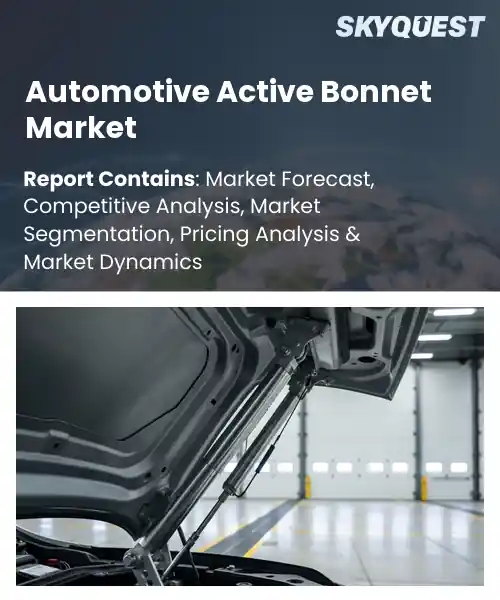
Automotive Active Bonnet Market
Report ID: SQMIG25C2261
Report ID: SQMIG25C2261
[email protected]
USA +1 351-333-4748
Report ID:
SQMIG25C2261 |
Region:
Global |
Published Date: June, 2026
Pages:
157
|Tables:
172
|Figures:
79


Global Automotive Active Bonnet Market size was valued at USD 524.6 Million in 2024 and is poised to grow from USD 555.03 Million in 2025 to USD 871.37 Million by 2033, growing at a CAGR of 5.8% during the forecast period (2026-2033).
Active mechanisms are used to raise the front engine hood of a vehicle (bonnet) in the event of a frontal impact to provide additional space for the engine compartment which, in turn, will reduce the likelihood of injuries sustained to the persons/a passengers in the vehicle. This technology first appeared on vehicles like the Mercedes EQ and Volvo XC90 in early 2010's as a result of the introduction of strict new pedestrian safety regulations in Europe and increasing consumer demand for features that assist with crash avoidance. Over the past ten years, the active bonnet market has transitioned from a niche luxury segment to a regular offering on most medium to large sedan and SUV manufacturing due to the addition of actuators and sensors by manufacturers; thus, increasing the number of active bonnets sold annually from just a few hundred thousand in 2015 to an estimated 3.2 million units in 2028.
Therefore, as the number of active hoods in vehicles has increased, so has the overall number of suppliers; regulatory pressures through new pedestrian protection legislation serve as an added driver of the active bonnet market towards widespread adoption because whenever legislation such as the ECE R129 for the European Union becomes law with requirements such as a minimum impact energy requirement or threshold for compliance, the manufacturers need to have in place systems to meet these new standards which compels them to pursue investments in their supply chain, e.g., actuator and sensor arrays; this opens up new opportunities for tier one suppliers to obtain contracts, such as Bosch and Hyundai for their active lift system in the Sonata N-Line. As compliance costs diminish through economies of scale, manufacturers can offer active bonnets as standard features, enhancing brand safety credentials and stimulating consumer preference for vehicles equipped with safety mitigation technology.
How is AI-driven Automation Influencing Design And Adoption In The Automotive Active Bonnets Market?
Automation of active bonnet design has been redefined through AI, as it incorporates sensor fusion, real-time data processing, and predictive algorithms. Machine learning models can simulate impact scenarios allowing engineers to fine-tune both the actuators' response and structural geometry to provide the best possible protection for pedestrians. Additionally, this technology streamlines the virtual testing process resulting in fewer physical testing prototypes, thus speeding up the development cycle. As manufacturers continue to seek "smarter" safety systems, automation is allowing active bonnets to display a more dynamic capability, such as responding to colliding with a vehicle or between vehicles, as well as adapting to road conditions and vehicle dynamics.
Therefore, the implementation of AI in the design of active bonnets has made them less of a niche safety device and more of an everyday component used in all new vehicle platforms. Nissan will showcase the success of this technology with their newest sedan, expected to launch in June 2024. The incorporation of AI optimized actuation control has led to an increase in speed at which the bonnet deploys after an impact as well as increased reliability of deployment, proving automation can enhance the speed at which active bonnets are adopted and improve the overall level of safety provided by active bonnets.
Market snapshot - (2026-2033)
Global Market Size
USD 524.6 Million
Largest Segment
Fastest Growth
Growth Rate
5.8% CAGR
To get more insights on this market click here to Request a Free Sample Report
Global automotive active bonnet market is segmented by actuation type, sensor type, vehicle type, sales channel, propulsion type and region. Based on actuation type, the market is segmented into Electric actuators, hydraulic actuation, Pyrotechnic Systems, Spring-Based Systems, Electromechanical Systems, and Others. Based on sensor type, the market is segmented into Acceleration Sensors, Pressure Sensors, Vision Sensors, and Others. Based on vehicle type, the market is segmented into Passenger Cars, Sport Utility Vehicles, Luxury Vehicles, and Others. Based on sales channel, the market is segmented into OEM and Aftermarket. Based on propulsion type, the market is segmented into Internal Combustion Engine Vehicles, Hybrid Electric Vehicles, Battery Electric Vehicles. Based on region, the market is segmented into North America, Europe, Asia Pacific, Latin America and Middle East & Africa.
Electric actuators dominate the automotive active bonnet market due to their ability to provide the freedom of a lightweight design that integrates seamlessly with the vehicle's electronic systems. Since there are no longer bulky hydraulic lines required, there are fewer packaging constraints for designers, allowing them more opportunities to install the mechanism inside tighter engine compartments. In addition, electric motors offer the best in terms of control, which enhances the reliability of deployment during pedestrian impacts. This combination of operational efficiency, freedom of design and safety performance is what will continue to drive the leadership position of electric actuation in this emerging market. As a result, vehicles that utilize electric actuation have a greater value proposition than those with hydraulic actuation.
As per automotive active bonnet market forecast, hydraulic actuation is experiencing the fastest rate of growth, due to OEMs continuing to build vehicles on long-standing legacy platforms, those vehicles typically utilize mature hydraulic systems that allow for easier integration and lower cost of engineering. Many OEMs are currently focused on improving the efficiency of their hydraulic pumps and developing smaller diameters for hydraulic cylinders to reduce the overall weight of the components while at the same time creating opportunities to apply their products into more models, which will ultimately accelerate the rate of growth of this segment of the active bonnets market.
Due to the capability of providing robust long-range detection that seamlessly integrates with advanced driver assistance systems (ADAS), the radar sensor segment is the current leading provider of detection that allows for the timely deployment of the bonnet before an impact occurs. Radar sensors provide additional consumer safety confidence by continuing to operate in adverse weather conditions, furthering the desire for manufacturers to utilize radar sensor systems in their vehicle architecture/engineering. The predictive algorithms developed from the data collected by radar sensors can also help to refine the timing of actuation, improving occupant protection and allowing the manufacturer to meet governmental requirements in terms of vehicle safety features, thus further solidifying radar sensors as leaders in the automotive active bonnet marketplace.
As per automotive active bonnet market analysis, the lidar sensor is quickly developing into a key area of high-growth due to its ability to develop new predictive safety algorithms that use high-resolution depth mapping to detect pedestrians at much earlier points than other sensor types. With ongoing cost reductions and the ability for lidar sensors to be integrated into the new vehicle lighting systems, the overall appeal and acceptance of lidar sensors can only be expected to increase rapidly, resulting in many new opportunities for the development of lidar sensor technology within the automotive industry.
To get detailed segments analysis, Request a Free Sample Report
The automotive pick-up truck hood sales in Asia Pacific are largely driven by the industry's advanced engineering capabilities, comprehensive safety requirements from consumers and businesses, and willingness to adopt new technologies. Major automotive manufacturing companies within Japan and Korea invest millions of dollars in researching and developing their active hood designs through automated products with high levels of application integration, leading to a strong supply network for providing the research-based development with the necessary component supply, leading to strong production capabilities with fast prototyping options. There are also other trends contributing to the increased sales of active hoods, including; increased public awareness regarding pedestrian safety, increased awareness regarding human lives and property being lost or destroyed due to automobile crashes (there are a lot of automobile accidents), and government recommendations and incentives for OEM's to provide active hoods within the automobile marketplace in all vehicle models will support this long-term positive growth. In many cases this growth is driven by "collaborative networks" or "collaborative ecosystems" that exist among OEM's, Tier 1 suppliers and technology companies involved in the automotive marketplace, which has accelerated the development of products that meet the high standards synonymous with the Asia Pacific automotive marketplace, ultimately resulting in the Asia Pacific region becoming globally benchmarked against other major automotive markets in terms of quality and innovative products offered.
Due to a deeply ingrained culture of vehicle safety and precision engineering, there is substantial activity within the Automotive Active Bonnet Market in Japan. Large automakers work closely with electronics companies to develop sensor-based systems that can detect an impact and respond accordingly. An established and expanding supply base of reputable domestic suppliers provides high-quality actuation systems for this technology. Additionally, the onerous regulatory requirements encourage manufacturers to implement this advanced technology early in production as manufacturers produce multiple vehicle types. Moreover, these organizations have developed their reputations for both reliable performance and innovative technology on a global basis.
In South Korea, the Automotive Active Bonnet Market has grown rapidly because advanced driver assistance systems are quickly becoming widespread and because there is a strong emphasis on pedestrian safety. Many manufacturers have combined compact actuation systems with high-performance, sensitive sensors due to a strong presence in the electronics sector. The South Korean government has also provided incentives that promote early implementation of this technology within their passenger and commercial vehicle markets. Collaboration between the universities and the manufacturing industry has greatly sped up the pace of development and implementation.
The rapid expansion of the automotive active bonnet market in Europe is driven by a blend of progressive safety legislation, high consumer expectations for pedestrian protection, and a mature automotive engineering landscape. Leading vehicle manufacturers collaborate with a dense network of specialized component suppliers to develop integrated systems that combine lightweight materials with precise actuation. The region’s commitment to sustainability encourages the use of recyclable components, while strong intellectual property frameworks support continuous innovation. Moreover, a collaborative culture among OEMs, research institutes, and technology firms accelerates the translation of advanced sensor technologies into market‑ready solutions, positioning Europe as a dynamic hub for active bonnet advancement. Automakers also prioritize seamless integration of active bonnet functions with broader driver‑assistance suites, ensuring a coherent safety architecture. This holistic approach, combined with rigorous testing protocols, reinforces confidence among regulators and end‑users, further propelling market uptake across passenger and commercial vehicle segments.
Automotive Active Bonnet Market in Germany is anchored by engineering expertise and a strong tradition of safety innovation. Leading German manufacturers embed active bonnet systems within executive vehicle lines, leveraging precision mechanics and advanced sensor fusion. The domestic supplier base excels in high‑strength materials and reliable actuation technology, while stringent national safety standards push integration across model ranges. This combination sustains Germany’s reputation as a benchmark for performance and protection.
Automotive Active Bonnet Market in United Kingdom is experiencing significant growth propelled by regulatory encouragement and an automotive supply chain. OEMs prioritize the integration of active bonnet mechanisms within compact and electric models to meet tightening pedestrian‑impact standards. Collaborative research hubs link universities with industry, fostering prototyping of lightweight actuation concepts. Consumer enthusiasm for safety features further accelerates adoption, positioning United Kingdom as a leader in active bonnet deployment.
Automotive Active Bonnet Market in France is emerging as a promising segment focused on urban safety and electric mobility. French manufacturers embed active bonnet solutions into city‑focused models, using compact actuation units that suit limited vehicle footprints. Government initiatives promoting pedestrian protection encourage early system deployment, while innovative material suppliers provide lightweight composites. This supportive environment nurtures market growth and positions France as an emerging player in active bonnet technology.
The North American region is reinforcing its position in the automotive active bonnet market through a combination of robust innovation ecosystems, strategic partnerships, and an escalating emphasis on safety across diverse vehicle categories. Leading manufacturers leverage advanced manufacturing techniques and integrate active bonnet systems with broader driver assistance platforms, creating seamless safety experiences. The presence of a large supplier base specializing in high‑precision actuation and sensor technologies accelerates product development cycles. Regulatory encouragement for pedestrian impact mitigation, together with growing consumer awareness, drives wider adoption in both passenger and commercial fleets. Collaborative research initiatives between automotive firms and technology institutes further enhance the readiness of next‑generation active bonnet solutions, solidifying North America’s role as a key market contributor. Industry leaders also focus on cost‑effective designs to broaden accessibility across market segments.
Automotive Active Bonnet Market in United States is driven by R&D investment and a strong emphasis on integrating active bonnet technology into diverse vehicle platforms. Domestic OEMs combine sensor arrays with rapid‑response actuators to meet stringent safety expectations. A supplier network offers advanced materials and reliable actuation components, while collaborative programs with technology firms accelerate innovation. Significant consumer demand for safety features further propels adoption across passenger and commercial segments.
Automotive Active Bonnet Market in Canada benefits from an ecosystem that emphasizes safety research and manufacturing capability. Canadian OEMs adopt active bonnet systems to satisfy domestic safety standards and to enhance appeal in markets. A network of material innovators and precision actuator suppliers supports development of lightweight, reliable solutions. Government programs encourage testing and certification, while growing consumer awareness of pedestrian protection drives market acceptance across passenger and commercial vehicles.
To know more about the market opportunities by region and country, click here to
Buy The Complete Report
Increasing Safety Regulations
Consumer Preference for Advanced Features
High Cost of Integration
Complex Certification Processes
Request Free Customization of this report to help us to meet your business objectives.
The competitive landscape is shaped by tier‑1 suppliers such as Valeo, Autoliv and ZF, which are accelerating M&A to bundle active‑bonnet hardware with advanced sensor suites, while forming OEM partnerships to integrate solutions directly into new vehicle platforms. Tech innovation is evident in Valeo’s laser‑based pedestrian‑impact detection and Autoliv’s lightweight composite bonnet structures, both driving differentiation in a market where safety regulations and cost efficiencies intensify rivalry.
SkyQuest’s ABIRAW (Advanced Business Intelligence, Research & Analysis Wing) is our Business Information Services team that Collects, Collates, Correlates, and Analyses the Data collected by means of Primary Exploratory Research backed by robust Secondary Desk research.
As per SkyQuest analysis the global automotive active bonnet market is expanding rapidly, driven primarily by tightening safety regulations that compel OEMs to embed pedestrian‑protective systems, while a strong consumer appetite for advanced safety features provides a second boost. The electric‑actuation segment dominates because it aligns with lighter vehicle architectures and seamless electronic integration, and Asia Pacific leads the market thanks to its advanced engineering base and proactive safety standards. However, the high cost of integrating sensors, actuators and structural redesigns restrains broader adoption, especially in cost‑sensitive markets, moderating the overall growth pace. Manufacturers are therefore focusing on modular designs and economies of scale to mitigate the cost barrier and unlock wider deployment across vehicle classes.
| Report Metric | Details |
|---|---|
| Market size value in 2024 | USD 524.6 Million |
| Market size value in 2033 | USD 871.37 Million |
| Growth Rate | 5.8% |
| Base year | 2024 |
| Forecast period | (2026-2033) |
| Forecast Unit (Value) | USD Million |
| Segments covered |
|
| Regions covered | North America (US, Canada), Europe (Germany, France, United Kingdom, Italy, Spain, Rest of Europe), Asia Pacific (China, India, Japan, Rest of Asia-Pacific), Latin America (Brazil, Rest of Latin America), Middle East & Africa (South Africa, GCC Countries, Rest of MEA) |
| Companies covered |
|
| Customization scope | Free report customization with purchase. Customization includes:-
|
To get a free trial access to our platform which is a one stop solution for all your data requirements for quicker decision making. This platform allows you to compare markets, competitors who are prominent in the market, and mega trends that are influencing the dynamics in the market. Also, get access to detailed SkyQuest exclusive matrix.
Table Of Content
Executive Summary
Market overview
Parent Market Analysis
Market overview
Market size
KEY MARKET INSIGHTS
COVID IMPACT
MARKET DYNAMICS & OUTLOOK
Market Size by Region
KEY COMPANY PROFILES
Methodology
For the Automotive Active Bonnet Market, our research methodology involved a mixture of primary and secondary data sources. Key steps involved in the research process are listed below:
1. Information Procurement: This stage involved the procurement of Market data or related information via primary and secondary sources. The various secondary sources used included various company websites, annual reports, trade databases, and paid databases such as Hoover's, Bloomberg Business, Factiva, and Avention. Our team did 45 primary interactions Globally which included several stakeholders such as manufacturers, customers, key opinion leaders, etc. Overall, information procurement was one of the most extensive stages in our research process.
2. Information Analysis: This step involved triangulation of data through bottom-up and top-down approaches to estimate and validate the total size and future estimate of the Automotive Active Bonnet Market.
3. Report Formulation: The final step entailed the placement of data points in appropriate Market spaces in an attempt to deduce viable conclusions.
4. Validation & Publishing: Validation is the most important step in the process. Validation & re-validation via an intricately designed process helped us finalize data points to be used for final calculations. The final Market estimates and forecasts were then aligned and sent to our panel of industry experts for validation of data. Once the validation was done the report was sent to our Quality Assurance team to ensure adherence to style guides, consistency & design.
Analyst Support
Customization Options
With the given market data, our dedicated team of analysts can offer you the following customization options are available for the Automotive Active Bonnet Market:
Product Analysis: Product matrix, which offers a detailed comparison of the product portfolio of companies.
Regional Analysis: Further analysis of the Automotive Active Bonnet Market for additional countries.
Competitive Analysis: Detailed analysis and profiling of additional Market players & comparative analysis of competitive products.
Go to Market Strategy: Find the high-growth channels to invest your marketing efforts and increase your customer base.
Innovation Mapping: Identify racial solutions and innovation, connected to deep ecosystems of innovators, start-ups, academics, and strategic partners.
Category Intelligence: Customized intelligence that is relevant to their supply Markets will enable them to make smarter sourcing decisions and improve their category management.
Public Company Transcript Analysis: To improve the investment performance by generating new alpha and making better-informed decisions.
Social Media Listening: To analyze the conversations and trends happening not just around your brand, but around your industry as a whole, and use those insights to make better Marketing decisions.
REQUEST FOR SAMPLE
 REQUEST FREE CUSTOMIZATION
Global Automotive Active Bonnet Market size was valued at USD 524.6 Million in 2024 and is poised to grow from USD 555.03 Million in 2025 to USD 871.37 Million by 2033, growing at a CAGR of 5.8% during the forecast period (2026-2033).
The competitive landscape is shaped by tier‑1 suppliers such as Valeo, Autoliv and ZF, which are accelerating M&A to bundle active‑bonnet hardware with advanced sensor suites, while forming OEM partnerships to integrate solutions directly into new vehicle platforms. Tech innovation is evident in Valeo’s laser‑based pedestrian‑impact detection and Autoliv’s lightweight composite bonnet structures, both driving differentiation in a market where safety regulations and cost efficiencies intensify rivalry. 'Continental AG', 'ZF Friedrichshafen AG', 'Robert Bosch GmbH', 'Autoliv, Inc.', 'Joyson Safety Systems', 'Hyundai Mobis Co., Ltd.', 'Denso Corporation', 'Aisin Corporation', 'Tokai Rika Co., Ltd.', 'Toyoda Gosei Co., Ltd.', 'Nihon Plast Co., Ltd.', 'Ashimori Industry Co., Ltd.', 'Daicel Corporation', 'Kolon Industries, Inc.', 'Mitsubishi Electric Corporation', 'HELLA GmbH & Co. KGaA', 'Forvia SE', 'Marelli Holdings Co., Ltd.', 'Aptiv PLC', 'Veoneer, Inc.'
Growing emphasis on pedestrian protection and crash mitigation in many regions prompts manufacturers to incorporate active bonnet systems, which deploy to cushion impact and reduce injury severity. This regulatory push encourages original equipment manufacturers to prioritize integration of such technologies within new vehicle platforms, fostering collaboration with suppliers and accelerating design innovations. Consequently, the market experiences heightened demand as compliance becomes a key differentiator, prompting broader adoption across vehicle segments seeking to meet stringent safety standards globally and reinforce industry commitment to safety advancements.
Advanced Material Adoption: Automakers are increasingly integrating lightweight composites and high‑strength alloys into active bonnet structures to improve crash performance while reducing vehicle weight. These materials enable more sophisticated actuation mechanisms and lower fuel consumption, aligning with stricter emissions regulations and consumer demand for efficiency. Manufacturers collaborate with specialty suppliers to develop tailored laminates that maintain reliability under repeated deployments, fostering a shift toward modular design platforms that can be adapted across multiple vehicle segments and support future autonomous driving functionalities worldwide today.
Why does Asia Pacific Dominate the Global Automotive Active Bonnet Market? |@12


Want to customize this report? This report can be personalized according to your needs. Our analysts and industry experts will work directly with you to understand your requirements and provide you with customized data in a short amount of time. We offer $1000 worth of FREE customization at the time of purchase.
Feedback From Our Clients


 USA (+1) 351-333-4748

