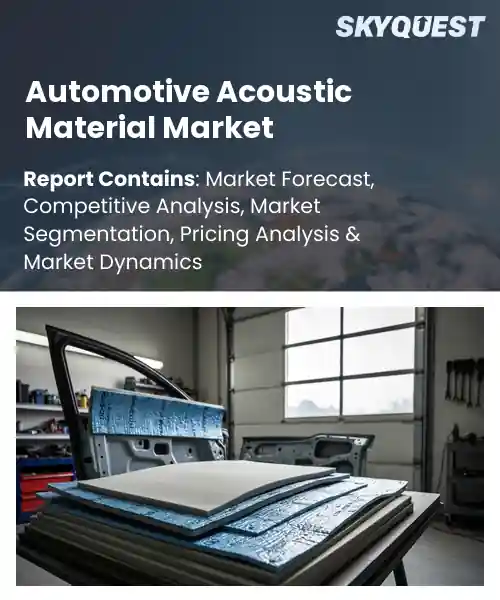
Automotive Acoustic Material Market
Report ID: SQMIG45J2551
Report ID: SQMIG45J2551
[email protected]
USA +1 351-333-4748
Report ID:
SQMIG45J2551 |
Region:
Global |
Published Date: June, 2026
Pages:
157
|Tables:
173
|Figures:
79


Global Automotive Acoustic Material Market size was valued at USD 4.26 Billion in 2024 and is poised to grow from USD 4.53 Billion in 2025 to USD 7.39 Billion by 2033, growing at a CAGR of 6.3% during the forecast period (2026-2033).
The automotive acoustic material industry produces specialized laminate, composite, and foam products that dampen vibration and reduce driver and passenger boredom with the noise from inside the car (ie., cabin noise) by using various methods in order to meet consumer expectations for a quiet interior. With consumers continuing to demand a more superior internal acoustical environment (this has a large influence on their perception of vehicle quality and willingness to remain loyal to a vehicle brand), the development of acoustic materials has progressed from some simple fiberglass insulation products that were produced in the 1980's to utilize the most technologically advanced polymer-based micro-perforated sheets currently available in the production of electric sedans. This evolution/development has primarily been driven by more stringent government regulations concerning acceptable interior noise levels, and that the continued increase in the number of electric powertrains will now produce less engine noise and therefore, create a more distinct road noise and wind noise when driving in a vehicle without an internal combustion engine/engine.
As such, manufacturers are now placing a high value on acoustic engineering as a true differentiator in vehicle design; and finally, the third area impacting the global growth in this market is the emergence of lightweight acoustic solutions that meet or exceed both fuel efficiency requirements and electric vehicle range requirements. Due to the development of more fuel-efficient powertrains, automobile manufacturers are looking to new and innovative material architectures that provide lighter weight solutions while maintaining equivalent sound-attenuating (property) performance, which leads to increased investment in both nano-cellular foams and bio-based composites for use as acoustic materials. In fact, one premium automobile manufacturer in Europe is utilizing hemp fiber-based acoustic material panels in order to provide a 15 percent weight reduction, while also providing a 3.0 dB improvement to the acoustic performance of a vehicle's interior.This cause‑and‑effect relationship lighter structures reducing overall energy consumption and allowing thicker acoustic layers opens opportunities for suppliers to differentiate through sustainability credentials and performance guarantees in the automotive sector.
How are AI-driven Automation And Iot Reshaping The Automotive Acoustic Material Market?
With the help of AI and robotics manufacturers are developing the quality of their acoustic foams and composites by utilizing rapid simulations. With this technology, trial and error processes between product development will be reduced and will allow businesses to get their products to market quickly. Real-time vibration and noise measurements from vehicle cabin sensors are sent from inside the vehicle to cloud computing where machine learning algorithms can determine where to place or how thick to use the materials for the best sound quality in the vehicle.
All of these new technologies are intended to create a continuous feedback mechanism resulting in better quality sound production by allowing manufacturers to reduce their development period, improve sound quality, and provide less waste in material. Currently, manufacturers are integrating their design software with their manufacturing floor equipment to create quicker products for their customers due to the rapidly changing standards that limit the quality of the acoustic products being produced by the automobile manufacturers.
Market snapshot - (2026-2033)
Global Market Size
USD 4.26 Billion
Largest Segment
Fastest Growth
Growth Rate
6.3% CAGR
To get more insights on this market click here to Request a Free Sample Report
Global automotive acoustic material market is segmented by material type, product type, application area, vehicle type, sales channel, propulsion type and region. Based on material type, the market is segmented into Polyurethane Foam, Textile Materials, Fiberglass Materials, and Others. Based on product type, the market is segmented into Absorption Materials, Barrier Materials, Damping Materials, and Others. Based on application area, the market is segmented into Engine Compartment, Cabin Interior, Trunk Area, and Others. Based on vehicle type, the market is segmented into Passenger Cars, Light Commercial Vehicles, Heavy Commercial Vehicles. Based on sales channel, the market is segmented into OEM and Aftermarket. Based on propulsion type, the market is segmented into Internal Combustion Engine Vehicles, Hybrid Vehicles and Battery Electric Vehicles. Based on region, the market is segmented into North America, Europe, Asia Pacific, Latin America and Middle East & Africa.
Fiberglass is the most popular material used to construct acoustic insulation products and panels. It provides a well-documented combination of lightweight, high-density construction materials and superior sound-dampening properties that match automotive manufacturers’ priorities for efficient fuel consumption and decreased cabin noise levels. The historical presence of fiberglass as an acoustic insulation product has resulted in proven performance under a wide range of temperature and humidity, and it can be manufactured in such a way that allows for installation into complex vehicle structures with ease of processing. As a result, automotive designers consistently select fiberglass for use in the majority of interior noise reduction applications, further solidifying its status as an industry leader.
As per automotive acoustic material market analysis, the natural fibre components can be viewed as the fastest-growing segment. This is due to the fact that natural fibre content meets the increasing enforcement of sustainability initiatives and provides similar sound-damping capabilities to traditional composites. In addition, new innovation in the production of bio-based adhesives and advancements in production processes have resulted in greater flexibility in design possibilities, which has prompted automakers to specify natural fibre composites for use in the interior of cars, including roof liners and panels. The growth of this segment is anticipated to create additional market opportunities and contribute to continued growth within the automotive sound insulation industry.
Owing to its capacity to meet consumer goals of noise reduction for cabin environments, the Door Trim Acoustic Laminates segment is the leading source of revenue within the larger market for interior sound-muting products. The combination of dense cores and flexible skins makes for an ideal solution that provides excellent vibration attenuation and provides for ease of molding into complex shapes typical of today’s passenger vehicle doors. The durability of this material, when subjected to repeated opening cycles and compatibility with aesthetic finishes, has positioned it as the preferred choice for OEM manufacturers for several years and will continue to be so moving forward.
As per automotive acoustic material market forecast, growth in the Engine Compartment Sound Deadening Mats segment has been driven by increasing OEM pressures associated with complying with stricter NVH regulations as they relate to powertrain noise and creating more targeted solutions for customers. The use of advanced viscoelastic formulations that exhibit both high temperature resilience and thin profile design allows OEMs to integrate sound-dampening products into their engine packaging without negatively affecting cost or performance. The rapid growth of this segment is creating new sales opportunities as well expanding the overall available size of the market.
To get detailed segments analysis, Request a Free Sample Report
Asia Pacific automotive acoustic material sector utilises a combination of high vehicle production volumes, advanced engineering capabilities, and an active regulatory framework that prioritises cabin quietness and comfort for occupants. The region's mature supply chains allow for the rapid scaling of innovative materials (e.g. acoustic foams, laminates and composites), and manufacturing processes are cost-effective so that acoustic materials remain competitively priced. Japan and South Korea have robust R&D ecosystems that enable the development of lightweight/high-performance solutions developed specifically for electric and hybrid powertrains, which also drive OEMs to incorporate advanced acoustic solutions into new vehicle designs in order to provide consumers with premium ride experiences. This helps cement both technological leadership and market acceptance within this region.
The automotive acoustic material marketplace in Japan is based on the deep experience of high-performance polymers and a culture of precision engineering to generate ultra-lightweight acoustic foam products that exceed all applicable noise standards. Major original equipment manufacturers (OEMs) work closely with material suppliers during the design phase to incorporate an acoustic solution into the vehicle architecture early in the design process (e.g., luxury and electric vehicles) and provide the required aesthetic integration with both internal/external design elements and safe operation of safety equipment and systems.
The South Korean Automotive Acoustic Material market has been growingily supported as a result of heavy investment into nanocomposite type technologies and an excellent vehicle manufacturing foundation including many global companies. There are also government incentives to further research sustainable acoustic materials, as well as strong relationships between car manufacturers and their suppliers which have led to rapid adoption of new innovative panel and damping systems that improve cabin safety, while still keeping the vehicles highly efficient.
In Europe, the market is expanding as a result of stringent environmental and noise regulations that require manufacturers to focus their efforts on reducing the interior noise and vibration of their vehicles. The premium segment of the vehicle market in Europe is also requesting higher quality acoustic environments, and as such, the OEMs have begun to adopt advanced laminates, perforated fabrics and bio-based composites. Research institutions and automotive clusters are innovating through strong collaborations and the emphasis on sustainability continues to lead to increased demand for recycled and low-emission materials for the creation of soundproofing products. As a result of these factors all working together, Europe is developing into a major global centre for the production of high-quality and environmentally friendly acoustic materials.
Automotive Acoustic Material Market in Germany is underpinned by a legacy of engineering excellence and a dense network of Tier‑1 suppliers that produce precision‑engineered acoustic panels and damping structures. OEMs focus on integrating high‑performance acoustic materials to meet consumer expectations for quiet, refined cabins, especially in premium and performance vehicles, driving continuous refinement of material properties and manufacturing techniques.
Automotive Acoustic Material Market in United Kingdom is experiencing rapid growth as manufacturers respond to heightened demand for electric vehicle cabins with minimal road and wind noise. Investment in research hubs and collaborations with material innovators accelerate the development of lightweight acoustic foams and composites that deliver superior sound attenuation, aligning with the market’s shift toward premium, quiet driving experiences.
Automotive Acoustic Material Market in France is emerging through a focus on luxury brand interiors that require bespoke acoustic treatments and a tactile feel. Industry initiatives emphasize the use of sustainable, high‑end materials that complement sophisticated cabin designs, while government programs support the adoption of environmentally friendly acoustic solutions, fostering a growing niche for advanced acoustic technologies.
North America reinforces its market role by capitalizing on a sizable vehicle fleet, strong consumer appetite for premium comfort, and early adoption of electric and autonomous technologies that demand sophisticated acoustic management. Leading OEMs invest heavily in research to develop next‑generation acoustic composites that reduce weight while improving sound isolation. An extensive supplier ecosystem provides rapid prototyping and scalable production, enabling swift integration of cutting‑edge acoustic panels and damping systems across vehicle platforms. Collaboration between automakers, material scientists, and technology firms further accelerates innovation, cementing the region’s influence in shaping global acoustic material trends.
Automotive Acoustic Material Market in United States benefits from extensive manufacturing capacity and a focus on advanced composite technologies that address both noise reduction and weight savings. Major automakers partner with material innovators to embed high‑performance acoustic solutions early in vehicle design, particularly for electric and luxury models where cabin quietness is a critical differentiator.
Automotive Acoustic Material Market in Canada draws on strong academic research and a commitment to sustainable material development, fostering the creation of eco‑friendly acoustic laminates and foams. Collaborative projects between universities, suppliers, and OEMs accelerate the adoption of low‑emission acoustic products, supporting the region’s growing emphasis on environmentally responsible vehicle interiors.
To know more about the market opportunities by region and country, click here to
Buy The Complete Report
Growing Demand For Cabin Quietness
Adoption Of Lightweight Materials
High Cost Of Advanced Materials
Regulatory Variability Across Regions
Request Free Customization of this report to help us to meet your business objectives.
The competitive landscape is shaped by active M&A, strategic partnerships, and rapid tech innovation, with companies leveraging advanced composite materials and acoustic damping technologies to secure OEM contracts and differentiate product portfolios. Recent examples include Perseus Materials securing a strategic investment from Lockheed Martin and forming a partnership to showcase its modular acoustic system at JEC World 2026, while major suppliers are acquiring niche acoustic firms to broaden their material offerings and accelerate time‑to‑market.
SkyQuest’s ABIRAW (Advanced Business Intelligence, Research & Analysis Wing) is our Business Information Services team that Collects, Collates, Correlates, and Analyses the Data collected by means of Primary Exploratory Research backed by robust Secondary Desk research.
As per SkyQuest analysis, the global automotive acoustic material market is being propelled primarily by the growing demand for cabin quietness, as manufacturers race to deliver quieter interiors that enhance perceived vehicle quality. A second strong driver is the adoption of lightweight acoustic composites, which help meet fuel‑efficiency and electric‑vehicle range targets while maintaining sound attenuation. However, the high cost of advanced materials restrains broader uptake, especially in mass‑market segments. Asia Pacific dominates the market due to its massive production volumes, advanced engineering capabilities and supportive regulations. Within the segment landscape, fiberglass continues to lead, offering a proven balance of lightweight construction and high acoustic absorption that remains the preferred choice for OEMs.
| Report Metric | Details |
|---|---|
| Market size value in 2024 | USD 4.26 Billion |
| Market size value in 2033 | USD 7.39 Billion |
| Growth Rate | 6.3% |
| Base year | 2024 |
| Forecast period | (2026-2033) |
| Forecast Unit (Value) | USD Billion |
| Segments covered |
|
| Regions covered | North America (US, Canada), Europe (Germany, France, United Kingdom, Italy, Spain, Rest of Europe), Asia Pacific (China, India, Japan, Rest of Asia-Pacific), Latin America (Brazil, Rest of Latin America), Middle East & Africa (South Africa, GCC Countries, Rest of MEA) |
| Companies covered |
|
| Customization scope | Free report customization with purchase. Customization includes:-
|
To get a free trial access to our platform which is a one stop solution for all your data requirements for quicker decision making. This platform allows you to compare markets, competitors who are prominent in the market, and mega trends that are influencing the dynamics in the market. Also, get access to detailed SkyQuest exclusive matrix.
Table Of Content
Executive Summary
Market overview
Parent Market Analysis
Market overview
Market size
KEY MARKET INSIGHTS
COVID IMPACT
MARKET DYNAMICS & OUTLOOK
Market Size by Region
KEY COMPANY PROFILES
Methodology
For the Automotive Acoustic Material Market, our research methodology involved a mixture of primary and secondary data sources. Key steps involved in the research process are listed below:
1. Information Procurement: This stage involved the procurement of Market data or related information via primary and secondary sources. The various secondary sources used included various company websites, annual reports, trade databases, and paid databases such as Hoover's, Bloomberg Business, Factiva, and Avention. Our team did 45 primary interactions Globally which included several stakeholders such as manufacturers, customers, key opinion leaders, etc. Overall, information procurement was one of the most extensive stages in our research process.
2. Information Analysis: This step involved triangulation of data through bottom-up and top-down approaches to estimate and validate the total size and future estimate of the Automotive Acoustic Material Market.
3. Report Formulation: The final step entailed the placement of data points in appropriate Market spaces in an attempt to deduce viable conclusions.
4. Validation & Publishing: Validation is the most important step in the process. Validation & re-validation via an intricately designed process helped us finalize data points to be used for final calculations. The final Market estimates and forecasts were then aligned and sent to our panel of industry experts for validation of data. Once the validation was done the report was sent to our Quality Assurance team to ensure adherence to style guides, consistency & design.
Analyst Support
Customization Options
With the given market data, our dedicated team of analysts can offer you the following customization options are available for the Automotive Acoustic Material Market:
Product Analysis: Product matrix, which offers a detailed comparison of the product portfolio of companies.
Regional Analysis: Further analysis of the Automotive Acoustic Material Market for additional countries.
Competitive Analysis: Detailed analysis and profiling of additional Market players & comparative analysis of competitive products.
Go to Market Strategy: Find the high-growth channels to invest your marketing efforts and increase your customer base.
Innovation Mapping: Identify racial solutions and innovation, connected to deep ecosystems of innovators, start-ups, academics, and strategic partners.
Category Intelligence: Customized intelligence that is relevant to their supply Markets will enable them to make smarter sourcing decisions and improve their category management.
Public Company Transcript Analysis: To improve the investment performance by generating new alpha and making better-informed decisions.
Social Media Listening: To analyze the conversations and trends happening not just around your brand, but around your industry as a whole, and use those insights to make better Marketing decisions.
REQUEST FOR SAMPLE
 REQUEST FREE CUSTOMIZATION
Global Automotive Acoustic Material Market size was valued at USD 4.26 Billion in 2024 and is poised to grow from USD 4.53 Billion in 2025 to USD 7.39 Billion by 2033, growing at a CAGR of 6.3% during the forecast period (2026-2033).
The competitive landscape is shaped by active M&A, strategic partnerships, and rapid tech innovation, with companies leveraging advanced composite materials and acoustic damping technologies to secure OEM contracts and differentiate product portfolios. Recent examples include Perseus Materials securing a strategic investment from Lockheed Martin and forming a partnership to showcase its modular acoustic system at JEC World 2026, while major suppliers are acquiring niche acoustic firms to broaden their material offerings and accelerate time‑to‑market. 'Autoneum Holding AG', 'Forvia SE', 'Borgers SE & Co. KGaA', 'Sumitomo Riko Company Limited', 'Nihon Tokushu Toryo Co., Ltd.', '3M Company', 'Adler Pelzer Holding GmbH', 'Grupo Antolin Irausa, S.A.', 'Asimco Technologies Limited', 'ElringKlinger AG', 'Recticel NV', 'Rogers Corporation', 'Freudenberg SE', 'Covestro AG', 'BASF SE', 'Toray Industries, Inc.', 'Huntsman Corporation', 'Saint-Gobain S.A.', 'Johns Manville Corporation', 'Lydall, Inc.'
Automotive manufacturers are intensifying efforts to enhance passenger comfort, and the desire for quieter cabin environments is driving extensive integration of advanced acoustic materials. By incorporating sound‑absorbing foams, laminates, and barrier composites, manufacturers can mitigate engine, road, and wind noise, thereby elevating perceived vehicle quality. This focus on acoustic comfort aligns with premium branding strategies and consumer expectations for refined driving experiences, prompting increased procurement of specialized acoustic solutions across all vehicle segments in emerging electric and hybrid models and in autonomous vehicle prototypes.
Lightweight Acoustic Composites Adoption: Manufacturers are increasingly incorporating lightweight acoustic composites into vehicle interiors to balance sound attenuation with fuel efficiency targets. These materials combine porous structures with high‑modulus fibers, delivering superior vibration damping while reducing overall mass. As consumer demand for quieter cabins grows, OEMs prioritize solutions that do not compromise vehicle weight budgets, further propelled by electrified powertrains, where reduced engine noise amplifies interior acoustic expectations, prompting suppliers to innovate flexible, recyclable composite panels adaptable to diverse vehicle architectures and future‑proof designs.
Why does Asia Pacific Dominate the Global Automotive Acoustic Material Market? |@12


Want to customize this report? This report can be personalized according to your needs. Our analysts and industry experts will work directly with you to understand your requirements and provide you with customized data in a short amount of time. We offer $1000 worth of FREE customization at the time of purchase.
Feedback From Our Clients


 USA (+1) 351-333-4748

