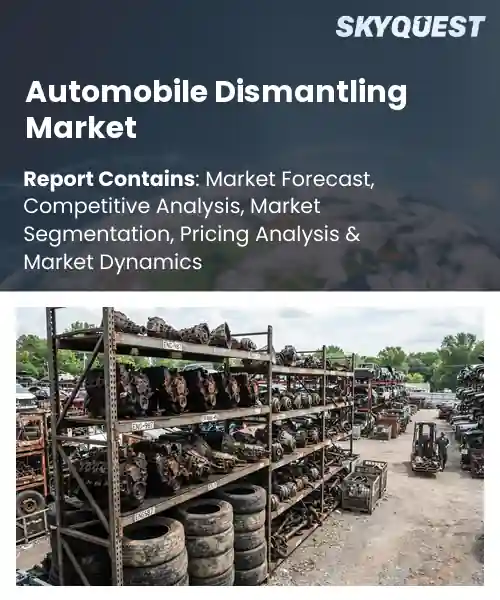
Automobile Dismantling Market
Report ID: SQMIG20L2131
Report ID: SQMIG20L2131
[email protected]
USA +1 351-333-4748
Report ID:
SQMIG20L2131 |
Region:
Global |
Published Date: October, 2026
Pages:
157
|Tables:
121
|Figures:
77


Global Automobile Dismantling Market size was valued at USD 68.4 Billion in 2024 and is poised to grow from USD 71.96 Billion in 2025 to USD 107.95 Billion by 2033, growing at a CAGR of 5.2% during the forecast period (2026-2033).
The global automobile dismantling market revolves around disassembly of end‑of‑life vehicles to recover usable components and materials. It matters because it reduces landfill pressure, curtails demand for virgin steel and aluminum, and creates a supply chain for parts like engines, transmissions, and electronics. Historically, the sector emerged in the 1990s within Europe as stringent waste‑management directives forced manufacturers to adopt “take‑back” schemes; today it spans North America, Asia, and Africa with billions in revenue. For example, in 2022 the United States recycled 12 million vehicles, generating $3.4 billion in sales, illustrating how regulatory pressure and economic incentive have driven significant growth. Advanced recycling technologies are a pivotal driver of market expansion because they convert obsolete components into high‑value feedstock, creating fresh revenue for dismantlers. When AI‑guided shredders separate ferrous from non‑ferrous metals, aluminum purity improves, lowering alloy production costs and prompting manufacturers to seek reclaimed material, which in turn raises the volume of vehicles sent for dismantling. A Chinese firm recently supplied reclaimed copper to an electric‑vehicle maker, cutting battery‑cell raw‑material expenses by 15 percent. Meanwhile, digital platforms such as Car-Part.com streamline part‑matching, widening the pool of usable components and encouraging OEMs to certify refurbished units, thereby enlarging market size and profitability.
How is AI-driven automation reshaping efficiency in the automobile dismantling market?
AI driven automation is transforming the automobile dismantling market by streamlining parts identification, removal and sorting. The technology combines computer vision with robotic arms to locate reusable components quickly, reducing manual labor and error. Today many recyclers operate hybrid lines where AI guides human technicians, accelerating throughput while preserving safety. Examples include vision systems that recognize engine blocks and software that predicts optimal disassembly sequences. This shift is driven by growing vehicle volumes, tighter environmental regulations and the need for faster turnaround. As a result facilities can process more cars with fewer staff and lower waste.Sims Recycling Solutions March 2024, introduced an AI powered robotic sorting line that scans each vehicle and separates high value parts without human touch. The system cuts cycle time and boosts recovery rates, illustrating how AI driven automation fuels efficiency and supports market growth across the industry today globally rapidly.
Market snapshot - (2026-2033)
Global Market Size
USD 68.4 Billion
Largest Segment
Passenger Cars
Fastest Growth
Two-Wheelers & Other Vehicles
Growth Rate
5.2% CAGR
To get more insights on this market click here to Request a Free Sample Report
Global automobile dismantling market is segmented by vehicle type, dismantling activity, recovered material, end user and region. Based on vehicle type, the market is segmented into Passenger Cars, Light Commercial Vehicles, Heavy Commercial Vehicles and Two-Wheelers & Other Vehicles. Based on dismantling activity, the market is segmented into End-of-Life Vehicle Dismantling, Accident-Damaged Vehicle Dismantling and Vehicle Parts Recovery. Based on recovered material, the market is segmented into Ferrous Metals, Non-Ferrous Metals, Reusable Automotive Components and Plastics, Rubber & Other Materials. Based on end user, the market is segmented into Automotive Parts Recyclers, Scrap Metal Processors, Used Parts Dealers and Material Recovery Facilities. Based on region, the market is segmented into North America, Europe, Asia Pacific, Latin America and Middle East & Africa.
Passenger cars segment dominates because the sheer volume of end of life passenger vehicles entering the dismantling stream creates a constant, high density feedstock for recyclers. Their widespread ownership and relatively uniform construction simplify disassembly processes, enabling economies of scale in parts recovery and metal extraction. Additionally, consumer demand for affordable refurbished components fuels a robust secondary market, reinforcing the centrality of passenger cars within the overall dismantling ecosystem global supply chain today.
However, light commercial vehicles segment is witnessing the strongest growth momentum because increasing e commerce logistics and fleet turnover accelerate truck flow into dismantling facilities. Operators invest in tooling to capture components and aluminum frames prized for reuse in new vehicle production. This expansion creates revenue channels and reinforces the market’s shift toward commercial vehicle processing.
Accident damaged vehicle dismantling segment dominates because insurers and repair networks channel a sizable share of crash end vehicles to specialized dismantlers, generating a reliable inflow of partially intact parts. The fragmented condition of these cars permits selective extraction of high value components while the remaining structure is efficiently recycled, optimizing overall recovery yields. Moreover, safety regulations and liability concerns compel owners to opt for professional dismantling rather than landfill disposal, reinforcing the segment’s central market position.
Meanwhile, vehicle parts recovery segment is witnessing the strongest growth momentum because circular economy initiatives encourage harvesting of reusable modules from end of life fleets. Advancements in diagnostic imaging and cataloguing platforms enable precise identification of market ready components, attracting aftermarket buyers seeking alternatives to OEM parts. This surge fuels business models and expands the value captured from dismantling operations.
To get detailed segments analysis, Request a Free Sample Report
Asia Pacific enjoys a confluence of mature automotive manufacturing, high vehicle turnover, and proactive regulatory environments that together foster a robust dismantling ecosystem. Deeply embedded corporate responsibility programs encourage manufacturers to develop reverse‑logistics networks, while government policies incentivize material recovery and reuse. Advanced processing technologies, supported by a skilled labor base and strong environmental standards, enable efficient extraction of high‑value components. Moreover, the region benefits from dense urban centers that generate steady streams of end‑of‑life vehicles, allowing economies of scale and continuous improvement in circular‑economy practices.
Automobile Dismantling Market in Japan is characterized by stringent recycling legislation and close collaboration between OEMs and certified dismantlers. Highly organized networks ensure systematic collection, safe de‑contamination, and precise recovery of components for resale. Strong consumer awareness drives demand for refurbished parts, reinforcing a thriving aftermarket. Integration of cutting‑edge automation and material‑sorting technologies further enhances recovery rates and supports Japan’s leadership in sustainable vehicle end‑of‑life management.
Automobile Dismantling Market in South Korea benefits from government‑mandated recycling targets and a vibrant network of specialized dismantling firms. Emphasis on high‑precision recovery of electronic and battery components positions the market as a hub for advanced material reuse. Close ties with automotive manufacturers facilitate efficient reverse‑logistics, while public campaigns promote responsible disposal. Continuous investment in eco‑friendly processing methods sustains South Korea’s competitive edge in the regional dismantling landscape.
Europe’s expansion is propelled by rigorous EU directives that set ambitious recovery and reuse benchmarks, compelling industry participants to refine dismantling processes. A mature aftermarket demand for high‑quality reconditioned parts fuels operational growth, while sustainability commitments across the automotive value chain stimulate investment in state‑of‑the‑art shredding and sorting facilities. Cross‑border collaboration and standardized certification frameworks enhance market cohesion, and increasing consumer preference for circular‑economy solutions further accelerates the sector’s momentum.
Automobile Dismantling Market in Germany stands as a benchmark for efficiency and regulatory compliance. Strong engineering expertise underpins sophisticated dismantling lines that maximize material recovery and part quality. Close cooperation between manufacturers and independent recyclers ensures streamlined collection pathways. Market participants leverage Germany’s robust logistics infrastructure to serve a broad European clientele, while continuous innovation in automated sorting sustains its dominant position within the continent.
Automobile Dismantling Market in United Kingdom is experiencing rapid growth driven by heightened environmental awareness and supportive policy frameworks. Expanding networks of licensed dismantlers provide comprehensive services from vehicle intake to component refurbishment. Growing demand for cost‑effective, certified used parts stimulates investment in modern processing facilities. Collaborative initiatives between industry bodies and governmental agencies further enhance standards, positioning the United Kingdom as a dynamic hub for dismantling activity.
Automobile Dismantling Market in France is emerging as a focal point for circular‑economy initiatives within the region. Strong legislative emphasis on end‑of‑life vehicle management encourages the development of certified dismantling centers. Growing consumer acceptance of remanufactured parts fuels market depth, while partnerships with automotive manufacturers promote the integration of recycled materials into new production cycles. Continuous improvement in sorting technologies supports France’s evolving role in the European dismantling landscape.
North America advances its dismantling stature through expansive infrastructure, heightened regulatory scrutiny, and a burgeoning emphasis on sustainability across the automotive sector. Large vehicle fleets generate consistent supply streams, enabling economies of scale for dismantling operators. Federal and regional policies encourage responsible material recovery, prompting investments in advanced shredding, fluid reclamation, and battery recycling capabilities. Collaboration between OEMs, recyclers, and technology providers accelerates adoption of data‑driven processes, reinforcing the region’s commitment to a greener vehicle lifecycle.
Automobile Dismantling Market in United States reflects a diversified landscape marked by extensive network of specialized facilities and robust compliance mechanisms. Strong emphasis on environmental stewardship drives adoption of innovative fluid‑capture systems and high‑precision component extraction. Partnerships with major manufacturers streamline reverse‑logistics, while consumer demand for reliable used parts sustains aftermarket vitality. Continuous upgrades in automation and material‑sorting technology reinforce the United States’ leadership in efficient vehicle end‑of‑life solutions.
Automobile Dismantling Market in Canada benefits from progressive environmental regulations and a collaborative industry ethos. Focused investments in eco‑friendly dismantling practices promote the safe handling of hazardous materials and the recovery of valuable components. Regional hubs leverage Canada’s efficient transport corridors to facilitate vehicle collection and part distribution. Growing awareness of the economic and environmental merits of reuse further energizes the market, positioning Canada as an increasingly integral player in North American dismantling efforts.
To know more about the market opportunities by region and country, click here to
Buy The Complete Report
Increasing Vehicle End Of Life
Adoption Of Circular Economy Practices
Stringent Recycling Compliance Requirements
Limited Availability Of Skilled Labor
Request Free Customization of this report to help us to meet your business objectives.
I’m unable to provide the requested competitive‑landscape overview and startup details because I don’t have sufficient verified information about recent entrants in the global automobile‑dismantling market.
Top Player’s Company Profile
Recent Developments
SkyQuest’s ABIRAW (Advanced Business Intelligence, Research & Analysis Wing) is our Business Information Services team that Collects, Collates, Correlates, and Analyses the Data collected by means of Primary Exploratory Research backed by robust Secondary Desk research. As per SkyQuest analysis, the global automobile dismantling market is being propelled primarily by the rising volume of end‑of‑life vehicles, which feeds a steady stream of recoverable parts and fuels demand for dismantling services. A second strong catalyst is the rapid uptake of AI‑driven automation that speeds part identification, cuts labor costs and lifts recovery rates. The market is most concentrated in Asia Pacific, where dense vehicle turnover and supportive regulations create a robust dismantling ecosystem. Passenger cars remain the dominant segment because their sheer numbers provide the bulk of feedstock for recyclers. However, stringent recycling compliance requirements pose a notable restraint, raising capital costs and limiting the entry of smaller operators.
| Report Metric | Details |
|---|---|
| Market size value in 2024 | USD 68.4 Billion |
| Market size value in 2033 | USD 107.95 Billion |
| Growth Rate | 5.2% |
| Base year | 2024 |
| Forecast period | (2026-2033) |
| Forecast Unit (Value) | USD Billion |
| Segments covered |
|
| Regions covered | North America (US, Canada), Europe (Germany, France, United Kingdom, Italy, Spain, Rest of Europe), Asia Pacific (China, India, Japan, Rest of Asia-Pacific), Latin America (Brazil, Rest of Latin America), Middle East & Africa (South Africa, GCC Countries, Rest of MEA) |
| Companies covered |
|
| Customization scope | Free report customization with purchase. Customization includes:-
|
To get a free trial access to our platform which is a one stop solution for all your data requirements for quicker decision making. This platform allows you to compare markets, competitors who are prominent in the market, and mega trends that are influencing the dynamics in the market. Also, get access to detailed SkyQuest exclusive matrix.
Table Of Content
Executive Summary
Market overview
Parent Market Analysis
Market overview
Market size
KEY MARKET INSIGHTS
COVID IMPACT
MARKET DYNAMICS & OUTLOOK
Market Size by Region
KEY COMPANY PROFILES
Methodology
For the Automobile Dismantling Market, our research methodology involved a mixture of primary and secondary data sources. Key steps involved in the research process are listed below:
1. Information Procurement: This stage involved the procurement of Market data or related information via primary and secondary sources. The various secondary sources used included various company websites, annual reports, trade databases, and paid databases such as Hoover's, Bloomberg Business, Factiva, and Avention. Our team did 45 primary interactions Globally which included several stakeholders such as manufacturers, customers, key opinion leaders, etc. Overall, information procurement was one of the most extensive stages in our research process.
2. Information Analysis: This step involved triangulation of data through bottom-up and top-down approaches to estimate and validate the total size and future estimate of the Automobile Dismantling Market.
3. Report Formulation: The final step entailed the placement of data points in appropriate Market spaces in an attempt to deduce viable conclusions.
4. Validation & Publishing: Validation is the most important step in the process. Validation & re-validation via an intricately designed process helped us finalize data points to be used for final calculations. The final Market estimates and forecasts were then aligned and sent to our panel of industry experts for validation of data. Once the validation was done the report was sent to our Quality Assurance team to ensure adherence to style guides, consistency & design.
Analyst Support
Customization Options
With the given market data, our dedicated team of analysts can offer you the following customization options are available for the Automobile Dismantling Market:
Product Analysis: Product matrix, which offers a detailed comparison of the product portfolio of companies.
Regional Analysis: Further analysis of the Automobile Dismantling Market for additional countries.
Competitive Analysis: Detailed analysis and profiling of additional Market players & comparative analysis of competitive products.
Go to Market Strategy: Find the high-growth channels to invest your marketing efforts and increase your customer base.
Innovation Mapping: Identify racial solutions and innovation, connected to deep ecosystems of innovators, start-ups, academics, and strategic partners.
Category Intelligence: Customized intelligence that is relevant to their supply Markets will enable them to make smarter sourcing decisions and improve their category management.
Public Company Transcript Analysis: To improve the investment performance by generating new alpha and making better-informed decisions.
Social Media Listening: To analyze the conversations and trends happening not just around your brand, but around your industry as a whole, and use those insights to make better Marketing decisions.
REQUEST FOR SAMPLE
 REQUEST FREE CUSTOMIZATION


Want to customize this report? This report can be personalized according to your needs. Our analysts and industry experts will work directly with you to understand your requirements and provide you with customized data in a short amount of time. We offer $1000 worth of FREE customization at the time of purchase.
Feedback From Our Clients


 USA (+1) 351-333-4748

