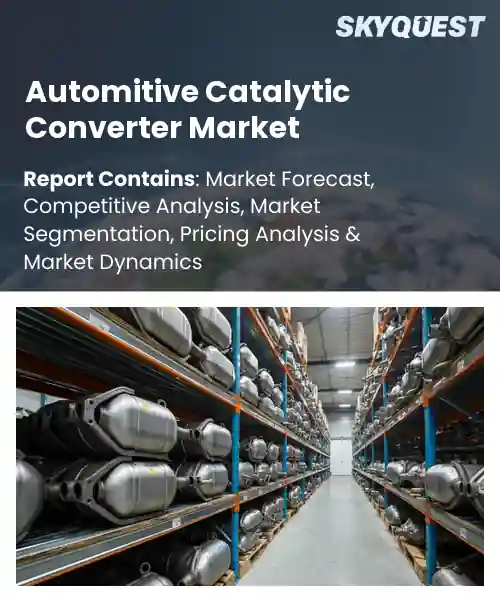
Automitive Catalytic Converter Market
Report ID: SQMIG25A2953
Report ID: SQMIG25A2953
[email protected]
USA +1 351-333-4748
Report ID:
SQMIG25A2953 |
Region:
Global |
Published Date: August, 2026
Pages:
157
|Tables:
120
|Figures:
77


Global Automitive Catalytic Converter Market size was valued at USD 69.45 Billion in 2024 and is poised to grow from USD 73.83 Billion in 2025 to USD 120.36 Billion by 2033, growing at a CAGR of 6.3% during the forecast period (2026-2033).
The global automotive catalytic converter market comprises manufacturers of emissions‑control devices that transform toxic exhaust gases into less harmful compounds, a technology mandated by environmental regulations. Its importance stems from the need to curb carbon monoxide, hydrocarbons, and nitrogen oxides that drive air pollution and climate change. Originating in the 1970s after the U.S. Clean Air Act, the market expanded as European and Chinese standards followed, prompting automakers to fit converters on every gasoline vehicle. Over the past decade, advances in substrate materials and precious‑metal loading have cut costs while boosting efficiency, expanding use across cars, trucks, and hybrid powertrains.
Regulatory tightening of emission standards remains the key trend driving the global automotive catalytic converter sector, compelling manufacturers to adopt converters with higher‑performance palladium, rhodium, and platinum formulations. Lower NOx and hydrocarbon limits push automakers toward lean‑burn engines and gasoline direct injection, which raise exhaust temperature and require more durable catalyst designs. Volkswagen’s recent transition to a rhodium‑rich coating illustrates compliance with Euro 7 while preserving fuel efficiency. This pressure also accelerates recycling initiatives that recover precious metals, creating a secondary supply chain that mitigates raw‑material volatility and opens business opportunities for firms specializing in collection networks and metal refining.
How is AI-Driven Automation Impacting Emissions Compliance in the Automotive Catalytic Converter Market?
AI driven automation is reshaping how manufacturers monitor and meet emissions standards in the catalytic converter sector. Machine learning models analyze exhaust data in real time, flagging deviations before they become violations. Predictive maintenance schedules reduce downtime and ensure optimal catalyst performance. Integrated digital twins allow engineers to simulate new formulations without costly physical trials. The result is faster certification cycles and lower risk of non compliance. Suppliers are embedding these tools into production lines, giving OEMs clearer insight into regulatory trends. This shift is turning compliance from a reactive checkpoint into a continuous optimization process.
In June 2025, BASF continued applying AI and machine-learning technologies across catalyst research and development, using data-driven models to accelerate catalyst formulation and performance optimization. Because BASF supplies automotive emission-control catalysts, these AI capabilities can indirectly support catalytic-converter innovation by reducing development time, improving catalyst efficiency, and helping engineers design solutions for increasingly stringent vehicle-emission standards.
Market snapshot - (2026-2033)
Global Market Size
USD 69.45 Billion
Largest Segment
Three-Way Catalytic Converters
Fastest Growth
Selective Catalytic Reduction Systems
Growth Rate
6.3% CAGR
To get more insights on this market click here to Request a Free Sample Report
Global automitive catalytic converter market is segmented by product type, vehicle type, fuel type, sales channel and region. Based on product type, the market is segmented into two-way catalytic converters, three-way catalytic converters, diesel oxidation catalysts, selective catalytic reduction systems and lean NOx Traps. Based on vehicle type, the market is segmented into passenger vehicles, light commercial vehicles, heavy commercial vehicles and off-highway vehicles. Based on fuel type, the market is segmented into gasoline, diesel, hybrid vehicles and alternative fuel vehicles. Based on sales channel, the market is segmented into original equipment manufacturer (OEM) and aftermarket. Based on region, the market is segmented into North America, Europe, Asia Pacific, Latin America and Middle East & Africa.
Based on the global automotive catalytic converter market growth, three way catalytic converters segment dominates because it meets stringent emission standards for gasoline engines while delivering comprehensive reduction of carbon monoxide, hydrocarbons, and nitrogen oxides. Its integrated chemistry provides simultaneous treatment of multiple pollutants, making it the default choice for original equipment manufacturers. The widespread adoption of gasoline passenger vehicles and regulatory pressure to achieve low tailpipe emissions reinforce its central position, driving continuous material optimization and supply chain stability.
Meanwhile, lean NOx traps segment is witnessing the strongest growth momentum as diesel engines adopt aftertreatment solutions to meet tightening NOx limits. Advanced trap materials capture nitrogen oxides during lean operation and release them for reduction, attracting manufacturers seeking cost effective compliance. This innovation fuels expanding demand and positions the segment as a key growth engine.
OEM segment dominates because vehicle manufacturers integrate catalytic converters at the factory stage, ensuring compliance with emissions regulations from the first mile. This integration simplifies warranty support and guarantees performance consistency, making original equipment the preferred source for new vehicle builds. Strong relationships between converter producers and automakers, coupled with stringent type‑approval processes, lock in long‑term volumes and drive continuous material and design refinement.
On the other hand, aftermarket segment emerges as the key high growth area as vehicle aging drives replacement demand and retro fit initiatives. Consumers and fleet operators seek upgraded converters to meet newer standards, spurring innovation in cost effective designs and quick install solutions. This renewal cycle expands service revenue and creates fresh opportunities for specialty manufacturers.
To get detailed segments analysis, Request a Free Sample Report
As per the global automotive catalytic converter market share, Asia Pacific benefits from a concentration of leading automobile manufacturers and a mature supplier ecosystem that accelerates innovation in emission control technologies. Robust regulatory frameworks compel manufacturers to adopt advanced catalytic solutions, fostering continuous improvement. Extensive research institutions collaborate closely with industry players, driving material advances and design efficiencies. Moreover, the presence of high‑volume production hubs lowers cost structures while maintaining quality, enabling the region to serve both domestic and export markets effectively. Strategic investments in green technology and a cultural emphasis on engineering excellence further reinforce the region’s leadership position in the global landscape.
Automitive catalytic converter market in Japan is shaped by long‑standing collaboration between automotive giants and specialist suppliers, resulting in highly reliable and efficient designs. Strict national emission standards push continual refinement of catalyst formulations, while a focus on compact, lightweight solutions aligns with the country’s emphasis on fuel efficiency. Domestic demand for hybrid and electric platforms creates opportunities for integrated catalytic systems, and an established export channel enhances Japan’s influence on global supply dynamics.
Automitive catalytic converter market in South Korea leverages a strong manufacturing base and aggressive investment in next‑generation catalyst materials. Government policies supporting low‑emission vehicles stimulate domestic adoption, while close ties between OEMs and component firms foster rapid technology transfer. The country’s expertise in precision engineering contributes to high‑performance converter designs that meet demanding environmental criteria. Export orientation and participation in regional supply chains amplify South Korea’s role as a pivotal contributor to the broader market.
Based on global automotive catalytic converter regional forecast, North America is propelled by rigorous environmental regulations that compel manufacturers to integrate advanced catalytic technologies across vehicle line‑ups. Consumer preference for cleaner-running engines aligns with strong policy incentives, encouraging OEMs to prioritize emission control solutions. A well‑established network of specialized parts manufacturers provides a resilient supply chain, facilitating swift adoption of new catalyst formulations. Collaboration between research institutions and industry accelerates innovation, particularly in lightweight and high‑efficiency designs. Additionally, the emphasis on fuel‑efficient and low‑emission vehicles across the market reinforces demand for sophisticated catalytic converters, solidifying the region’s expansion trajectory.
Automitive catalytic converter market in the United States is driven by an extensive fleet of vehicles subject to stringent emission standards, prompting continuous upgrades to catalytic technology. Strong collaboration between leading OEMs and a deep pool of specialized suppliers fuels rapid product development. Investment in green research initiatives supports the emergence of novel catalyst substrates, while a broad distribution network ensures timely market penetration. Consumer awareness of environmental impact further amplifies demand for high‑performance converters in both passenger and commercial segments.
Automitive catalytic converter market in Canada reflects a commitment to stringent air quality objectives that influence vehicle compliance strategies. Close integration with North American supply chains enables access to advanced catalytic solutions, while domestic policy incentives encourage adoption of low‑emission technologies. The market benefits from a collaborative ecosystem of research institutions and manufacturers focused on developing catalysts that perform well in colder climates. Growing consumer demand for environmentally responsible transportation reinforces the sector’s upward momentum.
As per global automotive catalytic converter regional outlook, Europe sustains its influence through a combination of rigorous emission directives and a tradition of engineering excellence that drives catalyst innovation. A dense network of automotive manufacturers and specialized component firms facilitates rapid iteration of high‑efficiency designs. Investment in sustainable research programs promotes the development of alternative catalyst materials and greener production processes. Collaborative industry clusters across key economies enable shared expertise and cost‑effective scaling. Furthermore, a strong regulatory environment encourages early adoption of next‑generation converters, reinforcing Europe’s role as a leader in emission control technology.
Automitive catalytic converter market in Germany is anchored by world‑renowned automotive brands that set high benchmarks for emission performance. Precision engineering capabilities support the creation of catalysts with superior durability and conversion efficiency. Close cooperation between research institutes and manufacturers accelerates the introduction of novel substrate technologies. Export‑oriented production and a robust domestic supply chain reinforce Germany’s pivotal position within the broader European market.
Automitive catalytic converter market in the United Kingdom benefits from a strong emphasis on research collaboration and innovative material science. Policy frameworks encouraging low‑emission vehicle adoption drive demand for advanced catalytic solutions. A network of specialized component firms works closely with OEMs to tailor converters for diverse vehicle platforms. The UK’s focus on sustainable manufacturing practices enhances its contribution to the regional ecosystem.
Automitive catalytic converter market in France is shaped by a deep integration of automotive engineering and environmental policy. French manufacturers prioritize catalysts that meet exacting emission standards while optimizing fuel efficiency. Partnerships with academic laboratories foster the development of next‑generation catalyst formulations. A commitment to eco‑friendly production processes and strong domestic demand for clean‑technology vehicles bolster France’s standing in the European market.
To know more about the market opportunities by region and country, click here to
Buy The Complete Report
Increasing Stringent Emission Standards
Growing Adoption of Hybrid Vehicles
High Cost of Precious Metals
Stringent Recycling Regulations
Request Free Customization of this report to help us to meet your business objectives.
The global automotive catalytic converter market outlook is highly competitive, with BASF, Johnson Matthey, Umicore, Tenneco, Faurecia, and Eberspächer among major international players. BASF focuses on advanced catalyst technologies for stringent emission standards, while Johnson Matthey emphasizes R&D, product innovation, and global manufacturing. Umicore strengthens its position through precious-metal recovery and recycling, whereas Tenneco and Faurecia leverage integrated exhaust-system portfolios and OEM relationships to expand market presence.
Top Player’s Company Profile
Recent Developments
SkyQuest’s ABIRAW (Advanced Business Intelligence, Research & Analysis Wing) is our Business Information Services team that Collects, Collates, Correlates, and Analyses the Data collected by means of Primary Exploratory Research backed by robust Secondary Desk research.
As per SkyQuest analysis, the global automotive catalytic converter industry is being propelled primarily by increasingly stringent emission standards that force OEMs to adopt higher‑performance converters, while the rapid growth of hybrid vehicles provides a second driver by demanding designs suited to lower exhaust temperatures. The high cost of precious metals such as platinum, palladium and rhodium acts as a notable restraint, limiting price‑sensitive adoption especially in emerging markets. Asia‑Pacific dominates the market thanks to its massive production base, advanced supplier ecosystem and tight regulatory frameworks, and within the product mix the three‑way catalytic converter remains the leading segment, delivering comprehensive CO, HC and NOx reduction for gasoline engines.
| Report Metric | Details |
|---|---|
| Market size value in 2024 | USD 69.45 Billion |
| Market size value in 2033 | USD 120.36 Billion |
| Growth Rate | 6.3% |
| Base year | 2024 |
| Forecast period | (2026-2033) |
| Forecast Unit (Value) | USD Billion |
| Segments covered |
|
| Regions covered | North America (US, Canada), Europe (Germany, France, United Kingdom, Italy, Spain, Rest of Europe), Asia Pacific (China, India, Japan, Rest of Asia-Pacific), Latin America (Brazil, Rest of Latin America), Middle East & Africa (South Africa, GCC Countries, Rest of MEA) |
| Companies covered |
|
| Customization scope | Free report customization with purchase. Customization includes:-
|
To get a free trial access to our platform which is a one stop solution for all your data requirements for quicker decision making. This platform allows you to compare markets, competitors who are prominent in the market, and mega trends that are influencing the dynamics in the market. Also, get access to detailed SkyQuest exclusive matrix.
Table Of Content
Executive Summary
Market overview
Parent Market Analysis
Market overview
Market size
KEY MARKET INSIGHTS
COVID IMPACT
MARKET DYNAMICS & OUTLOOK
Market Size by Region
KEY COMPANY PROFILES
Methodology
For the Automitive Catalytic Converter Market, our research methodology involved a mixture of primary and secondary data sources. Key steps involved in the research process are listed below:
1. Information Procurement: This stage involved the procurement of Market data or related information via primary and secondary sources. The various secondary sources used included various company websites, annual reports, trade databases, and paid databases such as Hoover's, Bloomberg Business, Factiva, and Avention. Our team did 45 primary interactions Globally which included several stakeholders such as manufacturers, customers, key opinion leaders, etc. Overall, information procurement was one of the most extensive stages in our research process.
2. Information Analysis: This step involved triangulation of data through bottom-up and top-down approaches to estimate and validate the total size and future estimate of the Automitive Catalytic Converter Market.
3. Report Formulation: The final step entailed the placement of data points in appropriate Market spaces in an attempt to deduce viable conclusions.
4. Validation & Publishing: Validation is the most important step in the process. Validation & re-validation via an intricately designed process helped us finalize data points to be used for final calculations. The final Market estimates and forecasts were then aligned and sent to our panel of industry experts for validation of data. Once the validation was done the report was sent to our Quality Assurance team to ensure adherence to style guides, consistency & design.
Analyst Support
Customization Options
With the given market data, our dedicated team of analysts can offer you the following customization options are available for the Automitive Catalytic Converter Market:
Product Analysis: Product matrix, which offers a detailed comparison of the product portfolio of companies.
Regional Analysis: Further analysis of the Automitive Catalytic Converter Market for additional countries.
Competitive Analysis: Detailed analysis and profiling of additional Market players & comparative analysis of competitive products.
Go to Market Strategy: Find the high-growth channels to invest your marketing efforts and increase your customer base.
Innovation Mapping: Identify racial solutions and innovation, connected to deep ecosystems of innovators, start-ups, academics, and strategic partners.
Category Intelligence: Customized intelligence that is relevant to their supply Markets will enable them to make smarter sourcing decisions and improve their category management.
Public Company Transcript Analysis: To improve the investment performance by generating new alpha and making better-informed decisions.
Social Media Listening: To analyze the conversations and trends happening not just around your brand, but around your industry as a whole, and use those insights to make better Marketing decisions.
REQUEST FOR SAMPLE
 REQUEST FREE CUSTOMIZATION
Global Automitive Catalytic Converter Market size was valued at USD 69.45 Billion in 2024 and is poised to grow from USD 73.83 Billion in 2025 to USD 120.36 Billion by 2033, growing at a CAGR of 6.3% during the forecast period (2026-2033).
Top Player’s Company Profile 'FORVIA SE', 'Tenneco Inc.', 'BASF SE', 'Umicore SA', 'Johnson Matthey Plc', 'Eberspächer Gruppe GmbH & Co. KG', 'Benteler International AG', 'Bosal International N.V.', 'Marelli Holdings Co., Ltd.', 'Futaba Industrial Co., Ltd.', 'SANGO Co., Ltd.', 'Sejong Industrial Co., Ltd.', 'Faurecia Clean Mobility', 'Yutaka Giken Co., Ltd.', 'Friedrich Boysen GmbH & Co. KG', 'Katcon Global', 'Eisenmann SE', 'Continental AG', 'CDTi Advanced Materials, Inc.', 'NGK Insulators, Ltd.'
The global push for lower tailpipe pollutants compels manufacturers to integrate advanced catalytic converters across new vehicle lines. This regulatory pressure drives continuous product innovation, prompting suppliers to develop higher efficiency designs that meet tighter limits. As automakers seek compliant solutions, demand for sophisticated converter technologies rises, fostering expansion of the supply chain and encouraging investment in research and development. Consequently, market growth is accelerated through heightened adoption of emissions‑control components in diverse vehicle segments across emerging global markets worldwide.
Electrified Powertrain Adoption: OEMs are rapidly integrating electric and hybrid powertrains, driving demand for catalytic converters optimized for lower exhaust temperatures and new after‑treatment chemistries. Suppliers are redesigning substrate structures and coating formulations to maintain conversion efficiency while accommodating reduced engine outputs. This shift encourages collaborations between battery manufacturers and traditional converter producers, fostering hybrid solutions that combine electro‑catalytic functions. The resulting product portfolios broaden market reach, positioning converters as essential components even as zero‑emission vehicles gain share in global regulatory frameworks today.
Why does Asia Pacific Dominate the Global Automitive Catalytic Converter Market? |@12


Want to customize this report? This report can be personalized according to your needs. Our analysts and industry experts will work directly with you to understand your requirements and provide you with customized data in a short amount of time. We offer $1000 worth of FREE customization at the time of purchase.
Feedback From Our Clients


 USA (+1) 351-333-4748

