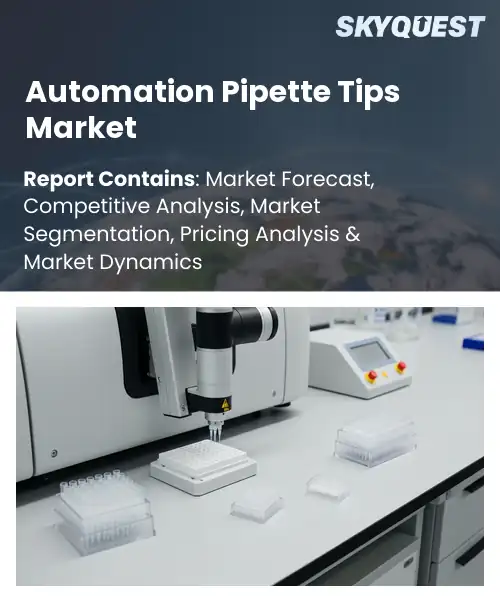
Automation Pipette Tips Market
Report ID: SQMIG35B2474
Report ID: SQMIG35B2474
[email protected]
USA +1 351-333-4748
Report ID:
SQMIG35B2474 |
Region:
Global |
Published Date: August, 2026
Pages:
157
|Tables:
125
|Figures:
77


Global Automation Pipette Tips Market size was valued at USD 892.7 Million in 2024 and is poised to grow from USD 969.47 Million in 2025 to USD 1875.75 Million by 2033, growing at a CAGR of 8.6% during the forecast period (2026-2033).
The global automation pipette tips market supplies disposable tips that attach to robotic liquid‑handling systems used in genomics, drug discovery, and clinical diagnostics. Its importance stems from the need to minimize cross‑contamination while accelerating assays, a requirement that has intensified as laboratories shift toward workflows. Historically the market emerged in the early 2000s when manufacturers introduced polymer tips compatible with the first generation of liquid‑handling robots. Over the past decade, advances in tip geometry, anti‑drip designs, and standards have expanded adoption across academic cores and large biotech firms, illustrating an evolution from niche consumables to essential components of laboratory automation.
The surge in high‑throughput screening drives the major catalyst for market expansion, because laboratories need reliable tips to sustain sample transfers. Sensor‑enabled tips that detect volume deviations in time reduce failed runs and conserve reagents; this capability has prompted pharmaceutical firms to adopt platforms for COVID‑19 antiviral libraries, cutting development timelines by weeks. Tightening regulatory standards for traceability lead manufacturers to introduce barcoded and RFID‑linked tips that streamline inventory control and audit trails, creating opportunities for software providers to offer consumable management. This convergence of precision engineering, data integration, and compliance pressures fuels demand across research, clinical, and industrial settings.
How is AI-driven Automation Improving Efficiency In The Pipette Tips Market?
AI-driven automation is reshaping the pipette tips market by enhancing precision, throughput, and consistency across laboratory and diagnostic workflows. Automated liquid handling platforms integrated with AI algorithms enable real-time calibration and error detection, reducing pipetting inaccuracies caused by human variability and thereby improving reproducibility in high-throughput applications such as genomics, drug discovery, and clinical diagnostics. Machine learning models are increasingly used to predict tip usage patterns and optimize inventory management, minimizing waste and ensuring uninterrupted laboratory operations. AI-powered robotic systems also facilitate seamless integration of pipette tips with automated workstations, allowing labs to scale sample processing without proportionally increasing labor costs. Furthermore, computer vision and sensor-based automation help detect tip misalignment, clogging, or contamination before it affects results, supporting quality assurance protocols.
This shift toward automation is particularly valuable in pharmaceutical and biotechnology settings, where speed and accuracy directly influence research timelines and regulatory compliance. As laboratories continue adopting AI-integrated automation platforms, pipette tip manufacturers are innovating compatible, automation-ready tip designs, strengthening the symbiotic relationship between consumable design and intelligent laboratory ecosystems.
Market snapshot - (2026-2033)
Global Market Size
USD 892.7 Million
Largest Segment
Filter Pipette Tips
Fastest Growth
Conductive Pipette Tips
Growth Rate
8.6% CAGR
To get more insights on this market click here to Request a Free Sample Report
Global automation pipette tips market is segmented by product type, volume range, application, end user and region. Based on product type, the market is segmented into Filter Pipette Tips, Non-Filter Pipette Tips, Conductive Pipette Tips, Sterile Pipette Tips and Non-Sterile Pipette Tips. Based on volume range, the market is segmented into Up to 50 µL, 51–200 µL, 201–1000 µL and Above 1000 µL. Based on application, the market is segmented into Genomics, Drug Discovery, Clinical Diagnostics, Proteomics, Forensic Testing and Others. Based on end user, the market is segmented into Pharmaceutical & Biotechnology Companies, Clinical & Diagnostic Laboratories, Academic & Research Institutes, Contract Research Organizations (CROs) and Others. Based on region, the market is segmented into North America, Europe, Asia Pacific, Latin America and Middle East & Africa.
Filter Pipette Tips segment dominates because they provide a reliable barrier against contaminant ingress, which is critical for high‑throughput robotic workflows. Their ability to maintain sample integrity while reducing cross‑contamination risk aligns with the precision demands of automated liquid handling platforms. This reliability encourages manufacturers to integrate dedicated dispensing heads, and laboratories prioritize these tips to ensure reproducible outcomes across large assay batches.
Meanwhile, Conductive Pipette Tips segment emerges as the fastest growing because its integrated electrode enables direct electrical measurements during dispensing, supporting emerging bio‑electronic assays. The rise of label‑free detection methods and demand for real‑time monitoring fuels adoption, prompting equipment developers to design compatible modules and expanding the market’s innovative horizon.
Genomics application leads because it demands ultra‑precise sample preparation for next‑generation sequencing, where any contamination can compromise data quality. Automated pipette tips minimize manual error, accelerate library construction, and support high‑density plate formats, making them essential for large‑scale genomics initiatives. The expanding focus on population‑wide studies and personalized medicine further heightens the need for reliable, tip‑based robotics that preserve nucleic‑acid integrity while handling varied volumes.
On the other hand, Forensic Testing application emerges as the fastest growing because crime‑scene laboratories increasingly adopt automated workflows to improve evidence throughput and chain‑of‑custody integrity. The growing regulatory emphasis on traceability and the rise of DNA‑profiling technologies drive demand for specialized tips, prompting manufacturers to develop contamination‑controlled designs that accelerate forensic analyses.
To get detailed segments analysis, Request a Free Sample Report
North America maintains a leading position in the automation pipette tips market due to a confluence of advanced research infrastructure, strong funding mechanisms for life‑science innovation, and mature supply chains that integrate precision manufacturing with rapid distribution. The region benefits from a high concentration of biotech clusters and pharmaceutical giants that demand reliable, high‑throughput liquid‑handling solutions. Established regulatory frameworks ensure product quality and accelerate adoption, while collaborations between academia and industry foster continuous improvement of tip designs. Additionally, the presence of major instrument manufacturers and a skilled workforce supports the development of integrated automation platforms, reinforcing the market’s robustness and sustaining its dominant status.
Automation Pipette Tips Market in the United States thrives on extensive investment in genomic research and a vibrant biotech ecosystem that prioritizes high‑efficiency laboratory workflows. The strong presence of leading instrument producers drives co‑development of specialized tips, while regulatory clarity promotes rapid market entry. Strategic partnerships between research institutions and manufacturers further accelerate innovation, positioning the United States as a central hub for cutting‑edge tip technology.
Automation Pipette Tips Market in Canada is bolstered by a collaborative research environment and government initiatives that support life‑science commercialization. The country’s focus on precision medicine and emerging bio‑manufacturing sectors creates demand for reliable automated dispensing solutions. Integration of domestic manufacturing capabilities with international supply networks enhances accessibility, while academic‑industry alliances nurture the development of customized tip configurations for niche applications.
Europe’s rapid expansion of the automation pipette tips market is propelled by a strong emphasis on sustainable laboratory practices, coupled with a dense network of research institutions and pharmaceutical manufacturers that prioritize high‑throughput experimentation. The region’s regulatory landscape encourages standardization and quality assurance, fostering confidence among end users. Investment in digital transformation initiatives supports the adoption of integrated liquid‑handling platforms, while collaborative programs across borders stimulate innovation in tip materials and geometry. Moreover, the presence of specialized biotech hubs in key countries energizes demand for tailored automation solutions, reinforcing Europe’s position as a dynamic growth engine for the market.
Automation Pipette Tips Market in Germany is characterized by a robust pharmaceutical sector and a concentration of leading research universities that drive rigorous demand for high‑precision liquid handling. The country’s emphasis on engineering excellence promotes the development of sophisticated tip designs, while strong regulatory compliance ensures product reliability. Collaborative ecosystems between instrument vendors and academic labs foster continuous improvement, solidifying Germany’s dominant role in the European market.
Automation Pipette Tips Market in the United Kingdom experiences the fastest growth, fueled by an aggressive push toward digital lab transformation and a vibrant biotech startup community. Government funding programs encourage the adoption of automated workflows, while a mature contract research organization network amplifies demand for reliable pipette tips. The synergy between innovative manufacturers and academic research centers accelerates the introduction of advanced tip technologies, positioning the United Kingdom as a rapid‑growth market leader.
Automation Pipette Tips Market in France is emerging as a notable segment, driven by increasing investment in life‑science research and a strategic focus on precision medicine. The country’s strong pharmaceutical heritage supports the uptake of automated dispensing solutions, while collaborations between national research institutes and equipment suppliers nurture tailored tip developments. Growing awareness of efficiency gains in laboratory operations further stimulates market acceptance, establishing France as an emerging contributor within Europe.
Asia Pacific is strengthening its position in the automation pipette tips market through a combination of accelerating biotech commercialization, expanding academic research capacity, and a concerted shift toward laboratory automation to enhance productivity. Regional manufacturers are investing in advanced manufacturing technologies that enable high‑quality tip production at competitive costs, while strategic partnerships with global instrument providers facilitate technology transfer. Government initiatives aimed at fostering innovation ecosystems encourage the integration of automated liquid‑handling solutions across pharmaceutical and diagnostic domains. Growing awareness of efficiency and precision in research workflows further drives demand, establishing Asia Pacific as an increasingly influential player in the global market.
Automation Pipette Tips Market in Japan benefits from a well‑established pharmaceutical industry and a strong culture of precision engineering that emphasizes meticulous liquid‑handling standards. The nation’s emphasis on automation in research laboratories, supported by government incentives, promotes widespread adoption of high‑performance pipette tips. Collaborative ventures between leading instrument manufacturers and research institutions accelerate the development of specialized tip configurations, reinforcing Japan’s prominent role within the Asia Pacific landscape.
Automation Pipette Tips Market in South Korea is propelled by rapid growth in biotechnology startups and a national drive toward digital health solutions. The country’s focus on integrating smart laboratory systems encourages the use of advanced pipette tip technologies that support high‑throughput assays. Partnerships between domestic manufacturers and global equipment leaders facilitate knowledge exchange, while supportive regulatory frameworks ensure quality compliance. These dynamics collectively enhance South Korea’s emerging position in the regional automation pipette tips market.
To know more about the market opportunities by region and country, click here to
Buy The Complete Report
Increasing Laboratory Automation Adoption
Stringent Regulatory Standards for Sample Integrity
High Cost of Specialized Tip Manufacturing
Limited Compatibility with Legacy Equipment
Request Free Customization of this report to help us to meet your business objectives.
The Automation Pipette Tips market is highly competitive, marked by the presence of established global players alongside specialized regional manufacturers. Leading companies such as Thermo Fisher Scientific, Eppendorf, Sartorius, Corning, Mettler Toledo, Tecan, Hamilton, Sarstedt, and Integra Biosciences compete by offering pipette tips tailored for applications like molecular biology and microbiology. These firms are investing heavily in R&D to develop innovative automation pipette tips that address evolving end user needs, alongside driving innovation in automation integration, green manufacturing, and specialized tips for advanced applications. Strategic collaborations remain central, as market players focus on strategic collaborations and product innovations to cater to changing customer requirements. Companies are also pursuing enhanced collaboration with academic and research institutions to co-develop pipetting solutions integrating automation and artificial intelligence. Product differentiation is another key battleground, with firms developing high performance tips for specialized uses, including robotic compatible and filtered variants for sensitive experiments.
SkyQuest’s ABIRAW (Advanced Business Intelligence, Research & Analysis Wing) is our Business Information Services team that Collects, Collates, Correlates, and Analyses the Data collected by means of Primary Exploratory Research backed by robust Secondary Desk research.
As per SkyQuest analysis, the global automation pipette tips market is expanding rapidly driven by increasing laboratory automation adoption that pushes labs toward robotic tip dispensing, while stringent regulatory standards for sample integrity act as a second driver encouraging premium, traceable consumables. The filter pipette tips segment dominates because it offers reliable contamination barriers essential for high‑throughput workflows. North America remains the leading region, benefiting from advanced research infrastructure and strong biotech investment. However, the high cost of specialized tip manufacturing restrains broader uptake, especially for budget‑conscious institutions, tempering the overall growth pace. This dynamic suggests continued innovation and pricing strategies will be crucial for sustaining momentum.
| Report Metric | Details |
|---|---|
| Market size value in 2024 | USD 892.7 Million |
| Market size value in 2033 | USD 1875.75 Million |
| Growth Rate | 8.6% |
| Base year | 2024 |
| Forecast period | (2026-2033) |
| Forecast Unit (Value) | USD Million |
| Segments covered |
|
| Regions covered | North America (US, Canada), Europe (Germany, France, United Kingdom, Italy, Spain, Rest of Europe), Asia Pacific (China, India, Japan, Rest of Asia-Pacific), Latin America (Brazil, Rest of Latin America), Middle East & Africa (South Africa, GCC Countries, Rest of MEA) |
| Companies covered |
|
| Customization scope | Free report customization with purchase. Customization includes:-
|
To get a free trial access to our platform which is a one stop solution for all your data requirements for quicker decision making. This platform allows you to compare markets, competitors who are prominent in the market, and mega trends that are influencing the dynamics in the market. Also, get access to detailed SkyQuest exclusive matrix.
Table Of Content
Executive Summary
Market overview
Parent Market Analysis
Market overview
Market size
KEY MARKET INSIGHTS
COVID IMPACT
MARKET DYNAMICS & OUTLOOK
Market Size by Region
KEY COMPANY PROFILES
Methodology
For the Automation Pipette Tips Market, our research methodology involved a mixture of primary and secondary data sources. Key steps involved in the research process are listed below:
1. Information Procurement: This stage involved the procurement of Market data or related information via primary and secondary sources. The various secondary sources used included various company websites, annual reports, trade databases, and paid databases such as Hoover's, Bloomberg Business, Factiva, and Avention. Our team did 45 primary interactions Globally which included several stakeholders such as manufacturers, customers, key opinion leaders, etc. Overall, information procurement was one of the most extensive stages in our research process.
2. Information Analysis: This step involved triangulation of data through bottom-up and top-down approaches to estimate and validate the total size and future estimate of the Automation Pipette Tips Market.
3. Report Formulation: The final step entailed the placement of data points in appropriate Market spaces in an attempt to deduce viable conclusions.
4. Validation & Publishing: Validation is the most important step in the process. Validation & re-validation via an intricately designed process helped us finalize data points to be used for final calculations. The final Market estimates and forecasts were then aligned and sent to our panel of industry experts for validation of data. Once the validation was done the report was sent to our Quality Assurance team to ensure adherence to style guides, consistency & design.
Analyst Support
Customization Options
With the given market data, our dedicated team of analysts can offer you the following customization options are available for the Automation Pipette Tips Market:
Product Analysis: Product matrix, which offers a detailed comparison of the product portfolio of companies.
Regional Analysis: Further analysis of the Automation Pipette Tips Market for additional countries.
Competitive Analysis: Detailed analysis and profiling of additional Market players & comparative analysis of competitive products.
Go to Market Strategy: Find the high-growth channels to invest your marketing efforts and increase your customer base.
Innovation Mapping: Identify racial solutions and innovation, connected to deep ecosystems of innovators, start-ups, academics, and strategic partners.
Category Intelligence: Customized intelligence that is relevant to their supply Markets will enable them to make smarter sourcing decisions and improve their category management.
Public Company Transcript Analysis: To improve the investment performance by generating new alpha and making better-informed decisions.
Social Media Listening: To analyze the conversations and trends happening not just around your brand, but around your industry as a whole, and use those insights to make better Marketing decisions.
REQUEST FOR SAMPLE
 REQUEST FREE CUSTOMIZATION
Global Automation Pipette Tips Market size was valued at USD 892.7 Million in 2024 and is poised to grow from USD 969.47 Million in 2025 to USD 1875.75 Million by 2033, growing at a CAGR of 8.6% during the forecast period (2026-2033).
I’m unable to provide the requested competitive‑landscape overview and startup details because I don’t have sufficient source information. 'Eppendorf SE', 'Mettler-Toledo International Inc.', 'Danaher Corporation', 'Thermo Fisher Scientific Inc.', 'Corning Incorporated', 'Greiner AG', 'Sartorius AG', 'Hamilton Company', 'Tecan Group AG', 'Gilson Incorporated', 'INTEGRA Biosciences AG', 'Brand GmbH + Co. KG', 'Capp ApS', 'Azenta, Inc.', 'Analytik Jena GmbH+Co. KG', 'Bioer Technology Co., Ltd.', 'NEST Biotechnology Co., Ltd.', 'Socorex Isba SA', 'AHN Biotechnologie GmbH', 'Suzhou ACE Biomedical Technology Co., Ltd.'
Automation technologies are being integrated across research and clinical laboratories to streamline sample handling, reduce manual errors, and accelerate throughput. This shift encourages the use of specialized consumables such as pipette tips designed for robotic platforms, driving demand for higher quality and compatible products. As laboratories prioritize efficiency and reproducibility, the preference for automated tip dispensing solutions expands, prompting manufacturers to develop diverse tip formats that meet evolving workflow requirements, thereby supporting market growth and creating new opportunities for suppliers worldwide.
Ai-Driven Tip Optimization: The integration of machine‑learning algorithms into liquid‑handling platforms enables real‑time adjustment of tip geometry, dispensing volume, and aspiration speed, dramatically improving assay precision. By analyzing historical performance data, systems predict wear patterns and automatically select optimal tip types for each protocol, reducing error rates and consumable waste. This intelligence layer also facilitates seamless scaling from research to clinical laboratories, as operators rely on software‑guided tip selection rather than manual trial‑and‑error, accelerating workflow adoption and enhancing overall productivity across diverse applications.
Why does North America Dominate the Global Automation Pipette Tips Market? |@12


Want to customize this report? This report can be personalized according to your needs. Our analysts and industry experts will work directly with you to understand your requirements and provide you with customized data in a short amount of time. We offer $1000 worth of FREE customization at the time of purchase.
Feedback From Our Clients


 USA (+1) 351-333-4748

