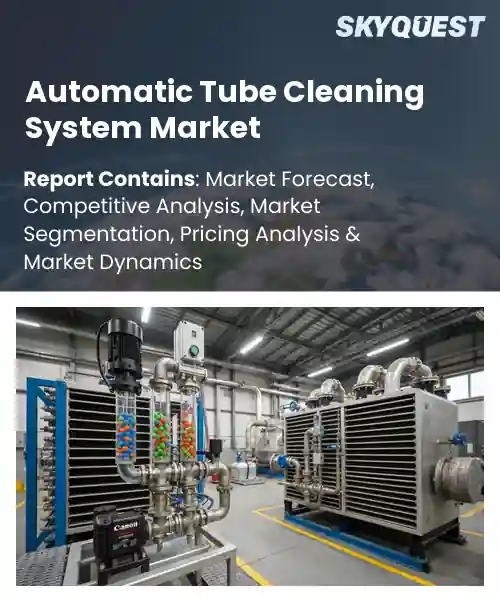
Automatic Tube Cleaning System Market
Report ID: SQMIG20I3093
Report ID: SQMIG20I3093
[email protected]
USA +1 351-333-4748
Report ID:
SQMIG20I3093 |
Region:
Global |
Published Date: June, 2026
Pages:
157
|Tables:
147
|Figures:
78


Global Automatic Tube Cleaning System Market size was valued at USD 142.0 Million in 2024 and is poised to grow from USD 149.81 Million in 2025 to USD 229.91 Million by 2033, growing at a CAGR of 5.5% during the forecast period (2026-2033).
Automatic tube cleaning systems are engineered assemblies that remove fouling from heat exchanger and condenser tubes without shutdown, preserving thermal efficiency and reducing maintenance costs. This market matters because fouling imposes energy penalties, production losses and safety risks across power generation, petrochemical and HVAC sectors, so continuous cleaning yields measurable operational improvements. Over recent decades the market evolved from manual brush racks and periodic pigging toward automated in-situ devices featuring mechanical scrapers, rotating brushes and pneumatic actuators, exemplified by installations in combined cycle plants and refinery heat trains. Such adoption has been driven by rising energy costs and emissions standards.
Regulatory pressure for higher plant efficiency and lower emissions accelerates demand for automatic tube cleaning systems because fouling reduction improves heat transfer, reducing fuel consumption and carbon intensity. Utilities and refineries continue to invest in cleaning their systems on a regular basis to reduce excessive costs, meet compliance requirements of environmental permits and generate additional revenue from aftermarket products that provide monitoring and spare parts. This allows the vendors to offer combined service packages or retrofits that create new opportunities in developing countries where the need for upgrades will be imminent because of the deteriorating infrastructure and increasing energy prices.
How is IoT Enhancing Efficiency in the Automatic Tube Cleaning System Market?
By adding an additional level of connectivity with IoT, sensor data on the state of the water being transported, along with flow pressure and fouling data, are collectively used to enable cleaning solutions that provide continuous condition monitoring, adaptive cleaning, and allow for remote operation. Furthermore, predictive analytics from sensors and data in the cloud allow facilities to anticipate when cleaning of the equipment will be necessary, while closed-loop controllers provide the ability to adjust cleaning cycles based on actual operating parameters. In addition, vendors (manufacturers) are incorporating smart sensors into their matrix of cleaning equipment, providing dashboards and alerts that help operators identify priorities of operations and outsource monitoring capabilities that enable them to respond faster to issues, while decreasing the friction associated with operational expense.
In February 2025, Taprogge announced a digitally assisted installation and remote monitoring service for its tube cleaning systems, demonstrating how IoT enabled remote diagnostics and continuous performance tracking reduce on site visits and extend run times. This development highlights practical gains in lifecycle efficiency and service led market growth.
Market snapshot - (2026-2033)
Global Market Size
USD 142.0 Million
Largest Segment
Automatic Ball Tube Cleaning System
Fastest Growth
Automatic Brush Tube Cleaning System
Growth Rate
5.5% CAGR
To get more insights on this market click here to Request a Free Sample Report
Global automatic tube cleaning system market is segmented by type, application, automation level, tube type, industry and region. Based on type, the market is segmented into automatic ball tube cleaning system and automatic brush tube cleaning system. Based on application, the market is segmented into condensers, chillers, boilers and cooling towers. Based on automation level, the market is segmented into fully automated, semi-automated and manual. Based on tube type, the market is segmented into straight tubes, U-tubes, finned tubes and others. Based on industry, the market is segmented into power generation, oil & gas, commercial buildings, hospitality and others. Based on region, the market is segmented into North America, Europe, Asia Pacific, Latin America and Middle East & Africa.
As per the global automatic tube cleaning system market growth, automatic ball tube cleaning system segment dominates because its low intrusion, continuous cleaning mechanism minimizes fouling without interrupting operations, directly reducing unscheduled downtime and maintenance labor. Proven reliability across diverse tube geometries and compatibility with automated controls make it a preferred option for retrofits and new installations. Purchase decisions are made based on preferences for predictable cleaning cycles and lower total lifecycle cost. Across numerous industries where both uninterrupted heat transfer and operational uptime are primary considerations, owner's decisions to purchase have generally followed these two criteria.
However, automatic brush tube cleaning system is the most rapidly expanding choice, propelled by advances in brush materials and adaptable designs that remove stubborn deposits. Its growth is fueled by easier retrofit integration, reduced dependence on chemical cleaning, and strong demand in applications where mechanical brushing better restores heat transfer and lengthens maintenance cycles.
Condensers segment dominates because condensers experience aggressive fouling from cooling water and process streams, which quickly degrades heat transfer and system efficiency; this creates strong, continuous demand for reliable cleaning solutions. Because condenser performance is critical for overall plant production, profitability, and energy consumption, operating conditions will require operators to purchase automated systems that will minimize the need for unplanned downtime. Therefore, the most cost-effective option to ensure reliable condenser performance is to use an automated solution specifically designed to maintain thermal efficiency through targeted cleaning solutions.
Meanwhile, chillers are the most rapidly expanding application area, driven by growing HVAC complexity and demand for energy efficient cooling in commercial and industrial facilities. Facility managers can leverage technology advancements in automation to create positive environments for occupants by also reducing energy consumption due to improved performance standards compared to previous technologies.
To get detailed segments analysis, Request a Free Sample Report
As per global automatic tube cleaning system market share, Asia Pacific dominance is driven by concentrated industrial activity, extensive thermal power capacity, advanced manufacturing clusters, and proactive adoption of automated maintenance technologies. The ability for companies to build a unique tube cleaning solution quickly and efficiently can occur due to strong relationships between local engineering capabilities and the existing regional supply chain network. Working together, the three groups develop integrated products and aftermarket support. There are relatively few policy incentives available for investing in preventive maintenance systems that promote improved efficiency and/or environmental performance in industrial activities. The ability of mature suppliers located in strategic markets to manufacture components at a lower price than suppliers with only a production facility in North America supports this lower cost structure and increases supplier competitiveness through improved production capabilities and capacity.
Automatic tube cleaning system market in Japan benefits from a mature industrial base, emphasis on reliability, and strong engineering capabilities. Manufacturers, especially equipment makers, partner with utilities and other manufacturers to provide cleaning solutions for thermal and process equipment that is complicated and difficult to maintain. This is done by creating customized solutions that emphasize high quality, extended life cycles of assets, and innovative approaches to using advanced maintenance strategies.
Automatic tube cleaning system market in South Korea is supported by a strong manufacturing ecosystem, advanced shipbuilding and power sectors, and emphasis on modernization. Increased collaboration between developers of technologies and the operators of plants has increased the speed of adoption of automation in cleaning, as well as monitoring methods. Other factors that facilitate the implementation and enhancement of automated cleaning and monitoring in critical heat exchange applications include well-established service networks and aftermarket capabilities.
Based on global automatic tube cleaning system regional forecast, North America expansion is propelled by a combination of industrial modernization, emphasis on uptime, and appetite for technology-driven maintenance solutions among large utilities and industrial operators. The widespread availability and support of aftermarket products provided through a solid network of service and distribution channels gives a base for the expansion of ultimately the distribution of aftersales parts, and service beyond initial installation. The adoption of digital monitoring tools, remote monitoring/diagnostics, and condition-based maintenance systems that will help to drive demand for automated cleaning systems that require little to no human attention, resulting in decreased downtime due to the use of automated cleaning systems. The increased regulatory scrutiny placed on emissions and efficiency combined with the emphasis on total cost of ownership by asset owners promotes additional investment into the reliability of the systems that will utilize automated cleaning systems.
Automatic tube cleaning system market in United States is characterized by demand from utilities, petrochemical complexes, and manufacturers prioritizing uptime and efficiency. The growing importance of integrating digital solutions and predictive maintenance into manufacturing has made automated equipment cleaning systems that interface with a facility's plant-control systems the preferred method for cleaning. Strong service ecosystems and specialized system integrators facilitate large, complex installations of these automated technologies.
Automatic tube cleaning system market in Canada is shaped by demand from power generation, oil and gas, and industrial sectors seeking operational resilience. Vendors who supply local service providers have developed the automated cleaning system they have created to work under different conditions. Local service providers and integrators adapt systems for varied conditions. Collaboration with technology vendors supports customization, while focus on asset life encourages investment in reliable, hands off cleaning approaches.
As per global automatic tube cleaning system regional outlook, Europe is strengthening its position through technological refinement, emphasis on energy efficiency, and coordinated efforts to modernize industrial assets. In order to meet the high-performance and green goals for their customers, manufacturers and service suppliers have been increasingly focused on modular, retrofittable solutions. Collaborating across borders through local engineering expertise and using existing supply chains have allowed for customized implementations in various industrial sectors. As cleaning systems use remote monitoring technology in conjunction with Condition Based Maintenance, this will help implement lifecycle-oriented maintenance strategies. Developing skilled service capabilities, along with creating partnerships between manufacturers/suppliers of equipment and utilities will enable strong aftermarket support and create a region that is viewed as an authority in providing dependable, compliant tube cleaning solutions. Additionally, providing a supportive, innovation-driven approach to industry-specific adaptations will allow European suppliers to be viewed as preferred partners for maintenance programs.
Automatic tube cleaning system market in Germany benefits from engineering heritage and emphasis on energy efficient operations. Operators will benefit through integrated plant automation and monitoring, which creates the conditions for predictable maintenance. Many established service networks have experience providing specialized retrofits for this type of equipment, so that important factors such as regulatory compliance and overall lifecycle performance can lead to more reliable solutions for cleaning systems, thereby reducing the amount of time spent performing manual tasks to maintain or produce clean equipment and preserving productivity from their assets.
Automatic tube cleaning system market in United Kingdom is driven by focus on operational efficiency across power, maritime and industrial sectors. Suppliers offer systems with flexibility toward retrofitting allowing easy integration of the supplier's systems into the existing asset management. As much of the industry works toward reducing its carbon footprint, manufacturers will continue to develop and adopt technology that improves thermal transfer performance, reduces the burden of maintenance, and supports reliability goals through the use of decarbonization technologies and more efficient operations of their plants.
Automatic tube cleaning system market in France is driven by industrial modernization, energy efficiency and strong engineering services. Operators are looking to have their suppliers focus on retrofitting capabilities and integrating those retrofits to be able to meet the operators' needs for scheduling predictable maintenance through plant monitoring. The collaboration between technology providers and utilities provides opportunities for the end-user, across the chemical, food and energy sector industries, to extend the applicability of those technology providers' products.
To know more about the market opportunities by region and country, click here to
Buy The Complete Report
Industrial Process Efficiency Drivers
Maintenance Cost Reduction Benefits
High Initial Capital Requirement
Technical Integration And Compatibility
Request Free Customization of this report to help us to meet your business objectives.
The competitive landscape in the global automatic tube cleaning system market outlook is moderately concentrated around legacy suppliers and fast-moving niche entrants, with competition driven by technology differentiation and channel partnerships rather than price alone; recent strategic moves include targeted acquisitions and product launches that add IoT analytics and robotics to traditional ball and brush systems, while vendors form installation and service partnerships with facilities operators to secure recurring revenue and faster rollouts.
Top Player’s Company Profile
Recent Developments
SkyQuest’s ABIRAW (Advanced Business Intelligence, Research & Analysis Wing) is our Business Information Services team that Collects, Collates, Correlates, and Analyses the Data collected by means of Primary Exploratory Research backed by robust Secondary Desk research.
As per SkyQuest analysis, the global automatic tube cleaning system industry is driven by rising demand for operational efficiency as a key driver, with continuous in-service cleaning preserving heat transfer, lowering energy use and reducing unscheduled downtime. A second driver is regulatory pressure for higher plant efficiency and lower emissions that accelerates investments and supports digital, condition-based services. A restraint is the high initial capital requirement and integration challenges with legacy heat exchangers that can delay projects. The dominating region is Asia Pacific and the dominating segment is Automatic Ball Tube Cleaning System, which leads due to low intrusion, retrofit compatibility and predictable lifecycle costs.
| Report Metric | Details |
|---|---|
| Market size value in 2024 | USD 142.0 Million |
| Market size value in 2033 | USD 229.91 Million |
| Growth Rate | 5.5% |
| Base year | 2024 |
| Forecast period | (2026-2033) |
| Forecast Unit (Value) | USD Million |
| Segments covered |
|
| Regions covered | North America (US, Canada), Europe (Germany, France, United Kingdom, Italy, Spain, Rest of Europe), Asia Pacific (China, India, Japan, Rest of Asia-Pacific), Latin America (Brazil, Rest of Latin America), Middle East & Africa (South Africa, GCC Countries, Rest of MEA) |
| Companies covered |
|
| Customization scope | Free report customization with purchase. Customization includes:-
|
To get a free trial access to our platform which is a one stop solution for all your data requirements for quicker decision making. This platform allows you to compare markets, competitors who are prominent in the market, and mega trends that are influencing the dynamics in the market. Also, get access to detailed SkyQuest exclusive matrix.
Table Of Content
Executive Summary
Market overview
Parent Market Analysis
Market overview
Market size
KEY MARKET INSIGHTS
COVID IMPACT
MARKET DYNAMICS & OUTLOOK
Market Size by Region
KEY COMPANY PROFILES
Methodology
For the Automatic Tube Cleaning System Market, our research methodology involved a mixture of primary and secondary data sources. Key steps involved in the research process are listed below:
1. Information Procurement: This stage involved the procurement of Market data or related information via primary and secondary sources. The various secondary sources used included various company websites, annual reports, trade databases, and paid databases such as Hoover's, Bloomberg Business, Factiva, and Avention. Our team did 45 primary interactions Globally which included several stakeholders such as manufacturers, customers, key opinion leaders, etc. Overall, information procurement was one of the most extensive stages in our research process.
2. Information Analysis: This step involved triangulation of data through bottom-up and top-down approaches to estimate and validate the total size and future estimate of the Automatic Tube Cleaning System Market.
3. Report Formulation: The final step entailed the placement of data points in appropriate Market spaces in an attempt to deduce viable conclusions.
4. Validation & Publishing: Validation is the most important step in the process. Validation & re-validation via an intricately designed process helped us finalize data points to be used for final calculations. The final Market estimates and forecasts were then aligned and sent to our panel of industry experts for validation of data. Once the validation was done the report was sent to our Quality Assurance team to ensure adherence to style guides, consistency & design.
Analyst Support
Customization Options
With the given market data, our dedicated team of analysts can offer you the following customization options are available for the Automatic Tube Cleaning System Market:
Product Analysis: Product matrix, which offers a detailed comparison of the product portfolio of companies.
Regional Analysis: Further analysis of the Automatic Tube Cleaning System Market for additional countries.
Competitive Analysis: Detailed analysis and profiling of additional Market players & comparative analysis of competitive products.
Go to Market Strategy: Find the high-growth channels to invest your marketing efforts and increase your customer base.
Innovation Mapping: Identify racial solutions and innovation, connected to deep ecosystems of innovators, start-ups, academics, and strategic partners.
Category Intelligence: Customized intelligence that is relevant to their supply Markets will enable them to make smarter sourcing decisions and improve their category management.
Public Company Transcript Analysis: To improve the investment performance by generating new alpha and making better-informed decisions.
Social Media Listening: To analyze the conversations and trends happening not just around your brand, but around your industry as a whole, and use those insights to make better Marketing decisions.
REQUEST FOR SAMPLE
 REQUEST FREE CUSTOMIZATION
Global Automatic Tube Cleaning System Market size was valued at USD 142.0 Million in 2024 and is poised to grow from USD 149.81 Million in 2025 to USD 229.91 Million by 2033, growing at a CAGR of 5.5% during the forecast period (2026-2033).
The competitive landscape is moderately concentrated around legacy suppliers and fast-moving niche entrants, with competition driven by technology differentiation and channel partnerships rather than price alone; recent strategic moves include targeted acquisitions and product launches that add IoT analytics and robotics to traditional ball and brush systems, while vendors form installation and service partnerships with facilities operators to secure recurring revenue and faster rollouts. 'Taprogge GmbH', 'BEAUDREY', 'Innovas Technologies LLC', 'WSA Engineered Systems', 'Hydroball Technics Holdings Pte Ltd', 'Ovivo Inc.', 'WesTech Engineering Inc.', 'Nijhuis Saur Industries', 'Balltech Energy Ltd.', 'CET Enviro Pvt. Ltd.', 'Thermax Limited', 'Trane Technologies', 'Alfa Laval', 'SPX Flow Inc.', 'Pentair plc', 'Ecomax Solutions Pvt. Ltd.', 'NLB Corporation', 'Ecoair Cooling Systems', 'SAS Powertech Pvt. Ltd.', 'Sentro Technologies'
Automatic tube cleaning systems enhance operational efficiency by maintaining consistent heat transfer and reducing the frequency of manual interventions. By preventing fouling and scaling, these systems sustain process performance and minimize unscheduled downtime, which encourages adoption across industrial sectors. The ability to maintain optimal thermal performance through continuous cleaning supports better energy utilization and resource management, creating a strong value proposition for plant operators seeking reliability and smoother operations without increasing staffing demands. This perceived return on investment drives procurement decisions and long term deployment planning.
Operational Efficiency Through Predictive Maintenance: Operators increasingly adopt condition-based cleaning driven by real-time sensing, remote monitoring, and predictive analytics to anticipate fouling and schedule interventions more precisely. This transition reduces process interruptions, extends equipment life, and shifts service models toward performance contracts and remote support. Vendors are focusing on modular, retrofit-friendly solutions that integrate with plant control systems and provide actionable diagnostics, enabling continuous optimization of cleaning cycles and enhancing overall asset utilization without relying on frequent manual inspections.
Why does Asia Pacific Dominate the Global Automatic Tube Cleaning System Market? |@12


Want to customize this report? This report can be personalized according to your needs. Our analysts and industry experts will work directly with you to understand your requirements and provide you with customized data in a short amount of time. We offer $1000 worth of FREE customization at the time of purchase.
Feedback From Our Clients


 USA (+1) 351-333-4748

