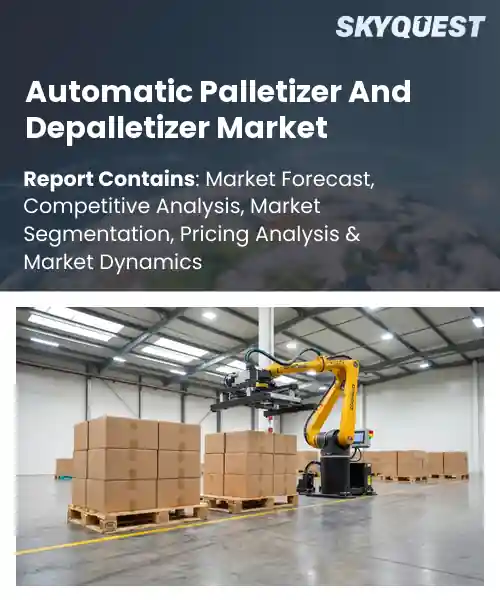
Automatic Palletizer and Depalletizer Market
Report ID: SQMIG20I2615
Report ID: SQMIG20I2615
[email protected]
USA +1 351-333-4748
Report ID:
SQMIG20I2615 |
Region:
Global |
Published Date: February, 2026
Pages:
178
|Tables:
114
|Figures:
70


Global Automatic Palletizer and Depalletizer Market size was valued at USD 1.7 Billion in 2024 and is poised to grow from USD 1.76 Billion in 2025 to USD 2.34 Billion by 2033, growing at a CAGR of 3.6% during the forecast period (2026-2033).
Automatic palletizers and depalletizers are experiencing steady growth as industries continue to automate their warehouses for better productivity, higher throughput, and lower labor costs.
Automatic palletizing and depalletizing machines are vital to many industrial sectors (e.g. logistics and transportation; manufacturing; food & beverages; Pharmaceuticals; and eCommerce) because they provide for high-speed, accurate and efficient ways of stacking/unstacking products from and onto pallets.
Various factors driving growth in the automatic palletizing and depalletizing markets include continued growth of ecommerce globally and consumer demand for quicker filling of orders; need for flexible automated solutions that can accommodate various sizes and weights of products. The increasing shortages of Labor around the world will result in many companies increasing their use of automation for material handling to maintain productivity and safety within the workplace; rising labor costs are creating a trend for automation in the material handling sector. Unfortunately, the significant upfront cost of purchasing automatic palletizing/depalletizing equipment and potential difficulties associated with its Integration will prevent many Small and Medium-Sized Businesses (SMBs) that cannot afford such costs from using these types of equipment.
Automatic palletizing and depalletizing processes are revolutionizing the material handling industry by automating every aspect of material handling while increasing the amount of operational resiliency, scalability and real time adaptability of this equipment to meet current and future demands of industries worldwide.
How is AI Improving Efficiency in the Automatic Palletizer and Depalletizer Market?
Artificial Intelligence (AI) effects on the automation palletization and depalletization market are greatly increasing the use of automated systems, optimizing product output, decreasing the need for skilled labor through more intelligent systems, and expanding the types of materials that can be moved using automated systems.
Market snapshot - 2026-2033
Global Market Size
USD 1.79 Billion
Largest Segment
Robotics
Fastest Growth
Conventional
Growth Rate
5.1% CAGR
To get more insights on this market click here to Request a Free Sample Report
Global Automatic Palletizer and Depalletizer Market is segmented by Type of Equipment, End User Industry, Operation Mode, System Configuration and region. Based on Type of Equipment, the market is segmented into Automatic Palletizers and Automatic Depalletizers. Based on End User Industry, the market is segmented into Food and Beverage, Pharmaceuticals and Consumer Goods. Based on Operation Mode, the market is segmented into Manual Operation, Fully Automated and Semi-Automated. Based on System Configuration, the market is segmented into Standalone Systems and Integrated Systems. Based on region, the market is segmented into North America, Europe, Asia Pacific, Latin America and Middle East & Africa.
Why are Organizations Prioritizing Conventional Technology?
As per the global automatic palletizer and depalletizer market outlook, the conventional segment is currently dominating the market as it has been widely adopted due to cost and established usage across many industries. Many end-users rely on Conventional systems due to their proven reliability and lower initial investment, along with ease of operation when compared to Robotic systems. Conventional technologies also benefit from a larger availability of skilled labour, and little need for training staff in developed countries, making them the preferred method, particularly in Developing Regions. Conventional systems also have a well-developed infrastructure which supports their market dominance.
As per the global automatic palletizer and depalletizer market forecast, the robotics segment is expected to grow the fastest during the forecast period. As industries adopt more flexible production lines and deal with a variety of product types, demand for the adaptability and precision of robotic arms is increasing. The shortage of manual labor for repetitive, heavy lifting tasks and the need for seamless integration with other automated systems are driving this segment's rapid growth.
Why is Direct Sales Segment Leading Global Automatic Palletizer and Depalletizer Market?
The direct sales segment dominates the automatic palletizer and depalletizer market. This segment benefits from the fact that many large-scale manufacturers prefer to purchase their palletizing systems directly from the manufacturer. The benefits of direct sales include the ability to have custom solutions, better support through after-sales service, and more control over pricing and service quality for the manufacturer and end-user. Additionally, large manufacturers of palletizers maintain direct relationships with customers in the food and beverage, pharmaceutical, and chemical industries, thereby reinforcing this segment's leading position in the overall market.
The analysis of the global automatic palletizer and depalletizer market demonstrates that the system integrator segment will grow at the fastest rate during the forecast period. The rising demand for increased automation in a variety of industries has contributed to the increased utilization of integrated material handling systems, and system integrators have been at the center of this growth. System integrators design and implement integrated automated systems that combine palletizers with other equipment (e.g., conveyors, wrappers, robot arms) to provide a total solution for customers. The expertise of system integrators in designing and implementing complete automated systems, as well as their economical and flexible solutions, is resulting in increased demand from small to large commercial operations.
To get detailed segments analysis, Request a Free Sample Report
How is the Automatic Palletizer and Depalletizer Market Performing in North America?
In North America is the largest and most mature automatic palletizer and depalletizer market and seen significant growth due primarily to widespread adoption of automation technologies used by manufacturers, along with ongoing efforts to streamline their supply chains. There is a growing supply of robotized and hybrid palletizing technologies and the need for improved packaging solutions with higher efficiencies in velocity and quality of outputs.
Automatic Palletizer and Depalletizer Market in U.S.
The United States is the largest automatic palletizer and depalletizer market in North America due to its rapid advancement in industrial automation technologies and its focus on improving operational efficiency. Manufacturers are looking towards using both robotic and hybrid palletizing systems as solutions for meeting these needs due to the increasing number of production volumes and an ongoing shortage of labor. Also contributing to the growth of the automatic palletizer and depalletizer markets in the U.S. are the large presence of many major players in automation and robotics technologies as well as ongoing technological advancements and increasing adoption rates of high-speed palletizing solutions through the U.S. supply chain process.
Automatic Palletizer and Depalletizer Market in Canada
The Canada automatic palletizer and depalletizer market is also experiencing consistent growth, supported through diversification in automation in food processing, logistics, and manufacturing segments. Several government programs and initiatives focused on modernizing industry and promoting workplace safety have taken place in an effort to encourage producers to invest in automated material handling equipment. Additionally, as e-commerce and distribution continue to expand, so does the growth and demand for efficient, productive, and reliable palletizing equipment.
What are the Key Trends Driving Growth in Asia Pacific?
The Asia-Pacific region is growing rapidly due to the region’s growing manufacturing sector and increasing investments in automation as well as favourable government policies. Companies within the Asia-Pacific region are beginning to use automated palletizer systems to improve productivity, reduce labour costs and increase packaging efficiency in high volume production environments.
Automatic Palletizer and Depalletizer Market in Japan
In Japan, growth in demand for automatic palletizer and depalletize systems is driven primarily by a rapidly ageing workforce and an established commitment to precision manufacturing within the country. The government continues to promote smart factories and provides incentives to encourage the implementation of robotics. In the high-tech and automotive sectors, there is a significant demand for AI-powered and collaborative palletization systems where precision and consistency are essential.
Automatic Palletizer and Depalletizer Market in South Korea
According to automatic palletizer and depalletizer regional forecast, South Korea has experienced rapid growth in automated palletizing and depalletizing equipment adoption due to its advanced manufacturing capability coupled with the government’s commitment to Industry 4.0. The government has also launched several programmes that have been developed to assist manufacturers with the implementation of smart factory technology, particularly within the electronic, automotive, and chemical industries where a higher level of quality control and automation is required. Increasingly, manufacturers are integrating robotic palletizers with vision systems and intelligent controls to improve flexibility and overall operational efficiency.
How is the Palletizer Landscape Evolving in Europe?
In Europe, the powerful growth of the automatic palletizer and depalletizer market is directly related to the increasing focus on manufacturing efficiency, rising labor costs, and the growing interest in more sustainable packaging options. Lesser emphasis on human labor, ergonomic work places, and improved logistics, are continuing to drive European companies to invest in more advanced palletizing systems.
Automatic Palletizer and Depalletizer Market in Germany
Germany plays a significant role in the European automatic palletizer and depalletizer market. The solid manufacturing foundation of the country, particularly in the automotive, machinery, and food and beverage segments, along with publicly funded programs for industrial automation, is contributing to the adoption. As a country committed to high-quality manufacturing, demand for precision and high-throughput palletizing systems is increasing.
Automatic Palletizer and Depalletizer Market in the U.K.
According to automatic palletizer and depalletizer regional outlook, the U.K. is evolving its palletizer landscape though greater automation in distribution centres and manufacturing sites. The food and beverage and the pharmaceutical industries are some of the most significant industries using automated palletizing solutions and are too increasingly looking at these solutions in light of the demand for e-commerce and streamlined operations of warehouses.
Automatic Palletizer and Depalletizer Market in Italy
According to automatic palletizer and depalletizer industry analysis, Italy is quickly modernizing its industrial infrastructure, which includes the integration of automated palletizing systems in its manufacturing and logistics sectors. Investments from national recovery plans are driving demand for robotic palletizers, traditional systems, and complete end-of-line packaging solutions, particularly in the food processing and consumer goods sectors.
To know more about the market opportunities by region and country, click here to
Buy The Complete Report
Automatic Palletizer and Depalletizer Market Drivers
Rising Automation Across Industries
Growing Need for Operational Efficiency and Labor Cost Reduction
Automatic Palletizer and Depalletizer Market Restraints
Lack of Skilled Automation Professionals
Integration Complexities Across Diverse Production Lines
Request Free Customization of this report to help us to meet your business objectives.
The automatic palletizer and depalletizer industry include a vibrant community of large, established industrial automation companies; niche material handling equipment manufacturers; and new, innovative robotics companies. Large companies like FANUC, ABB, and KUKA have led the market through their size, number of robots that can be selected, breadth of industrial integration services, and unusually high investments in automation. In the meantime, niche companies like Columbia/Okura, Premier Tech, and Sidel have developed brand strength in palletizing with conventional, robotic and hybrid robotic palletizing technologies along with complete end-of-line packaging.
With the evolving landscape of palletizing, some new startups have changed our thinking of how to handle end-of-line packaging. One company has designed highly flexible collaborative robots that can safely work alongside human workers. This offers a cost-effective and adaptable solution for a variety of product mixes and lower-volume operations.
SkyQuest’s ABIRAW (Advanced Business Intelligence, Research & Analysis Wing) is our Business Information Services team that Collects, Collates, Correlates, and Analyses the Data collected by means of Primary Exploratory Research backed by robust Secondary Desk research.
As per SkyQuest analysis, key drivers of automatic palletizer and depalletizer market growth include the rising use of automation in manufacturing and logistics, along with the growing complexity and variety of products that need efficient handling. There is an increased prevalence of automated palletizing systems in the industries which are addressing and improving material flow. This is also intended to reduce manual labor. These solutions often use advanced algorithms and data analysis to track large amounts of product and operational data, ensuring stable and efficient pallet setups. As production demands change and the need for higher output increases, traditional manual or semi-automated methods are falling short. Palletizing systems with features like AI-based pattern recognition and predictive maintenance are now necessary for ensuring production continuity and the ability to manage different packaging needs seamlessly.
| Report Metric | Details |
|---|---|
| Market size value in 2024 | USD 1.7 Billion |
| Market size value in 2033 | USD 2.34 Billion |
| Growth Rate | 3.6% |
| Base year | 2024 |
| Forecast period | 2026-2033 |
| Forecast Unit (Value) | USD Billion |
| Segments covered |
|
| Regions covered | North America (US, Canada), Europe (Germany, France, United Kingdom, Italy, Spain, Rest of Europe), Asia Pacific (China, India, Japan, Rest of Asia-Pacific), Latin America (Brazil, Rest of Latin America), Middle East & Africa (South Africa, GCC Countries, Rest of MEA) |
| Companies covered |
|
| Customization scope | Free report customization with purchase. Customization includes:-
|
To get a free trial access to our platform which is a one stop solution for all your data requirements for quicker decision making. This platform allows you to compare markets, competitors who are prominent in the market, and mega trends that are influencing the dynamics in the market. Also, get access to detailed SkyQuest exclusive matrix.
Table Of Content
Executive Summary
Market overview
Parent Market Analysis
Market overview
Market size
KEY MARKET INSIGHTS
COVID IMPACT
MARKET DYNAMICS & OUTLOOK
Market Size by Region
KEY COMPANY PROFILES
Methodology
For the Automatic Palletizer and Depalletizer Market, our research methodology involved a mixture of primary and secondary data sources. Key steps involved in the research process are listed below:
1. Information Procurement: This stage involved the procurement of Market data or related information via primary and secondary sources. The various secondary sources used included various company websites, annual reports, trade databases, and paid databases such as Hoover's, Bloomberg Business, Factiva, and Avention. Our team did 45 primary interactions Globally which included several stakeholders such as manufacturers, customers, key opinion leaders, etc. Overall, information procurement was one of the most extensive stages in our research process.
2. Information Analysis: This step involved triangulation of data through bottom-up and top-down approaches to estimate and validate the total size and future estimate of the Automatic Palletizer and Depalletizer Market.
3. Report Formulation: The final step entailed the placement of data points in appropriate Market spaces in an attempt to deduce viable conclusions.
4. Validation & Publishing: Validation is the most important step in the process. Validation & re-validation via an intricately designed process helped us finalize data points to be used for final calculations. The final Market estimates and forecasts were then aligned and sent to our panel of industry experts for validation of data. Once the validation was done the report was sent to our Quality Assurance team to ensure adherence to style guides, consistency & design.
Analyst Support
Customization Options
With the given market data, our dedicated team of analysts can offer you the following customization options are available for the Automatic Palletizer and Depalletizer Market:
Product Analysis: Product matrix, which offers a detailed comparison of the product portfolio of companies.
Regional Analysis: Further analysis of the Automatic Palletizer and Depalletizer Market for additional countries.
Competitive Analysis: Detailed analysis and profiling of additional Market players & comparative analysis of competitive products.
Go to Market Strategy: Find the high-growth channels to invest your marketing efforts and increase your customer base.
Innovation Mapping: Identify racial solutions and innovation, connected to deep ecosystems of innovators, start-ups, academics, and strategic partners.
Category Intelligence: Customized intelligence that is relevant to their supply Markets will enable them to make smarter sourcing decisions and improve their category management.
Public Company Transcript Analysis: To improve the investment performance by generating new alpha and making better-informed decisions.
Social Media Listening: To analyze the conversations and trends happening not just around your brand, but around your industry as a whole, and use those insights to make better Marketing decisions.
REQUEST FOR SAMPLE
 REQUEST FREE CUSTOMIZATION
Global Automatic Palletizer and Depalletizer Market size was valued at USD 1.79 Billion in 2025 and is poised to grow from USD 1.88 Billion in 2026 to USD 2.66 Billion by 2033, growing at a CAGR of 5.1% in the forecast period (2026-2033).
The automatic palletizer and depalletizer industry include a vibrant community of large, established industrial automation companies; niche material handling equipment manufacturers; and new, innovative robotics companies. Large companies like FANUC, ABB, and KUKA have led the market through their size, number of robots that can be selected, breadth of industrial integration services, and unusually high investments in automation. In the meantime, niche companies like Columbia/Okura, Premier Tech, and Sidel have developed brand strength in palletizing with conventional, robotic and hybrid robotic palletizing technologies along with complete end-of-line packaging. 'Smart Robotics', 'Doosan Robotics', 'ONExia Inc.', 'Pacteon Group', 'Sidel', 'ProMach Inc.', 'Columbia/Okura, LLC', 'Premier Tech Ltd.', 'ABB', 'KUKA AG', 'FANUC Corporation', 'Honeywell Intelligrated', 'BEUMER Group'
Companies are transitioning from manual operations to automated systems in manufacturing, logistics, and warehousing. In doing this, they will exhibit more demands for palletizing capability. Industries like food and beverage, pharmaceuticals, and consumer goods are adopting automation to improve efficiency, consistency, and worker safety. This rapid change creates a strong need for new palletizing equipment, including robotic and hybrid systems, as well as integrated control and optimization software. These tools are designed for highly automated production environments.
Rise of AI and ML-Powered Optimization Solutions: AI and machine learning are quickly changing the palletizer landscape. They provide predictive pattern optimization, real-time variations in product handling, and automatic fault detection. The palletizing world is starting to embrace usable AI algorithms that provide optimum stacking smaller load out configurations, reduce product damaged pallet loads, and continue to improve operations overall. This trend could change the perception of how organizations will address end-of-line packaging, which will result in throughput and cost savings.
How is the Automatic Palletizer and Depalletizer Market Performing in North America?


Want to customize this report? This report can be personalized according to your needs. Our analysts and industry experts will work directly with you to understand your requirements and provide you with customized data in a short amount of time. We offer $1000 worth of FREE customization at the time of purchase.
Feedback From Our Clients


 USA (+1) 351-333-4748

