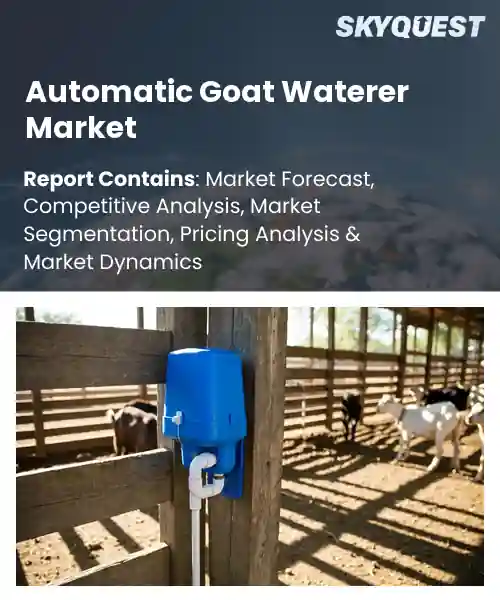
Automatic Goat Waterer Market
Report ID: SQMIG20H2106
Report ID: SQMIG20H2106
[email protected]
USA +1 351-333-4748
Report ID:
SQMIG20H2106 |
Region:
Global |
Published Date: July, 2026
Pages:
157
|Tables:
115
|Figures:
77


Global Automatic Goat Waterer Market size was valued at USD 145.8 Million in 2024 and is poised to grow from USD 153.02 Million in 2025 to USD 225.22 Million by 2033, growing at a CAGR of 4.95% during the forecast period (2026-2033).
Rising adoption of precision livestock farming, increasing focus on animal health and welfare, rising labor shortages in agriculture, advancements in automated livestock equipment, and growing emphasis on water conservation are driving demand for automatic goat waterers.
The increasing need for ensuring a reliable source of clean drinking water and reducing labor needs is driving farmers to switch from traditional to automatic water dispensing systems. The growing use of sensors that are IoT-enabled for tracking water usage, temperature, and purity is helping with managing the herd and improving efficiency. Precision livestock farming investments, demand for sustainable water management practices, and adoption of smart agriculture technologies at commercial goat farms are other factors set to drive market growth. High awareness regarding livestock health and farm productivity coupled with increasing adoption of automated farming technologies is expected to primarily drive automatic goat waterer market growth.
However, high initial installation costs, limited adoption among small-scale farmers, maintenance challenges in remote farming locations, and lack of awareness in developing regions are expected to hamper automatic goat waterer market penetration across the study period and beyond.
How is IoT Automation Improving Efficiency of Automatic Goat Waterer Systems?
IoT is revolutionizing the automatic goat waterer industry by introducing smarter and more efficient livestock waterers. IoT waterers make use of sensors to determine the levels of water, the temperatures, and water consumption; the system regulates the water flow automatically. The information collected is transmitted to the cloud-based platforms where the farmer can get to know how much water is being consumed, whether there are leaks, and low water levels which might signal possible health problems. Solar powered models can also be used in grazing land where power supply is not available.
Market snapshot - (2026-2033)
Global Market Size
USD 145.8 Million
Largest Segment
Horizontal Waterers
Fastest Growth
Vertical Waterers
Growth Rate
4.95% CAGR
To get more insights on this market click here to Request a Free Sample Report
Global automatic goat waterer market is segmented by type, material, application, end-use sector, and region. Based on type, the market is segmented into horizontal waterers and vertical waterers. Based on material, the market is segmented into plastic, steel, and cast iron. Based on application, the market is segmented into small farm applications and large farm applications. Based on end-use sector, the market is segmented into livestock industry, private farms, and others. Based on region, the market is segmented into North America, Europe, Asia Pacific, Latin America, and Middle East & Africa.
The horizontal waterers segment is forecasted to lead the global automatic goat waterer market revenue generation across the study period. Its design is consistent with the way goats drink water, and it ensures that several goats can get access to the water at the same time without any form of competition. The design makes it easy to integrate the device into the current existing system, and the process will not require much time or effort to achieve. The effectiveness of the device is what attracts farmers to use it.
However, vertical waterers emerges as the most rapidly expanding segment because the sensors will enable innovative control of the water flow that will save water and regulate flow according to the goat’s behavior. This advantage of technology will make advanced farmers who are concerned about precise livestock management more interested in the product.
The plastic segment is slated to account for the highest global automatic goat waterer market share going forward. It is made from material that makes its construction light and thus easy to move around and install regardless of the layout of the farm. This material is resistant to rust caused by either moisture or cleaning fluids, hence making its use durable without requiring expensive maintenance procedures. Plastic waterers are able to be molded into different shapes depending on the positioning of the goat’s neck; thereby, promoting drinking of water.
On the other hand, steel segment is witnessing the strongest growth momentum as per this automatic goat waterer industry analysis, as producers develop durable frames which can sustain heavy movement by goats and tough climatic conditions. Durability is an attraction for big farmers who want reliable machines, and this increases the purchase and growth of the market.
To get detailed segments analysis, Request a Free Sample Report
A mature livestock infrastructure, widespread adoption of precision farming technologies, and strong emphasis on animal welfare standards support high demand for automatic goat waterers in the region. Extensive research networks allow producers to take full advantage of innovative watering technologies, which can be easily integrated into the production process because of the well-developed distribution channels. The regulatory aspect of the region ensures the constant practice of hygiene, which is why herd managers are willing to implement automated watering systems minimizing the need for effort and making water more accessible to animals. Moreover, the tradition of constant improvement inspires producers to develop sustainable and energy-efficient products for herds of different size.
Automatic goat waterer demand in the United States thrives on a robust network of agribusiness consultants who promote technology adoption across small and large operations. Farmers appreciate integration between such technologies and the other farm management tools already in use, enabling them to monitor the amount of water used by the animals and their health status. The importance attached to sustainability makes farmers appreciate devices that reduce wastage and run on renewable sources of energy.
Automatic goat waterer market in Canada benefits from strong collaborative research initiatives between universities and equipment manufacturers.The farmers welcome innovations that can withstand cold climatic conditions since they provide them with water during tough climatic situations. The need for high welfare standards among animals means that the need for an easy-to-use system that can control the rate of water supply is paramount.
Stringent animal welfare legislation, coupled with a growing preference for precision livestock farming among progressive producers supports high sales of automatic goat waterers in Europe. Moreover, the wide range of agricultural settings in the region promotes the use of tailor-made options that take into consideration different topographies on farms and different herd sizes. Joint research efforts by member countries ensure quick development of innovative technologies and lead to the development of energy-saving machines that fit well into the computerized farm management systems. Increasing awareness among consumers regarding sustainable food production encourages farmers to install automated goat waterers because of cost-effectiveness in labor utilization and efficient water usage.
Automatic goat waterer market in Germany is characterized by emerging interest from medium‑scale farms seeking scalable solutions. Industry partnerships focus on developing modular systems that can be expanded as herd sizes grow, emphasizing flexibility and low operational overhead. German producers value precision monitoring capabilities that align with broader data‑driven farm management strategies, enhancing overall productivity and compliance with welfare guidelines.
Automatic goat waterer demnand in the United Kingdom experiences rapid growth as forward-thinking farmers adopt smart watering technologies to streamline operations. Focus on analytics in the cloud ensures that the consumption of water is assessed continuously, which helps in early diagnosis of any health complications. The industry prefers devices that are light in weight and can be easily installed without requiring much human labor.
Automatic goat waterer market in France enjoys a dominant position driven by long‑standing dairy goat traditions and a strong focus on product quality. The French farmers emphasize systems which will provide an uninterrupted water flow, preventing any stress due to changing seasons. The compatibility of these automatic systems with other farm machinery and stringent hygiene measures contribute towards their acceptability.
Heightened investment in agricultural modernization and a cultural shift toward technology-enabled farming practices are creating an opportune setting in the region for automatic goat waterer vendors. With the increasing number of small farmers in the region, there is an urgent need for water sprinkling solutions that are inexpensive, efficient, easy to maintain, and resolve issues of water shortages without compromising animal welfare. To promote efficient agriculture, governmental schemes have provided the impetus for using automatic equipment that can be used across diverse climatic settings. Working together with regional manufacturers and research facilities helps to create compact battery-driven systems that will work on distant farms.
Automatic goat waterer market in Japan emphasizes precision engineering and compact designs suitable for limited farm spaces. Producers value reliability and ease of integration with advanced livestock monitoring platforms, allowing seamless data collection on water consumption patterns. The market also responds to heightened awareness of environmental stewardship by favoring systems that minimize water waste and operate efficiently under diverse temperature ranges.
Automatic goat waterer market in South Korea benefits from a tech‑savvy agricultural sector that readily adopts smart farming solutions. Korean farmers prioritize intuitive user interfaces and real‑time alerts that enhance herd management and reduce manual labor. Emphasis on durable, energy‑efficient devices aligns with national goals of sustainable livestock production and reinforces the market’s growth trajectory.
To know more about the market opportunities by region and country, click here to
Buy The Complete Report
Rising Demand for Automated Feeding
Improved Animal Welfare Practices
High Initial Capital Investment
Complex Maintenance Requirements
Request Free Customization of this report to help us to meet your business objectives.
The competitive landscape for automatic goat waterers is shaped by a handful of niche manufacturers leveraging advanced sensor technology and durable materials to differentiate their products. Recent M&A activity has seen larger livestock equipment firms acquiring specialized waterer producers to broaden their portfolio, while strategic partnerships with smart‑farm platforms enable real‑time monitoring of water usage. Continuous innovation, such as solar‑powered pumps and IoT‑enabled flow controls, is driving market positioning and prompting firms to expand distribution through agricultural cooperatives.
SkyQuest’s ABIRAW (Advanced Business Intelligence, Research & Analysis Wing) is our Business Information Services team that Collects, Collates, Correlates, and Analyses the Data collected by means of Primary Exploratory Research backed by robust Secondary Desk research.
As per SkyQuest analysis, high adoption of precision livestock farming, increasing focus on animal health and welfare, rising labor shortages in agriculture, and advancements in automated livestock equipment are anticipated to drive the demand for automatic goat waterers going forward. However, high initial installation costs and limited adoption among small-scale farmers are slated to slow down the adoption of automatic goat waterers in the future. North America is slated to spearhead the demand for automatic goat waterers owing to widespread adoption of precision livestock farming, high investments in agricultural automation, strong presence of commercial livestock farms, and increasing focus on sustainable water management practices. IoT-enabled smart watering systems and integration of cloud-based livestock monitoring platforms are anticipated to be key trends driving the automatic goat waterer sector in the long run.
| Report Metric | Details |
|---|---|
| Market size value in 2024 | USD 145.8 Million |
| Market size value in 2033 | USD 225.22 Million |
| Growth Rate | 4.95% |
| Base year | 2024 |
| Forecast period | (2026-2033) |
| Forecast Unit (Value) | USD Million |
| Segments covered |
|
| Regions covered | North America (US, Canada), Europe (Germany, France, United Kingdom, Italy, Spain, Rest of Europe), Asia Pacific (China, India, Japan, Rest of Asia-Pacific), Latin America (Brazil, Rest of Latin America), Middle East & Africa (South Africa, GCC Countries, Rest of MEA) |
| Companies covered |
|
| Customization scope | Free report customization with purchase. Customization includes:-
|
To get a free trial access to our platform which is a one stop solution for all your data requirements for quicker decision making. This platform allows you to compare markets, competitors who are prominent in the market, and mega trends that are influencing the dynamics in the market. Also, get access to detailed SkyQuest exclusive matrix.
Table Of Content
Executive Summary
Market overview
Parent Market Analysis
Market overview
Market size
KEY MARKET INSIGHTS
COVID IMPACT
MARKET DYNAMICS & OUTLOOK
Market Size by Region
KEY COMPANY PROFILES
Methodology
For the Automatic Goat Waterer Market, our research methodology involved a mixture of primary and secondary data sources. Key steps involved in the research process are listed below:
1. Information Procurement: This stage involved the procurement of Market data or related information via primary and secondary sources. The various secondary sources used included various company websites, annual reports, trade databases, and paid databases such as Hoover's, Bloomberg Business, Factiva, and Avention. Our team did 45 primary interactions Globally which included several stakeholders such as manufacturers, customers, key opinion leaders, etc. Overall, information procurement was one of the most extensive stages in our research process.
2. Information Analysis: This step involved triangulation of data through bottom-up and top-down approaches to estimate and validate the total size and future estimate of the Automatic Goat Waterer Market.
3. Report Formulation: The final step entailed the placement of data points in appropriate Market spaces in an attempt to deduce viable conclusions.
4. Validation & Publishing: Validation is the most important step in the process. Validation & re-validation via an intricately designed process helped us finalize data points to be used for final calculations. The final Market estimates and forecasts were then aligned and sent to our panel of industry experts for validation of data. Once the validation was done the report was sent to our Quality Assurance team to ensure adherence to style guides, consistency & design.
Analyst Support
Customization Options
With the given market data, our dedicated team of analysts can offer you the following customization options are available for the Automatic Goat Waterer Market:
Product Analysis: Product matrix, which offers a detailed comparison of the product portfolio of companies.
Regional Analysis: Further analysis of the Automatic Goat Waterer Market for additional countries.
Competitive Analysis: Detailed analysis and profiling of additional Market players & comparative analysis of competitive products.
Go to Market Strategy: Find the high-growth channels to invest your marketing efforts and increase your customer base.
Innovation Mapping: Identify racial solutions and innovation, connected to deep ecosystems of innovators, start-ups, academics, and strategic partners.
Category Intelligence: Customized intelligence that is relevant to their supply Markets will enable them to make smarter sourcing decisions and improve their category management.
Public Company Transcript Analysis: To improve the investment performance by generating new alpha and making better-informed decisions.
Social Media Listening: To analyze the conversations and trends happening not just around your brand, but around your industry as a whole, and use those insights to make better Marketing decisions.
REQUEST FOR SAMPLE
 REQUEST FREE CUSTOMIZATION
Global Automatic Goat Waterer Market size was valued at USD 145.8 Million in 2024 and is poised to grow from USD 153.02 Million in 2025 to USD 225.22 Million by 2033, growing at a CAGR of 4.95% during the forecast period (2026-2033).
The competitive landscape for automatic goat waterers is shaped by a handful of niche manufacturers leveraging advanced sensor technology and durable materials to differentiate their products. Recent M&A activity has seen larger livestock equipment firms acquiring specialized waterer producers to broaden their portfolio, while strategic partnerships with smart‑farm platforms enable real‑time monitoring of water usage. Continuous innovation, such as solar‑powered pumps and IoT‑enabled flow controls, is driving market positioning and prompting firms to expand distribution through agricultural cooperatives. 'Ritchie Industries Inc.', 'Miraco Livestock Waterers', 'Nelson Manufacturing Company', 'Gallagher Group Limited', 'Highlands Engineering', 'Kane Manufacturing', 'Behlen Mfg. Co.', 'Tarter Farm & Ranch Equipment', 'Hawkeye Steel Products Inc.', 'Brower Equipment', 'Farmweld Inc.', 'Agri-Pro Enterprises', 'La Buvette SAS', 'Suevia Haiges GmbH', 'Kerbl GmbH', 'Equi-Theme', 'J&D Manufacturing', 'Agri-Plastics Mfg.', 'Sydell Inc.', 'Premier 1 Supplies'
Farmers are increasingly adopting automatic goat waterers to ensure consistent hydration, reduce labor intensity, and mitigate the risk of waterborne diseases; this technology enables hands‑free operation, allowing producers to allocate time to higher‑value tasks, while maintaining optimal animal health and productivity, thereby supporting overall farm profitability and encouraging broader market uptake. The reliability of automated systems also lessens dependence on weather conditions, ensures water availability during night hours, and provides owners with real‑time monitoring capabilities, which together foster confidence in adopting such solutions across varied farm sizes.
Smart Sensor Integration: The rise of Internet‑of‑Things connectivity and low‑cost sensor technologies is prompting goat farms to adopt automatic waterers equipped with real‑time monitoring, moisture detection, and remote control. Farmers can now receive alerts on mobile devices when water levels drop or contamination is detected, enabling proactive maintenance and reducing animal stress. This data‑driven approach also supports precise water budgeting, improves herd health tracking, aligns with broader precision‑agriculture initiatives, driving higher adoption rates among progressive livestock operations worldwide and sustainability and efficiency.
Why does North America Dominate the Global Automatic Goat Waterer Market? |@12


Want to customize this report? This report can be personalized according to your needs. Our analysts and industry experts will work directly with you to understand your requirements and provide you with customized data in a short amount of time. We offer $1000 worth of FREE customization at the time of purchase.
Feedback From Our Clients


 USA (+1) 351-333-4748

