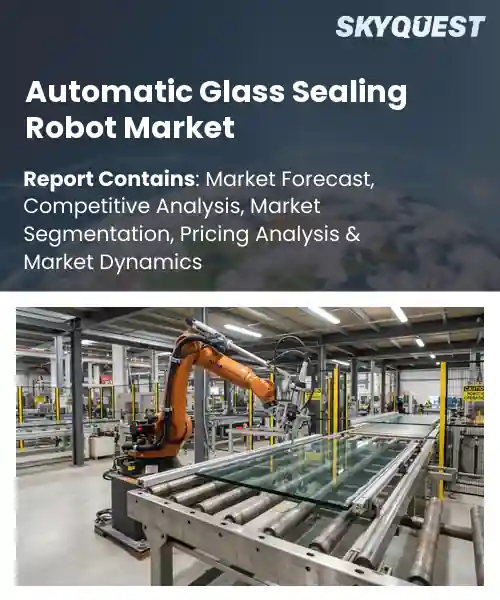
Automatic Glass Sealing Robot Market
Report ID: SQMIG20I3707
Report ID: SQMIG20I3707
[email protected]
USA +1 351-333-4748
Report ID:
SQMIG20I3707 |
Region:
Global |
Published Date: August, 2026
Pages:
157
|Tables:
143
|Figures:
78


Global Automatic Glass Sealing Robot Market size was valued at USD 486.2 Million in 2024 and is poised to grow from USD 517.32 Million in 2025 to USD 849.75 Million by 2033, growing at a CAGR of 6.4% during the forecast period (2026-2033).
Demand for efficiency standards in envelopes drives a wave of growth in the glass sealing robot market because stricter thermal‑performance regulations force manufacturers to produce tighter, defect‑free seals on insulated glazing units. By adopting robotic sealing, factories create uniform bond lines that reduce thermal bridges, directly meeting LEED and EU‑Passivhaus criteria and allowing premium pricing of certified windows. Saint‑Gobain’s French plant installed a sealer and saw a 25 % cut in rework and a 15 % boost in output. This gain pushes robot suppliers to broaden offerings, while users gain systems that meet mandates and open export channels to markets with codes.
How is AI-driven automation enhancing efficiency in the automatic glass sealing robot market?
AI‑driven automation is reshaping the automatic glass sealing robot market by embedding real‑time vision, predictive analytics and adaptive control into the sealing process. Machines now detect glass edge variations, adjust temperature and pressure on the fly, and predict maintenance needs before a fault occurs. This reduces cycle time, cuts scrap, and frees operators from manual tuning, making production lines more reliable and scalable. The technology also enables seamless integration with factory‑wide digital twins, allowing manufacturers to simulate changes and optimize throughput without physical trials. As a result, glass processors are achieving higher yields while lowering energy consumption, positioning the market for sustained growth.East Glass Machine July 2026, unveiled a new sealing robot that leverages AI‑driven automation to fine‑tune sealing parameters in real time, boosting efficiency and supporting the market’s rapid expansion.
Market snapshot - (2026-2033)
Global Market Size
USD 486.2 Million
Largest Segment
Articulated Robots
Fastest Growth
SCARA Robots
Growth Rate
6.4% CAGR
To get more insights on this market click here to Request a Free Sample Report
Global automatic glass sealing robot market is segmented by robot type, sealing method, application, end-use industry, automation level and region. Based on robot type, the market is segmented into Articulated Robots, Cartesian Robots and SCARA Robots. Based on sealing method, the market is segmented into Silicone Sealing, Hot-Melt Sealing and Adhesive Sealing. Based on application, the market is segmented into Automotive Glass, Architectural Glass and Insulating Glass Units. Based on end-use industry, the market is segmented into Automotive, Construction and Glass Manufacturing. Based on automation level, the market is segmented into Semi-Automatic and Fully Automatic. Based on region, the market is segmented into North America, Europe, Asia Pacific, Latin America and Middle East & Africa.
Articulated robots segment dominates because their multi axis flexibility aligns perfectly with the complex geometries of automotive and architectural glass panels. This flexibility enables precise positioning and adaptive motion paths, reducing cycle times while maintaining seal integrity. Manufacturers favor them for handling varied glass sizes and shapes, which drives higher equipment utilization. Their capability to integrate vision systems further enhances defect detection, reinforcing their leadership in the automatic glass sealing robot market.
However, SCARA robots segment emerges as the fastest growing area because their compact design and repeatable motion excel in high volume sealing of insulating glass units. The lower footprint supports line integration, while rapid cycle capability meets rising demand for energy efficient windows, propelling adoption across construction and glass manufacturing lines.
Hot melt sealing segment leads because the process delivers rapid cure times and strong bonds that suit fast paced production lines. Its thermoplastic nature allows precise bead control, minimizing material waste while ensuring uniform seal strength across varied glass thicknesses. The technology integrates easily with robotic dispensers, enabling seamless automation and reducing labor dependence, which fortifies its position in the market.
Meanwhile, Adhesive sealing segment witnesses the strongest growth momentum as performance adhesives provide superior durability and UV resistance for architectural applications. Innovations in low odor formulations improve workplace safety, encouraging adoption. The ability to seal curved surfaces without heating expands its use in automotive glass, unlocking opportunities and driving market expansion.
To get detailed segments analysis, Request a Free Sample Report
The region combines deep engineering expertise with a mature supply chain that supports high‑volume production of precision glass components. Strong collaboration between robotics manufacturers and leading glass fabricators accelerates technology transfer and customization. Competitive labor dynamics encourage early adoption of automation to maintain cost efficiency, while government initiatives promote advanced manufacturing and Industry 4.0 integration. Proximity to key downstream industries such as automotive, architecture, and consumer electronics creates a virtuous cycle of demand, fostering continuous innovation and reinforcing the region’s leadership position.
Automatic Glass Sealing Robot Market in Japan benefits from world‑class precision engineering and a longstanding tradition of robotics excellence. Local manufacturers integrate sophisticated vision systems and adaptive control algorithms that address the exacting tolerances required by high‑performance glazing applications. Close ties with automotive and high‑rise construction sectors drive collaborative development, ensuring solutions are tightly aligned with evolving product specifications and production rhythms.
Automatic Glass Sealing Robot Market in South Korea is propelled by rapid adoption of smart factory concepts and a robust electronics ecosystem. The country’s focus on modular robot architectures and IoT connectivity enables flexible deployment across diverse glass manufacturing lines. Strong support from research institutions and a culture of continuous process improvement encourage early implementation of automation, enhancing throughput and product consistency for both domestic and export‑oriented manufacturers.
Europe’s emphasis on sustainability and energy‑efficient building standards fuels demand for high‑quality sealed glass products, prompting manufacturers to seek automated solutions that guarantee repeatable quality. Collaborative frameworks between engineering consortia and robotic firms stimulate shared innovation, while stringent safety and environmental regulations encourage the deployment of advanced sealing technologies. A well‑established network of precision tooling suppliers and a skilled labor base further accelerate integration, positioning the region as a hub for sophisticated, environmentally conscious glass sealing automation.
Automatic Glass Sealing Robot Market in Germany leverages a strong heritage of mechanical engineering and a dense cluster of specialty glass producers. The country’s emphasis on precision and reliability drives the development of robust sealing robots capable of handling complex glass geometries. Integration with Industry 4.0 platforms ensures seamless data exchange, supporting predictive maintenance and optimal cycle times across high‑mix, low‑volume production environments.
Automatic Glass Sealing Robot Market in the United Kingdom experiences accelerated growth through vibrant research partnerships and a proactive regulatory environment that promotes automation for safety and energy savings. Innovative start‑ups focus on adaptable robotic cells that can be reconfigured for diverse glazing applications, catering to a market that values rapid product development and flexible manufacturing footprints. Close collaboration with design firms further aligns robot capabilities with emerging architectural trends.
Automatic Glass Sealing Robot Market in France is emerging as a niche driven by strong government support for high‑tech manufacturing and a growing demand for architecturally sophisticated glazing. French firms prioritize modular robot designs that can be easily integrated with existing production lines, emphasizing ease of use and reduced commissioning time. Partnerships with design schools and specialized glass makers foster a culture of creative problem solving, advancing the adoption of automated sealing solutions.
North America harnesses a combination of deep capital investment and a culture of technological experimentation that encourages rapid deployment of advanced robotics in glass sealing. Leading manufacturers benefit from close collaboration with research institutions that focus on AI‑driven control systems, enhancing precision and adaptability. The region’s strong emphasis on supply chain resilience and lean manufacturing practices motivates the adoption of automation to improve cycle efficiency and reduce waste. A mature regulatory framework that values product safety and energy performance further reinforces the strategic shift toward automated sealing technologies across a broad spectrum of applications.
Automatic Glass Sealing Robot Market in the United States thrives on a dynamic ecosystem of venture‑backed innovators and established OEMs that co‑develop next‑generation sealing solutions. Emphasis on modular hardware and cloud‑based analytics enables manufacturers to scale automation while maintaining real‑time visibility into process health. The vast domestic construction and automotive sectors create a continuous demand loop, prompting ongoing refinement of robot flexibility and integration with broader smart factory initiatives.
Automatic Glass Sealing Robot Market in Canada reflects a strategic focus on energy‑conscious building practices and a reputation for high‑quality glass production. Collaborative programs between academic labs and industry leaders emphasize sustainable robot designs that reduce energy consumption and material waste. The market benefits from a supportive policy environment that encourages automation as a pathway to maintaining global competitiveness while meeting rigorous environmental standards.
To know more about the market opportunities by region and country, click here to
Buy The Complete Report
Increasing Demand For High‑Precision Assembly
Adoption Of Industry 4.0 Standards
High Initial Capital Investment
Complex Integration With Existing Lines
Request Free Customization of this report to help us to meet your business objectives.
The competitive landscape is shaped by manufacturers accelerating product integration and expanding geographic reach, with firms leveraging M&A to acquire complementary sealing technologies and forming partnerships with glass manufacturers to embed robots in production lines. Notable tech innovation includes the rollout of fully automatic dual‑component sealing units and AI‑driven defect detection, driving differentiation and prompting rivals to accelerate similar capabilities.
Top Player’s Company Profile
Recent Developments
SkyQuest’s ABIRAW (Advanced Business Intelligence, Research & Analysis Wing) is our Business Information Services team that Collects, Collates, Correlates, and Analyses the Data collected by means of Primary Exploratory Research backed by robust Secondary Desk research. As per SkyQuest analysis, the global automatic glass sealing robot market is being propelled primarily by the rising demand for high‑precision assembly in automotive and architectural glass, while the parallel surge in Industry 4.0 adoption further accelerates uptake by linking robots to real‑time data and predictive maintenance. The articulated‑robot segment leads the market because its multi‑axis flexibility best handles complex glass geometries, and Asia Pacific remains the dominant region thanks to its mature supply chain and strong engineering base. However, the high initial capital outlay required for robots and the specialized tooling needed act as a notable restraint, tempering adoption among smaller manufacturers.
| Report Metric | Details |
|---|---|
| Market size value in 2024 | USD 486.2 Million |
| Market size value in 2033 | USD 849.75 Million |
| Growth Rate | 6.4% |
| Base year | 2024 |
| Forecast period | (2026-2033) |
| Forecast Unit (Value) | USD Million |
| Segments covered |
|
| Regions covered | North America (US, Canada), Europe (Germany, France, United Kingdom, Italy, Spain, Rest of Europe), Asia Pacific (China, India, Japan, Rest of Asia-Pacific), Latin America (Brazil, Rest of Latin America), Middle East & Africa (South Africa, GCC Countries, Rest of MEA) |
| Companies covered |
|
| Customization scope | Free report customization with purchase. Customization includes:-
|
To get a free trial access to our platform which is a one stop solution for all your data requirements for quicker decision making. This platform allows you to compare markets, competitors who are prominent in the market, and mega trends that are influencing the dynamics in the market. Also, get access to detailed SkyQuest exclusive matrix.
Table Of Content
Executive Summary
Market overview
Parent Market Analysis
Market overview
Market size
KEY MARKET INSIGHTS
COVID IMPACT
MARKET DYNAMICS & OUTLOOK
Market Size by Region
KEY COMPANY PROFILES
Methodology
For the Automatic Glass Sealing Robot Market, our research methodology involved a mixture of primary and secondary data sources. Key steps involved in the research process are listed below:
1. Information Procurement: This stage involved the procurement of Market data or related information via primary and secondary sources. The various secondary sources used included various company websites, annual reports, trade databases, and paid databases such as Hoover's, Bloomberg Business, Factiva, and Avention. Our team did 45 primary interactions Globally which included several stakeholders such as manufacturers, customers, key opinion leaders, etc. Overall, information procurement was one of the most extensive stages in our research process.
2. Information Analysis: This step involved triangulation of data through bottom-up and top-down approaches to estimate and validate the total size and future estimate of the Automatic Glass Sealing Robot Market.
3. Report Formulation: The final step entailed the placement of data points in appropriate Market spaces in an attempt to deduce viable conclusions.
4. Validation & Publishing: Validation is the most important step in the process. Validation & re-validation via an intricately designed process helped us finalize data points to be used for final calculations. The final Market estimates and forecasts were then aligned and sent to our panel of industry experts for validation of data. Once the validation was done the report was sent to our Quality Assurance team to ensure adherence to style guides, consistency & design.
Analyst Support
Customization Options
With the given market data, our dedicated team of analysts can offer you the following customization options are available for the Automatic Glass Sealing Robot Market:
Product Analysis: Product matrix, which offers a detailed comparison of the product portfolio of companies.
Regional Analysis: Further analysis of the Automatic Glass Sealing Robot Market for additional countries.
Competitive Analysis: Detailed analysis and profiling of additional Market players & comparative analysis of competitive products.
Go to Market Strategy: Find the high-growth channels to invest your marketing efforts and increase your customer base.
Innovation Mapping: Identify racial solutions and innovation, connected to deep ecosystems of innovators, start-ups, academics, and strategic partners.
Category Intelligence: Customized intelligence that is relevant to their supply Markets will enable them to make smarter sourcing decisions and improve their category management.
Public Company Transcript Analysis: To improve the investment performance by generating new alpha and making better-informed decisions.
Social Media Listening: To analyze the conversations and trends happening not just around your brand, but around your industry as a whole, and use those insights to make better Marketing decisions.
REQUEST FOR SAMPLE
 REQUEST FREE CUSTOMIZATION


Want to customize this report? This report can be personalized according to your needs. Our analysts and industry experts will work directly with you to understand your requirements and provide you with customized data in a short amount of time. We offer $1000 worth of FREE customization at the time of purchase.
Feedback From Our Clients


 USA (+1) 351-333-4748

